Skip to content
DevMeme
3848 of 7435
Corporate bug bounty surprise: only Bounty candies instead of vulnerability rewards
Security Post #4191, on Feb 9, 2022 in TG

Corporate bug bounty surprise: only Bounty candies instead of vulnerability rewards

Why is this Security meme funny?

Level 1: Sweet Disappointment

Imagine your teacher promises a reward if you find and fix a big problem in the school computer. You get excited and work hard because “reward” sounds like something really good – maybe a trophy or some money. But when you finally solve the problem, the teacher smiles and gives you... a candy bar. And not just any candy, but one actually named “Bounty.” It’s kind of funny because the word bounty means a great reward, and here it’s just the name of the chocolate. You did something important and hoped for a big prize, but you only got a small sweet treat. It’s a sweet disappointment – the candy is nice, but it’s not what you expected. The joke is that the adults took the word “bounty” literally, giving you candy instead of the real prize you thought you’d get. It’s like being promised treasure and receiving a tiny candy bar – silly and a bit disappointing, all at once.

Level 2: Literal Bug Bounty

Let’s break down the joke in simpler terms. In tech, a "bug bounty" is a program where companies reward people for finding software bugs, especially security holes. The reward is usually money, like a prize for helping make the software safer. For example, a company might say, “We’ll pay $1,000 if you report a serious security vulnerability in our website.” This encourages hackers to act as friendly helpers (called "white hat" hackers) by reporting problems responsibly instead of exploiting them. It’s a win-win: the company fixes the bug before bad guys abuse it, and the researcher gets recognition and cash. Security teams love these programs because they crowdsource the hunt for weaknesses.

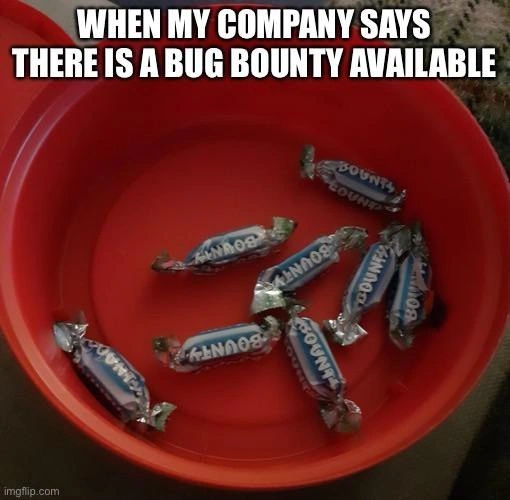
Now, the meme plays on a big pun: the word "bounty". Normally, bounty means a reward (historically, like a cash prize for capturing an outlaw, or in tech, money for catching a bug). But Bounty is also the name of a chocolate candy bar (a sweet coconut-filled treat in a shiny blue-and-silver wrapper). The meme shows a bowl of these Bounty chocolates. The caption says, "WHEN MY COMPANY SAYS THERE IS A BUG BOUNTY AVAILABLE," implying the person got excited thinking a bug bounty program (with real rewards) was announced. But instead, the company literally provided Bounty candy bars for finding bugs.

This is a classic case of misaligned expectations and a goofy misunderstanding. The developer or security researcher hears “bug bounty” and expects maybe a bonus, a cash reward, or at least some serious acknowledgment for squashing a critical bug. That’s the normal expectation in the tech community when you hear BugBounty – maybe your company has joined the ranks of firms with a proper security reward system. Meanwhile, someone in management or HR took it literally or decided to make a corny joke: “bug bounty? Sure, here’s a bowl of Bounty bars for any bugs you find!” It’s like management thought they were being cute or cost-effective (since a bag of candy is way cheaper than actual bounty payouts).

For a junior developer or someone new to CorporateCulture, this meme highlights how communication can get crossed. The company might have thought a playful tech humor approach would motivate the team or lighten the mood about security bugs. But to the engineers, it comes off as either a bad joke or a letdown. It underscores a bit of truth: sometimes non-technical folks don’t fully grasp the importance of a term. A “bug bounty program” isn’t just a bounty-themed office party – it’s supposed to be a serious security effort. If a company only offers candy for finding a security flaw that could've been exploited, it suggests they might not value the work properly. In real life, some companies without formal bounty programs might give token rewards like a thank-you note, a T-shirt, or at least public recognition to researchers. Handing out candy bars as the only reward is an exaggeration for comedy, but it points to that feeling of reward_disappointment.

So, the meme is explaining in a funny way: the company said “bug bounty,” I heard “cash reward,” but all I got was this lousy candy. It’s making fun of a possible security_program_misunderstanding. If you’re newer to tech, imagine being told by your boss, “We have a bounty for any bugs you find in the code!” You’re thinking, “Cool, maybe I can earn a bonus or a gift card.” Then you report a bug and they hand you a mini chocolate bar. You’d probably laugh, kind of, but also think, “Wait, seriously?” That mix of amusement and disappointment is exactly what the meme conveys to those in the know.

Level 3: Candy-Coated Bounty

At the highest technical level, this meme highlights a painfully familiar disconnect between security best practices and corporate culture. In the security world, a bug bounty program is a serious initiative: companies invite ethical hackers to find vulnerabilities and pay out real money rewards for each discovered flaw. It’s a cornerstone of modern security strategy – think responsible disclosure via platforms like HackerOne or Bugcrowd, with payouts that can reach thousands of dollars for critical bugs. Here, however, our fictional company hilariously misses the point (or pinches pennies) by interpreting "bounty" in the most literal way possible: offering Bounty candy bars instead of cash.

This absurd scenario tickles developers' dark humor because it’s not that far-fetched. CorporateCulture can sometimes produce exactly this kind of outcome where tech jargon meets managerial literalism. You can almost imagine the meeting:

Manager: "Our security team says we need a bug bounty program. Any ideas?"
HR: "We have leftover mini Bounty bars from Halloween... let's do a bug bounty – get it?"

The image of a red bowl with a scant handful of Bounty chocolates perfectly captures the anticlimax. Only eight bite-sized bars sitting forlornly on a cushion – as if that’s the grand reward pool for diligent vulnerability hunters. It’s a visual punchline for MisalignedExpectations: engineers hear “bug bounty available” and envision a structured program with monetary rewards, while management delivers a sugary pun. The humor cuts deep because it reflects an underlying truth in tech: sometimes leadership talks the talk of trendy initiatives (be it security, DevOps, or “innovation Fridays”) without truly walking the walk. In this case, they’ve reduced a critical Security practice to a bowl of candy, likely valuing cost savings over actual security incentives.

From a veteran developer perspective, this is both funny and facepalm-worthy. BugBounty programs exist because finding a serious security bug can save a company from catastrophic breaches – the kind of bugs that could leak customer data or bring down systems. A proper reward signals “we take this seriously.” But a bounty_chocolate handout? That signals “we have no budget (or clue)”. It’s reminiscent of companies that reward all-night on-call disaster fixes with nothing more than lukewarm pizza and a pat on the back. The meme exaggerates to make a point: a security_program_misunderstanding of this magnitude would be laughable if it weren’t also a little too plausible in some organizations. TechHumor like this gets shared because so many of us have war stories of well-intentioned corporate initiatives turning into comic misfires.

To put it in perspective, here’s a tongue-in-cheek comparison of expectations vs. reality in a bug bounty scenario:

Real Bug Bounty Program 🛡️ This Company's "Bug Bounty" 🍬
Substantial cash rewards (e.g. $500 – $50,000 per bug) Fun-size Bounty bars (value ≈ $0.50 each)
Attracts skilled security researchers worldwide Attracts confused developers looking for a snack
Improves security by uncovering serious vulnerabilities Might uncover who has a sweet tooth, but not much else
Signals strong commitment to protecting data Signals management’s sweet but naive misunderstanding

The pun_bug_bounty here is clever: the word “bounty” means reward, but it’s also a candy brand. A hardened engineer can’t help but smirk (and maybe groan) at how management chose the cheapest interpretation. It’s a classic case of corporate bug bounty surprise: you thought you’d get a bonus for your exploit-finding prowess, but you end up with a coconut-filled candy that half the office won’t even eat. In security circles, that’s almost an insult – akin to catching a robber and the sheriff gives you a lollipop instead of the prize money. The meme’s dark humor lies in this gulf between expectation and reward, serving as a cautionary chuckle: if your company ever offers a bug bounty, you might want to clarify what kind of bounty they mean!

Description

The meme shows a red plastic bowl sitting on what looks like a sofa cushion. Inside the bowl are eight bite-sized Bounty chocolates in shiny silver and blue foil. Across the top of the image, in bold white block letters with a black outline, the caption reads: "WHEN MY COMPANY SAYS THERE IS A BUG BOUNTY AVAILABLE." The joke plays on the dual meaning of “bug bounty” - developers expect monetary rewards for responsibly disclosing security flaws, but management has literally provided Bounty chocolates instead. It highlights a disconnect between engineering expectations and corporate understanding of security programs, poking fun at how seriously vulnerability disclosure initiatives can be misunderstood

Comments

8
Anonymous ★ Top Pick Our new bug-bounty tiers: P1 earns a fun-size Bounty bar, P2 gets a “thanks” from legal, and anything lower is auto-closed as “Risk Accepted - coconut optional.”
  1. Anonymous ★ Top Pick

    Our new bug-bounty tiers: P1 earns a fun-size Bounty bar, P2 gets a “thanks” from legal, and anything lower is auto-closed as “Risk Accepted - coconut optional.”

  2. Anonymous

    After 15 years of submitting critical RCE vulnerabilities only to receive 'informational' severity ratings and $50 gift cards, this is actually an improvement over most corporate bug bounty programs' reward structures

  3. Anonymous

    Responsible disclosure: report an RCE, receive a coconut bar and a 'thanks' email from a no-reply address

  4. Anonymous

    When your company's bug bounty program has a maximum payout that's literally worth less than the chocolate bars in this bowl, you know they're serious about security - seriously hoping nobody finds anything critical. At least with these Bounty bars, the 'responsible disclosure' timeline is just however long it takes to unwrap them, and the only CVE you're filing is 'Critically Valuable Edibles.'

  5. Anonymous

    Our bug bounty pays in Bounty bars - XSS gets fun-size, RCE gets full-size, and anything touching prod earns a cease-and-desist from Legal

  6. Anonymous

    Our bug bounty budget pays in Bounty bars: XSS earns a fun-size, RCE gets two; finance calls it cost-optimized disclosure, attackers call it 'see you in prod'

  7. Anonymous

    Bug bounties where the payout's entropy matches a hardcoded salt: predictably underwhelming

  8. @ZgGPuo8dZef58K6hxxGVj3Z2 4y

    Lmao

Use J and K for navigation