A SysAdmin's Holy Intervention for Unruly Daemons
Why is this SystemsAdministration meme funny?
Level 1: Haunted Computer
Imagine your computer or phone is acting really weird, like it’s frozen or doing things on its own. You might joke, “Argh, it’s like my device is haunted!” Now, how do people deal with a haunted thing in movies? They call a priest or a ghostbuster to chase the evil spirit away. That’s exactly what this meme is showing, but in a silly way.
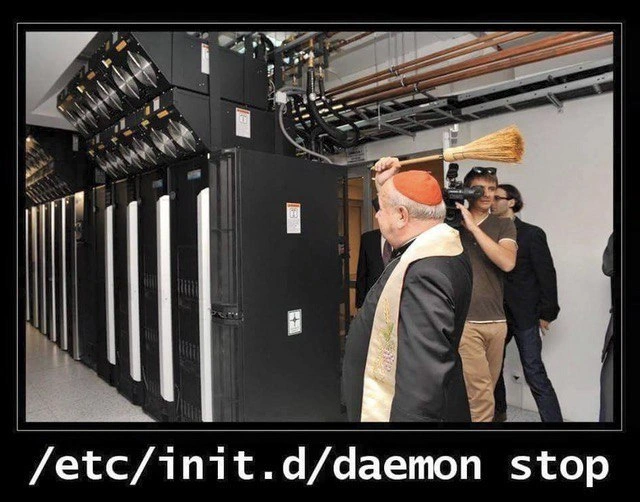
In the picture, there’s a priest splashing holy water on a bunch of large computers (servers) as if the computers have a ghost or demon inside them causing trouble. Of course, computers don’t actually get ghosts in them, but when they have bugs or errors it can feel mysterious and frustrating. The text at the bottom, “/etc/init.d/daemon stop”, is like a magic phrase or a special command to make the bad thing go away. It’s actually a real computer command, but here it’s being used like a magic spell. It basically says “stop the daemon,” and a daemon in computing is kind of like a little helper program running in the background. But the word sounds just like “demon.” So it’s as if the priest is saying “stop the demon!” in computer language.
So, in very simple terms: the computer is acting crazy, people pretend it’s because an evil spirit (demon) is inside, and the funny solution is a priest using a computer command (instead of Latin or the Bible) to cast it out. It’s mixing real-life problem solving (you normally fix a server by typing commands) with a pretend supernatural twist (like the priest vs. demon movies). The reason it’s funny is because it’s an over-the-top way to express frustration with technology. Even though we know downloading a software patch is what’s needed, the meme jokes, “Maybe we just need a bit of holy water to fix this tech problem!” It’s a playful way to say that sometimes fixing computers feels as tricky as getting rid of a ghost – and wouldn’t it be nice if an easy command or a sprinkle of holy water could chase the “computer demons” away?
Level 2: Daemon vs Demon
In this meme, a few technical and cultural elements are coming together in a funny way. Let’s break down what’s happening and the terms involved:
Data Center and Servers: The photo shows the inside of a data center – basically a big room filled with racks of powerful computers called servers. These servers host websites, databases, and applications. They’re the machines that keep online services running 24/7. The black cabinets lined up on the left are full of server hardware (blinking lights, whirring fans, and lots of cables). It’s normally a very secular, business-like environment.
Sysadmin (Systems Administrator): A person whose job is to keep these servers running smoothly. They do things like installing software, applying updates, monitoring for problems, and fixing issues. A sysadmin typically uses command-line tools (text-based commands) to control servers. That green-and-black terminal window you might have seen hackers use in movies? Sysadmins actually use something like that for real (though usually with less dramatic typing sounds!). This meme calls to mind a sysadmin who is so fed up with a troublesome server that they’re play-acting as an exorcist.
CLI Command
/etc/init.d/daemon stop: This text at the bottom of the image is a command you’d type into a Linux/Unix command-line shell. It’s shown in a monospace font, identical to how it would appear on a terminal screen. Let’s parse it:/etc/init.d/is a directory on Linux systems that, in older versions, contained scripts to start and stop system services. Think of a service as a program that runs in the background (for example, a web server program, a database server, or anything that should always run and do its job without direct user interaction).daemonin this context looks like the name of a service. In many real cases, you’d have specific names here, like/etc/init.d/apache2 stopto stop the Apache web server, or/etc/init.d/mysql stopto stop a database. In the meme, they chose the generic word “daemon” to make the joke clear. It’s as if a service literally named “daemon” is being stopped – which sounds like “demon.” So it perfectly fits the exorcism theme.stopis an argument telling that script to halt the service. In essence, running/etc/init.d/daemon stoptells the system: “Please stop the background service called ‘daemon’.” The script would then take care of shutting it down safely.
So, the caption is basically showing the sysadmin’s solution: run a command to stop the misbehaving “daemon.” It just so happens that the command reads like “stop demon.” It’s a techie way of saying “begone, evil spirit!” 😄
Daemon (Computing) vs Demon (Supernatural): A daemon in computing (with that ae spelling) is not evil at all – it’s just a program running silently in the background. Common examples include things like web server software (often called httpd, where the d stands for daemon), or
sshd(the Secure Shell daemon that allows remote logins). The word daemon in Unix culture has been around for ages and usually has a friendly or at least neutral connotation (a helper that does tasks for you). However, it’s pronounced almost the same as “demon,” so there’s a long-running source of jokes and confusion. Many newcomers do a double-take: “Wait, the system has daemons? Like... demons?!” Sysadmins, having a sense of humor, play along with the spooky vibe. We even refer to processes that don’t die properly as “zombie processes” in Unix. The terminology is full of these little spooky easter eggs.The Priest and Holy Water: In the image, the man in the cassock with the red skullcap and stole is clearly a Catholic priest (possibly even a high-ranking one, given the attire). He’s holding an aspergillum, a liturgical tool used to sprinkle holy water during blessings or exorcisms. This is completely out-of-place in a server room, and that contrast is the point of the joke. It visualizes the phrase “stop the daemon” as if a demon (evil spirit) is literally being cast out of a machine. Exorcism is the religious practice of expelling demons from a person or place believed to be possessed. Here the “possessed” objects are the server racks! Of course, servers don’t really get possessed by ghosts — but when you’re battling a nasty computer bug or a crashing service, it feels a bit like dealing with a naughty spirit. The priest is a comedic stand-in for a very frustrated sysadmin. It’s as if the company said, “We’ve tried turning it off and on again, and it STILL isn’t fixed — better call Father O’Malley.”
Blend of Humor: This is a classic example of sysadmin humor and Unix culture references. Sysadmins often have inside jokes about their tools and the situations they encounter. They deal with invisible, abstract problems (software glitches, configuration errors) that sometimes seem almost ghostly. And they often work in high-pressure situations where a bit of humor relieves stress. So, jokes about “praying to the server gods” or “sacrificing a rubber chicken to appease the network” are tongue-in-cheek ways to cope. This meme belongs to that family of jokes. The phrase “Holy spirit! Save us from sin!” in the post text mimics what a devout person might exclaim when facing evil — here it’s just an over-the-top dramatic way to say “I hope this server isn’t ruined by whatever’s wrong with it!”
Outdated vs. Modern: One side note – the command shown (
/etc/init.d/...) is a bit old-fashioned now. Most modern Linux distributions use a system called systemd for managing services. Instead of manually calling scripts in/etc/init.d, you’d typically run a command likesystemctl stop daemon.service. But the meme purposefully uses the old script style because (1) it contains the actual word “daemon” which sells the joke, and (2) it gives that feeling of an old ritual. Systemd’s commands are more abstract and wouldn’t read as clearly to non-tech folks. By using the SysV init style, the meme ensures that anyone familiar with Linux gets it immediately, and even those who aren’t super technical can at least read “daemon stop” and connect it to the priest stopping a demon. It’s a bit like using ye olde language for comedic effect.
In summary, at this “junior” level of understanding: The meme shows a priest figuratively “exorcising” computer servers. The text he’s “invoking” is actually a Linux command to stop a background service (called a daemon). It’s funny because it mixes up a computer problem with a religious solution, using a clever wordplay (daemon vs demon). If you’re new to these concepts, just know that sysadmins sometimes jokingly treat broken machines as if they were possessed, and they jokingly treat their command-line fixes as if they were magical spells. This image takes that joke literally, for comedic effect.
Level 3: The Power of Root Compels You
For the seasoned sysadmin or Site Reliability Engineer, this image is hilariously relatable. It captures that feeling when a server or service is so uncooperative that you’re ready to invoke divine intervention. The meme depicts a priest in a data center aisle, holy water in hand, as if performing an exorcism on unruly server racks. The caption running along the bottom — **/etc/init.d/daemon stop** — is styled like a console command, essentially casting the priest as an ultimate superuser. It’s as if he’s invoking root privileges and the Holy Spirit at the same time: “The power of root compels you!” 😇🖥️
This joke resonates on multiple layers for experienced folks:
Pun and Homophone: The core pun is the similarity between daemon (a background service on Unix systems) and demon (an evil spirit in religion). We routinely say we need to “kill a rogue daemon,” which sounds like battling a demon. Here that line is taken literally — a clergy member is “killing” a daemon/demon. It’s Sysadmin humor 101: a play on words that only exists because of Unix’s quirky terminology.
Sysadmin Daily Life: Using the command line to manage services is everyday work for a Linux admin. Running a command like
/etc/init.d/xyz stopto stop a service is mundane – yet in the heat of an outage at 3 AM, it sometimes feels like a dramatic ritual. We half-joke that some fixes require black magic or sacrificial offerings. This meme visually exaggerates that: a literal ritual to fix a server. Every sysadmin who's struggled with a stubborn process can smirk and think, “Yep, been there – tried everything short of holy water.” In real life, when a process won’t die, we escalate from politestopto the dreadedkill -9. In the meme, holy water serves as that ultimate escalation.Legacy Tech Reference: The use of the explicit path
/etc/init.d/screams “old school Unix”. It hints that the person behind the joke is probably a Linux veteran who remembers the pre-systemd era. It’s funny in the way an in-joke is funny: not only are we exorcising a daemon, we’re doing it with a SysV init script – the administrative equivalent of using Latin and incense. This detail delights those in the know: it’s a nod to the classic way of managing services, which many modern devs might never touch. It’s like seeing an old wizard use a spell scroll from ancient times.The Absurd Visual Contrast: Data centers are hyper-rational places – all cold air, LED indicators, and organized cables. Seeing a robed priest swinging an aspergillum (that straw brush for holy water) in such a setting is absurd in the best way. It juxtaposes the mystical with the technical. Operators often joke about “praying” for a deployment to succeed or calling upon the “machine gods” during a tough debug session. This meme takes that idea and runs with it. There’s even a cameraman in the shot as if this were a serious, newsworthy ceremony. The whole thing screams DevOps drama! It humorously acknowledges that sometimes sysadmins feel like caretakers of possessed machines – when servers behave erratically, you do whatever it takes to set things right, even if it means metaphorically casting out devils (or literally rebooting the box).
There’s also a cultural undercurrent: In tech communities (especially Unix/Linux culture), there’s long been a tongue-in-cheek use of religious metaphor. We speak of the “Church of Emacs vs. Vim”, refer to a guru’s wisdom, or joke about sysadmins performing voodoo to get legacy systems running. “Blessing the servers” could very well be an office joke during maintenance nights. In practice, seasoned engineers troubleshoot with logs, metrics, and shell commands – but after enough all-nighters, it sure feels like you’re chanting spells and fighting spirits. The post’s message text, “Holy spirit! Save us from sin!”, parodies what an exorcist might cry, but here “sin” could be any number of IT horrors (data corruption, downtime, config mistakes – take your pick of sysadmin sins 😅). Everyone in on this joke understands that desperation: “please, let this command finally fix the issue!”
Finally, the phrase "/etc/init.d/daemon stop" itself on the meme’s black border looks like a snippet out of a terminal session, giving the whole image that hacker aesthetic. It’s written in a monospace font just like you’d see in a console window. It’s as if the meme-maker is saying: this is the incantation the sysadmin-priest is uttering. In reality, of course, no actual priest is trained in Unix commands (well, never say never – there are priest-programmers out there!). But that absurdity is what makes it funny. It’s a perfect devops inside joke: mixing server room reality with supernatural fantasy. Any DevOps/SRE who’s battled an inexplicable outage can appreciate the feeling of, “maybe I need to exorcise whatever’s haunting these systems.” The meme gets a knowing laugh because it captures a universal truth of IT work: when faced with a truly baffling tech problem, even the most logical engineers joke about praying for a miracle. And sometimes, as a last resort, you do find yourself whispering “please work… please” into the ether of the server room – the secular version of a quiet prayer to the tech gods. This picture just takes that one step further and makes the invisible visible. The next time a daemon refuses to die, don’t be surprised if a co-worker jokingly mutters, “Time to grab the holy water.”
Level 4: Arcane Unix Rites
At the deepest technical level, this meme taps into Unix operating system lore and the almost ritualistic procedures of server management. In computing, a daemon (pronounced “DEE-mun”, just like demon) is a background process that runs continuously, handling tasks without direct user interaction. The term daemon itself has a fascinating origin: it was inspired by the concept of Maxwell’s demon (a thought experiment in thermodynamics) and the older Greek idea of a guiding spirit (δαίμων). Early computer scientists at MIT adopted “daemon” to describe background helper programs – not because they were evil, but because these processes worked invisibly, tirelessly sorting and managing tasks in the system’s background, much like mythical unseen spirits. The spelling with an extra ‘a’ differentiates it from “demon” in the religious sense, yet the pronunciation overlaps, setting the stage for puns.
In a Unix or Linux system, managing these daemons was traditionally done through an init system. The meme’s command /etc/init.d/daemon stop is a classic SysV-init (System V init) invocation. SysV init was the standard initialization scheme on many Unix-like systems for decades. It organizes the boot process into runlevels (think of them as different modes of operation), and within each runlevel, a series of scripts in directories like /etc/init.d/ (or linked through /etc/rc*.d/) are executed to start or stop services (daemons). Each service (be it a web server, database, or scheduler) would have a script in /etc/init.d/ with a standardized interface: you could call it with parameters like start, stop, or restart. For example, one might run sudo /etc/init.d/ssh stop to shut down the SSH service. Under the hood, such a script typically contains a shell case statement to handle those arguments. When you issue the stop command, the script will usually: locate the service’s process (often via a PID file in /var/run), send it a termination signal (often a SIGTERM to request a graceful shutdown), and wait a bit. If the daemon refuses to terminate (say it’s wedged in some unresponsive state), the script might escalate to a stronger signal like SIGKILL (kill -9), which the process cannot ignore – the computing equivalent of a forceful banishment.
So, /etc/init.d/daemon stop is essentially a command-line incantation to politely — and then persistently — expel a running background program. It’s a formatted way to exorcise a misbehaving service from the system’s memory. The parallel to a religious exorcism is technically tongue-in-cheek, yet apt: we have formal rituals (procedures and scripts) for removing unwanted processes (daemons) from a server, much as a priest might have formal rites for casting out a demon. The meme leans into this parallel by depicting a priest performing a literal ritual, while the caption is a literal Unix ritual (a command). It’s a delightful convergence of two worlds: the arcane knowledge of system administration and the imagery of ancient religious ceremony.
Notably, the use of the SysV init script path indicates some old-school context. Modern Linux distributions have largely moved to more advanced init systems like systemd, where you’d write systemctl stop daemon.service instead. Systemd doesn’t use /etc/init.d/ scripts for most services, so seeing that path in the meme is a deliberate throwback. It signals to seasoned sysadmins that we’re referencing the traditional way of doing things – almost like quoting Latin in a modern church service. This adds depth to the joke: the priest isn’t using a modern language, he’s using Latin (old Unix). By invoking an older command, the meme evokes the nostalgia of early Linux/Unix days when SRE and devops practices were literally a collection of custom scripts – it felt a bit like performing sorcery to newcomers.
In short, on this advanced level, the humor arises from fundamental CS concepts and history: the homophone of daemon/demon, the structured yet folkloric nature of SysV init service management, and the way system administrators have traditionally personified and controlled processes with nearly ceremonial commands. It’s a reminder that beneath our high-tech infrastructures lie decades-old design decisions and terminology – some of which (like calling processes daemons) were quirky and imaginative. The meme plays with this rich context, turning a routine OS command into a scene of supernatural warfare, as if the Operating System itself had to contend with metaphysical mischief. It’s a playful nod to the idea that running a server can sometimes feel like dealing with unseen forces, where system administration involves a bit of faith and a lot of carefully executed procedure.
Description
This meme uses the classic demotivational poster format, featuring a photograph within a black border followed by a caption. The image shows a high-ranking clergyman, likely a Catholic cardinal, in a server room, raising a straw broom as if to strike a large server rack. In the background, a cameraman is filming the event. The caption below reads '/etc/init.d/daemon stop'. The humor is a clever, multi-layered pun for a technical audience. In Unix-like operating systems, a 'daemon' is a background process. The command '/etc/init.d/daemon stop' is a legacy way to terminate such a process. The joke visualizes this command literally, replacing a system administrator with a clergyman who is trying to stop a 'demon' (daemon) using a more traditional, physical method. It’s particularly funny to experienced engineers who recognize the outdated command and appreciate the visual gag of exorcising a misbehaving server process
Comments
8Comment deleted
Some daemons don't respond to `kill -9`. For those, you need the holy water of a full power cycle and the sacred rites of `fsck` on reboot
“/etc/init.d/daemon stop” still feels cathartic - right up until systemd resurrects the possessed process as a socket-activated unit five seconds later
After 20 years in the industry, I've finally found the root cause of our production issues: we've been trying to kill daemons with SIGTERM when what we really needed was holy water and a proper exorcism ritual. No wonder systemd is so controversial - it's literally playing with forces beyond our comprehension
When the CTO insists on 'hands-on infrastructure management' but the team is still running SysV init in production. At least they're not using `kill -9` on the actual hardware - though given the cable management overhead, a broom might be the most reliable tool for dealing with those legacy daemons that refuse to gracefully shut down
SRE escalation path: SIGTERM -> SIGKILL -> systemctl stop -> call a priest to run /etc/init.d/daemon stop via the meatware interface
Escalation policy, circa SysV: SIGTERM -> SIGKILL -> update-rc.d remove -> priestctl sprinkle --force when the daemon ignores runlevel changes
When 'kill -9' bounces off like holy water on a demon, grab the broom - etc/init.d/daemon stop demands cardinal authority
Holy Omnissiah! Comment deleted