Skip to content
DevMeme
3113 of 7435
Stack Overflow's Hidden Unicorn: An April Fool's Source Code Surprise
DevCommunities Post #3431, on Jul 18, 2021 in TG

Stack Overflow's Hidden Unicorn: An April Fool's Source Code Surprise

Why is this DevCommunities meme funny?

Level 1: Secret in the Code

Imagine you have a storybook, and when you finish reading, you get curious and peek behind the last page. You discover a little secret drawing and a note from the author that says “Happy Holidays!” that isn’t part of the story. It was hidden there for only the very curious to find. Something like that actually happened on a popular website for programmers. The people who built the Stack Overflow site hid a surprise picture made out of keyboard characters (letters, numbers, and symbols) inside the website’s code. Normally, when you go on the site, you’d never see this picture or the message because they don’t show it on the page. It’s like an invisible ink note on a painting – you only notice it if you know how to look in just the right way.

On April Fool’s Day, the Stack Overflow developers played a kind of digital treasure hunt. They left a message that said “Happy April Fool’s from Stack Overflow” along with a big text-art horse and some little ASCII “eggs” hidden in the page’s inner code. It didn’t change how the site looked for regular visitors at all. But for someone who was extra curious and peeked into the site’s inner workings (the code), it was as if they found a secret prize. The whole joke is funny because it’s so unexpected — it’s like finding out your teacher hid a silly doodle on the back of your homework just to see if you’d notice. It makes you smile because you feel like you discovered a special little secret that the creators left just for clever eyes to find. In simple terms, the developers hid an Easter egg (a fun hidden surprise, not a real egg!) in the website, and finding it feels exciting, like you’re in on a friendly joke that most people never even realize is there.

Level 2: HTML Hide-and-Seek

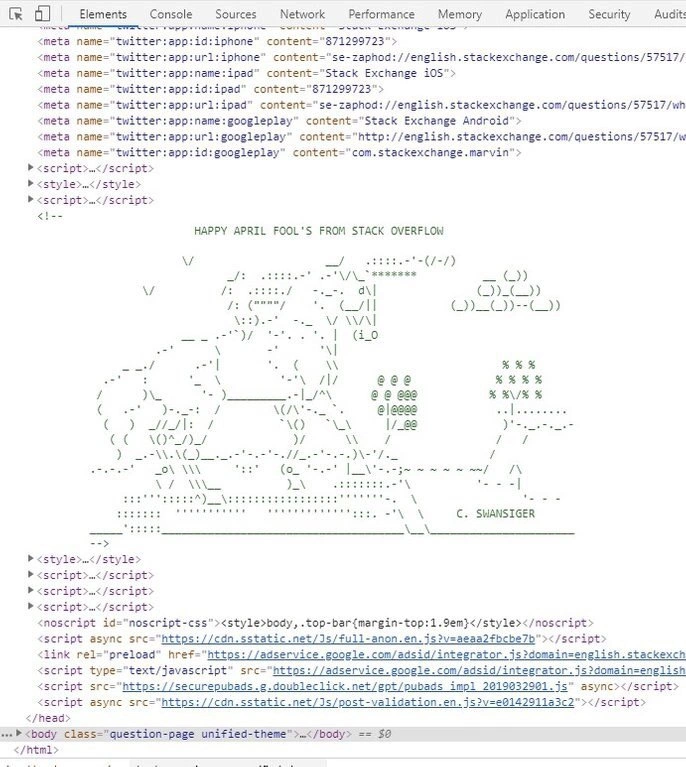
Even as a newer developer, you might know that websites are built with HTML – the code that structures content on a page. If you right-click a webpage and choose “View Page Source” or open your browser’s DevTools (for example, pressing F12 in Chrome and looking at the Elements tab), you can see the behind-the-scenes HTML that the browser uses to display the site. In the screenshot here, the DevTools view of a Stack Overflow page shows a bunch of typical tags: multiple <meta> tags (these provide information about the page, like descriptions or links for apps), some <script> tags and <style> tags (for JavaScript and CSS files). This is all normal content you’d find in the <head> of a webpage or around the document.

But hidden among this normal code is something that you wouldn’t expect: a large HTML comment block that contains an ASCII art picture and a message. In HTML, anything between <!-- and --> is a comment. Comments are meant for developers’ notes or code that is not meant to display on the page. The browser simply ignores this content, so it doesn’t show up to users. Here, the Stack Overflow team used a comment as a clever hiding spot for a joke. Inside the comment, it says “HAPPY APRIL FOOL’S FROM STACK OVERFLOW” and below that, there's an elaborate ASCII art image of a horse-like creature in a field (you can see shapes that look like a horse, some trees, and eggs drawn with characters like slashes, parentheses, underscores, and at-signs). At the bottom of this art, the name "C. SWANSIGER" appears, which is likely the artist’s signature for the ASCII image.

This hidden block is an example of a software Easter egg. In tech terms, an Easter egg is a secret or surprise that developers hide in a product for users to find, named after the tradition of Easter egg hunts where eggs are hidden for children to discover. In this case, the Easter egg was placed for April Fool’s Day (April 1st). Many tech companies and websites do pranks or fun little additions on April Fool’s as a way to celebrate humor in the community. Stack Overflow’s prank was very subtle: they didn’t show anything obvious on the site’s pages, but they placed this fun ASCII artwork in the HTML source code. That means only people who inspect the code (like developers or very curious power users) would find it. If you were just browsing the page normally, you’d never know it was there.

For a junior web developer, finding something like this is a delightful surprise. It’s like doing your usual task of checking a page’s structure or debugging some CSS, and suddenly you come across a hidden drawing and message left by the site’s creators. It highlights the playful side of web development. The Stack Overflow developers essentially said, “Hey, we know our fellow devs often peek under the hood, so let’s give them something to make them smile.” It’s a bit of hide-and-seek in the HTML. This also teaches an interesting lesson: not everything a website delivers is meant to be seen by end-users; sometimes there are notes or jokes left in the code intentionally. It reminds us that coding and web development have human touches and humor — it's not all just functional logic. And if you ever needed motivation to inspect and learn from real websites’ source code, finding a quirky Easter egg like this is proof that sometimes you’ll uncover fun surprises along with learning opportunities.

Level 3: Source Code Horseplay

From the vantage of a seasoned developer, stumbling upon Stack Overflow's hidden ASCII art in the page's HTML feels like uncovering a secret handshake. In the Chrome DevTools Elements panel, nestled among routine <meta> tags and <script> includes, we see a large HTML comment:

<!--  
HAPPY APRIL FOOL'S FROM STACK OVERFLOW  
      //  
     (OO)   <- neigh?  
     (  )\_______  
     /|\        **\  
    / | \       |\\  
~~~/_|__\~~~~~~/ |_~~  
C. SWANSIGER  
-->  

This is an Easter egg cleverly tucked away in the source code. It's invisible to normal users because browsers ignore anything inside <!-- ... --> HTML comments. Only the curious developer viewing source or using the inspector would ever see this artwork. It's a nod from Stack Overflow's developers to the community: "If you're nerdy enough to dig around under the hood, here's a little surprise for you."

The humor resonates with experienced devs because it blends old-school ASCII art culture with modern web development. ASCII art — creating images out of text characters — harkens back to the days of text-based terminals and early internet forums. Seeing a horse-like creature drawn with punctuation and letters inside an HTML comment is delightfully unexpected on a serious Q&A site. The message "HAPPY APRIL FOOL'S FROM STACK OVERFLOW" immediately clues us in that this was a playful April 1st prank – a tradition in tech. Instead of a flashy joke visible to everyone (which might confuse normal users), Stack Overflow hid theirs in plain sight, only visible to those "in the know." It's an insider joke, a bit of source code horseplay that doesn’t disrupt the site but rewards geeks with a grin.

For senior developers, there’s extra appreciation in how unobtrusive and clever this is. Hiding jokes in comments or console logs has become a gentle art in web development. Many of us recall other hidden gems – like sites printing cheeky messages or ASCII logos in the browser console as a recruiting trick or inside joke. It’s part of DevCommunities culture to communicate through code itself. Here, the frontend team left a friendly greeting and an elaborate ASCII scene inside the HTML as a winking salute to fellow coders. The presence of "C. SWANSIGER" as an artist credit is a classy touch, reminiscent of early software Easter eggs where developers would sign their work once discovered.

Technically, the combination of an HTML comment and ASCII art is clever because it leverages the browser’s parsing rules. It won’t break anything — the page renders normally — yet it injects a hefty slab of text art into the DOM for anyone inspecting. In an era of minified, ultra-optimized production code, finding a whimsical multi-line ASCII tableau in the source is ironically refreshing. It’s proof that even a highly professional site’s codebase can carry a hidden message in source for those adventurous enough to look. This meme captures a senior dev’s giddy delight at encountering that kind of inside joke. After years of viewing source for debugging or curiosity, discovering a stack_overflow_easter_egg like this feels like finding a bonus level in a familiar game — a little reward for our curiosity and a reminder that developers have a sense of humor too.

Description

This is a screenshot of a website's HTML source code as viewed through a browser's developer tools. The main focus is a large block of ASCII art depicting a unicorn, placed within an HTML comment. Above the art, the text 'HAPPY APRIL FOOL'S FROM STACK OVERFLOW' is clearly visible. The surrounding code includes typical meta tags for Twitter and Google Play apps, along with various script and style tags. The signature 'C. SWANSIGER' appears next to the ASCII art, crediting the artist. The joke is a classic developer Easter egg. It's hidden from the average user but easily discoverable by developers who use their browser's inspection tools. This type of humor celebrates the curious nature of programmers and pays homage to the early internet culture of ASCII art, making it a clever, non-disruptive prank from a major developer community platform

Comments

12
Anonymous ★ Top Pick Juniors look for answers on Stack Overflow. Seniors look for ASCII art in the source code on April 1st
  1. Anonymous ★ Top Pick

    Juniors look for answers on Stack Overflow. Seniors look for ASCII art in the source code on April 1st

  2. Anonymous

    Ran git blame on the mysterious empty divs - turns out they all trace back to a 2011 April-Fools commit that stashed a 400-line ASCII horse in an HTML comment. Technical debt accrues interest; ours is paying out in livestock

  3. Anonymous

    The real Stack Overflow experience: spending 20 minutes debugging why your ASCII unicorn won't render, only to realize it's intentional and you've just discovered why the senior devs were smirking during standup on April 1st

  4. Anonymous

    Stack Overflow's April Fool's ASCII art in the console is the developer equivalent of leaving a note that says 'If you're reading this, you're probably procrastinating on fixing that production bug.' It's a beautiful reminder that even the platform where we frantically search for answers at 3 AM has a sense of humor - and that someone got paid to meticulously craft ASCII art while the rest of us were debugging why our CSS wasn't centering a div

  5. Anonymous

    April Fools level: ship a feature only visible to people who know what $0 is

  6. Anonymous

    The rare prank where downvotes finally pulled their weight in pixel-perfect architecture

  7. Anonymous

    April Fools in an HTML comment: perfect segmentation - only the folks already debugging why twelve “async” ad scripts still nuke TTI will ever see it

  8. @ZgGPuo8dZef58K6hxxGVj3Z2 4y

    This is exactly what I expected

  9. @misesOnWheels 4y

    but was it closed as duplicate ?

    1. @pztrn 4y

      As offtopic

  10. @dsmagikswsa 4y

    The most annoyed thing in SO is when your post is closed, it is hard to reopened again. They should set a 30mins timer to not allow people close the post too early…

    1. @mainfme 4y

      just do not use SO🤷🏻‍♂️ use your own brain

Use J and K for navigation