Skip to content
DevMeme
2075 of 7435
When a Programmer Solves a Math Problem
CS Fundamentals Post #2320, on Nov 16, 2020 in TG

When a Programmer Solves a Math Problem

Why is this CS Fundamentals meme funny?

Level 1: A Rocket to Next Door

Imagine your teacher asks you to make the number 6 using just the cards labeled 1, 2, 3, and 4, expecting you to do something easy like putting 2 and 4 together to get 6. Instead, you do something wild: you take the card with 3 on it, magically multiply it a bunch of times until you somehow have 48, then you cut that down by taking away pieces until you’re back to 6. In everyday terms, it’s like your friend dared you to walk to the house next door, and you built a rocket ship and went all the way around the Earth only to land next door. 🤷 It’s completely over-the-top, but hey, you did end up at the right place (the number 6)! The joke is funny because the student solved the problem in a ridiculously complicated way just to show off. It’s as if they said, “Sure, I can get 6, but let me do it in the fanciest way possible!” Everyone else would simply do a little addition, but our “intellectual” took a huge detour. The result? We’re both impressed and amused, because they technically followed the rules but in a way nobody expected. It’s that silly feeling of using a crazy method to do something super simple — and that’s why we can’t help but laugh.

Level 2: Shift Happens

Let’s break down exactly what 3<<4>>2>>1 means, because if you’re new to bit manipulation or haven’t seen these operators before, it looks pretty strange. In many programming languages (like C, C++, Java, and Python), << is the left shift operator and >> is the right shift operator. These are not your everyday arithmetic symbols from math class; they’re language features used to manipulate the binary representation of numbers. Here’s how they work:

  • Left shift (<<): This takes all the bits of the number and shifts them to the left. Shifting left by 1 bit multiplies the number by 2, because in binary you’re effectively adding a zero to the right end of the number (just like how appending a zero in base-10 multiplies a number by 10). So x << 1 = x * 2. More generally, x << n = x * 2^n. It’s a quick way to multiply by powers of two.
  • Right shift (>>): This moves the bits to the right. Shifting right by 1 bit divides the number by 2 (and discards any remainder, essentially taking the floor of the division if it’s an integer). So x >> 1 = ⌊x / 2⌋. In general, x >> m = ⌊x / 2^m⌋. It’s like cutting the number in half for each shift to the right (for positive numbers, it’s straightforward division by 2^m).

Now, let’s apply these operations to the expression in the meme step by step:

  1. Start with the number 3.
  2. 3 << 4: Shift the bits of 3 to the left by 4 positions. Each left shift doubles the number, and doing it 4 times multiplies 3 by 2^4 (which is 16). So this equals 48. In math terms, 3 << 4 = 3 * 16 = 48.
  3. Now take that result: 48 >> 2. This shifts the bits of 48 to the right by 2, which divides 48 by 2^2 (which is 4). So 48 >> 2 = 12. (48 / 4 = 12, no remainder to worry about here.)
  4. Next: 12 >> 1. Shift the bits of 12 to the right by 1, dividing 12 by 2^1 (which is 2). So 12 >> 1 = 6.

If we put it all together, 3<<4>>2>>1 sequentially does: 3 becomes 48, then 48 becomes 12, then 12 becomes 6. We used the numbers 3, 4, 2, 1 exactly as instructed, just with a twist — the operations were shifts instead of standard + - × ÷. The final outcome is indeed 6. The math teacher challenge was met! The teacher said “with only numbers 1, 2, 3, 4 and basic operations,” and our solver technically obeyed: they used 3, 4, 2, 1 and they used operations (shifts). The sneaky part is that a math teacher probably meant basic arithmetic operations (like addition, subtraction, etc.), not bit shifts. But since the problem wasn’t explicitly phrased in programming terms, the solver treated bitwise shifts as allowable operations. It’s a bit of a loophole exploit — taking “allowed operations” to include these lesser-known ones.

For a newer developer or a student, seeing 3<<4>>2>>1 might be a bit confusing at first, because it’s not immediately obvious it equals 6 until you know how shifts work. But once you break it down, it’s a clear demonstration of binary math in action. It’s also an example of how understanding the binary representation of numbers can open up alternative ways to compute things. This kind of bit trick often appears in programming exercises or competitive programming. For instance, once you learn about binary, you soon encounter neat facts like: multiplying by 2, 4, 8, ... is just shifting left; dividing by 2, 4, 8, ... is shifting right. It’s an essential part of CS fundamentals, because bits are the building blocks of all data in a computer.

In practical programming, you’ll see bit shifts used for tasks like optimizing calculations, working with low-level data (e.g., encoding/decoding information in a single number by shifting and combining bits), or handling flags and masks (where you use bits to represent boolean states). For example, if you have a binary number 00000110 (which is 6 in decimal), shifting it left by 1 gives 00001100 (which is 12). Shifting it right by 1 would bring it back to 00000110 (6). The meme’s solution essentially leveraged these moves: it doubled 3 four times (that’s what <<4 does), then halved the result twice (>>2), and halved once more (>>1). Each of those operations on its own is pretty basic in programming, but chaining them like this to solve a simple math puzzle isn’t something a beginner might think of — it’s a playful language quirk application.

To put it simply, the solver treated the numbers 1, 2, 3, 4 as tools not for normal arithmetic, but for bitwise operations that ultimately achieved the arithmetic goal. It’s a bit like using a wrench (intended for bolts) to hammer in a nail — it’s an unexpected use of a tool. For someone learning programming, this meme might even be educational: now you know what << and >> do! And you can appreciate that while 3<<4>>2>>1 is a valid expression in many languages, it’s doing a lot under the hood just to get the number 6. The humor (and the insight) comes from recognizing that this “intellectual” developer solved the puzzle by thinking in terms of binary shifts instead of plain old addition. It’s a fun reminder of how knowing the ins and outs of language features and binary can lead to very inventive (if impractical) solutions.

Level 3: Shifting the Rules

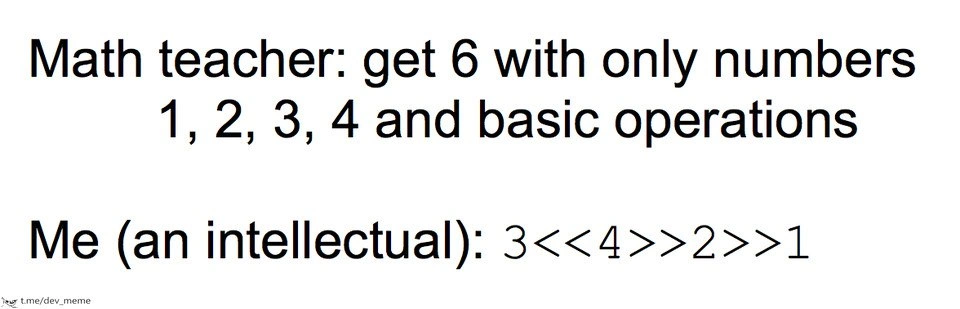
Math teacher: get 6 with only numbers 1, 2, 3, 4 and basic operations.

Me (an intellectual): 3<<4>>2>>1

This meme sets up a classic developer humor scenario: the authority (the math teacher) poses a straightforward challenge, likely expecting a solution using basic operations like addition or multiplication (for example, 2 + 4 = 6, or 3 + 3 = 6). But the punchline is the self-proclaimed intellectual (the developer or savvy student) who completely shifts the problem into a different domain—literally. Instead of conventional arithmetic, they use a sequence of bitwise shifts (<< and >>) to arrive at 6. It’s an unexpected answer that technically meets the stated requirements (only using the numbers 1, 2, 3, 4 and some operations) while blatantly ignoring the spirit of the challenge. This is the humor: a cheeky workaround that follows the letter of the law but not the intent, much to the math teacher’s (hypothetical) dismay and the developer’s amusement.

Why is this funny to those in the know? For one, it’s a bit of a knowledge flex. Bitwise operators (<< and >>) are not something you’d ever use in a normal grade-school math problem. They’re firmly in the realm of programming language features and low-level programming tricks. So when a developer sees 3<<4>>2>>1, they immediately recognize it as a tongue-in-cheek overengineering of a trivial task. It recalls the times when we, as programmers, might have encountered a simple problem but couldn’t resist using a fancy technique or an obscure language quirk just to show off or entertain ourselves. It’s the same energy as solving a puzzle in the most convoluted way possible not because you should, but because you can.

This is also a nod to code golf culture – those competitions or challenges where developers try to achieve something with as few characters or unusual methods as possible. In code golf, using bit shifts to perform arithmetic (like multiplying or dividing by two) is a common trick to shave off characters or meet bizarre constraints. The meme’s solution 3<<4>>2>>1 looks like something straight out of a code-golfing session or a Stack Overflow question where someone shows an unconventional one-liner. By chaining shifts, the “intellectual” solver effectively does (3 * 16) / 4 / 2 in one terse expression, which is a roundabout way to get 6. It’s humorous because it’s comically unnecessary—any normal person would just do 4 + 2 or 3 * 2, but that wouldn’t demonstrate cleverness or deep knowledge of binary operations.

There’s an element of gentle satire here about how developers sometimes approach problems. The math teacher’s request was simple, but the developer’s mindset is in programming mode, tapping into bit manipulation tricks instead of straightforward arithmetic. It highlights a kind of insider knowledge: only those familiar with programming understand that << and >> are operators and can decode the expression. If you showed 3<<4>>2>>1 to a non-programmer, it would look like gibberish. To a coder, it’s instantly clear and even a bit impressive that it evaluates exactly to 6. We’ve all seen or written code where someone used a clever one-liner or an unconventional method to solve a problem, eliciting both admiration and an eye-roll from peers. This meme pokes fun at that impulse.

From a senior developer’s perspective, there’s also a tongue-in-cheek lesson: just because you can do something in a single clever expression doesn’t mean you should in real life! In production code, clarity usually trumps cleverness. Writing 3<<4>>2>>1 to get 6 is like writing a riddle — it might confuse other programmers who maintain your code. However, within the safe confines of a meme (or a coding challenge), it’s delightful. It celebrates the esoteric corners of programming languages (these bitwise shift operators) and the shared amusement of solving problems in out-of-the-box ways. The “(an intellectual)” label is the meme’s way of laughing at itself: the solver is portrayed as a smug know-it-all doing something fancy, which is a comedic exaggeration of how we feel when we find a clever solution. We laugh because we recognize a bit of ourselves in that — the pride in finding a solution that’s technically brilliant but completely over-the-top for the task at hand.

In short, the meme is funny to developers because it’s a perfect storm of developer humor: it combines a common situation (teacher’s simple assignment) with a programmer’s twist (bitwise arithmetic), showcases CS fundamentals knowledge (binary shifts), and lands as an inside joke about the quirky ways programmers think. It’s the kind of joke where you nod knowingly and perhaps groan-laugh, thinking, “Of course the solution works… and of course only a programmer would come up with that!”

Level 4: Bit-Twiddling Wizardry

At the very heart of this joke is some bitwise sorcery leveraging the fundamental properties of binary numbers. In computing, shifting bits is an incredibly low-level programming operation that directly exploits how numbers are represented in binary (base-2). A left shift << by n positions multiplies a number by 2^n (adding n zero bits at the right end), while a right shift >> by m positions divides the number by 2^m (chopping off m bits on the right). These operations correspond to powers of two because of the positional value system: shifting one place in base-2 doubles or halves the value, just as shifting one place in base-10 multiplies or divides by 10.

Consider the binary breakdown of the given expression 3<<4>>2>>1 step by step (using an 8-bit representation for clarity):

// Using binary (8-bit representation for clarity):
3        -> 00000011 (binary)
3 << 4   -> 00110000 (binary) = 48 decimal  // 3 * 2^4 = 48
48 >> 2  -> 00001100 (binary) = 12 decimal  // 48 / 2^2 = 12
12 >> 1  -> 00000110 (binary) = 6 decimal   // 12 / 2^1 = 6

This little binary math trick relies on the fact that 3 << 4 multiplies 3 by 16 (2^4) to get 48, then >> 2 divides by 4, and another >> 1 divides by 2. In combined effect, 3 × 16 ÷ 4 ÷ 2 = 6. It’s a deterministic outcome guaranteed by how binary arithmetic works at the bit level. Under the hood, most CPUs have dedicated arithmetic logic unit (ALU) instructions for shifts because they are fundamentally simple and O(1) operations — the hardware literally just shifts all the bits left or right, which is much faster than performing multiple additions or a general multiplication. This kind of operation is so basic that it’s part of the earliest CS fundamentals: any computer architecture or low-level programming course will cover bitwise shifts as a tool for efficient arithmetic manipulation.

What makes this wizardry delightful is that it’s reminiscent of classic bit-twiddling hacks found in texts like Hacker’s Delight. Early programmers often used shifts to optimize multiplications or divisions by powers of two (back when saving CPU cycles was critical). Here, the meme’s author applies that same fundamental idea in a cheeky way: they treat a simple arithmetic puzzle as if it were a low-level binary computation problem. It’s a perfect example of how understanding the binary underpinnings of numbers can lead to clever solutions that feel almost like a magic trick to the uninitiated. The humor emerges from the collision of two worlds: the pristine, high-level realm of a math teacher’s puzzle and the gritty, bit-level operations that systems programmers and compiler designers play with. It’s both an academic flex and a nod to the beauty of how math and binary intertwine.

Description

A text-only meme on a white background. The first line presents a challenge from a math teacher: 'Math teacher: get 6 with only numbers 1, 2, 3, 4 and basic operations'. The second part of the meme presents a clever, domain-specific solution: 'Me (an intellectual): 3<<4>>2>>1'. There is a small watermark in the bottom left corner for 't.me/dev_meme'. The humor is rooted in the creative interpretation of 'basic operations'. While a math student would think of addition, subtraction, multiplication, and division, the 'intellectual' (a programmer) uses bitwise shift operators, which are fundamental in low-level programming but not in elementary arithmetic. The expression evaluates to 6 (3 << 4 is 48, 48 >> 2 is 12, 12 >> 1 is 6), correctly solving the puzzle in a way that showcases a programmer's distinct problem-solving mindset

Comments

50
Anonymous ★ Top Pick The math teacher was looking for `(4-1)*2/3` or something. They weren't prepared for a solution that's O(1) in terms of cognitive overhead for a programmer, but requires explaining binary to the rest of the class
  1. Anonymous ★ Top Pick

    The math teacher was looking for `(4-1)*2/3` or something. They weren't prepared for a solution that's O(1) in terms of cognitive overhead for a programmer, but requires explaining binary to the rest of the class

  2. Anonymous

    Nothing says “senior engineer” like turning a middle-school math problem into 3<<4>>2>>1 - then spending the rest of the sprint debating whether it should be an arithmetic or logical shift across four languages and two compilers

  3. Anonymous

    When you've spent so many years optimizing embedded systems that you instinctively reach for bit shifts instead of multiplication, only to realize the compiler would've done it anyway - but hey, at least you saved those precious 3 CPU cycles in 1987

  4. Anonymous

    When your solution is technically correct but uses O(log n) brain cells where O(1) would suffice - because why write '1+2+3' when you can demonstrate your intimate knowledge of CPU instruction sets? This is the software equivalent of using a distributed microservices architecture to calculate 2+2, proving once again that the shortest path between two points is a bitwise operation that makes your code reviewer question their career choices

  5. Anonymous

    It evaluates to 6 - until someone runs it on a negative int and we spend the retro arguing arithmetic versus logical right shift

  6. Anonymous

    Arithmetic? Too basic. Real devs approximate 6 with a syntax error and a straight face

  7. Anonymous

    3<<4>>2>>1 - because to anyone raised on Hacker’s Delight, “basic operations” includes the barrel shifter; correct at the ALU, guaranteed to start a code review about precedence and sign-extension

  8. @pyproman 5y

    But you could just 2*3 or 4+2 or 1+2+3

    1. @Four_Velocity 5y

      But then you're not an intellectual

    2. @yyuriykiss 5y

      3^2+1-4

      1. @desperado_gmbh 5y

        caret means XOR, so 1+(2^3)+4

      2. @zherud 5y

        how the fuck is power a basic operation?

        1. @tyomych88 5y

          Это ХOR

          1. @zherud 5y

            а ну да, 3XOR2+1-4=-2=6

    3. @Juliaz852 5y

      The point is to use all of them

      1. @pyproman 5y

        So, 2|4*1**3?

        1. @minicooper666 5y

          Explain that.

        2. @feskow 5y

          Is it like a | b returns a+b?

          1. @Juliaz852 5y

            It's bytewise or

            1. @feskow 5y

              Makes sense now, that's cool

          2. @pyproman 5y

            In this case, yes.

      2. @t_Shatterhand 5y

        1+4+3-2

  9. @tyomych88 5y

    It sais BASIC operations The guy uses C

  10. @yyuriykiss 5y

    Still not intellectual

  11. dev_meme 5y

    Image text: Math teacher: get 6 with only numbers 1, 2, 3, 4 and basic operations Me (an intellectual): 3<<4>>2>>1

    1. Deleted Account 5y

      (1+3+4)-2?

    2. @I_like_trains 5y

      So, ((3x4)/2)/1, do I get it right?

      1. dev_meme 5y

        Y'all just too smart for this shit, wouldn't you mind unsubscribe?

  12. @d3p43x 5y

    4*3/2*1

    1. dev_meme 5y

      Y'all just too smart for this shit, wouldn't you mind unsubscribe?

      1. @I_like_trains 5y

        Ahah, lol

  13. @tyomych88 5y

    (4|2) * (1&3)

  14. @slnt_opp 5y

    4 + 3 + 1 - 2

  15. @I_like_trains 5y

    Funny that it matched, though

    1. dev_meme 5y

      Of course it does!

    2. dev_meme 5y

      Did you think we're joking here?

  16. @I_like_trains 5y

    Nah, I think we're 3 -> 48 -> 12 -> 6 here

  17. @tyomych88 5y

    Int(Asc(Int(Str(1*2+3) + Str(4))))

  18. @tyomych88 5y

    (1|2)<<(4-3)

  19. @tyomych88 5y

    (1+2)**3/4

  20. @Cinill 5y

    4\2*3*1

  21. @Cinill 5y

    4-2+3+1

  22. @Cinill 5y

    Остальное избыточно

  23. @b4dapp13 5y

    4 | 3 | 2 - 1

  24. @p4vook 5y

    lol I can do it with 3 different operations 2 * 4 - 3 + 1

  25. @feskow 5y

    I wonder how many ways you can get 6 using basic operations

    1. @p4vook 5y

      infinite number of ways

      1. @feskow 5y

        Using only 4 numbers that are given

        1. @feskow 5y

          And 4 times

  26. Deleted Account 5y

    1+2+3+4-4

Use J and K for navigation