Raspberry Pi vs. Actual Raspberry Pie
Why is this Hardware meme funny?
Level 1: One Tasty Mistake
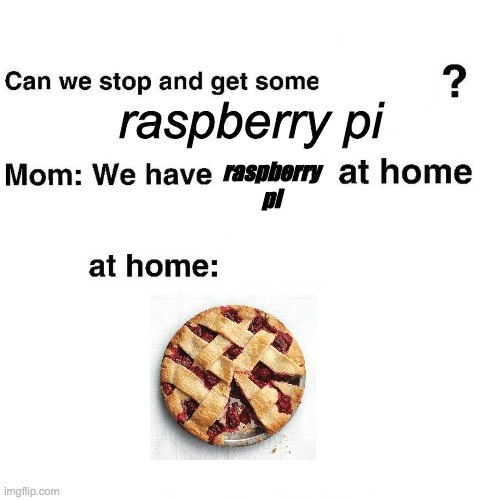
This meme is basically a big name mix-up, and that’s why it’s funny. It’s like if you asked your mom for an Apple for your birthday – meaning the fancy iPad or iPhone from Apple – but she misunderstood and gave you a shiny red apple fruit instead. In the picture, the kid asks for something called a Raspberry Pi, which is actually a tiny computer for inventing cool projects. But his mom only knows the words “raspberry pie” as a type of pie you eat. So she says, “We have that at home,” and serves him a slice of real raspberry pie. Oops! The kid ended up with a delicious dessert instead of the little computer he wanted. It’s a silly misunderstanding: both Raspberry Pi and raspberry pie sound the same, even though one is a gadget and the other is food. The funny part is the kid got exactly what he didn’t mean – a treat for his tummy instead of a tool for his hobby. He’s probably thinking, “Mom, that’s not what I meant!” but at the same time, he has a tasty pie in front of him. The humor comes from that mix of confusion and sweetness – Mom tried to help but totally goofed, and now the kid has to enjoy a snack while laughing about how parents just don’t get these crazy tech names.
Level 2: Board vs Baked
Let’s break down why this meme is funny, in simpler terms. It’s all about a mix-up between Raspberry Pi and raspberry pie – two things that sound the same but couldn’t be more different! A Raspberry Pi (notice the spelling “Pi” like the number π) is a tiny computer board about the size of a deck of cards. It’s a fully functional little computer used in electronics projects, robotics, and Internet of Things (IoT) gadgets. People in the embedded systems community use Raspberry Pis to learn programming, control hardware (like sensors or motors), or even run small web servers. It’s basically a mini PC that you can hook up to a keyboard, monitor, and start coding on – a dream tool for a young programmer or engineer. On the other hand, a raspberry pie (spelled P-I-E, like the dessert) is a delicious fruit pie you can eat, made with raspberries and pastry. Apart from the similar name, these two share nothing in common (except maybe causing excitement – one for techies, one for dessert lovers). To make it super clear, here’s a comparison:
| Raspberry Pi (tech device) | Raspberry Pie (dessert) |
|---|---|
| A small hardware board with chips, ports, and memory. | A pastry with a flaky crust and fruity filling. |
| Used for computing: you can program it to build gadgets, robots, or media centers. | Used for eating: you bake it in an oven and serve it as a sweet treat. |
| Runs an operating system (often Linux) and can host software like a media player or web server. | Runs out of the pan quickly at dinner because it’s so tasty! (No software, just sweetness 😋.) |
| Requires electricity, an SD card, and some setup to get going. | Requires ingredients (flour, sugar, raspberries) and some baking skills to make. |
| Named “Pi” as a nerdy pun (reference to math π and programming). | Named “pie” because... well, it’s literally a pie! No tech meaning here. |
In the meme, when the kid says, “Can we stop and get some Raspberry Pi?”, he’s clearly asking for the gadget — maybe he wants to tinker with a fun new hardware project. The mom’s response, “We have raspberry pi at home,” shows she thinks he meant the food (perhaps she’s never heard of the tech RaspberryPi before). The line “at home:” in the meme then reveals a picture of a homemade-looking raspberry pie dessert. For the kid (and for us knowing what he actually meant), that’s a facepalm moment – Mom completely misunderstood! This meme format (the “Mom, we have it at home” template) is commonly used online to joke about getting a lame or wrong substitute instead of the real thing you wanted. The text in the meme even makes the “raspberry pi at home” look messed up on purpose, as if it’s a glitchy off-brand version. Here the “off-brand” is not a knock-off gadget but something totally different due to a simple hearing mistake.
Now, think of this from a new developer’s perspective: it highlights how important clear communication is in tech. The term “stakeholder miscommunication” is often used in software teams to describe when a person who isn’t a developer (like a client, manager, or in this case a parent) misunderstands what the developer is asking for. A stakeholder is basically anyone who has an interest in the project – not necessarily writing code, but affected by or involved in it. Because they don’t always speak the same technical language, things can get mixed up. Imagine you tell your boss, “We need to implement cookies for our website,” meaning small data files for login sessions, but your boss gives you a puzzled look and says, “Did someone say cookies? Is it snack time?” 🍪 Or you excitedly tell your family you’re learning Python, and your grandma goes, “Be careful with that snake!” 🐍 These misunderstandings happen because tech words often sound like everyday words. In our meme, Raspberry Pi sounds just like raspberry pie when spoken out loud. The mom isn’t being mean – she genuinely thinks there’s no difference and that she’s saving time and money by offering the pie at home. It’s a cute example of how a request can get totally lost in translation between a techie and a non-techie.
For a junior developer or someone new to EmbeddedSystemsAndIoT, this meme is a lighthearted lesson. It reminds us that when asking for something technical, you might need to clarify what it is to those who aren’t familiar. If you told a friend who knows nothing about computers that you want a Raspberry Pi, you might want to add “it’s a small computer, not the dessert” to avoid this exact scenario! The humor also shows how quirky tech terminology can be – we name devices after fruits (Raspberry), use terms like “Pi”, and then act surprised when our poor moms get confused. So the next time you request a piece of gear or start tossing around acronyms at home, don’t be shocked if someone hands you an actual pie or something else funny. It’s all in good humor. The meme gives everyone a good laugh and maybe teaches our non-tech family and friends a new term. And hey, the kid in the meme might not have gotten to program a gadget that day, but at least they got a yummy dessert out of it! 😄
Level 3: Not That Kind of Pi
In this meme, a tech-savvy kid asks, “Can we get some raspberry pi?” meaning the Raspberry Pi microcomputer, but the mom hears it as the dessert raspberry pie. The classic reply, “We have raspberry pi at home,” sets up the punchline: the at-home version is a golden, lattice-crust raspberry pie straight out of the oven. This twists the familiar “Mom, can we get X? – We have X at home” meme format, which usually compares a desired item to a disappointing knock-off. Here the twist is a hilarious homophone mix-up – the high-tech gadget vs. the homemade pastry – rather than a cheap imitation. The meme even visually emphasizes the mix-up: the text “raspberry pi” in the mom’s reply is shown all jumbled and misaligned, as if the very words got corrupted in transmission (a wink to how a stakeholder miscommunication can garble a request). Seasoned developers immediately recognize the humor in this misunderstanding: it’s hardware humor that plays on the gulf between a specialist term and its everyday sound-alike.
The heart of the joke lies in how a precise EmbeddedSystems request can be lost on someone not fluent in tech jargon. A Raspberry Pi is a small single-board computer beloved by engineers, hackers, and IoT tinkerers – essentially a tiny Linux-powered machine the size of a credit card. Hearing that, Mom’s brain auto-corrects to something familiar: a delicious raspberry pie you’d have for dessert. It’s a classic case of “not that kind of Pi”. For those of us in tech, there’s an instant laugh because we’ve all experienced moments where a non-technical person interprets our request in a completely different (often hilariously literal) way. It’s the same energy as asking for a new Java framework and getting handed a cup of coffee, or telling your project manager you need some “cookies” and they start talking about chocolate chips. In real engineering projects, this kind of misunderstanding can lead to frustrating outcomes – like a purchase order for the wrong component – but in meme land it’s distilled to a simple, absurd example everyone can chuckle at.
What makes this especially DevMeme-worthy is the relatable communication gap. The mom in the meme is essentially a stand-in for that well-meaning stakeholder (be it a manager, client, or family member) who doesn’t quite grasp the request. The kid’s earnest question for a piece of hardware is met with a literal interpretation. Every developer who’s tried to justify a budget request for specialized tech to upper management, or explain to Aunt Mary that “No, my Python isn’t a snake,” can see themselves in this scenario. It satirizes the experience of having your technical needs misunderstood by those outside the bubble. The absurdity lies in how drastically off the mark the substitution is – a cutting-edge computing device vs. a home-baked pastry – highlighting how precise terminology matters in engineering. In the workplace, this might be like requesting a specific cloud server and IT saying, “We have servers at home,” handing you a dusty old PC. Here, thankfully, the consequence is just a comic mismatch (and maybe a tasty snack) rather than a career-killing project failure.
Underlying the humor is also a nod to the playful naming in tech culture. Raspberry Pi itself was named to be fun and approachable – “Raspberry” follows a fruity computer tradition (think Apple), and “Pi” is a nerdy pun on the mathematical $\pi$ (and a shoutout to Python programming). Such whimsy in naming makes tech more inviting but also primes these misunderstandings. The meme exploits that dual meaning: say “raspberry pie” aloud and no one can tell if you mean coding or cooking. Veteran devs have seen this movie before: terminology that doubles as common words (bug, virus, window, Apple, cookie) inevitably leads to crossed wires with the uninitiated. This shared experience is why the meme resonates – it’s tech humor that almost doubles as an inside joke among engineers. And yet, it’s accessible enough that even someone who’s never touched a Raspberry Pi can get the joke after a beat, because who hasn’t had a request misheard in daily life?
So the meme is poking fun at both the IoT gadget and the family dynamic. It gently ribs the non-techie folks who earnestly try to fulfill requests (Mom did bring something raspberry, after all!) but miss the nuance. At the same time, it’s a self-deprecating laugh for developers about how our beloved gadgets sound like gibberish – or in this case, like dessert – to everyone else. The image of the raspberry pie at home is the punchline that brings it all together: sweet, completely wrong, and ironically a fruitful outcome of a misunderstanding. In a real scenario, you obviously can’t run your code on a pie (sudo apt-get install whipped-cream is not going to fly), and you can’t ssh into a slice of pastry. As one might joke: the Raspberry Pi runs Linux, but the raspberry pie just runs out of the fridge. 🍰 In the end, the kid (or developer) might not have gotten the SBC they wanted, but at least they got dessert – a comedic consolation prize that makes this scenario so fun and relatable.
Description
A three-part meme using the 'We have food at home' format to create a tech-related pun. The top section shows a request: 'Can we stop and get some raspberry pi ?'. The middle section is the classic parent response: 'Mom: We have raspberry pi at home'. The word 'pi' is awkwardly split onto a second line. The final section, labeled 'at home:', displays a stock photo of a literal raspberry pie with a lattice crust and one slice removed. The humor comes from the pun on 'Raspberry Pi' (a single-board computer popular with hobbyists) and 'raspberry pie' (a dessert). It plays on the disappointment of being offered a less desirable, homespun alternative to what one actually wants, a feeling familiar to many developers who have had to make do with suboptimal tools or hardware

Comments
7Comment deleted
The raspberry pie at home has a flaky crust and O(1) boot time, but good luck getting it to run anything more complex than a sugar rush
Still an upgrade - this pie has better thermal characteristics than the real board stuck in back-order purgatory
The real tragedy isn't getting pie instead of Pi - it's explaining to your mom why you need a seventh single-board computer when the other six are already gathering dust in your 'definitely going to build that home automation system' drawer
The real Raspberry Pi at home is the one gathering dust in your drawer with that half-finished home automation project you swore you'd complete 'next weekend' three years ago - at least the pie gets consumed within a reasonable timeframe
Procurement marked the Jira as 'Resolved: Raspberry Pi acquired' - it was 3.14 lbs of CAP (Consistently Available Pastry); throughput is great, but GPIO support is flaky
Asked for a Raspberry Pi; procurement sent raspberry pie. With the 2023 supply chain, it’s the only pi that shipped - and it still runs cooler than our dev board
Wanted GPIO for the IoT prototype; got infinite flaky layers instead - mom's zero-cost container orchestration