Skip to content
DevMeme
6027 of 7435
Terminal slips up and prints a blocky ASCII troll face instead of logs
CLI Post #6599, on Mar 29, 2025 in TG

Terminal slips up and prints a blocky ASCII troll face instead of logs

Why is this CLI meme funny?

Level 1: Computer is Joking

Imagine you’re reading a book and suddenly one of the pages is replaced by a big, goofy drawing of a laughing face. Instead of the words you expected, you see this silly grin looking back at you. You’d probably be startled at first – “Huh, what’s this doing here?” – and then maybe you’d find it funny (someone must be playing a joke, right?). That’s exactly what’s going on in this meme, but with a computer. The developer expected the computer to show a page of important information (the logs, kind of like a diary of what the computer is doing). But the computer “slipped up” and showed a troll face – which is basically a famous silly face from the internet used to say “Gotcha!” or “I’m pranking you.” It’s like the computer is playing a prank on the programmer.

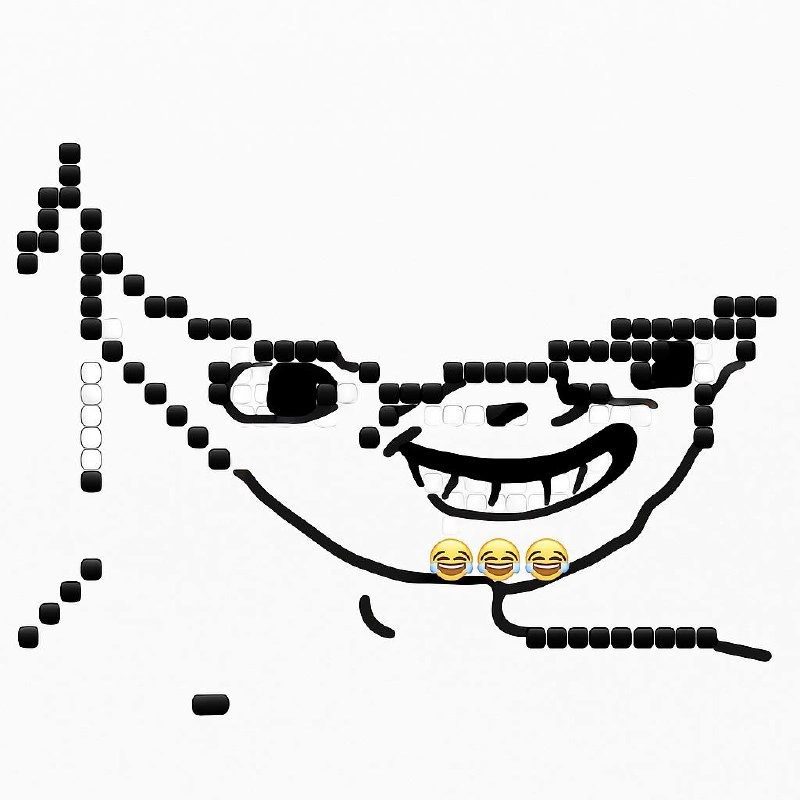
So instead of helpful text, the screen is filled with a big pixelated smiley face that’s laughing. It’s made out of text characters (imagine using lots of little Lego blocks to build a picture – here the blocks are letters or symbols). There are even some 😂 laughing emojis on it to make sure you know it’s cracking up. The whole joke is that the poor programmer just wants to do their work, but the computer is being cheeky and not cooperating, almost saying, “Haha, I won’t tell you what you want. Look at this funny face instead!” It’s a humorous way to show how sometimes computers give us nonsense when we expect sense. And even though it’s frustrating in real life, here we laugh because the computer acting like a goofy friend pulling a prank is a pretty funny idea. In simple terms: the computer basically went “LOL!” and showed a laughing face when it was supposed to be serious.

Level 2: Terminal Trollface

Let’s break down what’s happening in this meme in simpler terms. We have a command-line interface (CLI) environment – basically, the text-only terminal where developers run commands and see output logs. Instead of showing the expected log messages (you know, the usual dull but important info like “Server started on port 8080” or “Error: NullPointerException at line 42”), the terminal has displayed a big ASCII art picture of the “troll face” meme. ASCII art means creating pictures using the characters available on a standard keyboard (or extended symbol set). Here, the troll face’s mischievous grin, eyes, and chin are all made up of little black and white blocks as characters, arranged in a grid so that from a distance you recognize the face. It’s like digital mosaic art, but done with text symbols. The troll face is a very famous image in internet culture — a cartoony smiling face used to indicate someone is being a troll (intentionally messing with you or pulling a prank). Seeing that pop up in a place it doesn’t belong (like your error logs) immediately signals, “Haha, you’re being pranked!” or “the system is not taking you seriously right now.”

In front of the troll face’s chin, the image even added three 😂 laughing emojis (the “face with tears of joy” emoji). That detail drives home that the face is laughing at you. 🍕 Why emojis? Well, modern terminals can display Unicode characters (which include emojis), so it’s mixing old-school black-and-white text art with new-school colorful emoji icons. It’s a stylistic choice to emphasize laughter, basically giving the troll a literal laugh. It’s as if the terminal is saying, “I’m not just trolling, I find it hilarious!” This combination of ASCII blocks and emoji is unusual and absurd, which adds to the humor. In a normal scenario, you’d never put emojis in server logs, right? So this is really pointing out how wrong and out-of-place the whole thing is.

Now, why might a terminal print gibberish or weird symbols instead of proper text? One common reason is a text encoding mix-up. Encoding is how computers represent letters and symbols as bytes. If the program producing the logs and the terminal displaying them don’t agree on which encoding is in use, the output can look like random garbage characters. For example, imagine the program tries to print “Hello!” but the terminal decodes those bytes incorrectly – you might see something like “█▓▒░” (random block shapes) instead of letters. Those black squares we see in the troll face are actually valid text characters in certain encodings (like the extended ASCII or Unicode block elements). So an encoding slip means bytes intended to be letters might be interpreted as those block graphics. In other words, the computer mixed up the language for the text, and suddenly your log turned into illegible symbols. It’s like if you set your phone to the wrong language and all the menus turned into gibberish. Developers dread this because logs are crucial for figuring out what’s happening in an application; if they turn into art (pretty as it may be), you can’t do your job easily.

Another possibility (more fun, less likely) is an Easter egg or prank within a tool. In developer communities, there’s a tradition of hiding little jokes in programs (often harmless and hidden, triggered by specific input). A classic one is typing apt-get moo on some Linux systems – it doesn’t install a cow, but it prints an ASCII art cow saying a witty phrase. 🐮 This troll face could be something like that: maybe an inside joke left by a developer so that if a certain unlikely condition happens, the program prints a troll face instead of logs, just to break the tension. Or it could even be a real person’s doing – perhaps a colleague with a sense of humor who replaced the log output with a meme, just to see who notices. It’s not standard behavior by any means, but devs sometimes inject memes into their work (we’ve seen ASCII Nyancat in terminals, Star Wars in ASCII via telnet, or fancy banners made of text in app start-up logs). So this image is relatable because many of us have encountered or heard of such stunts.

Let’s clarify some of the key terms and context tags to make sure everything’s understood:

  • Terminal / CLI: This is the text-based interface where you type commands and the computer prints responses. Think of it as a chat with your computer using only text. No windows, no buttons, just text in and text out. Developers often use it to run programs or check logs because it’s very powerful and scriptable.

  • stdout: Short for “standard output”. It’s basically the default channel where a program sends its output text. If you run a script, whatever it prints normally goes to stdout (which in a terminal, means it shows up on your screen). In this scenario, instead of printing log lines to stdout, it printed the troll face art.

  • ASCII: Stands for American Standard Code for Information Interchange. It’s an old standard (from the 1960s) that assigns numeric codes to letters, digits, and some symbols. In ASCII, for example, 65 is A, 66 is B, etc. Extended ASCII (like code page 437 on old PCs) added extra symbol characters like those block shapes, card suits, smiley faces, etc., by using the values 128-255. Nowadays we use Unicode (like UTF-8 encoding) to cover thousands of symbols and emoji, but the basic ASCII characters (0-127) are still the foundation. When we say ASCII art, we mean making pictures using those text symbols. Artists use characters like # or O or _ carefully placed on a grid to draw outlines and shading. In our meme, the “blocks” are likely special block characters (like and ) which are part of the extended ASCII or Unicode set, often used to create pixel-like images in text.

  • Troll face meme: This is an image of a goofy, grinning face used in memes to represent someone who is trolling (which means intentionally provoking or tricking people online for amusement). The face has a big toothy grin, wrinkled cheeks, and a knowing expression. In internet forums, if someone made an outrageous comment just to stir things up, people might reply with that face to say “you’re just trolling us.” It became one of the most famous meme faces. Seeing it pop up anywhere basically communicates “Gotcha!” or “I did it just to annoy you.” For a developer, having this show up in your error logs is like the computer itself saying “Gotcha! I’m messing with you.”

  • Pixel/block art: The troll face in the image is described as “blocky ASCII” art. That suggests they used block elements (solid squares) as pixels to draw a larger picture. It ends up looking very chunky, almost like a Minecraft version of the troll face, all rectangles and squares, no smooth lines. This style is reminiscent of old printers or old computer graphics where everything was pixelated. It also reminds of BBS art, where users on Bulletin Board Systems (text-based online communities from the pre-internet and early internet days) created elaborate pictures using just the text characters available. That was a big thing in the 80s and early 90s. They had to be creative with characters like |, /, \, _, and special symbols to make pictures of dragons, logos, or yes, faces. So what we’re seeing is a deliberate homage to that style – or a glitch that accidentally mimicked it.

  • stdout_garbage_output (context tag given): This basically means “garbage output to standard output.” It’s when a program prints nonsense characters instead of useful text. Usually caused by either a bug, printing binary data by mistake, or encoding issues as mentioned. It’s literally treating the troll face art as if it were garbage output. In truth, to get a perfect troll face, it was likely intentionally crafted output (the term garbage here is part of the humor — from the system’s perspective, it’s unexpected junk).

Now, put yourself in a developer’s shoes. You’re deploying some code or running a script, and you expect to see maybe a bunch of lines detailing what’s happening (like “Connecting to database... Migration complete... etc.”). Instead, the whole terminal screen turns into this huge monochrome troll face picture laughing at you. You’d probably double-take: Did I open the wrong program? Is this a joke application? Did I get hacked by meme-loving hackers? The immediate reaction is confusion, then realization of the prank or error, and then (once you know it’s not truly harmful) a bit of laughter or at least an exasperated sigh. It’s a very relatable humor moment among developers because many have experienced their tools outputting something utterly unexpected. Maybe not a troll face specifically, but for example: a compiler that prints a funny quote as an error message, or a test suite that shows a little ASCII rocket ship when all tests pass. These things actually happen! There’s a long tradition of these hidden gems.

However, usually those gems appear deliberately. A pure accident resulting in a coherent image is extremely unlikely (that’s part of why it’s funny — it’s so absurdly improbable). So the meme likely implies someone (the “terminal” or rather the program) slipped up, as in it mistakenly or mischievously printed this face. It’s anthropomorphizing the terminal: “the terminal slips up” – as if the terminal itself goofed and output a meme by accident. We know in reality it’d be the program or script’s fault or a dev’s Easter egg. But we play along with the idea that the console has a mind of its own and is a bit of a troll. This is humorous because we don’t expect our serious tools to have a sense of humor. When they seem to, it catches us off guard.

Finally, consider why it’s specifically blocky and ASCII. If a terminal is going to misbehave and draw a picture, ASCII or text art is the only way it can do it (since terminals generally deal in text, not arbitrary graphics). It also taps into nerd nostalgia: many devs recall making or seeing simple ASCII smiley faces, or the classic “¯\(ツ)” shrug emoticon in chats. The troll face ASCII is like a mega-version of that – an advanced “drawing” made of characters. It resonates because it merges the technical (terminal output, encoding) with the cultural (internet troll meme). A junior dev might just be learning about how logging works, how encoding issues can cause weird output, and they likely know the troll face from internet culture. This meme ties those together in a single visual joke. It basically screams: “When your tool is supposed to give you logs but instead gives you attitude.” And if you’re new in the field, it’s both a funny image and a little heads-up: terminals can and will surprise you, sometimes in hilarious ways!

Level 3: Ghost in the Shell Script

At first glance, seeing a Terminal spew out a perfectly rendered ASCII troll face instead of the usual log lines feels like a repository of inside jokes exploded onto your screen. This is deep TerminalHumor that blends old-school tech quirks with MemeCulture. It’s the kind of absurd mishap seasoned developers swap war stories about: “Remember that 2 AM deploy when the server logs turned into a meme?” The humor here comes from the idea that the system itself is trolling you – as if your shell prompt became sentient and decided to have a laugh. The classic troll face (with its mischievous grin and eyes) is an emblem of internet pranks; rendered in chunky pixelated blocks on a console, it’s like the computer literally saying “Problem?” when you expected serious data.

Technically speaking, this scenario pokes fun at how fragile text output can be. One stray byte or an encoding mix-up and your neatly formatted logs can devolve into stdout garbage output that looks like alien glyphs. In the best case, those gibberish characters accidentally align into something recognizable – here, the notorious trollface. It’s a comedic exaggeration of real-world bugs where logging output gets corrupted: maybe a misconfigured character encoding, or piping binary data to the terminal by mistake. Seasoned devs have seen it all: UTF-8 vs ASCII mix-ups, null bytes spawning blank squares, or ANSI escape codes painting funky shapes. In ancient times (circa BBS and dial-up), sending control codes to a terminal could literally redraw the screen – hijacking a session with ASCII art was a known prank. This meme riffs on that heritage: the CLI has always been both powerful and prone to creative fail states. A late-night deployment can feel like an uphill battle in itself; toss in a terminal that suddenly prints a laughing meme, and you’ve got the perfect storm of confusion and dark comedy.

From an architectural perspective, it’s also a cheeky nod to how DevCommunities hide Easter eggs in tools. Many Linux old-timers remember typing apt-get moo for a hidden ASCII cow or using utilities like cowsay to have a cartoon ASCII cow speak their message. The troll face showing up unbidden in logs is like the ultimate Easter egg – except you didn’t ask for it. Is it a rogue library author with a sense of humor? A hacker who replaced your logs with memes? Or just the universe pulling a one-in-a-billion glitch? Experienced devs recognize that feeling when a system’s behavior is so off-the-wall that the only reasonable response is nervous laughter. It’s relatable humor because we’ve all stared at a terminal thinking, “Is this thing laughing at me right now?”

To put it in context: logs are supposed to be the truth, the boring, structured output that tells you what’s going on under the hood. When that sacrosanct output becomes an art canvas for a troll face, it inverts the expectation completely. It’s the absurd juxtaposition that tickles the seasoned engineer’s funny bone. We expect maybe a stack trace or at worst a Unicode decode error – not an iconic meme mug grinning back at us. It’s a reminder that computers do exactly what we tell them (or what we accidentally told them), and sometimes the results border on the surreal. A senior dev might chuckle at the implied backstory: perhaps some junior dev left a “troll mode” flag on in the logging framework as a prank, or maybe an encoding error mapped log bytes to Unicode block characters, producing an accidental masterpiece. In any case, it’s a scenario that brilliantly lampoons the chaos of debugging under pressure. As the saying goes in ops circles, “whatever can go wrong will go wrong” — and apparently that includes your machine literally laughing at your misery during a deploy.

Let’s illustrate the absurdity with a pseudo-log excerpt. Imagine running your deploy script and getting this:

$ ./deploy.sh
[INFO] Starting deployment...
[INFO] Loading configuration...
( ͡° ͜ʖ ͡°)    <-- Trollface ASCII art suddenly appears here, grinning from your terminal
ERROR: Unexpected output format in logs.

👆 Here our friendly ( ͡° ͜ʖ ͡°) (a classic text-emoticon with raised eyebrow) stands in for the troll face ASCII art. In a real incident, it might have been many lines of black-and-white block characters forming that devious grin. Senior engineers see this and simultaneously facepalm and smirk, because it captures that WTF moment every dev eventually experiences. The system going off-script in a spectacularly unhelpful way is both the bane of our existence and the kind of thing you screenshot to share on Slack later. It’s the machine equivalent of a whoopee cushion prank – juvenile, untimely, but undeniably funny when it isn’t happening to you.

On a more serious note (spoken like a true Tech Historian), this meme also pays homage to the lineage of ASCII art in programming culture. Long before GPUs and high-res displays, developers crafted images out of text in terminals. Blocky faces, pixelated logos, and elaborate scene drawings made of characters were a staple of 1980s BBS art and early internet forums. The troll face itself is a more modern meme (born around 2008), typically a graphic image on the web – but here it’s rendered in a retro medium, connecting two eras of DeveloperHumor. It’s as if the ghost of the old ASCII art era is manifesting in a contemporary meme form, right in your console. The inclusion of actual 😂 emojis for the goatee is the cherry on top: a mashup of Unicode-era expression with ASCII artistry. It’s a wink to how far terminals have come – from green-on-black text only, to now even supporting colorful emoji characters. We’ve gone from :-) to 🎉 in our console outputs. Yet, as this meme jokes, even with all that progress, a simple misprint can still reduce us to deciphering a pixel_block_art face in our logs at 3 AM. Plus, those 😂 emoji hint that the computer is not just trolling you silently – it’s literally crying with laughter. Ouch.

In summary, at this level we’re appreciating the meme’s layered nods: the technical absurdity of an encoding mishap, the shared exasperation of late-night on-call duty, and the rich prankster streak running through programmer culture from ASCII art to today. It’s a reminder that sometimes our carefully engineered systems throw us curveballs so ridiculous, all we can do is meme about it. And trust me, nothing bonds a dev community quite like collectively feeling “attacked” by a cheeky piece of software misbehavior. This image captures that sentiment in one trollish grin.

Description

The image shows the classic internet 'troll face' rendered entirely out of small black and white square blocks, giving it a chunky pixel-art or ASCII-art aesthetic on a stark white background. The blocks outline the mischievous eyes, raised brows, wide grin, and even the chin of the character, with three 😂 emojis positioned where a goatee would be, emphasizing the laughter. No other text is present; the whole composition feels like something a misbehaving shell script might dump to stdout. For developers, it evokes memories of terminal-based doodles, BBS art, and those times an encoding slip turned log output into abstract glyphs. The minimalist, monochrome grid underscores how little it takes to hijack a console and the cognitive load of parsing “what just happened?” during a late-night deploy
Comments

6
Anonymous ★ Top Pick Proof that one stray printf("\x9b") can turn your production logs into a full-stack troll
  1. Anonymous ★ Top Pick

    Proof that one stray printf("\x9b") can turn your production logs into a full-stack troll

  2. Anonymous

    When you've been running a Bitcoin node since 2013 and finally explain to your team why your "distributed consensus mechanism" for choosing lunch spots is just everyone waiting for you to decide anyway

  3. Anonymous

    The classic deployment confidence curve: starts at 100% ('this code is perfect'), crashes to -273.15°C ('absolute zero confidence') the moment you hit deploy, then slowly climbs back as your monitoring dashboards stay green and the PagerDuty silence becomes deafening. That trollface? That's you at 3 AM realizing the deploy actually worked and you can finally unclench

  4. Anonymous

    Nothing says code ownership like a UTF-8 trollface labeled ‘whitespace fix’ - it passes CI, wrecks the diff viewer, and becomes your design system

  5. Anonymous

    When your 'temporary' shared mutable state in the actor model finally deadlocks the entire cluster - just as the CTO demos it

  6. Anonymous

    Looked pixel-perfect in iTerm; then Slack treated 😂 as double‑width and GitHub didn’t, so my ASCII banner became our cross‑platform compatibility test

Use J and K for navigation