Skip to content
DevMeme
1038 of 7435
Government says WFH, junior dev starts cooking spaghetti like production code
RemoteWork Post #1168, on Mar 24, 2020 in TG

Government says WFH, junior dev starts cooking spaghetti like production code

Why is this RemoteWork meme funny?

Level 1: Cooking Up Confusion

Imagine your teacher says, “Alright everyone, you have to do your schoolwork at home now.” That means you’re supposed to take your books and homework and do them in your room or at your desk at home, right? But now picture a kid who hears this and goes, “Work from home? Okay!” and then immediately runs to the kitchen, grabs some spaghetti noodles, and starts making a huge pot of pasta instead of doing their homework. Pretty silly, huh? That’s exactly the kind of mix-up this picture is joking about!

In the image, the boss (or the government) is essentially saying to a worker who is a computer programmer, “Please do your programming job from your house.” But the young junior programmer in the picture completely misunderstands. Instead of sitting down at his computer to write programs, he’s happily standing in his home kitchen cooking spaghetti for lunch, as if that is his job now. It’s like he thought “work from home” meant “do housework or cook because you’re at home.” Oops!

Why spaghetti? Well, there’s a funny saying in coding: if someone writes a computer program that’s all tangled and messy, people call it “spaghetti code.” It’s just a nickname – because messy code can look like a bunch of tangled spaghetti noodles in a bowl. So in this joke, the newbie coder’s work was probably as messy as spaghetti to begin with. Now that he’s working at home, the meme is cheekily showing him making actual spaghetti. It’s a play on words and situation: he’s literally doing what his messy code only figuratively resembled.

The humor is really about confusion and taking things too literally. The big laugh comes from the obvious mistake: everyone knows “work from home” means do your normal work, just not in the office. So seeing someone start cooking pasta instead is out-of-place and ridiculous. It’s as if a kid was told to do a school project at home about Italy, and he just started boiling noodles because he heard “Italy” and thought of pasta. We’d chuckle because he missed the whole point.

This meme makes people in the tech world laugh because they remember how weird it was when everyone suddenly had to work from home, and they also love joking about “spaghetti code.” But even if you’re not a programmer, you can find it funny: it’s a classic silly image of someone completely misunderstanding an instruction. The junior developer in the kitchen is basically saying, “Hey, I’m working from home, see? I’m making spaghetti!” — while the rest of us are like, “No, no, that’s not what we meant!” It’s light-hearted, relatable comedy about the chaos of suddenly working at home and the clumsy mistakes beginners can make.

Level 2: Coding in the Kitchen

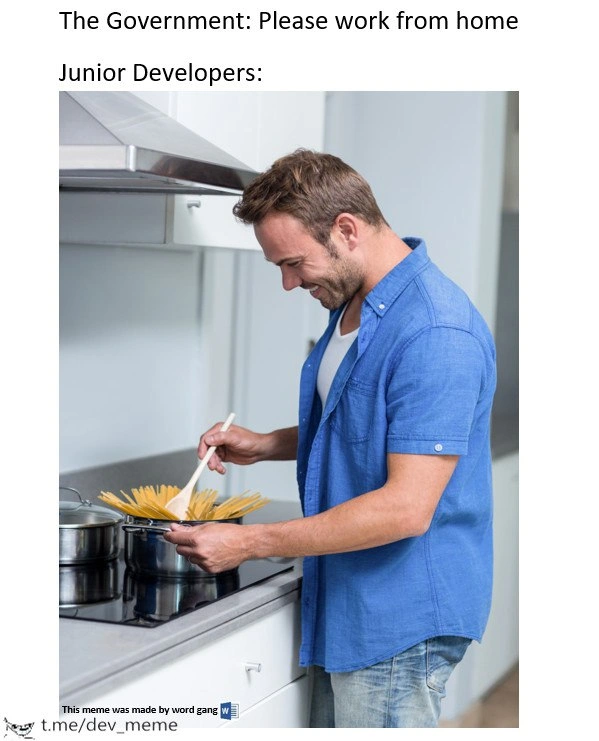
This meme shows a two-part caption and an image that play on the idea of Work From Home (WFH) and “spaghetti code.” The top text says, “The Government: Please work from home,” which refers to an official instruction (for example, during COVID-19 lockdowns) telling everyone to do their jobs remotely instead of going to the office. The next line says, “Junior Developers:” followed by a photo of a smiling young man in his kitchen stirring a pot of spaghetti. The humor comes from imagining that a junior developer (a beginner programmer) hears “work from home” and responds not by opening his laptop to write code, but by literally working in the kitchen cooking spaghetti!

Why spaghetti? In programming slang, “spaghetti code” is a term for code that is very messy and tangled. Picture a big bowl of cooked spaghetti noodles – they twist and turn everywhere, and it’s hard to follow one strand from start to end. Spaghetti code is just like that: it’s code with a structure that jumps all over the place, maybe with lots of GOTO statements or poor organization, so that reading it feels like untangling spaghetti. This term is often associated with beginners or unstructured programming from the old days. Junior developers, who are still learning good design and best practices, sometimes end up writing code that’s all mixed up – not intentionally, but because they haven’t yet learned how to organize it. Seasoned developers and team leads often use “spaghetti code” as a gentle tease or criticism when a piece of software has no clear architecture (for example, when functions call each other in confusing ways, or there’s a tangle of dependencies).

Now, the meme literally puts spaghetti in the junior dev’s hands. The young man in the image is standing in a modern home kitchen, stirring a pot with dry spaghetti sticking out. It’s a silly literal interpretation: instead of writing messy code, the junior dev might be cooking a messy meal. The idea is that the junior took “Please work from home” the wrong way. Rather than coding from his home office or laptop, he’s doing a home activity – cooking – as if that counts as his “work.” It’s like he thought, “Well, I usually make spaghetti code at work, so if I’m working from home, I guess I should make spaghetti here too!”

This joke also reflects how the sudden shift to remoteWork during the pandemic could be confusing for those not used to it. In March 2020, a lot of junior devs were right out of college or in their first job, and suddenly they had to work alone at home without direct supervision. Some might have felt a bit lost or too relaxed. The meme exaggerates this: imagine a new developer who, without the office environment to guide them, ends up doing something completely off-task like cooking a meal during work hours, thinking that’s okay. Remote_work_misinterpretation is the theme – mixing up the idea of being physically at home with being free to do home chores instead of actual job tasks. Of course, in reality, companies expected employees to continue coding, just from a home computer. But the meme plays with the scenario, pretending a naive newcomer might not get the nuance.

Let’s break down all the elements:

  • “The Government: Please work from home” – This sets up the context. It’s basically saying, "Authorities want you to do your job from your house." This was common during COVID-19 lockdowns, where staying home was required for safety.
  • “Junior Developers:” – This introduces a response or reaction specifically by junior developers. In meme format, it’s implying “Here’s how junior devs react to that instruction.”
  • Image of man cooking spaghetti – This is the punchline. The junior dev’s “reaction” shown by the image is absurd: he’s treating cooking spaghetti as if it’s his work-from-home duty. The spaghetti itself is sticking upright out of the pot, uncooked and chaotic, visually reinforcing the idea of disorganization. It’s a stock photo (you can tell by the staged kitchen and the generic pose). The man’s face is blurred probably to anonymize him, but you can still see he’s smiling, looking into the pot like he’s proud of what he’s doing. The body language says, “I’ve got this!” which is funny because we (the viewers) know he’s totally off-track.

The combination of text and image makes a coding_humor joke:

  • It references remote work (WFH) culture, which all developers experienced strongly in 2020.
  • It taps into the junior vs senior developers dynamic – seniors often jokingly blame juniors for messy code (spaghetti code). Here juniors are the butt of the joke, shown as misunderstanding instructions.
  • It uses a literal object (spaghetti pasta) to represent a figurative concept (spaghetti code). This literal interpretation is key to the humor.

There’s also a little footer text on the meme that says, “This meme was made by word gang” with a tiny Microsoft Word logo and a link (t.me/dev_meme). This is basically a watermark or credit from the meme creators. It tells us which group or channel made the meme (likely a Telegram channel named “dev_meme”). The Word icon suggests they might have even used MS Word to lay out the text for the meme – which is a quirky, playful detail but not really part of the joke’s meaning. It’s more of an easter egg showing the meme’s origin.

In summary, the meme is funny to developers because it blends a real-world situation (WFH orders during the pandemic) with a well-known programming in-joke (spaghetti code). It paints a picture of a rookie developer who is so clueless or literal that when he’s told to work from home, he just starts doing something homey (cooking spaghetti) instead of actually coding. And the spaghetti itself reminds everyone of the kind of tangled code that gives programmers headaches. If you’re new to programming, don’t worry – writing clean, well-structured code is a skill you build over time. The joke here is knowingly exaggerating how juniors code, for comedic effect. The takeaway: “Working from home” still means working – not making pasta – and please try not to let your code turn into a spaghetti mess! 😉

Level 3: Pasta Overflow

At first glance, this meme mashes together a pandemic_work_directive with classic programmer jargon, creating a perfect storm of inside humor. In early 2020 many governments told employees, "Please work from home," and overnight remote work became the norm. Here, that serious directive is contrasted with a goofy junior_dev_stereotype: a novice developer cheerfully cooking a pot of spaghetti in his kitchen. For seasoned engineers, the punchline operates on multiple levels: not only is the junior literally working from his home kitchen, he’s literally making spaghetti, alluding to the dreaded spaghetti code that juniors famously produce. This is a spaghetti_code_reference taken to its extreme: the developer’s work product has metaphorically become a cooking project!

For experienced developers who’ve slogged through tangled legacy systems, the sight of uncooked noodles sticking out in disarray from the pot is a hilarious visual metaphor. It evokes the memory of codebases where functions and modules are so interwoven that following the logic feels like tracking one noodle in a bowl of pasta. The image of the junior happily stirring that chaos is both absurd and painfully familiar. It hints at the unspoken truth in many code reviews: sometimes a newbie’s code is such a mess, you suspect they "cooked it up" without a recipe. The meme is basically saying: “We told you to do your coding job at home, and look – our junior dev interpreted that as cooking spaghetti, just like the code they write!” 😂

This humor resonates strongly in the developer_humor realm because it satirizes real industry patterns. When the 2020 WFH orders hit, companies suddenly had first-year developers trying to be productive from bedrooms and kitchen counters. Mentors and senior engineers recall the remote_work_misinterpretation moments – a junior might log into the daily standup from their kitchen, or check in code that felt half-baked because they struggled without in-person guidance. The kitchen_office_mixup in the meme exaggerates these experiences: it’s the ultimate home-office confusion, with the developer treating the kitchen stove as his workstation. This plays on the junior vs senior developers trope: a junior developer might lack the structured approach of a senior, so much so that given free rein at home, their workflow slides into chaos (or, in this case, into a pasta pot).

There’s also a tongue-in-cheek nod to software quality. Spaghetti code has a specific meaning: it’s a pejorative term for code that’s poorly structured, tangled in logic knots, and difficult to maintain – just like a heap of cooked spaghetti. When seniors encounter such code, they often joke that the developer must have thrown all best practices against the wall to see what sticks (like throwing spaghetti to test if it’s done 🍝). Seeing a junior literally working with spaghetti implies “his code was already a spaghetti disaster, so hey, why not make dinner out of it?” This is tech_humor at its finest: mixing coding metaphors with everyday objects to highlight the absurdity. It’s the same kind of laugh we get when someone says “my code is held together by duct tape” and a meme shows a PC literally wrapped in tape. Here, code quality becomes food quality. A senior dev might quip, “At least you can debug a pot of pasta by tasting it – debugging spaghetti code is far less enjoyable!”

Another subtle detail is the watermark: “This meme was made by word gang” with a Microsoft Word icon. This little footer (t.me/dev_meme) hints that the meme itself might have been cobbled together in an unconventional way – perhaps literally made in Word. It’s a light meta-joke for observant viewers: using a productivity tool not intended for image editing to create a meme is like writing code in a word processor – an amateur move that a junior might do. The word_gang_watermark quietly complements the theme: it’s an artifact of low-budget, home-made meme creation, analogous to a junior dev’s quick-and-dirty coding approach. Senior engineers smirk at that too, because it’s yet another layer where the execution is slightly off in a knowingly funny way.

In essence, this meme captures a 2020 moment in programmer culture: the collision of RemoteWork life with the learning curve of junior developers. It’s poking fun at how literal and unstructured things can get. The government said “take your work home,” and our rookie dev heard “cook up something at home.” The result? Pasta Overflow – a situation boiling over with comedic misinterpretation, much like a pot of spaghetti left unattended. Experienced devs laugh (and maybe groan) because they’ve been there: whether it’s untangling a coworker’s code or dealing with the quirky realities of working from a makeshift home office, they recognize the flavor of this joke all too well.

Description

The meme sits on a white canvas with two bold black captions: "The Government: Please work from home" followed by "Junior Developers:". Beneath the text is a stock image of a young man, face blurred, wearing a blue short-sleeve shirt in a modern kitchen, stirring a pot full of uncooked spaghetti that sticks out awkwardly above the boiling water. A small footer watermark reads "This meme was made by word gang" with a Microsoft Word icon and the link "t.me/dev_meme". Visually it literalizes the phrase "work from home", suggesting beginners misunderstand remote-work culture, while the spaghetti alludes to the messy "spaghetti code" juniors are infamous for shipping. The humor resonates with engineers who lived through pandemic remote mandates and have mentored first-year devs trying to stay productive at home
Comments

6
Anonymous ★ Top Pick Remote stand-up: junior says he’s “cooking spaghetti”; translation for the seniors: 3,000-line cookSpaghetti() pushed straight to main, sprinkled with catch(Exception) like parmesan - bon appétit, prod
  1. Anonymous ★ Top Pick

    Remote stand-up: junior says he’s “cooking spaghetti”; translation for the seniors: 3,000-line cookSpaghetti() pushed straight to main, sprinkled with catch(Exception) like parmesan - bon appétit, prod

  2. Anonymous

    Meanwhile, senior devs are in their third meeting explaining why the junior's "quick refactor" during lunch broke prod and why we can't just "roll back the spaghetti code."

  3. Anonymous

    Ah yes, the classic junior dev work-from-home stack: Node.js for the backend, React for the frontend, and al dente for the pasta. While senior engineers are debugging distributed systems across three time zones, juniors are discovering that 'boiling water' is the only deployment that consistently works on the first try. At least when the pasta throws an exception, you can just drain it and start over - unlike that production incident from last week that's still in the postmortem phase

  4. Anonymous

    Juniors on WFH: treating tickets as async promises - low priority, easily rejected for that blocking stove I/O

  5. Anonymous

    WFH translation: when a junior says they’re “cooking a quick POC,” assume the Strangler‑Fig will be your colander for the spaghetti that ships to prod

  6. Anonymous

    WFH update: the junior shipped a spaghetti monolith, swears it’s layered architecture - CI/CD now means Cook Immediately/Consume Daily

Use J and K for navigation