Skip to content
DevMeme
177 of 7435
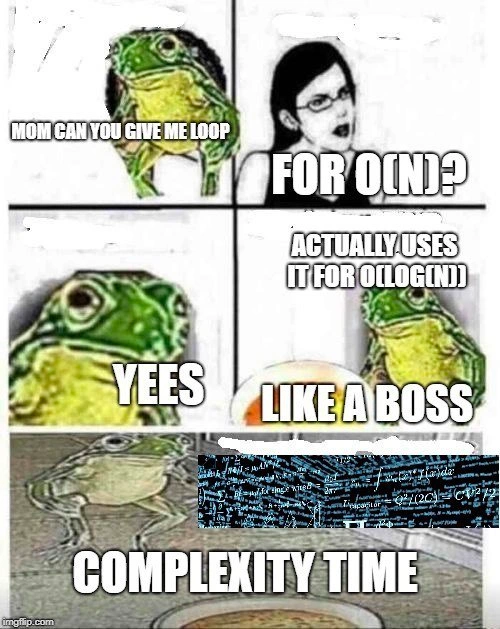
Frog kid requests O(N) loop, secretly rocks O(log N) like a boss
CS Fundamentals Post #217, on Mar 10, 2019 in TG

Frog kid requests O(N) loop, secretly rocks O(log N) like a boss

Why is this CS Fundamentals meme funny?

Level 1: Finding a Word in the Dictionary

Imagine looking for the word "penguin" in a dictionary. One way: start at page one and read every single word until you find it — that could take all day. The smarter way: open to the middle, see you're at "M," realize "penguin" comes later, and ignore the entire first half instantly. Keep splitting like that and you'll land on it in a dozen flips. The frog in this meme asked its mom for permission to do it the slow way, then did it the clever way instead — like a kid who asks for help with homework and secretly finishes it brilliantly alone. The joke is the proud little "like a boss" swagger over something deeply nerdy: being efficiently lazy is a programmer's highest honor.

Level 2: What O(n) and O(log n) Actually Mean

Big O notation describes how an algorithm's running time grows as its input grows — not how fast it is in seconds, but how badly it scales. O(n) ("linear time") means the work grows in direct proportion to input size: checking every item in a list, one by one, like a basic for loop. O(log n) ("logarithmic time") means each step eliminates half of what's left, so even huge inputs need few steps. The textbook example is binary search: to find a name in a sorted phone book, you open to the middle, decide which half the name is in, and repeat — you never read every page.

# O(n): visits every element
def find_linear(items, target):
    for i, x in enumerate(items):
        if x == target:
            return i

# O(log n): halves the search space each pass
def find_binary(items, target):  # items must be sorted!
    lo, hi = 0, len(items) - 1
    while lo <= hi:
        mid = (lo + hi) // 2
        if items[mid] == target:
            return mid
        elif items[mid] < target:
            lo = mid + 1
        else:
            hi = mid - 1

The early-career rite of passage this meme winks at: discovering your code that worked fine on 100 test rows takes minutes on a million real ones — and that the fix wasn't a faster computer, it was a smarter loop. That's "COMPLEXITY TIME": the moment you start judging code by its growth curve, not its line count.

Level 3: Under-Promise, Over-Deliver, Amphibian Edition

The four-panel structure is the classic "Mom, can we have X?" stuffed-frog template, and the dialogue maps perfectly onto a real engineering dynamic. The frog asks:

"MOM CAN YOU GIVE ME LOOP" — "FOR O(N)?" — "YEES"

…and then, per the caption, "ACTUALLY USES IT FOR O(LOG(N))LIKE A BOSS". It requested a humble linear loop and quietly delivered logarithmic performance. Anyone who's done code review recognizes the inverse far more often: the function that claims to be a quick lookup but hides a nested loop, turning a hot path quadratic the moment the dataset outgrows the test fixture. A loop that discards half its remaining work each iteration — the binary-search pattern of lo, hi, and midlooks like any other while loop, which is exactly the meme's sleight of hand: same syntax mom approved, radically different asymptotics.

The deeper satire is about how the industry treats Big O notation itself. It's the lingua franca of whiteboard interviews and the first thing forgotten in production, where a "temporary" SELECT * filtered in application code outlives three reorgs. Teams cargo-cult complexity talk ("this is O(1), basically") while shipping Array.prototype.includes inside a .map. So a frog that asks permission for O(n) and ships O(log n) is genuinely aspirational engineering: it's the only recorded instance of an estimate being beaten. The broken-English delivery ("YEES") and the imgflip watermark just add the appropriate level of gravitas for discussing asymptotic analysis — which is to say, none, which is the point. Complexity theory is one of the few genuinely deep things in CS, and the internet's chosen vessel for it is a crudely cut-out stuffed frog.

Level 4: Why Halving Beats Walking

The frog's upgrade from O(n) to O(log n) isn't just a bigger number on a benchmark — it's a different mathematical universe. A logarithm answers the question "how many times can I halve this before reaching one?" — formally, $log_2(n) = k$ where $2^k = n$. The practical consequence is staggering: a linear scan over a billion items takes a billion steps; binary search over the same sorted billion takes about 30. Double the input and the linear loop doubles its work, while the logarithmic one adds exactly one extra step. That's why every serious data structure for lookup — B-trees in databases, balanced BSTs, skip lists — is engineered around guaranteed halving.

There's also a hard floor here, which is what makes the frog's flex legitimate rather than lucky: comparison-based search over $n$ unordered possibilities provably needs $\Omega(\log n)$ comparisons, because each yes/no comparison can at best split the remaining candidate set in two — a decision tree distinguishing $n$ outcomes must have depth at least $\log_2 n$. The frog didn't just find a faster loop; it hit the information-theoretic speed limit. The dense blue wall of formulas in the final panel ("COMPLEXITY TIME") is the visual shorthand for this whole field — recurrences like $T(n) = T(n/2) + O(1)$, solved via the Master Theorem, collapsing into that elegant little $\log$.

Description

Multi-panel meme with a green frog character speaking to a blurred mother figure. Top-left panel text: "MOM CAN YOU GIVE ME LOOP"; top-right panel replies "FOR O(N)?". Second row left shows a zoomed frog proudly saying "YEES", while the right panel captions "ACTUALLY USES IT FOR O(LOGN)" with the smaller overlay "LIKE A BOSS" near a bowl of soup. The final wide panel shows a lounging frog overlaid on dark code/math scribbles, emblazoned with "COMPLEXITY TIME". The joke contrasts an expected O(N) loop with a more efficient O(log N) implementation, poking fun at algorithmic time-complexity bragging familiar to developers and CS students

Comments

7
Anonymous ★ Top Pick Sure, brag about your O(log N) loop - meanwhile the senior on-call is noting N never gets past the cache line and the real bottleneck is the synchronous I/O you left inside it
  1. Anonymous ★ Top Pick

    Sure, brag about your O(log N) loop - meanwhile the senior on-call is noting N never gets past the cache line and the real bottleneck is the synchronous I/O you left inside it

  2. Anonymous

    Successfully optimized the algorithm to O(log n), then spent three weeks explaining to the team why the binary search tree with self-balancing red-black properties was worth the 500 lines of rotation logic that nobody wants to maintain

  3. Anonymous

    Asking for O(n) and delivering O(log n) is the only known case of a developer under-promising on an estimate - naturally it happened to a frog, not in your sprint

  4. Anonymous

    The real power move isn't just optimizing from O(N) to O(log N) - it's doing it so subtly that code reviewers don't notice you've essentially replaced their linear search with a binary search until the performance metrics come in. Though let's be honest, the truly senior move is recognizing when O(N) is perfectly acceptable and not spending three days optimizing an algorithm that runs on a dataset of 10 items

  5. Anonymous

    Flexes O(N!) in sprint planning like a boss, ships O(log N), then spends retro proving it's not secretly O(N²) at scale

  6. Anonymous

    We optimized the loop to O(log n); prod replied with n ~ 40 and the real bottleneck being cache misses and syscalls - Big-O is for slides, constants are for pagers

  7. Anonymous

    Nothing says senior like writing a binary search and hiding a database call in the comparator - O(log n) on the whiteboard, O(n·latency) in prod

Use J and K for navigation