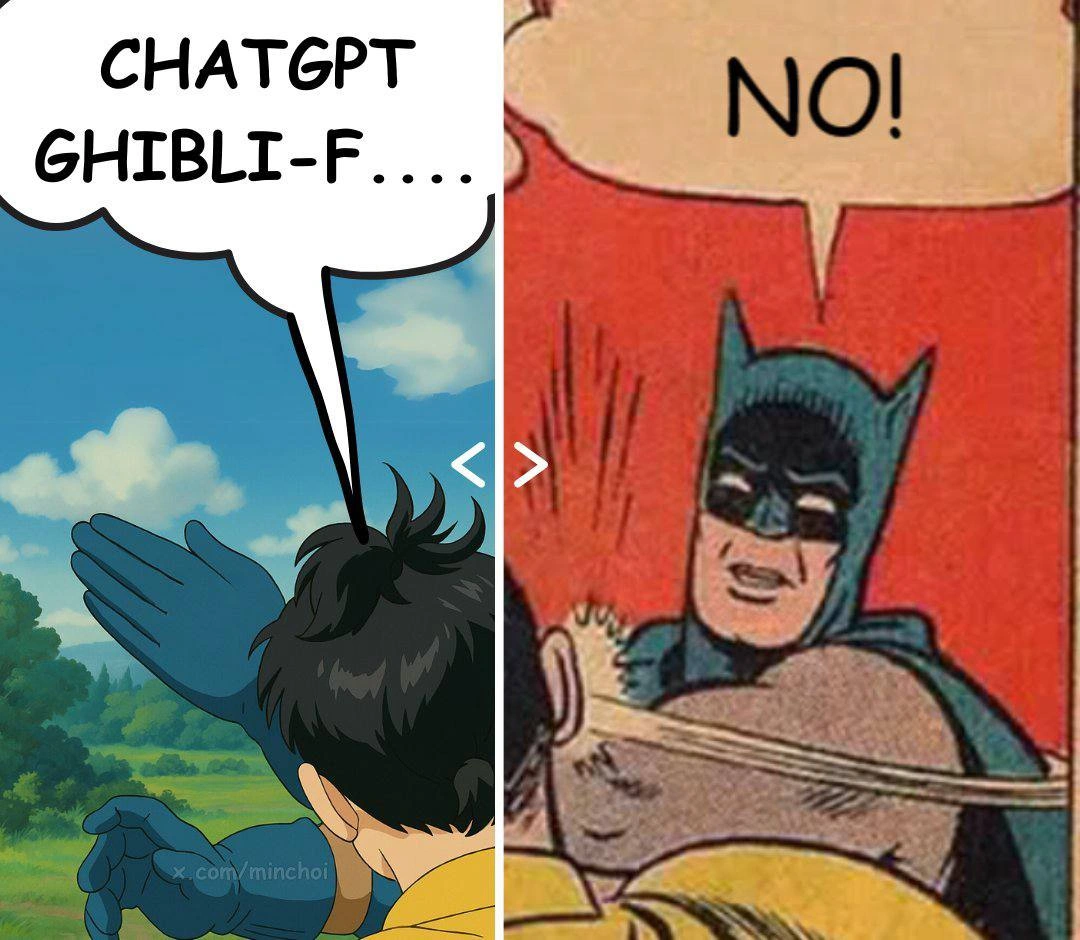
ChatGPT reaches for a Ghibli filter, policy Batman intervenes
Why is this AI ML meme funny?
Level 1: Batman Says No
Imagine you’re really excited to copy a drawing style from your favorite cartoon movie. You start to draw or ask a computer helper to do it, and you’re like, “Let’s make it look just like that beautiful Ghibli movie!” But suddenly, Batman (yes, the superhero) jumps in and shouts “NO!” while stopping you with a slap. 😮 It’s a funny picture because it’s so exaggerated. It’s like a strict teacher or parent catching you trying to do something that’s not allowed and instantly putting a stop to it in a super dramatic way. In real life, there are rules about copying art styles and characters. The meme is joking that whenever we try to get the AI (like ChatGPT) to create something in a special famous style, a strict rule-enforcer (dressed as Batman in the joke) will appear and say “No, you can’t do that!” It’s amusing because you don’t normally think of Batman as a librarian or a lawyer, but here he is acting like one, protecting the rules. So the picture makes us laugh at how the poor ChatGPT (or the user) gets a big “no-no” slap when it was just trying to do something cool. It’s basically showing a fun idea being stopped by a big rule, in a way that even a cartoon fan or a kid can understand – Batman stopping Robin from doing something, just like a rule stopping our fun request.
Level 2: Miyazaki Meets Moderation
Breaking it down, this meme is referencing a conflict between creative AI output and strict rules. Let’s go over the key parts. First, ChatGPT: this is a popular AI model (an example of a Large Language Model, or LLM). It usually works with text, but by 2025 many people use “ChatGPT” loosely to mean a whole AI assistant that might handle text, images, etc., with different plugins or filters. Here, the meme shows “ChatGPT Ghibli-f….” as if ChatGPT is about to apply a Studio Ghibli filter. Studio Ghibli is a famous Japanese animation studio co-founded by Hayao Miyazaki, known for movies like My Neighbor Totoro, Spirited Away, and Howl’s Moving Castle. When people say “Ghibli style,” they mean those movies’ distinctive hand-drawn, warm, detailed cartoon look – think lush landscapes, cute round spirits, and that nostalgic feel. It’s a style many artists and fans adore, so of course folks playing with AI image generators often try prompts like “in Ghibli style” to get that same aesthetic.
Now, why might that be a problem? Copyright and trademarks. Companies like Studio Ghibli likely have protections on their characters and possibly even on the use of their name or specific artistic assets. While an art “style” per se is a gray area in copyright law (you can’t copyright an art style in abstract, only specific expressions), big firms are very cautious. They don’t want their AI tool to be seen as ripping off or cloning a living artist’s work without permission – that’s bad press and could invite lawsuits or at least angry artists. So, AI providers implement a content policy. This is essentially a rulebook for the AI: things it’s not allowed to produce or help with. Common disallowed items are obviously harmful stuff (hate speech, violence, etc.), but also often include copyrighted material. For example, OpenAI’s policies have sections about not producing copyrighted images or lengthy text quotes, and not using the tool to imitate identifiable individuals’ art or writing. “Studio Ghibli” falls under that umbrella as a well-known entity. Therefore, if you explicitly ask for Ghibli-style output, the AI’s filtering system might flag that and stop. The meme personifies that filtering as Batman stepping in.
What’s the deal with Batman slapping Robin? That comes from an old DC comic panel (from the 1960s World’s Finest comics). In the original, Robin is saying something about Batman’s backstory and Batman slaps him, saying “Quiet!” It’s been turned into a meme format where you can replace the speech bubbles. Online, people use it whenever someone needs a metaphorical smack of reality or a forceful correction. Here, the creator put “CHATGPT GHIBLI-F….” in Robin’s speech (the thing about to be said) and “NO!” in Batman’s speech. So Robin, who’s usually the younger sidekick, represents either the user or ChatGPT itself trying to go ahead and produce Ghibli-style art. And Batman represents the strict content filter or policy that says nope. Visually, the left half actually draws this scene in a Studio Ghibli-esque way – bright colors, soft scenery – so it’s as if the request was being fulfilled in that beautiful style. But the right half reverts to the flat colors of the comic, symbolizing reality kicking in. The center has that little draggable arrow icon (common in image comparisons) to emphasize the split between the two versions. It’s a clever way to mix the ghibli_style_generation with the classic meme format.
The text in the speech bubbles is basically the dialogue of what’s happening:
- ChatGPT/User (Robin): “CHATGPT GHIBLI-F….” – We can imagine the full phrase might be “ChatGPT Ghibli-filter activated” or the user saying “Give me Ghibli-fied output...” Essentially starting to invoke the Ghibli style.
- Policy/Batman: “NO!” – A one-word shutdown. That’s the content policy enforcement kicking in loudly and unambiguously. No fancy explanation, just a strict denial.
So, essentially, the meme is about a style_transfer_request_denied. Style transfer in AI means making one thing appear in the style of another (here the “style” of Ghibli’s art). Many image AIs allowed style transfer; you could say “paint this photo in Van Gogh’s style” for example. But the “request denied” part is what happens when the AI refuses. AI systems often phrase it politely like “I'm sorry, I cannot do that,” but the meme exaggerates it as a big bold “NO!” for comedic effect. It captures the feeling a user might have: you ask something innocent like for a pretty Ghibli-style scene, and instead of a nice image, you get effectively a loud buzzer sound saying “Unauthorized!”
Why would the AI say no to Ghibli style? This falls under copyright_policy_enforcement. If an AI model has a filter list, it might detect the word “Ghibli” or references to known titles/characters and automatically block the output to avoid creating unlicensed derivatives. This is part of the AI content filter middleware alluded to by the tags. Middleware means software that sits in between – in this case, between the user’s request and the AI’s final response – scanning and intervening when needed. Think of it as a safety net or checkpoint. Every time you ask something from ChatGPT, another component checks “Is this answer okay to send back?” If not, it replaces or modifies it. That’s why sometimes if you try something edgy, you get a refusal or a toned-down answer.
For a junior dev or someone new to AI, it might be surprising that your AI buddy has these hard restrictions. But industry folks know it’s necessary. Early on, some AI image generators got in trouble for happily producing art that looked identical to living artists’ work when asked. There was public outcry — artists found AI users were effectively copying their signature styles by just typing a prompt. In reaction, big AI providers tightened their policies. By late 2024, for instance, many models would refuse prompts like “in the style of Disney” or “draw Mickey Mouse” outright. They might even filter out names of contemporary artists or studios. The meme is basically a fun portrayal of that scenario. It’s saying: We want our AI to produce cool Ghibli-like stuff, but the moment we try, the built-in superhero cop (Batman) slaps it down. It’s both humorous and a little telling of where AI tech vs. policy stands.
To see what this feels like in practice, imagine a quick example:
User: "Please write a scene description like a Studio Ghibli movie, with magical forests and spirits."
ChatGPT: "I'm sorry, but I cannot fulfill that request."
That literal refusal is what the meme transforms into a visual gag. Instead of a dry apology message, we see Batman physically enforcing the rule. For a newcomer, the takeaway is that even though AI models are powerful, they operate within strict boundaries set by their creators. And those boundaries can sometimes feel a bit overzealous or comically abrupt – much like a sudden slap in a comic panel. The meme uses a bit of PopCultureReference (Batman, Studio Ghibli, a famous meme format) to drive home an Industry trend: the hype of “AI can do anything!” meeting the reality of “AI can do anything!…that our policies allow.”
Level 3: Caped Content Crusader
This meme brilliantly mashes up modern AI content filtering woes with a classic comic template. On the left, we see a scene rendered in whimsical Studio Ghibli style – vibrant skies and rolling green fields – where a character with a blue glove (standing in for ChatGPT or its user) is mid-motion, about to invoke a “Ghibli-f…” filter. In a speech bubble, we catch “CHATGPT GHIBLI-F….” as if the AI is enthusiastically gearing up to produce a Miyazaki-esque masterpiece. But the right panel slams on the brakes: it’s the vintage “Batman slaps Robin” frame, with Batman’s gauntleted hand SMACKing the other figure (face blurred, presumably the ChatGPT avatar) while bellowing a huge “NO!”. The juxtaposition is a savvy commentary on AI generative models getting curbed by their built-in content-policy guardrails.
For seasoned developers, this hits a familiar nerve. We’ve all seen the hype around generative AI – promises that an LLM or image model can conjure up anything, even mimic any art style or artist on command. The left side (drawn in lovely Ghibli fashion) represents that shiny promise: “Sure, let’s just apply a Ghibli filter and get those magical Miyazaki vibes!” But the right side delivers the punchline: corporate reality striking down that idea, much like Batman disciplining Robin. In other words, “No, you can’t just do that.” It’s a playful nod to how AIHypeVsReality often plays out. The meme uses Batman as a metaphor for the AI’s moderation middleware – the unseen algorithmic bouncer that intercepts “forbidden” requests. Batman’s slap is the policy enforcement here, stopping ChatGPT from outputting anything that might infringe on Studio Ghibli’s intellectual property.
Why is this so relatable for devs? Because it echoes countless real encounters with AI APIs and content filters. Imagine a developer excitedly integrating a new image-generation API into their app, thinking: “Users will type ‘make it look like a Ghibli movie’, and it’ll just work!” Only to find the API returns an error or a bland refusal because the phrase “Ghibli” trips a copyright filter. It’s like the AI is trained on all this gorgeous art (likely it has seen plenty of Ghibli frames during training), but the moment you explicitly ask for that style, a big Bat-gloved hand comes out of nowhere. This frustratingly hilarious dynamic is a result of companies playing it safe: they know that mimicking a famous style edges into legal gray areas (and Studios or artists might not be happy about AI cloning their signature look without permission). So, they implement strict ai_content_filter_middleware – essentially a watchdog layer that yells “Stop!” if you try to get the model to produce something with a protected style or trademark.
The humor is amplified by the choice of meme format. Batman slapping Robin is an old but gold template used to depict one character abruptly shutting down another’s idea with a literal slap. In developer meme culture, it often symbolizes the harsh reality smacking down naive expectations. Here Batman represents the content policy – a stern enforcer, much like the Dark Knight enforcing Gotham’s law, but instead enforcing OpenAI’s (or any AI service’s) usage policies. And “Robin” is effectively ChatGPT (or the user’s prompt) getting ahead of itself. The speech bubbles say it all: ChatGPT begins to comply with a “Ghibli-f…” (we can imagine it was about to say “Ghibli-style filter applied!” or produce such output) and Batman interjects “NO!” with authoritative finality. To a senior dev, this is a tongue-in-cheek reflection of those internal battles between the engineers building cool features and the legal/compliance teams. It’s a nod to all the times an exciting feature (“Ghibli filter for our art app!”) got smacked down by the phrase “Sorry, that violates copyright.” The meme also hints at ongoing debates in AI ethics and law: Should an AI be allowed to mimic a famous art style? Legally, styles aren’t clearly protected like specific artwork, but companies often err on the side of caution to avoid lawsuits or public backlash from artists. So, the result is this almost comical strictness where even a whiff of a trademark (like the word “Ghibli”) triggers a refusal.
Technically, what might be happening under the hood is interesting too. Modern AI systems often have a two-step pipeline: first the generative model (here, ChatGPT or an image model) comes up with a candidate answer, then a policy filter reviews that answer before it’s shown to the user. If the answer mentions something disallowed – say it’s trying to produce a copyrighted style or character – the filter can either censor parts, or more often, block the output entirely and replace it with a generic refusal. It’s basically an automated content moderator. Developers who have worked with OpenAI’s API know this feeling well: you test a prompt that should produce something cool, and instead you get a response along the lines of, “I'm sorry, but I cannot fulfill that request.” It’s the AI equivalent of a big “NO” stamp. In meme terms, ChatGPT’s hidden Batman-side punched your creative prompt in the face. 😂
The combination of the Ghibli artwork and the Batman meme is also a clever visual pun. Studio Ghibli’s style is gentle, imaginative, and freeing – evoking childhood wonder. Batman’s comic panel is stark, aggressive, and authoritarian. By sliding that vertical reveal bar, you literally see a dreamy creative scene turn into a rigid “No fun allowed!” moment. It satirizes the experience of going from “Yay, let’s be creative with AI!” to “Oops, ran into a hard rule.” For senior folks, there’s even a whiff of “we’ve seen this before.” It recalls earlier tech hype cycles where initial wild west freedom (like Napster sharing any music, or early YouTube era) eventually met the crackdown of law and policy (DMCA takedowns, content ID systems). Now we’re watching the same pattern in AI: initial models would happily generate any style or image (no Batman in sight), but as the technology goes mainstream, the Caped Crusader of Compliance swoops in. The result? A meme-worthy smackdown of our lofty AI dreams by cold reality. It’s funny, a bit painful, and very on-point for anyone navigating AI_ML industry trends today.
Description
Side-by-side split meme with a draggable reveal arrow in the center. Left panel is drawn in lush, pastel Studio Ghibli style: a blue-gloved figure lifts a hand mid-slap while saying in a large speech balloon, “CHATGPT GHIBLI-F….” Puffy white clouds, rolling green fields, and saturated colors mimic classic Miyazaki backgrounds. Right panel is the vintage ‘Batman slaps Robin’ comic; Batman’s gauntlet connects with the other character (face deliberately blurred) as a bold speech balloon shouts “NO!”. The juxtaposition lampoons developers asking the LLM to produce trademarked Ghibli art and the model’s content-policy guardrails immediately shutting it down, echoing ongoing debates about generative-AI style cloning, copyright, and request filtering pipelines
Comments
8Comment deleted
That moment when OpenAI’s policy middleware race-conditions your creativity to a 403 faster than Redis can say “Miyazaki TTL expired.”
When your junior dev suggests using 'Ghibli-F' in production but you've already spent three sprints debugging hallucinations from the base model and know that adding anime aesthetics won't fix the token limit issues
When your pair programming partner is ChatGPT and it starts suggesting 'spiritedAwayException' and 'totoroBusFactory' for your enterprise banking application. Sure, the code might be magical, but your tech lead's reaction will be more 'Princess Mononoke' than 'My Neighbor Totoro.' This is why we have linters, code review, and the sacred rule: no matter how poetic the AI makes it sound, 'ponyo_db_connection' is not going into production
In enterprise GenAI, the moment you type “ghibli‑fy”, alignment middleware returns a 403 faster than our API gateway - Legal’s circuit breaker trips before the model even samples the next token
ChatGPT's Ghibli attempt: zero-shot style transfer via 175B params of pure hallucination
Say “Ghibli‑fy” and the safety middleware returns HTTP 451 while the logits are already halfway to Totoro
oh for sure we all gonna need a laugh soon Comment deleted
Or this? Comment deleted