Brokered handshake between the M-logo suit and the new X brand
Why is this IndustryTrends Hype meme funny?
Level 1: Announce First, Plan Later
Imagine your teacher stands up during a school assembly and says, “I’m happy to announce that Jimmy and Sally are going to create the coolest science project ever for the school fair!” She even makes Jimmy and Sally shake hands on the stage in front of everyone. The teacher is beaming with pride as if it’s a done deal. But Jimmy and Sally are just smiling nervously, because here’s the thing: they’ve never worked together before, and they have no idea what this project is going to be. The teacher basically decided for them that they’ll team up and do something amazing, but didn’t ask how they’re going to do it or if they have the supplies they need.
This is funny in a sort of “uh-oh” way. The adults are already celebrating like the project is finished – just like the bosses in the picture are celebrating that big AI partnership. But Jimmy and Sally? They’re like the engineers in this story. Once the handshake is done and everyone claps, the real work begins for them. They have to sit down and figure out: What are we making? Do we need to get special materials? How much time will it take? It might turn out they need permission to use the art room (kind of like getting OAuth permission in the tech world), or there’s a rule that they can only work during lunch break (kind of like a time limit or constraint). None of that was figured out before the announcement.
So now Jimmy and Sally are under pressure. If they succeed, the teacher looks genius. If they struggle, well, they’re the ones who have to deal with it while the teacher has already moved on. The humor (and the stress) comes from this mismatch: a big promise is made, but the planning comes after. Everyone’s had a moment like this – maybe a parent promised you’d do something great without checking with you first. It’s both flattering and frustrating. In the meme’s case, the bosses made a big promise about using fancy AI in their product. They shook hands and smiled for the camera. But the people who actually need to make that happen (like Jimmy and Sally with the project) will have to work through a bunch of unexpected challenges. We find it funny because we know those two suited guys don’t realize what they’ve signed up other people for – and those other people are probably muttering, “Thanks a lot, now we have to figure this out!” It’s a bit like celebrating winning a game before you’ve even played – there’s a long way to go after the handshake.
Level 2: Integration Fine Print
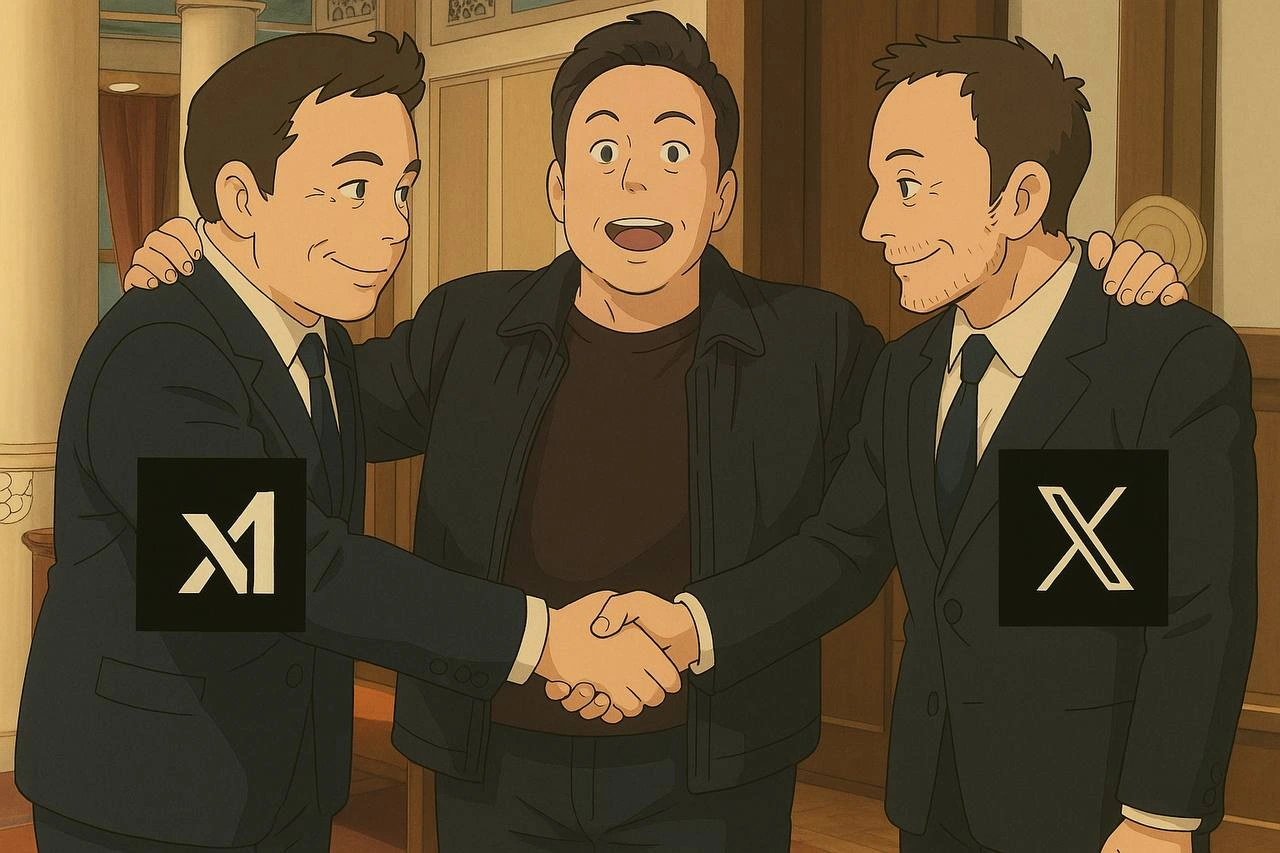
So what’s actually going on with this M and X handshake? Let’s unpack it in simpler terms. The picture shows two men in suits shaking hands, each wearing a square patch with a logo. The left one has a stylized “M” (that stands for Midjourney, a company known for its AI that generates images from text). The right one’s patch is the big white “X”, which is the new name and logo for what we all used to know as Twitter (yes, the bird app got rebranded as “X”). In the middle, there’s a happy guy who seems to be bringing them together – imagine him as the boss or deal-maker making sure this partnership happens.
What the image is telling us is: Midjourney and X are partnering up. In tech terms, that usually means integrating their services. Perhaps X (Twitter) wants to let its users create fancy AI-generated images (via Midjourney) directly on the platform. Sounds cool, right? But integration means a lot of nitty-gritty details need to be sorted out:
- APIs: To work together, X and Midjourney need to talk to each other through API calls. An API (Application Programming Interface) is like a menu of commands one service offers so that other software can use its features. For example, Midjourney might have an API endpoint where X can send a text prompt and get back a generated image. This handshake in the meme symbolizes an agreement like “Sure, you can use my AI if I can plug it into your app.” But using an API isn’t like flipping a switch; the developers have to write code to call these endpoints, handle the responses, and integrate the results into X’s user interface.
- Authentication (OAuth 2.0): X can’t just use Midjourney’s API freely without permission, and users might need to authorize X to generate images on their behalf. This is where OAuth comes in. OAuth 2.0 is an industry-standard protocol for authorization. Ever clicked “Log in with Google” or “Connect with Facebook”? That’s OAuth at work. It’s basically a way for one service to do things using another service’s account, but with permission and limits. Those limits are defined by OAuth scopes. A scope is like a specific permission— for example, “This app can post images to your timeline” might be a scope X requests from users so it can post the Midjourney-generated image to your feed. Setting up OAuth means redirecting users to a consent screen, exchanging secret codes for tokens, and making sure those tokens only let X do what it’s supposed to (and nothing more). It’s a lot of careful setup. The meme hints that no one at the top talked about these “scope” details during the handshake, which is why engineers joke about “OAuth scope nightmares.” It’s a nightmare because if the scopes are wrong, the integration might not work, or worse, could overstep privacy boundaries.
- Rate Limits: Both X and Midjourney will have rate limits on their APIs. Think of rate limits as a speed limit on how often you can use a service. For instance, Midjourney might only allow, say, 100 image generations per minute for each partner using their API. Twitter (X) also has limits on how frequently apps can post or read tweets. These are there to prevent abuse and to manage load. Now, if X suddenly lets millions of users generate images via Midjourney, you can see the potential issue: the demand could be way over those limits. If the limit is hit, the user might see errors or failed requests (like getting a message “Please wait, too many requests”). Engineers have to plan around this: maybe queue requests, cache results, or work with Midjourney to raise the limit. It’s not impossible, but it requires planning and often negotiation. The meme’s humor comes from knowing that the executives likely didn’t consider any of this while enthusiastically sealing the deal.
- SLAs and Reliability: Here’s another thing: reliability. SLA stands for Service Level Agreement, which is basically a promise one company makes to another about uptime and performance. For example, Midjourney might promise its service will be available 99.9% of the time and respond within 2 seconds, etc. If X is building a core feature on top of Midjourney, they’d want those guarantees. Otherwise, if Midjourney has a hiccup, suddenly images on X might not load, and users will blame X for it. Aligning on an SLA is something business folks and engineers usually hash out before launching the integration. The joke here is that the handshake probably happened without sorting all that out. It’s like selling tickets to a concert before booking the band. There’s a lot of trust and assumption, and if things go wrong, it’s going to be a scramble to fix it.
- Integration Testing & Edge Cases: When you plug two services together, you have to test a bunch of scenarios. What if Midjourney returns an inappropriate image by accident? Does X have a filter or moderation process (since it’s their platform showing it)? What if generating an image takes too long – does the X app show a spinner, or will it time out? How do errors appear to the user? These are the questions engineers obsess over, while the execs are busy patting each other on the back in that wood-paneled corridor.
All these technical details are the “fine print” of the integration. The meme shows a handshake and logos, which is the shiny surface. But the context tags like api_integration_handshake and oauth_scope_nightmares remind us of the messy beneath-the-surface work. When the description jokes about “rate limits, OAuth scopes, and SLAs,” it’s listing exactly the kind of things developers have to figure out after the bosses have made grand promises. If you’re a junior dev, imagine being told by your manager: “Hey, we need you to hook up this AI service to our app.” At first, it sounds fun – you get to work with cool AIGeneratedContent! But then you start hitting documentation full of jargon, you get error codes because of missing permissions (OAuth scopes), or you realize you can only use the API so many times per hour (rate limits). Suddenly it’s a lot more complicated.
In simpler terms, the meme is highlighting a common scenario in tech companies: CorporateCulture often celebrates big partnerships and buzzwords (like AI integration) without immediately acknowledging the hard engineering work needed. The people in suits are all about strategy and vision (“Wouldn’t it be awesome if our platform had AI-generated artwork everywhere? let’s do it!”). The engineers are the ones who later have to say, “Okay… how do we actually do this safely and reliably?” It’s funny in the way that inside jokes are funny: if you’ve been there, you’re nodding along. And if you haven’t, well, now you know what lies beneath those exciting tech headlines and announcements.
Level 3: Hype-Driven Development
In this scene, two corporate worlds collide under the banner of AI hype. On the left, a suit proudly wears a patch with a bold diagonally-split “M” — a dead ringer for the Midjourney logo, representing the popular AI image-generation tool. On the right, another executive sports the minimalist “X” logo, symbolizing Twitter’s grand rebrand to X. And who’s the grinning guy in the middle, dressed casually with a hand on each of their shoulders? Likely a high-flying visionary (perhaps someone like the owner of X himself) eagerly brokering this deal. The whole setup screams “press release photo-op” where two companies announce a shiny new partnership. It’s a classic case of hype-driven development: executives shaking hands over an integration that’s not even built yet.
This meme has us experienced developers both chuckling and cringing, because it captures that executive vision vs. engineering reality gap perfectly. We’ve seen this play out before: a big announcement that “Our platform will seamlessly integrate AI-generated content!”, followed by engineers whispering “We will? Did anyone check the details?”. The suits in the corridor are all smiles, celebrating an AI_ML synergy that will impress investors and media. Meanwhile, the folks who have to make it actually work are already anticipating the IntegrationPain lurking beneath the surface.
Why is this funny? Because it’s too real. The CorporateCulture here prioritizes hype cycles and big deals – integrating the trendiest AI tools just because everyone else is. Midjourney (an AI that creates images from text prompts) is in the limelight of the AIHypeCycle, and X (formerly Twitter) is desperate not to miss the bus on the next big thing. The result: handshake now, hard work later. Seasoned devs know that a handshake between logos is the easy part; it’s the handshake between systems that’s hard. We can already foresee late-night deploys and frantic messages about why the new AI image feature is timing out or hitting errors.
Let’s break down the stark contrast between the rosy executive narrative and the gritty engineering reality:
| Executive Announcement 🎉 | Behind-the-Scenes Reality 🔧 |
|---|---|
| “X will seamlessly integrate Midjourney’s AI to auto-generate images!” | Do our systems even talk? Engineers scrambling to figure out how to call Midjourney’s API reliably. |
| “It’s going to delight users with endless AI content.” | Hope you like AI-generated content floods. What about content moderation and filtering inappropriate outputs? |
| “We’ve shaken hands, so expect this feature next quarter.” | Clock’s ticking. Devs now face OAuth scope nightmares, rate-limit puzzles, and zero room for delays. |
See the pattern? It’s Announcement-Driven Integration: the deal gets publicized before the dev team has a chance to say “hello world.” The middleman in the image, with that reassuring grip, might as well be saying, “Don’t worry, it’ll be easy.” But every engineer knows that’s famous last words. Integrating an external AI tool into a platform like X involves a gauntlet of technical challenges:
- Authentication & OAuth: You can’t just plug one product into another like a USB stick. They’ll need secure authentication, likely using OAuth 2.0. That means carefully setting up tokens, callbacks, and permissions. Each OAuth scope (the specific access permission, e.g. “post images on user’s behalf”) must be negotiated. Mess that up and you either break the feature or create a security hole. It’s not as trivial as two execs shaking hands – more like a careful multi-step handshake between servers, with keys and tokens exchanged in a delicate dance.
- Rate Limits: Twitter (er, X) and Midjourney each have rate limiting in their APIs to prevent abuse. Execs might not even know what a rate limit is, until a demo fails because “Exceeded 100 requests/minute” pops up. Scaling this integration means engineering has to beg for higher API quotas, implement caching, or queue requests – otherwise users will hit errors when the service is flooded. The meme hints at this with those black patches on the sleeves – the details hidden in dark boxes that no one at the handshake is discussing.
- Reliability & SLAs: The handshake photo op certainly didn’t cover uptime guarantees. What happens when Midjourney’s service goes down, or takes 30 seconds to generate an image during peak load? Without a solid SLA (Service Level Agreement), X could end up with a feature that fails unpredictably. Engineers will need to design fallback plans (maybe default images or error messages) for when the AI is unavailable. It’s a lot of unseen work to uphold user experience to the level the execs just promised publicly.
All of this complexity is why we find humor (tinged with horror) in the image. The suits are content because to them, a handshake and a signed contract mean the job is done. The real handshake – aligning two complex systems – is left to the tech teams who now have to reconcile different technologies, handle myriad edge cases, and possibly deal with each other’s poorly documented APIs. The TechIndustryHumor here comes from experience: anyone who’s survived a big integration project knows how painful it can be behind the scenes. We’re laughing because we don’t know whether to cry – it’s absurd how often decisions are made at the top that snowball into all-nighters for developers.
In short, this meme is a savvy jab at AI hype in the industry. It highlights how companies chase trends (“Quick, add AI to everything!”) and make high-profile deals, while the practical alignment of systems is an afterthought. As a battle-scarred engineer, you look at that over-eager middleman and those brand-emblazoned suits and think, “Sure, go ahead and shake hands. I’ll be here merging pull requests and fighting OAuth errors at 3 AM while you’re celebrating.” The humor cuts deep because it’s borne from truth. This is the IndustryTrends_Hype cycle on display: excitement first, engineering later (if ever). The meme nails that contradiction with a simple handshake snapshot.
Description
Stylised cartoon drawing of three businessmen standing in a wood-panelled corridor. The two on the left and right wear dark blue suits and are engaged in a firm handshake; each sleeve carries a black square patch. The left patch shows a bold white, diagonally split “M” symbol, while the right patch shows a minimalist white “X”. A casually dressed middle figure (black jacket, dark t-shirt) places a reassuring hand on each of their shoulders, visually mediating the deal. The absence of other text draws focus to the ‘M’ (read: Midjourney-style AI tooling) and ‘X’ (Twitter’s rebrand) logos, implying yet another hype-fuelled integration that executives celebrate long before engineers have aligned rate limits, OAuth scopes, and SLAs
Comments
15Comment deleted
Nothing says ‘enterprise architecture’ like two marketing departments agreeing to a press release while the poor consultant in the middle quietly reverse-engineers both rate-limit headers into a single retry loop
When your AI startup needs training data and your social media platform needs engagement metrics, so you architect a beautiful circular dependency where the bots argue with each other while you call it "adversarial training."
When two AI coding assistants both claim they'll 10x your productivity, but you're just trying to remember which one has the better context window for your legacy codebase. Spoiler: neither understands your 15-year-old monolith's business logic, but both will confidently hallucinate solutions while their sales teams schedule 'synergy calls' to discuss your 'AI transformation journey.'
The flawless three-way handshake where M sends SYN, X replies SYN-ACK, and X seals ACK - no RST resets in sight
Translation of the “strategic partnership”: we flipped our own feature flag, pointed the LLM at our own APIs, and shipped the only real interface change - the press release
Call it Handshake-Driven Architecture: wire the firehose to RLHF, ship behind a feature flag, and hope the GDPR DPIA doesn’t page you
next time just drop a meme lol Comment deleted
Porn bots gonna teach us now on how to maintain meme channel? Folks, we are really being replaced, ain’t we? Comment deleted
let an LLM be a channel admin Comment deleted
Guys this AI thing is getting out of hand. When will we stop fr? Comment deleted
I was really born in the wrong time I feel like Comment deleted
Derailing is an option Comment deleted
Also this post's image was crapped out by AI, isn't it? Comment deleted
what's the prompt? Comment deleted
Its a fucking pyramid Comment deleted