Backend Developer's First Taste of CSS
Why is this Backend meme funny?
Level 1: Don't Eat the Code
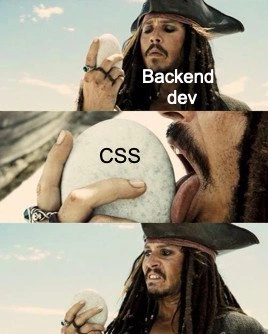
Imagine someone who is really good at one thing trying something completely different in the silliest way. This meme is funny for the same reason it would be funny to see a chef try to fix a car by licking the engine. Here, a programmer who usually works on behind-the-scenes stuff (the engine of a website) is trying to do artsy visual stuff (like painting a picture) without any clue how. It’s like if you gave a mechanic a paintbrush and they taste the paint to figure out how painting works – yuck! In the picture, the pirate thought the rock (labeled "CSS", which is a tool for making web pages look nice) might be something he could understand by tasting it. He immediately realizes that was a bad idea (it tastes horrible!). In simple terms: the poor backend developer treated the styling code like something you could literally bite into, and it blew up in his face. It’s funny because it’s a goofy mix-up – we never solve computer problems by licking them, just like you wouldn’t eat a book to learn what’s inside. The big goofy reaction in the last panel is basically saying, "Oops, that’s definitely NOT how to do it!"
Level 2: Backend Meets CSS
In simpler terms, this meme is showing a backend developer totally out of their element trying to deal with CSS, which is a core tool of frontend development. Let's break down the roles: a backend dev writes code that runs on servers – they handle things like databases, server logic, APIs, and performance behind the scenes of a website or app. A frontend dev focuses on everything the user sees and interacts with in their browser – HTML for content, CSS for styling (colors, layouts, fonts), and usually JavaScript for interactivity. Here, the backend person is confronted with CSS (the language used to style webpages) and is unsure how to even begin.
The meme uses a funny scene of Captain Jack Sparrow (from Pirates of the Caribbean) who in the movie licks a random white rock hoping it might be salt. In the meme panels:
- Panel 1: We see "Backend dev" labeled on Jack Sparrow’s head and "CSS" labeled on the rock he's holding. This means the backend dev is examining CSS, perhaps curiously or skeptically, like "Hmm, so this is what they call CSS...".
- Panel 2: Jack (the backend dev) actually sticks out his tongue and licks the rock labeled CSS. This visual gag implies the developer’s way of "trying out" CSS is totally wrong – literally tasting it. Of course, no real developer would lick their computer screen or code, but it's a metaphor for being clueless. It’s as if someone said “give CSS a try” and the literal-minded pirate-dev thought that meant physically tasting it.
- Panel 3: Jack Sparrow pulls back with a horrified, disgusted face, wiping his mouth. The rock (CSS) clearly tasted awful to him. This represents the backend dev’s reaction after attempting to mess with CSS and having a bad experience. Maybe the style didn’t work as expected, or it was frustrating and unpleasant. In real life, a backend dev might say "Yuck, CSS is awful!" after struggling with it, just like Jack spit out the rock.
The joke centers on a common developer stereotype: backend specialists are notoriously not great with CSS and front-end work. It’s not universally true, but it’s a trope in the developer world (hence tags like BackendVsFrontend and DeveloperHumor). CSS (Cascading Style Sheets) by nature can be tricky: styles can cascade (later rules override earlier ones), and little changes can have big unexpected effects on a web page. If you’ve never learned those quirks, diving into a complex stylesheet can feel as strange as a pirate licking a rock to understand it. The meme highlights this by comedic exaggeration.
We also see a hint of DeveloperExperience_DX issues here. "DX" means how easy or pleasant it is for developers to work with certain tools or code. For someone used to backend frameworks and structured logic, the experience of tweaking CSS without proper knowledge can be frustrating or confusing (a bad DX). They might not know the right way to “taste” or test changes (for example, using browser dev tools, checking cascade order, etc.). Instead, they do something silly – akin to a random lick – and are shocked when it doesn't work out. In teamwork, front-end developers often chuckle at how their back-end colleagues approach styling tasks with naïveté. Imagine a database expert trying to center a <div> or choose the right CSS selector – it can be a comical struggle due to unfamiliarity, just as shown in this meme.
In summary, the meme visually jokes about a backend dev vs. CSS scenario: the backend person treats CSS in a completely wrong way, gets a nasty surprise, and likely gains new respect for front-end devs who deal with CSS daily. It’s a lighthearted nod to the idea that sometimes very smart programmers feel completely lost when working with something outside their specialty. Seeing Jack Sparrow (a witty, overconfident pirate) used for the backend dev is extra fitting – he’s bold but clearly out of his depth licking that “CSS” rock. FrontEndHumor like this is very relatable on dev teams, especially when someone steps out of their comfort zone. Everyone ends up laughing, and maybe the backend dev learns to ask for a CSS expert’s help next time (instead of literally tasting the problem!).
Level 3: Cascading Confusion
At first glance, this meme hilariously captures a Backend vs Frontend culture clash. The "backend dev" (a server-side engineer used to logic and databases) is depicted literally licking a rock labeled CSS (which stands for Cascading Style Sheets). Why is this funny to experienced developers? Because it symbolizes a backend engineer trying to handle CSS with the wrong approach entirely – tasting it like a pirate would test a strange object. In real projects, backend specialists often treat front-end styling as an alien artifact. They might dive into a .css file expecting straightforward rules, only to be met with the eccentric logic of the cascading mechanism, inheritance, and quirky layout behaviors.
This scene is from Pirates of the Caribbean, where Jack Sparrow tastes a rock (hoping it's salt). Here it's repurposed: the backend dev gives CSS a naive "taste test." In tech terms, it's as absurd as trying to unit test a UI by licking the screen. The humor comes from a DeveloperStereotype: many backend developers have war stories of underestimating CSS. Perhaps they thought, "It's just styling, how hard can it be?" – only to recoil in shock (like Jack Sparrow spitting out the rock) when confronted with CSS quirks. Seasoned devs recognize this cascading confusion: things like specificity, the box model, or flexbox can feel like voodoo if you've only lived in Java, Python, or database stored procedures. The meme’s punchline – the pirate’s disgusted face – is every backend dev’s reaction after spending two hours on what they assumed was a “5-minute CSS fix.”
From an architectural perspective, backend and frontend involve very different paradigms, even though they work in tandem to deliver a web experience. Backend code is typically procedural or object-oriented logic running on servers. It deals with algorithms, data structures, API endpoints, and frameworks like Express or Django. Frontend, especially CSS, is declarative; you declare what a button or layout should look like, and the browser figures out how to render it. This requires a different mindset. A backend dev used to step-by-step debugging can feel lost at sea (pun intended) when CSS doesn't behave linearly – for example, when a <div> refuses to center despite all attempts. The DeveloperExperience (DX) of switching to CSS can be jarring: there's no compiler error if you do it wrong, but your page might look like a treasure map set on fire. Experienced developers find this meme funny because it exaggerates that feeling of being a competent engineer in one domain and a total amateur in another. It’s a gentle poke at the “Jack of all trades, master of none” scenario in full-stack development: even a coding pirate like Jack Sparrow finds CSS to be an unexpected foe.
Importantly, the meme also plays on words: in programming, we often say "let's get a taste of this new framework" meaning try it out. The backend dev here misinterprets that metaphor in the most literal, tongue-in-cheek way imaginable. FrontendHumor often highlights CSS struggles (#css_struggles) like wrangling with alignment or making a page responsive. The pirate’s dramatic lick and disgusted wipe symbolize that first painful encounter with a CSS codebase – perhaps opening a large stylesheet with 1000+ lines of somebody else's code (a style sheet from the depths of the sea!), or trying to override a style only to learn about !important the hard way. For senior developers, the image conjures real team moments: the backend guru volunteers to fix a tiny CSS bug during a sprint, and ends up cursing "why is this padding not working?" as everyone chuckles. It’s a shared industry joke that crossing into front-end territory without preparation can make even the most hardened backend pirate feel like they're licking something completely indistinguishable and nasty.
Description
A three-panel meme featuring Captain Jack Sparrow from the 'Pirates of the Caribbean' movie series. In the first panel, Jack Sparrow, labeled 'Backend dev', is looking quizzically at a smooth, white, egg-shaped rock. In the second, close-up panel, the rock is labeled 'CSS' as he licks it to get a sense of its nature. The third panel shows his face contorted in disgust and confusion after tasting it. This meme humorously illustrates the common stereotype of backend developers, who are comfortable with logic and data, finding the rules and behavior of Cascading Style Sheets (CSS) to be foreign, unpredictable, and unpleasant to work with. It's a classic take on the frontend vs. backend cultural divide in web development
Comments
9Comment deleted
A backend dev's relationship with CSS is like trying to debug a distributed system where the error messages are just different shades of beige
“I’ve debugged split-brain in a multi-region cluster, but after licking CSS I realize the cascade has more edge cases than Raft - keep the rock.”
After 15 years of optimizing database queries and designing microservice architectures, you still break into a cold sweat when someone asks you to center a div - and somehow the junior who started last week does it in 30 seconds with flexbox
The backend dev's relationship with CSS perfectly encapsulates the microservices philosophy: strict separation of concerns, minimal coupling, and absolute terror when boundaries are crossed. We've architected distributed systems handling millions of transactions per second, optimized database queries down to microseconds, and debugged race conditions in concurrent code - but ask us to center a div and suddenly we're questioning our entire career trajectory. It's not that we can't learn CSS; it's that we've spent years building mental models around deterministic systems, type safety, and predictable state machines, only to discover that CSS operates in a parallel universe where specificity rules are more complex than Byzantine consensus algorithms and 'margin: auto' works through what can only be described as arcane magic
Backend dev's full-stack rite: swallowing CSS whole, because 'just align the div' is the real production incident
Backend dev meets CSS: “just config, right?” Ten minutes later, the cascade behaves like global mutable state and the hotfix is called “!important”
A backend adds one '!important' thinking it’s idempotent, and the cascade starts a leader election - z-index wins, the tooltip becomes cluster leader, and the modal partitions
Fucking mood Comment deleted
lmao Comment deleted