Backend Developers' Natural Reaction to CSS
Why is this Backend meme funny?
Level 1: Running from Art Class
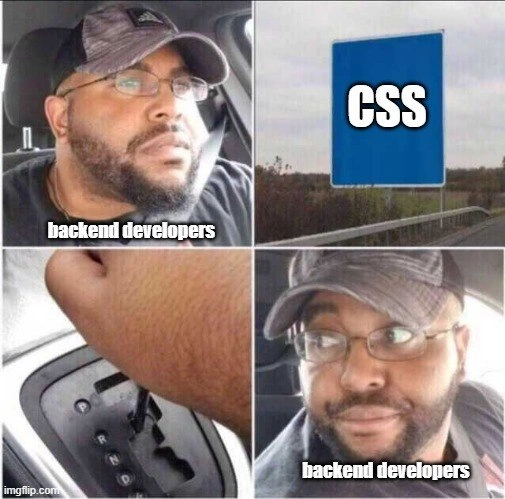
Imagine you have one friend who loves math and puzzles but really dislikes drawing or painting. Now suppose one day at school, the teacher says everyone has to do a big painting project – no math, just art. Your math-loving friend would probably feel super uncomfortable and maybe want to hide or run away from the art class! In this meme, the backend developer is like that friend. Backend developers enjoy working with the behind-the-scenes parts of a website (kind of like doing the logical math stuff), but when they’re asked to do CSS, it’s like asking them to make something look visually pretty (kind of like doing art). The meme shows a funny picture of a driver quickly shifting his car into reverse gear when he sees a road sign that says “CSS” – that’s exactly like our math friend trying to escape the art project. It’s saying in a silly way: “Uh oh, a design task is coming! Time to get out of here!” You don’t need to know coding to get the joke – it’s basically about someone encountering a task they’re not comfortable with and bolting away as fast as they can. It’s funny because we’ve all had moments where we wanted to avoid something we find hard or scary, just like a student running away from a class they don’t like.
Level 2: Shifting Gears on Styling
Let’s break this down in simpler terms. CSS stands for Cascading Style Sheets, and it’s the language used to make websites look nice. It controls things like colors, layouts, fonts, and spacing on a webpage. On the other hand, a backend developer is someone who works on the parts of a website or application that you don’t see directly – the server, database, and the logic that makes features work. Think of the backend as the behind-the-scenes code that handles calculations, data storage, and rules of how the app behaves. A CSS ticket means a task (often tracked in a system like JIRA or GitHub issues) to change or fix something about how the site looks. For example, a ticket might say “The signup button is the wrong shade of blue, please fix the CSS.” For a developer who usually works on the backend, seeing a CSS-related assignment pop up can be a bit daunting if styling isn’t their strong suit.
The meme shows a sequence of four images to tell a funny story. In the first panel (top-left), we see a man in a car, and he’s labeled “backend developers.” He looks relatively calm at first. In the second panel (top-right), there’s a big highway sign with “CSS” written on it in bold white letters. This sign represents the upcoming CSS task or issue – basically telling the driver that ahead lies the land of CSS. Now, the joke escalates in the third panel (bottom-left): we get a zoomed-in view of the driver hurriedly shifting the car’s gear into reverse. It’s such an emergency for him that it looks like he’s even pushing the gear lever with his face (his nose, specifically)! That exaggerated motion highlights a knee-jerk reaction: the moment he realizes he’s headed towards CSS territory, his reflex is to get out – fast. Finally, the fourth panel (bottom-right) shows the same man (again labeled “backend developers”) glancing sideways as if checking that he’s successfully backing away, with a look that’s a mix of relief and “avoided that one!” on his face. Together, these panels communicate: “Backend developers, upon encountering CSS, will quickly back away.”
Now, why is this funny or even a thing? In many development teams, people specialize. Frontend developers love working with CSS, HTML, and making things pretty and user-friendly. Backend developers are more comfortable dealing with servers, data, and the heavy logic. When a backend dev is suddenly asked to do something in CSS (which is more of a frontend/design skill), they might feel out of their element. It’s a bit like asking a skilled car mechanic (who’s great with engines) to do detailed pinstriping and paint art on the car’s exterior – they technically know it’s part of the car, but it’s not what they practice every day. So, a lot of backend folks jokingly fear CSS because it has its own rules and quirks that they might not remember or know well. For example, CSS has a concept called the “cascade” (that’s the C in CSS) which means that the order and specificity of rules matter; if you don’t know those rules, your changes might not do what you expect. A backend developer who doesn’t spend much time on front-end stuff might write some CSS and then scratch their head when it doesn’t work, not realizing another CSS rule elsewhere is overriding their change. This can be frustrating if you’re not used to thinking in terms of page layout and style rules.
The humor also comes from how dramatic the meme’s portrayal is. In real life, a backend dev wouldn’t literally jump in a car and drive in reverse to escape a CSS task. But metaphorically, they might swap the task with a teammate, procrastinate on it, or find some library to do the CSS for them – essentially “backing away” from doing it themselves. The meme just visualizes that inner instinct in a funny, over-the-top way. The gearshift_reaction image (where the nose hits the gear lever) is actually a known meme format used to show someone making a sudden, panicked decision. It emphasizes urgency. Here it implies “I need to get out of doing CSS immediately, no time to even think!” This plays on the stereotype and self-deprecating humor among developers: many backend devs joke that even though they can handle complex coding problems, styling a webpage with CSS might make them sweat. It’s a common relatableDevExperience joke – even people who are “full-stack developers” (meaning they do both backend and frontend) might secretly groan when they see a pure CSS issue assigned to them, because they know it could involve tedious tweaking of pixel spacing or fighting with styles to get things just right.
In simpler terms, this meme is labeled under BackendHumor and FrontendHumor because it pokes fun at the differences in these roles. The phrase “slam into reverse” is figurative: no one is literally driving away, but it captures that avoidance behavior. If you’re a junior dev or someone new to the field, it’s useful to know that CSS, while it looks straightforward (just styling, right?), has a reputation for being tricky until you learn its ins and outs. That’s why this image is funny – it’s showing a normally confident backend engineer reacting to a CSS task like it’s a monster on the road. And if you’ve ever felt uneasy about a task outside your comfort zone, you can relate to that sudden “Nope!” feeling. The meme takes that feeling and turns it into a goofy car scenario that many in tech find hilariously accurate.
Level 3: Cascading Escape Sequence
At the highest technical level, this meme satirizes the classic Backend vs Frontend divide in a developer team. The image of a backend developer slamming the gear into reverse upon seeing a road sign labeled CSS perfectly caricatures how server-side engineers often react to styling tasks. In software terms, we’re witnessing a humorous context switch failure: moving from back-end logic to front-end CSS feels like shifting into an entirely different gear. The meme exaggerates a Developer Experience (DX) pain point: backend specialists who are perfectly at home optimizing database queries or designing APIs can panic when confronted with a seemingly simple CSS ticket. It’s the comedic portrayal of css_phobia, an inside joke in developer communities referring to the almost allergic reaction some backend devs have to front-end styling work.
Why is this so relatable? Consider that writing CSS involves a different mindset than writing back-end code. In a backend language like Java or Python, you might deal with strict type systems, algorithms, and clear programmatic flow. CSS, on the other hand, is declarative and cascading – a style can cascade down through the DOM (Document Object Model) and be overridden by more specific rules. This fundamental difference means troubleshooting CSS often requires intuition about visual layouts and an understanding of the cascade, inheritance, and specificity. To a backend dev used to deterministic logic, CSS can feel like black magic or “spooky action at a distance” – change one rule and something entirely elsewhere on the page breaks because of an overriding style. There’s a famous saying that the two hard problems in computer science are cache invalidation, naming things, and off-by-one errors; many seasoned devs half-jokingly want to add CSS layout as a contender for that list. FrontendHumor memes often highlight how unexpectedly hard it can be to center a <div> or how adding one CSS rule can unleash chaos in your layout. So when this meme shows the driver (the backend dev) physically recoiling from the giant “CSS” highway sign, it’s poking fun at that very real complexity hiding behind “just make it look pretty.”
From an architectural perspective, modern web applications frequently separate concerns: frontend deals with user interface (UI) and experience, while backend deals with data, business logic, and performance. Many companies even have dedicated frontend engineers so that backend developers can focus on their domain expertise. When a CSS ticket lands on a backend developer’s plate, it often means stepping into a part of the codebase they seldom visit. The shared understanding in the industry is that context switching is costly: just like our driver in the meme needs to physically shift gears, a developer must mentally shift into a different mode of thinking. This abrupt change can be jarring. A backend dev might open the app’s stylesheet and be greeted by hundreds of lines of seemingly cryptic rules. For example, imagine a backend dev adds a quick CSS fix:
/* Our backend dev tries to make a button font larger */
.button {
font-size: 16px;
}
They test the page, and nothing happens – the button stubbornly stays small. Unbeknownst to them, elsewhere in the tangled CSS files lies a more specific rule:
.navbar .login-form .button {
font-size: 14px !important;
}
Despite their change, the browser applies the more specific rule with !important. The result? The frustrated backend engineer now believes the CSS is actively fighting them. This scenario is painfully familiar in BackendHumor threads: what looked like a trivial one-line change turns into an hour of tweaking selectors and Googling CSS quirks. The meme’s humor is in that instant recognition: “Yep, been there – saw a CSS bug and immediately wanted to run the other way.”
There’s also a cultural and historical layer to this joke. In the early days of the web, developers often had to do everything – from server configuration to page design. As web technology advanced, frontend development became a specialized skill set involving not just CSS, but HTML5, JavaScript frameworks, responsive design, and accessibility concerns. CSS itself evolved (with Flexbox, Grid, pre-processors, etc.), and it gained a reputation for being deceptively complicated. Plenty of RelatableHumor memes label CSS as the bane of otherwise fearless programmers. You’ll find jokes about how even a tiny CSS tweak can turn into a “pixel-pushing” nightmare or how CSS issues inexplicably fix themselves and then break again (Schrödinger’s div, anyone?). Over time, backend developers who haven’t kept up with front-end trends might see a CSS task as walking into a minefield of unknown unknowns. They might joke that CSS stands for “Couldn’t Style Straight” or “Cascading Spaghetti Sheets”, reflecting the perception that CSS code, especially in large projects, can become tangled and hard to maintain. It’s not that these engineers actually hate UI being pretty – it’s that they know making it pretty might require a lot of fiddling in a realm where they don’t feel expert. So when the highway sign ahead says “CSS”, the instinct (as the meme humorously shows) is to yank the steering wheel and find an alternate route!
This meme resonates so widely because it’s built on truth and RelatableDevExperience. It encapsulates the relief and terror of being asked to step outside your specialization. In a team meeting, when a product manager says, “We have a quick UI fix, who can take it?”, you’ll sometimes see all the backend devs suddenly avoid eye contact or invent reasons to focus on something else – exactly like our driver comically shoving the car into reverse. The gearshift_reaction_meme format amplifies this: the close-up of the driver aggressively shifting gears (with his nose of all things!) exaggerates the urgency to escape. It’s the perfect visual metaphor for a panicked retreat. In reality, a backend dev might simply reassign the ticket or ask a frontend colleague for help, but depicting it as a physical high-speed reverse is what makes it funny. The meme takes a mundane workplace scenario and turns it into an action movie escape scene – and anyone who has ever felt out of their depth with a CSS file can laugh at how dramatically accurate it feels. In summary, the humor works on multiple levels: it’s a nod to the complexity of CSS (that outsiders often underestimate), a wink at the well-known backend_dev_vs_css stereotype, and a lighthearted jab at how even extremely skilled programmers have that one technology that makes them say “Nope, not today!”
Description
A four-panel meme that humorously depicts the stereotypical aversion of backend developers to CSS. In the first panel, a man wearing glasses and a cap is driving with a serious expression, labeled 'backend developers'. The second panel shows a blue highway sign with 'CSS' written in bold white letters. The third panel is a close-up of a hand shifting a car's automatic transmission into reverse. In the final panel, the driver, still labeled 'backend developers', is looking back over his shoulder with a relieved smirk, clearly backing away. This meme uses the 'Man Driving and Reversing' format to joke about the common cultural divide in web development, where backend engineers, who specialize in server-side logic, often find the visual and sometimes unpredictable nature of CSS frustrating and prefer to avoid it entirely. It’s a relatable jab at specialization within the tech industry
Comments
25Comment deleted
I can design a distributed system that handles a million RPS, but asking me to vertically align a div with CSS feels like I'm trying to prove the Riemann hypothesis
Backend devs will happily orchestrate a live schema rewrite under full traffic, but assign them one CSS tweak and they’ll trigger an emergency failover - consistency models are still less terrifying than flexbox quirks
After 15 years of perfectly normalized databases and elegant microservice architectures, you still can't center a div without checking Stack Overflow - and somehow that one CSS rule you added breaks three unrelated components in production
Backend developers can architect distributed systems handling millions of transactions per second, design elegant database schemas with perfect normalization, and debug race conditions in concurrent code - but ask them to center a div vertically and suddenly they're white-knuckling the door handle like they're about to drive off a cliff. It's the classic tale of someone who speaks fluent SQL, REST, and gRPC but breaks into a cold sweat at the mere mention of 'box-sizing: border-box'
Backend preaching separation of concerns, until CSS's !important overrides their resolve
Backend dev here: I’ll debug a Raft split-brain before I touch why min-height: 0 on a flex child fixes Safari’s phantom scroll
Backends can reason about Raft safety, but when faced with CSS they instinctively throw it in reverse, ship an !important, and call it mitigation
Last time I was css frustrated when I tried to stick damn footer to the damn bottom of the page. Such a primitive task, no? I found several solutions and none of them was obvious. Comment deleted
display: fixed; bottom:0; Comment deleted
that's what I'd try Comment deleted
Ебанат Comment deleted
english please Comment deleted
There’s no way to translate this word in English Comment deleted
fair, google translate has the same opinion Comment deleted
Why are you so rude? Hope you become healthier soon Comment deleted
Life in Central Asia sucks man, that is the reason Comment deleted
By the way, that day I took this. https://css-tricks.com/couple-takes-sticky-footer/ Comment deleted
well that site sometimes overcomplicates things. My solution should work if you're not doing something funky. Comment deleted
translation: [CSS3] is SHIT! * please use English in this chat Comment deleted
can't translate stickers ( Comment deleted
You can send translation text Comment deleted
what anime is your profile image? Comment deleted
Sword Art Online [not a screenshot] Comment deleted
them do fit tho Comment deleted
Thats me Comment deleted