Skip to content
DevMeme
2088 of 7435
AWS Console Gets a Social Media Makeover
AWS Post #2336, on Nov 19, 2020 in TG

AWS Console Gets a Social Media Makeover

Why is this AWS meme funny?

Level 1: When Work Looks Like Play

Imagine you go to a very serious website that adults use for important work, but suddenly it looks like a fun app on your phone. You might think, “Huh, am I in the right place?” For example, think of your school’s online homework site suddenly showing colorful picture circles like on Instagram or Snapchat. You’d probably rub your eyes or check if you opened the wrong app. That’s what’s happening here. AWS is a serious tool (kind of like a big online office or library for computer stuff), and Instagram’s Stories are a fun feature (like playful stickers or quick videos). Mixing them together is so strange that it’s funny. It’s like seeing a business meeting where everyone is wearing party hats – you know it’s not supposed to happen! So people who use AWS would laugh and feel confused at the same time, because the “look” of a silly social media story just doesn’t belong on a professional work website. It’s so odd that anyone would double-check to make sure they didn’t accidentally go to a different site by mistake.

Level 2: Is This AWS or Instagram?

Amazon Web Services (AWS) is a huge platform providing cloud computing resources — basically, it’s where developers go to run servers, store data, and host applications on Amazon’s computers. The AWS Management Console is the web interface (a control panel site) where you can click around to manage all those services. It normally has a very professional, no-nonsense design. You’d see a list of services like EC2 (virtual machines that run your code), DynamoDB (a database service), Lambda (a service to run code without managing servers), IAM (Identity and Access Management for user permissions), etc. The console’s home page usually just shows things like a search bar, your recently visited services, and links to various AWS tools. It’s functional, not fancy — lots of tables, forms, and plain buttons.

Instagram, on the other hand, is a social media app known for sharing photos and videos. One popular feature of Instagram is Stories. These are the little round profile pictures at the top of your Instagram feed, each with a colorful ring. When you tap them, you see someone’s photo or video updates that disappear after 24 hours. It’s a fun, casual feature meant for quick sharing. In Instagram’s design, those multicolored ring icons (“Your Story” and friends’ stories) are now instantly recognizable. They scream “this is social media!”. Many apps have imitated this UI (User Interface) pattern to try to increase user engagement – we even saw professional networks like LinkedIn adding a stories feature around that time.

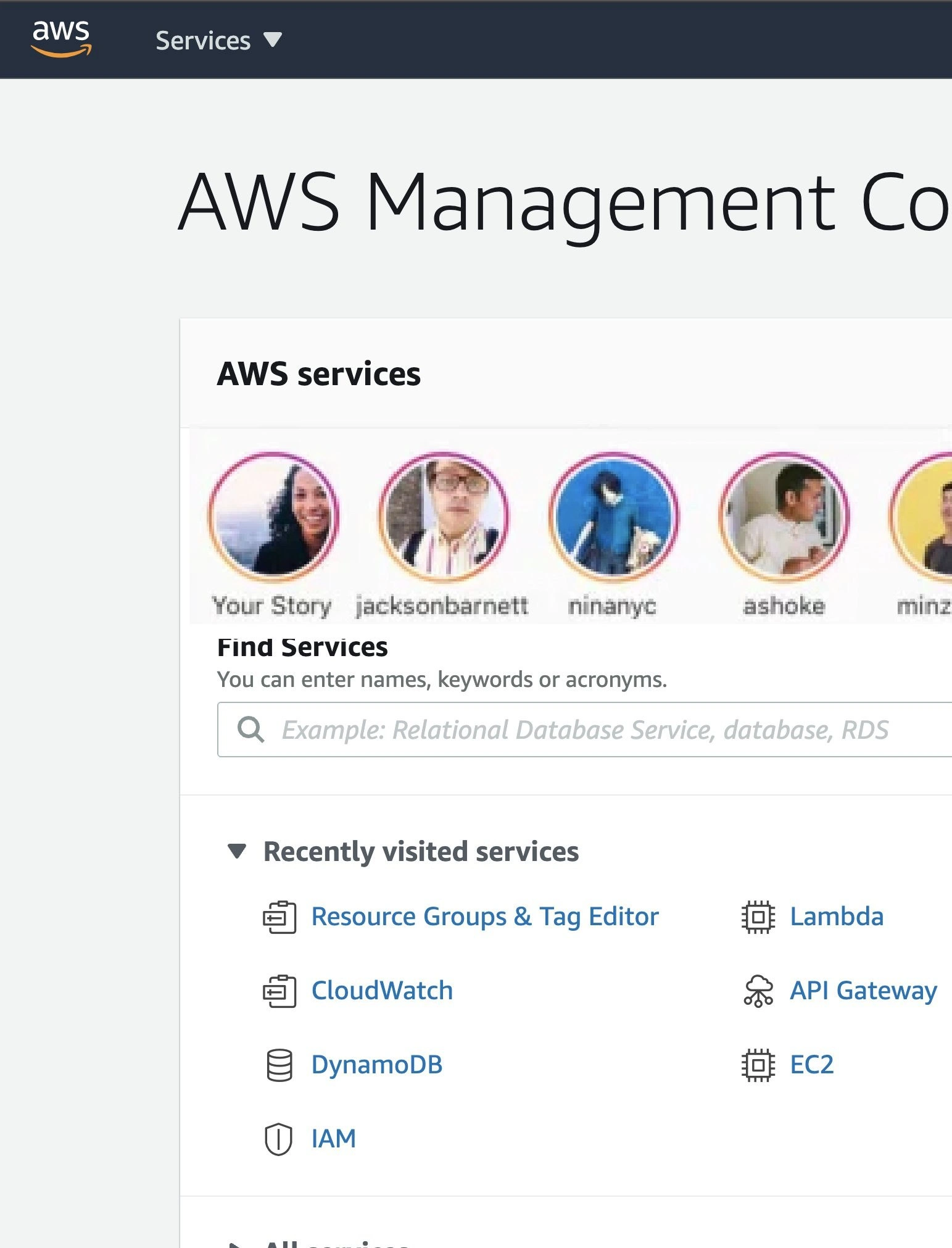
Now, this meme imagines that the AWS console got a redesign copying that Instagram Stories style. In the image, where you’d normally see the grid of AWS service icons or announcements, there’s instead a horizontal strip of round profile pictures with labels like “Your Story” and some user handles (e.g., jacksonbarnett, ninanyc). They even have that pink-orange gradient ring, exactly like Instagram. It’s as if AWS suddenly wants you to click on “Your Story” to post something, which makes no sense in a cloud management tool! The text under the search bar in the screenshot (“Find Services – Example: Relational Database Service, database, RDS”) is actually something real you’d find on AWS’s site. And below, the “Recently visited services” list (with CloudWatch, API Gateway, EC2, etc.) looks normal. This mix of real AWS elements with a totally fake social media feature is what creates the joke.

Why is this funny to developers? Because AWS is where you do serious work — launching servers, configuring networks, watching dashboards for outages. It’s the last place you’d expect to see a playful, social feature like Stories. The phrase “every engineer double-checks the URL” means any developer who saw this would literally glance up at their browser’s URL bar (the address, like https://console.aws.amazon.com/...) to make sure they’re on the correct site. It’s a way of saying “this is so unbelievable that I’d assume I’m on the wrong webpage.” Maybe they’d think, “Did I accidentally go to Instagram, or did some weird plugin modify my AWS console’s look?” It’s a form of disbelief. Developers take the AWS console seriously — sometimes changes do happen (AWS updates its interface occasionally), but something this dramatic would be completely unexpected.

This meme is a form of tech humor highlighting a kind of UX irony: mixing two user experiences that don’t belong together. Developer Experience (DX) tools like AWS usually focus on clarity, efficiency, and lots of data display. Social media focuses on engagement, visuals, and fun. Swapping these styles creates a silly contradiction. It’s also commenting on a trend where apps all try to copy each other’s popular features (what we jokingly call the “social media-ification” of everything). If even a cloud computing console started looking like a social app, that trend has gone way too far — and that absurdity is what makes people laugh. In short, the meme is funny because it pretends that AWS did a ridiculous UI redesign that no one in their right mind would actually want, and every developer who sees it would be so shocked they’d question if they’re even on the real AWS site anymore.

Level 3: UI Trend Whiplash

At first glance, any seasoned cloud engineer would do a double-take seeing Instagram-style Stories bubbles smack in the middle of the AWS Management Console. This is the kind of context clash that triggers a senior dev’s reflex to immediately check the browser’s address bar. On AWS, you expect spartan tables, menus, and maybe an overloaded dropdown of services – not a row of profile pics ringed in that pink-orange gradient screaming “New story!” The meme nails an absurd juxtaposition: serious cloud infrastructure tool meets social-mediaification. It’s funny because it’s utterly out-of-place. In a world where every other app is adding “Stories” (from LinkedIn to even Twitter’s short-lived Fleets in 2020), the thought of AWS following suit is both hilarious and horrifying to folks who use it daily. It’s as if a staid enterprise UI suddenly got infected by the latest trendy UX widget. Engineers with years in the console are thinking, “Wait, did I stumble into some AWS beta test or click on the wrong tab? This unexpected UI change is so bizarre that I’m questioning reality.”

Underlying the joke is a jab at how tech products sometimes cargo-cult popular features without context. We’ve seen business apps copy social feeds and chat bubbles to appear “modern.” Bringing ephemeral Stories into AWS – a mission-critical environment where uptime and clarity matter – would be the ultimate misfire. It pokes fun at the idea of chasing engagement in a dashboard meant for deploying code and monitoring servers. The meme’s text — “every engineer double-checks the URL” — underscores this disbelief. In a security-conscious world, if AWS’s interface suddenly looked like a social app, you’d literally suspect a phishing scam or that you typed aws.amazon.com wrong and landed on instagram.com by accident. It’s that jarring.

For veteran AWS users, there’s extra irony because the console’s design has historically been… let’s say utilitarian. AWS is famous for its powerful services (from EC2 virtual servers to DynamoDB databases and Lambda functions) but not for having a sleek, trendy interface. We beg for practical improvements (like a proper dark mode or faster navigation), not flashy distractions. So if one morning the AWS Console sprouted “Your Story” circles, senior devs would likely spit out their coffee. 🤨 They don’t open the console to be entertained; they open it to check CloudWatch alarms or tweak IAM permissions. Seeing jacksonbarnett and ninanyc (random as those names are) featured like influencers on your cloud dashboard would be so absurd that the first instinct is to assume it’s a prank or some rogue Chrome extension. (”Is this an April Fool’s release that I missed? Or did a product manager literally think we’d want to share selfies of our AWS Lambda deployments?” 😅)

The humor also touches on Developer Experience (DX) and how devs react to interface changes. In the enterprise world, UI overhauls are often met with groans, even when they’re for the better, because they disrupt muscle memory. AWS rolling out an Instagram-esque redesign would be the ultimate “Who asked for this?” moment. It hints at a disconnect between what engineers value and what some hypothetical design trend might dictate. The caption joking about “double-checking the URL” captures that collective distrust – like, this can’t be real, maybe I’m on a spoofed site. It’s a hyperbolic scenario that lets engineers laugh at how ridiculous it would be if AWS ever prioritized style over substance to such an extreme. The meme expertly exaggerates a fear every dev has had at some point: that the tools we rely on might suddenly adopt the frivolities of consumer apps. It’s comedic relief, because thankfully, AWS has not actually added a “Stories” feature – and if they ever do, you can bet every engineer will indeed be furiously hovering over the URL, wondering if the cloud just got a bit too cloudy.

Description

A screenshot of the AWS Management Console homepage, altered to include a social media 'Stories' feature. The top navigation bar shows the 'aws' logo and a 'Services' dropdown. Below the main title 'AWS Management Console', the 'AWS services' section unexpectedly features a row of circular profile pictures with usernames like 'Your Story', 'jacksonbarnett', 'ninanyc', 'ashoke', and 'minz', mimicking the layout of Instagram or Facebook Stories. Below this, the standard 'Find Services' search bar and a list of 'Recently visited services' are visible, including Resource Groups & Tag Editor, CloudWatch, DynamoDB, IAM, Lambda, API Gateway, and EC2. The humor comes from the absurd juxtaposition of a ephemeral, consumer-focused social media feature with a complex, professional cloud infrastructure management tool. It satirizes the tech industry's tendency to shoehorn popular features into every product, regardless of context or utility, a phenomenon often driven by product managers chasing trends rather than solving user problems
Comments

7
Anonymous ★ Top Pick The AWS Stories feature is great for ephemeral infrastructure. Your Lambda function's cold start disappears in 24 hours, just like your sanity
  1. Anonymous ★ Top Pick

    The AWS Stories feature is great for ephemeral infrastructure. Your Lambda function's cold start disappears in 24 hours, just like your sanity

  2. Anonymous

    AWS added Stories so my runaway Lambda can blow the month’s budget at 3 a.m. and the evidence auto-expires before Finance logs in

  3. Anonymous

    AWS finally admits their 200+ services are harder to keep track of than your ex's relationship status updates, but at least Instagram stories disappear after 24 hours while that misconfigured S3 bucket lives forever

  4. Anonymous

    When your 'Recently visited services' list in AWS looks like a greatest hits album, you know you've achieved true cloud-native enlightenment - or you're just desperately trying to remember which of the 200+ services actually does what you need. Lambda, DynamoDB, EC2, IAM... it's like collecting Pokémon, except each one costs money per millisecond and the documentation is 47 pages long

  5. Anonymous

    AWS search bar: where 'RDS' is the example because after 15 years, you still need training wheels for the other 237 database flavors

  6. Anonymous

    The new AWS Console ‘Stories’ feature: 15 seconds of a Lambda cold start, an IAM policy drifting from least to most privilege, and a cost anomaly spike - swipe up to open a P1

  7. Anonymous

    AWS console with “Your Story” is cute - mine’s a 15-second montage of IAM AccessDenied, Lambda cold starts in a VPC, NAT Gateway bill shock, and a DynamoDB hot partition; swipe up to silence the CloudWatch alarm

Use J and K for navigation