Blue Screen in Orbit
Why is this OperatingSystems meme funny?
Level 1: Space Laptop Sadness
This meme is like seeing a super fancy spaceship dashboard, then noticing one screen says, "I broke, please restart me." It is funny because the place looks incredibly advanced, but the problem is the same boring computer problem people get at home or work.
Level 2: The Blue Screen Problem
A blue screen is what Windows shows when the operating system hits a serious problem and decides it cannot keep running safely. It is different from one app freezing. If a browser crashes, you can usually reopen it. If the operating system crashes, the whole computer has to restart.
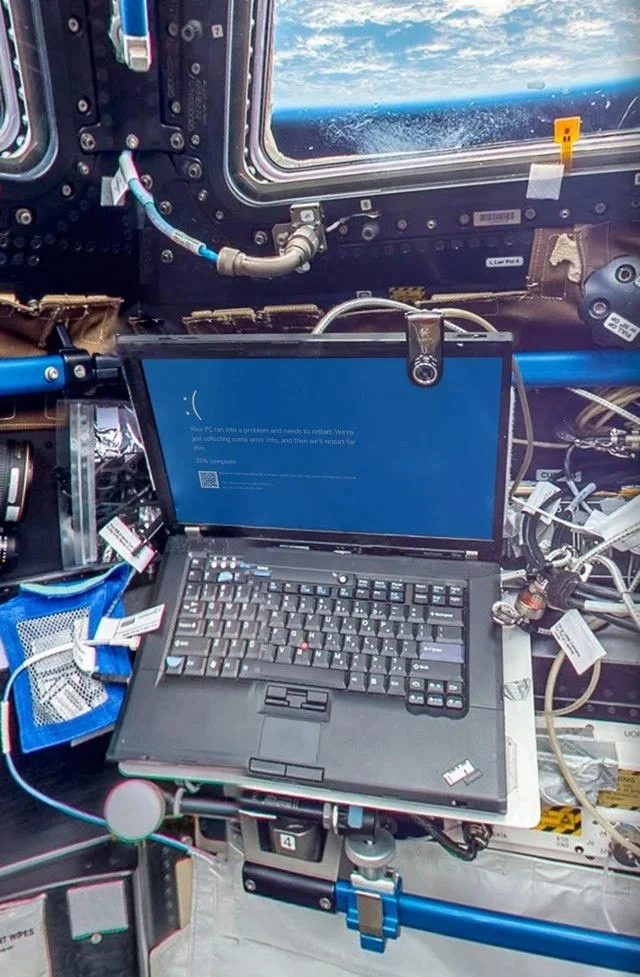
The visible laptop looks like a practical work machine, not a sleek consumer device. It is strapped into a busy workspace with cables and equipment around it, while Earth appears through the window above. That makes the crash feel funnier and more alarming. The same message people see on office laptops appears in a place that looks like it should be protected from ordinary computer nonsense.
For newer developers, this is a reminder that bugs and system failures happen at different layers. Your application can have a typo. A driver can mishandle hardware. The operating system can fail while managing memory or devices. The machine can restart even if the person using it did nothing wrong. Troubleshooting means figuring out which layer failed instead of just muttering "Windows" and staring into the middle distance, although that is a respected diagnostic phase.
Level 3: Rebooting the Cosmos
The post message says:
That's not rocket science, right?
The image answers: apparently it can be rocket science and still involve the same crash screen that ruins a spreadsheet on a Tuesday. That contrast is the whole payload. Around the laptop are cables, labels, brackets, rails, and a view of Earth from above. Everything in the frame signals expensive engineering, procedural discipline, and consequences. Then the laptop contributes the universal office ritual: SystemCrashes.
Experienced developers and systems administrators recognize the pain because reliability is contextual. A device can be physically rugged, mounted securely, and surrounded by mission-grade equipment while the software stack still depends on layers that were not designed with orbital romance in mind. The blue screen compresses a whole fault tree into one calm message. Somewhere beneath it could be:
- a kernel-mode driver failure
- a hardware interface behaving unexpectedly
- a bad update or configuration
- memory corruption
- a power or thermal edge case
- a peripheral that chose violence through the driver API
The joke also pokes at HardwareVsSoftware. People outside engineering often imagine hard problems as shiny physical machines: rockets, modules, windows, cables, titanium-looking brackets. Software failure is less cinematic, so it gets underestimated until a plain blue rectangle becomes the most important object in the room. The meme says the quiet part loudly: no matter how advanced the surrounding system looks, the software still gets a vote.
There is a small operational truth here too. In real high-stakes projects, the impressive part is not that nothing ever fails. The impressive part is that failures are expected, bounded, logged, and recoverable. A blue screen on a crew laptop may be annoying; a blue screen on a control path would be a design review with free coffee and no joy. The image is funny because it lets those worlds visually collapse into one absurd workstation.
Level 4: Kernel Panic, Earthside
The laptop is sitting in a spacecraft-like workstation with Earth visible through the window, and its display shows the most democratic failure mode in computing: the blue crash screen. The visible Windows text includes the sad face:
:(
and the familiar line:
Your PC ran into a problem and needs to restart.
That matters because a blue screen is not a normal application crash. In Windows terms, this usually means the operating system has hit a condition where continuing could corrupt memory, lose data, or leave hardware in an unsafe state. The kernel chooses to stop, collect diagnostic information, and reboot. It is the software equivalent of pulling the fire alarm because the building's electrical panel is making a noise the architect never wanted to hear.
The technical humor is in the mismatch between hardware reliability expectations and operating system reality. Space hardware is designed around fault tolerance, redundancy, and careful verification. Commodity laptops and general-purpose operating systems are designed around a much broader, messier ecosystem: drivers, peripherals, updates, device firmware, power states, storage controllers, and every cursed USB thing humanity has invented. A kernel crash can be triggered by bad memory, a driver dereferencing nonsense, an unexpected hardware response, or a race condition that appears only when timing, load, and cosmic irony align.
In high-stakes environments, the solution is not "make computers never crash," because that sentence belongs in the same drawer as "final final v3 really final." The serious engineering answer is containment: isolate critical control systems, use watchdogs, build fallback modes, separate mission-critical computers from crew laptops, and make sure a single workstation failure does not become a vehicle failure. The meme is funny because the laptop looks dramatically close to orbital seriousness, but the screen is saying, in essence, "give me a minute, I am becoming a dump file."
Description
The image shows a rugged black laptop strapped into a cramped spacecraft or space-station module, with Earth visible through a window above it and cables, labels, and equipment surrounding the workstation. The laptop displays a Windows-style blue crash screen with a sad face and text beginning "Your PC ran into a problem and needs to restart," followed by progress text about collecting error information. The sibling caption says "That's not rocket science, right?" which turns the literal aerospace setting into a joke about everyday operating-system failures appearing in high-stakes engineering environments. The humor comes from the contrast between complex mission hardware and the familiar fragility of a Windows crash screen.
Comments
9Comment deleted
Somewhere in the fault tree is a box labeled “try turning the orbital workstation off and on again.”
there is not enough space for windows on this station Comment deleted
👍 Comment deleted
Давайте дальше форсить фейкоту Comment deleted
Bruh, this is meme Comment deleted
Мем должен быть тру Comment deleted
откройте окно стало душновато Comment deleted
Install gentoo Comment deleted
Моя любимая раскладка Comment deleted