The Perils of Zero-Based Indexing in a Relationship
Why is this Languages meme funny?
Level 1: Counting Confusion
Imagine you have two toys and you label them in a silly way: you call the first toy “Toy 0” and the second toy “Toy 1”. Now if you tell your friend, “Toy 1 is my favorite,” your friend might think you mean the first toy (because most people start counting at 1). But you were counting from 0, so “Toy 1” was actually the second toy. That would be pretty confusing, right? In this meme, the boyfriend tells his girlfriend she’s “number one.” Normally, that means she’s the top, the very best. But since he’s a programmer who counts starting at zero, when he says “number one” he might really mean she’s in second place without realizing it. The poor girlfriend is left with a baffled look – kind of like that wide-eyed seal – thinking, “Wait, did he just make me second-best by mistake?” It’s funny (and a bit awkward) because a simple difference in how you count can completely change the meaning of a compliment.
Level 2: Counting from Zero
For those newer to coding, let’s break down the joke. In many programming languages (especially in the C family), arrays and lists start counting at zero. This is what we call zero-based indexing. That means if you have a list of things, the first item is at index 0, the second item is at index 1, the third item is at index 2, and so on. It’s a little counter-intuitive at first, because in everyday life we usually start counting at one (1st, 2nd, 3rd...). But in C programming, if you had an array of winners:
const char* winners[3] = {"Alice", "Bob", "Carol"};
// Here, winners[0] == "Alice" (1st place),
// winners[1] == "Bob" (2nd place),
// winners[2] == "Carol" (3rd place).
winners[0] is the first element ("Alice"), winners[1] is the second, etc. So index 1 corresponds to the 2nd item in the list. This is a classic LanguageQuirk of C and similar languages. New programmers often trip over this, accidentally creating an OffByOneError – a logic mistake where you’re off by one in your counting. For example, if you loop through 0 to 10 inclusive, you’ll actually run 11 iterations instead of 10, which can cause all sorts of bugs. Off-by-one errors are so common they’re an ongoing joke in programming.
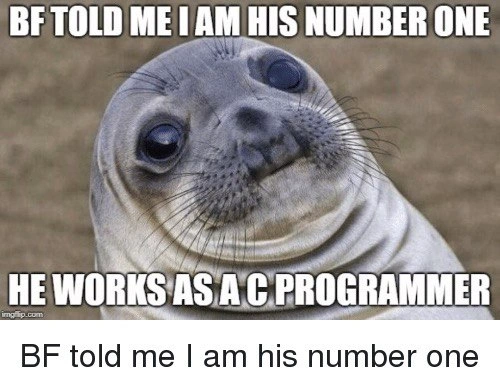
Now, the meme takes this technical concept and puts it into a relationship context. The top text says, “BF told me I am his number one,” and the bottom text reveals, “He works as a C programmer.” If someone’s boyfriend says “You’re my number one,” normally that means you’re the most important person to him — number one in his heart. 🥇 But the punchline here is that because he’s a C programmer, “number one” might actually mean index 1 in his mind. And index 1, in coding terms, is the second item! It implies a funny (and awkward) misunderstanding: the girlfriend thought she was being put in first place, but then she realizes her boyfriend’s nerdy brain might have counted from zero, effectively putting her in second place by accident.
The image of the Awkward Penguin/Seal (often used in memes to indicate a socially awkward or unsettling realization) captures how she might feel at that moment: a bit stunned and unsure how to react. Imagine your partner says something sweet, then you remember a nerdy fact about how they think, and suddenly you’re second-guessing the compliment. That “wait... what did you really mean?” feeling is exactly what the wide-eyed seal represents. It’s humor that combines programming and everyday life: only those who know about zero-based indexing get why “number one” could be misinterpreted. It’s a great example of HumorInTech, where understanding a tech concept (here, how C counts from 0) turns a normal phrase into a nerdy punchline. The tags like counting_from_zero and relationship_vs_programming sum it up: it’s a counting joke colliding with couple talk. For a junior dev or someone just learning to code, it’s a lighthearted reminder: be careful how you count – in code and in compliments!
Level 3: Zero-Based Romance
From a seasoned developer’s perspective, this meme hilariously spotlights an off-by-one error playing out in a relationship scenario. Off-by-one errors are the bane of many programmers’ existence – that classic bug where you loop one time too many or misalign an index by 1. Here the “bug” isn’t in code but in conversation: the boyfriend calls his partner “number one,” intending it as a loving compliment, but because he “indexes” things like a C programmer, it’s as if he’s accidentally ranked her second! 😅 This twist evokes a knowing groan from experienced devs because we’ve all been burned by off-by-one mistakes in our code, and the meme cleverly extends that concept to personal life. It’s humor in LanguageQuirks: a simple phrase gets a double meaning when you apply a programmer’s logic.
The shared joke is really about how a developer’s mental model can leak into daily life. In the world of C (and many languages influenced by it), starting counts at 0 is second nature. CFamilyLanguages like C, C++, Java, and others have trained us that the “first” element is index 0, so much that if you ask a seasoned C dev for the first item, a tiny part of their brain might translate that to index 0 without thinking. If such a dev calls someone “number one,” those in on the coding joke immediately suspect an intentional geeky compliment mishap – essentially saying “you’re second to none… literally one index after zero.” The Awkward Seal image (with its wide-eyed, uncomfortable expression) perfectly captures that “Uh oh, did he just…?” feeling when the realization hits. It’s the same face a programmer might make upon realizing they incremented a loop counter too far or used <= when they should’ve used < in a boundary check.
This meme resonates in tech circles because it’s too real: off-by-one errors happen all the time in code, and here we’re joking that they could happen in your love life as well. The caption “BF TOLD ME I AM HIS NUMBER ONE – HE WORKS AS A C PROGRAMMER” sets up a classic case of programmer humor. The implication is that when he said “number one,” he might have been indexing from zero in his head. That means the poor girlfriend might actually be index 1 in his internal priority array – i.e., his second priority! It’s a tongue-in-cheek way to poke fun at how programmers sometimes unintentionally prioritize or categorize things differently (hence the context tag c_programmer_priorities). Of course, in reality, no developer actually thinks of their partner as “index 1,” but the joke lands because we exaggerate a truth: developers spend so much time in structured, zero-indexed systems that it can warp our phrasing or humor.
There’s also an industry inside-joke here: “There are only two hard things in Computer Science: cache invalidation, naming things, and off-by-one errors.” 🤓 This famous witty quote ironically demonstrates an off-by-one error by listing three things as if they were two. In the spirit of that joke, the boyfriend’s compliment contains an off-by-one error — he meant she’s the top priority (1st place), but phrased as a coder would, it accidentally comes out as second place. Seasonsed devs chuckle because they’ve not only encountered countless off-by-one bugs in code, but they’ve also seen how easily a tiny numbering mistake can completely change meaning. The meme playfully warns: be careful when mixing your programming brain with romance — indexing issues aren’t so charming on date night! In short, the humor comes from a very real programmer pitfall being misapplied to relationships, highlighting a fun clash between relationship vs programming worldviews.
Level 4: Zeroth Means First
At the deepest technical layer, this meme touches on how computers count things versus how humans do. In low-level terms, languages like C use zero-based indexing for arrays: the first element is at index 0, the second element at index 1, and so on. This convention comes from the way memory addresses work. If an array starts at memory location 1000, then array[0] refers to address 1000 + (0 * element_size) – i.e., the very start of the array. Likewise, array[1] would be address 1000 + (1 * element_size), the next slot in memory. By numbering from 0, C makes the math clean and efficient: the index directly maps to an offset from the start address. Early language designers like Edsger Dijkstra even argued that counting from zero is more elegant and natural in computing because it makes array bounds a half-open interval [0, N), simplifying many algorithms. This is why in C (and many CFamilyLanguages that followed), the “first” item is at index 0 – a design decision rooted in pointer arithmetic and hardware efficiency.
Understanding this zero-based indexing is key to seeing the joke: when a C programmer says “number one,” their brain might literally be thinking of the item at index 1. In a C array or string, index 1 is the second element. So, there’s this subtle logical translation issue – a kind of off-by-one mental error – where “number one” in code is actually the runner-up in real life. This technical quirk sets the stage for the humor, illustrating how deeply programming concepts (like how we index and count) can seep into a developer’s everyday thinking. It’s a bit like a type mismatch between human language and code: the phrase is the same, but the underlying "indexing system" is different. The result? A perfectly logical compliment in code-speak turns into an accidental slight in normal speak, thanks to the fundamental way arrays and pointers work under the hood.
Description
This meme uses the 'Awkward Moment Seal' format, which features a close-up of a seal with a knowing, slightly uncomfortable expression, tilting its head. White text in Impact font is overlaid on the image. The top line reads, 'BF TOLD ME I AM HIS NUMBER ONE'. The bottom line delivers the punchline: 'HE WORKS AS A C PROGRAMMER'. The humor is derived from a core computer science concept, zero-based indexing, which is fundamental in the C programming language and many others. In this system, the first element in an array is at index 0, and the element at index 1 is actually the second. The joke implies that the boyfriend's compliment is unintentionally backhanded, making his partner the second most important, not the first. The seal's expression perfectly captures the dawning, awkward realization of this technicality

Comments
8Comment deleted
She's his number one, which is fine until he needs to iterate over his priorities and the loop starts with `for (int i = 0; ...)`
He called her “number one,” she opened a pull request titled “Off-by-one fix,” and their relationship immediately flagged as a breaking change
After 20 years in tech, you realize being someone's "number one" is just another off-by-one error waiting to happen in production
Being a C programmer's number one means there's a number zero he dereferences first - and she's probably a wild pointer
The real tragedy here isn't the off-by-one error in his romantic declaration - it's that he's probably spent so many years debugging segfaults and buffer overflows that his brain automatically decrements all positive integers. At least when the relationship inevitably crashes, he'll know exactly where to look: undefined behavior in the emotional memory management subsystem. Though to be fair, in a language where you can accidentally overwrite your entire stack with a misplaced pointer, being 'number one' instead of 'number zero' might actually be the least of their problems
She's his #1 - classic off-by-one, landing her at arr[1] right after the null pointer sweetheart at 0
Dating a C dev means romance via pointer arithmetic - “you’re my number one” translates to *(partner + 1); index 0 is kept for backward compatibility
Dating a C dev: he says I’m “number one.” I asked if that’s 1-based business speak or just an off-by-one in his priority array