Skip to content
DevMeme
6247 of 7435
Auto-caption glitch: Dev-kits hilariously misheard as deaf kids in game talk
AI ML Post #6850, on Jun 5, 2025 in TG

Auto-caption glitch: Dev-kits hilariously misheard as deaf kids in game talk

Why is this AI ML meme funny?

Level 1: Silly Mix-Up

Imagine you’re playing a game of telephone with friends. You whisper to the next person, “We have a secret box hiding toys,” but by the time it reaches the last person, they announce, “We have a secret box hiding boys!” Suddenly everyone goes, “Wait, WHAT?!” You’d quickly laugh and say, “No, no – I said toys, not boys!” It’s a funny misunderstanding. In this meme, something similar happened but with a computer doing the listening. The game developer said something normal (that they were hiding special game devices called dev kits), but the computer thought it heard something crazy (that they were hiding deaf kids!). Just like in the telephone game, one small hearing mistake made a totally different and silly message. It’s funny because the wrong message was so outrageous – of course they aren’t hiding children! The mistake was immediately fixed, and everyone could laugh in relief. The whole joke is a big silly mix-up: the computer’s “ears” got it wrong, and it turned a simple secret about games into a wildly goofy story by accident.

Level 2: Dev Kits, Not Deaf Kids

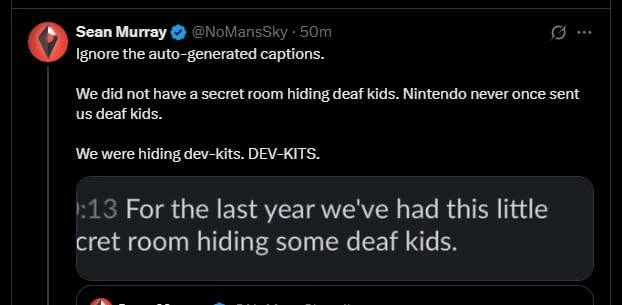
Let’s break down what’s happening in this meme in simpler terms. The image is a tweet from a game developer clarifying a funny mistake made by auto-generated captions. Auto-generated captions are subtitles that a computer writes out by listening to someone speaking in a video. It’s basically speech-to-text done by an AI – no human typist involved. These captions are super useful, especially for accessibility (like helping people who are deaf or hard-of-hearing, or anyone who wants to read along). But because a machine is doing the listening, it can mishear words – just like a person can, only a computer doesn’t have common sense to double-check if the result sounds ridiculous. That’s exactly what happened here: the AI captioning system thought it heard something that it actually didn’t.

The developer in the tweet mentions a "secret room" where they were hiding dev-kits. A dev-kit (short for development kit) in the context of GameDev is a special piece of hardware or console sent out by a company (like Nintendo) to game studios. For example, if Nintendo is working on a new console, they’ll send these Nintendo devkits to game developers so they can start making or optimizing games for that new system before it’s released to the public. These dev-kits are often top-secret. Studios usually keep them hush-hush – sometimes in locked rooms or under covers – because they’re often working under strict non-disclosure agreements (NDAs) not to show or talk about them. It’s common in the industry to hide a dev-kit so well that even some coworkers might not know it’s there! So "having a secret room hiding some dev-kits" is a totally normal (if exciting) thing in a game studio. It means they had new Nintendo hardware that nobody was supposed to see.

Now, here’s where the AI limitation and the humor come in. The automatic caption tool misheard the term "dev-kits" as "deaf kids". Those two phrases sound confusingly similar, especially if the audio quality isn’t perfect or the speaker’s accent makes "kits" and "kids" sound alike. Plus, "dev" is a tech slang word (short for developer) that the captioning AI might not be as familiar with, whereas "deaf" is a common real word. So the poor AI made a transcription error: it took a techie phrase it didn’t recognize and turned it into the closest familiar-sounding phrase in its dictionary. The result? The caption on the video ended up reading something absurd: “we've had this little secret room hiding some deaf kids”. You can imagine the viewers’ shock or confusion seeing that! It implies something totally different (and very wrong) compared to the actual statement.

The developer (Sean Murray) quickly posted this tweet to clear things up. He basically says, "Ignore the auto-captions. We absolutely did NOT have a secret room with deaf kids. Nintendo never sent us any children! We were hiding dev-kits. DEV-KITS." You can feel his emphasis – he’s practically spelling it out because the difference of one letter completely changes the meaning. It’s a bit of a voice_recognition_bug moment. Everyone following along realizes it was just a hilarious technical glitch. This is a great example of a bug in software that isn’t a crash or a typo in code, but rather the kind of bug where an AI feature misbehaves in a subtle way (subtle bug, big laugh). The tags like AIHumor and MachineLearningHumor apply because it’s the AI’s mistake that’s making us laugh. And indeed, it showcases the fallibility of machines: even advanced machine learning tools can mess up understanding simple dialogue if it includes uncommon lingo.

For a junior developer or someone new to this: it’s a gentle reminder that fancy tools aren’t infallible. If you’ve ever used a voice assistant (like Siri, Alexa, or Google) and had it misunderstand you – say you asked for “weather in Newark” and it heard “whether to knit work” – you’ve encountered this kind of error. The stakes here were a bit higher because it sounded like the studio had a dark secret, which could have been a PR disaster if people took it seriously. But since it was obviously a mistake, it turned into a joke. The phrase "Dev kits vs deaf kids" is now an internal punchline about how one misheard word can cause a world of difference. As developers (even junior ones), it’s a lesson in always considering edge cases: if your app uses speech-to-text or any AI, think about how it might fail. Thankfully, this failure just resulted in some laughs and a memorable tweet, rather than something truly harmful. And you can bet that team will manually check their subtitles next time!

Level 3: Dev Kits != Deaf Kids

Experienced developers can’t help but smirk and cringe at this scenario – it’s a collision of AI humor and real-life GameDev secrecy. The screenshot is a tweet from Sean Murray (known for No Man’s Sky), emphatically clarifying that they did not have a hidden room full of children. Instead, they were hiding dev-kits – the confidential development consoles sent by companies like Nintendo under strict NDA. In game development, hiding a dev kit is totally normal (studios often stash unreleased hardware in literal locked closets or under code names to avoid leaks). By contrast, hiding "deaf kids" would be a horrific crime! The absurdity of that phrase appearing in captions is what makes this meme peak developer humor – a perfect illustration of an innocuous tech term turning into a PR nightmare because a machine got one vowel wrong. It’s a caption misinterpretation of epic proportions.

For senior engineers, this hits on the recurring pain of AI/ML edge cases. We’ve all seen auto-generated captions fail in one way or another – from live conference transcripts mangling our jargon to voice assistants texting the wrong message. It’s always at the worst time, too. Here it happened while discussing a top-secret project element (Nintendo’s hardware). The AI’s speech_to_text_error popped out a phrase so scandalous that the dev had to immediately do damage control on Twitter. It’s a testament to why we double-check everything, even the subtitling, before going public. As seasoned devs know, you can’t entirely trust the voice recognition black box; it might have 95% accuracy in tests, but those 5% of errors tend to be real doozies. This one turned a mundane statement into something that could spawn wild rumors. (No one wants a headline like “Game Studio Allegedly Hides Children on Site” because of a subtitle glitch!) The tweet’s author even jokes in a deadpan way: "Nintendo never once sent us deaf kids." and "DEV-KITS, not deaf kids," making sure absolutely no one misunderstands. The reply caption "Never doubted Nintendo" wryly implies, of course Nintendo ships development hardware, not children — what a relief!

Critically, the humor also shines a light on AI limitations in understanding context. The AI heard "something kids" and confidently printed a very wrong thing because it had no concept of Nintendo or developer kits. A human transcriber with basic context would have caught the oddity (or at least asked for clarification), but the AI plowed ahead. This is a subtle software bug – not a bug in code logic, but a bug in the training/data sense. It’s subtle because thousands of captions might be correct, but one oddball phrase slips through and it’s suddenly machine learning humor legend. From an engineering perspective, it’s both funny and a bit sobering: even after testing, an AI edge case like this can sneak by. It reminds veteran devs of that classic truth: the last 1% of errors are as hard to eliminate as the first 99%. And it’s always the edge-case you didn’t anticipate that gets you – in this case, an AI mishearing dev jargon.

On the bright side, the fiasco is relatively harmless: it gave the community a laugh and wasn’t an actual bug that crashes a system or hurts users. But it did teach a quick lesson in PR for the studio – always review auto captions, especially when discussing anything secret. The overlap of AI limitations and real-world implications here is what senior devs find both hilarious and poignant. We chuckle because we know this could happen to any of us. It’s a modern "tech blooper": the kind of thing you share with the team saying, “Remember to disable live captions in the next reveal, or we might end up ‘hiding deaf kids’ in the subtitles!” In short, this meme nails a slice of developer life: advanced technology doing something dumb, a serious voice_recognition_bug that flips meaning on its head, and the collective sigh (and laugh) of engineers who’ve been there before. It’s absurd, a little alarming, but ultimately a memorable instance of humor in tech born from a simple AI slip-up.

Level 4: Phonetic Fiasco

At the deepest technical level, this meme highlights a classic speech-to-text failure born from the intricacies of automatic speech recognition (ASR) systems. Modern ASR is driven by AI/ML models that convert audio waveforms into text. Under the hood, these models juggle acoustic signals and language probabilities. Essentially, the AI is mapping sounds (phonemes) to words using patterns it learned from tons of data. Here, the phrase "dev-kits" tripped up the system because of phonetic ambiguity: the audio for "dev kits" can closely resemble "deaf kids" if enunciated quickly or with certain accents. The captioning algorithm doesn’t truly understand meanings; it operates on likelihoods. If the term "dev kit" (developer kit) wasn’t common in its training data, the model’s language model component might favor the more familiar-sounding phrase "deaf kids," especially since "kids" is a common English word ending that faintly echoes "kits".

This is a textbook AI edge case. The system likely heard sounds like "…dev kits" but its statistical model parsed it as "…deaf kids" because that sequence of words might have appeared more often in its learned vocabulary (even if "hiding deaf kids" is a bizarre concept, the words themselves are in its dictionary). The slight difference between the phonemes /v k/ and /f k/ (in "dev k-" vs "deaf k-") can confuse even advanced neural networks without strong contextual filtering. In academic terms, the model suffered a recognition error due to a near-homophone and an out-of-vocabulary term. Historically, speech recognition systems (from old Hidden Markov Models to new end-to-end deep learning models) have struggled with domain-specific jargon. “Dev-kit” might have been outside the AI’s comfort zone, a victim of sparse training examples or a missing entry in its lexicon.

Crucially, the AI lacks semantic awareness – it doesn’t know that "a secret room hiding some deaf kids" is nonsensical (and alarming) in context. It simply matched sounds to likely words without comprehending the scenario. This exposes the fundamental limitation of current ASR: no real-world context or common sense. The humor is underpinned by this theoretical gap. From a research perspective, it’s a language model misfire where the absence of real understanding led to a perfectly wrong transcription. In summary, this phonetic fiasco exemplifies how even advanced machine learning models can stumble on subtle differences, producing a surreal error when faced with uncommon GameDev jargon and illustrating the AI limitations lurking in seemingly polished technology.

Description

The screenshot shows a dark-themed Twitter post from Sean Murray (@NoMansSky) timestamped "50m." The tweet reads: "Ignore the auto-generated captions. We did not have a secret room hiding deaf kids. Nintendo never once sent us deaf kids. We were hiding dev-kits. DEV-KITS." Beneath the tweet is a grey, rounded-corner overlay from a video caption system displaying the mis-transcribed line: "For the last year we've had this little cret room hiding some deaf kids." The humor hinges on an AI speech-to-text model swapping the phrase "dev-kits" for "deaf kids," illustrating both the fallibility of machine-generated captions and the linguistic minefield around developer jargon. Senior engineers will recognize the recurring pain of AI/ML edge cases, especially when demoing unreleased hardware like Nintendo development kits under strict secrecy

Comments

8
Anonymous ★ Top Pick Proof that even the most sophisticated LLM pipeline still treats domain-specific jargon like an untyped variable - compile once, embarrass everywhere
  1. Anonymous ★ Top Pick

    Proof that even the most sophisticated LLM pipeline still treats domain-specific jargon like an untyped variable - compile once, embarrass everywhere

  2. Anonymous

    The real horror isn't finding a memory leak in production - it's when your auto-captioning service turns your NDA-protected Nintendo dev-kits into a kidnapping confession. This is why we still manually review PRs but trust AI to transcribe our legal depositions

  3. Anonymous

    When your NLP model has never signed an NDA with Nintendo and thinks 'dev-kits' are some kind of humanitarian crisis. Classic case of insufficient domain-specific training data - though to be fair, both dev-kits and the kids who want them can be equally hard to keep quiet about

  4. Anonymous

    When your ASR ships without a domain lexicon, WER turns “dev-kits” into a compliance incident and Legal gets pager duty

  5. Anonymous

    Proof that ASR without a custom lexicon is a Sev-1; one homophone and “hiding Nintendo dev-kits” turns into a legal review and a PR retro

  6. Anonymous

    Dev kits under NDA: So secret, speech-to-text outs them as a daycare scandal before merge conflicts even hit

  7. @yontouryuu 1y

    Nintendo never fails to deliver the disappointment

  8. @Valithor 1y

    The Wayfair of video gaming

Use J and K for navigation