Biggest Babies On Earth Are Devs Who Get PR Feedback
Why is this CodeReviews meme funny?
Level 1: Lego Tower Tantrum
Imagine you and a friend are building a LEGO tower together. You carefully stack one piece on top of another. It’s your creation, and you’re proud of it. Now, your friend notices that one block is a bit wobbly and says, "Hey, maybe push that block in tighter so the tower doesn’t fall." That’s a pretty helpful suggestion, right? But instead of fixing the block, you suddenly get very upset. You cross your arms, maybe stomp your foot, and shout, "No! My tower is fine! Stop picking on it!" You might even feel like crying or decide to quit the game entirely because you feel hurt. This reaction is like having a tantrum over a tiny comment.
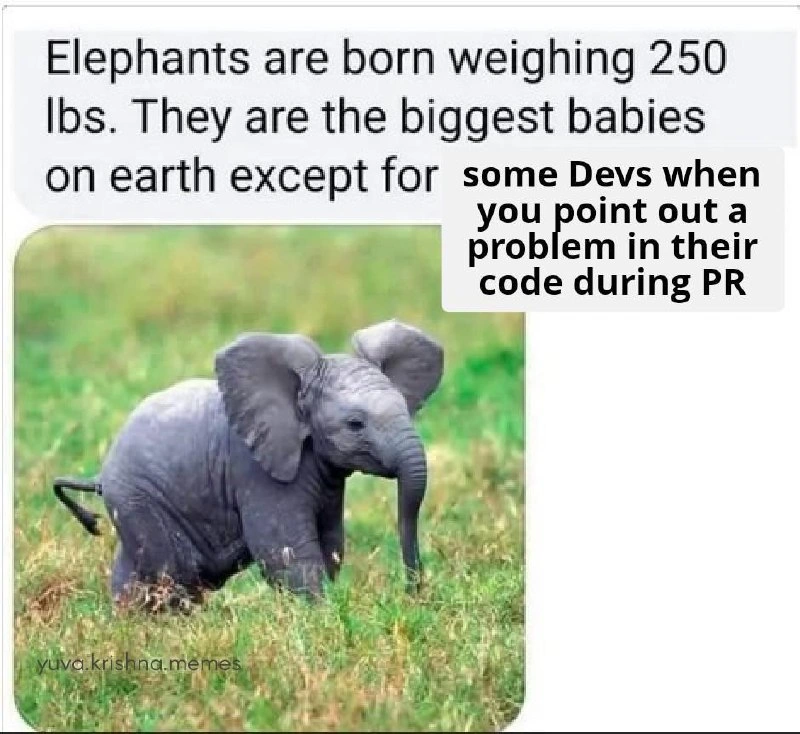
That’s exactly what the meme is joking about, but with grown-up programmers. The baby elephant in the picture is huge in size, but it’s still a baby. The meme says that some developers (people who write code) can act like the biggest babies when someone points out a small mistake or problem in their code. It’s as silly as a kid throwing a fit when a friend is just trying to help fix a leaning LEGO tower. In simple terms, the meme is funny because it shows an everyday truth in a playful way: sometimes, even adults behave childishly when they can’t handle a little bit of constructive criticism. It reminds us that, just like kids, grown-ups can have big feelings over a small fix. And maybe, just maybe, we should all try to listen and learn instead of kicking over the tower when someone offers help.
Level 2: When Code Feels Personal
Let’s break this down in simpler terms. Code reviews are a common practice where developers check each other’s code before it becomes part of the main project. Typically, this happens through a Pull Request (PR) on platforms like GitHub or GitLab. A pull request is essentially a request by the author for others to pull in (merge) their changes. During a PR, teammates will add comments, ask questions, or point out mistakes in the code. This process is meant to catch bugs, ensure consistency, and share knowledge. In theory, everyone’s just talking about the code, not the coder. But in reality, it’s easy for someone to feel like the comments are about them personally. That’s where the meme gets its punchline: it suggests that aside from 250-pound newborn elephants (the biggest babies physically), the "biggest babies on earth" are actually some developers when you point out a problem in their code during a review. In plainer words, some devs act really immature and touchy when given even mild feedback on their code.
Why would a developer react so strongly to a code comment? Well, many programmers pour a lot of time and pride into their work. It’s like a personal project for them. So when someone finds an issue or suggests a different approach, it can feel like a personal criticism, even if it’s not meant that way. This is often referred to as the developer’s ego getting tied up in the code. We sometimes call it code_review_ego: thinking your code is an extension of yourself. A developer with this mindset might get defensive – that is, they might argue back, get upset, or refuse to accept the suggestion. That’s why we use the term defensive_pr_author – it describes an author of code who reacts defensively to review comments in a PR. The meme specifically points to "some devs" implying not all, but enough that it’s a known issue. If you’ve ever heard someone say “Don’t take it personally, it’s just a code review,” this is the situation they’re trying to avoid.
Now, let’s decode some jargon and tags seen around this topic:
- Hypersensitive feedback response: This is a fancy way of saying overreacting to feedback. "Hypersensitive" means very easily hurt or offended. So if a reviewer says “there’s a small bug here,” a hypersensitive response would be the author getting very upset or acting like it’s a huge insult rather than a normal comment.
- PR commenting etiquette: “Etiquette” means polite manners. In PRs, there are unwritten rules for being polite and constructive. For example, instead of writing “Your code is wrong,” a polite reviewer might say “I think there’s an issue here, maybe consider another approach.” Reviewers often soften language to avoid sounding harsh. They also might avoid using personal language (“your code”) and focus on the code itself (“this code”). Good PR etiquette includes thanking the author for their work, pointing out positives, and framing suggestions kindly (e.g., saying "what do you think about doing X?").
- Senior engineer tact: “Tact” means sensitivity in dealing with others or doing something carefully to avoid offense. A senior (experienced) engineer often has learnt how to give feedback tactfully. They might add emoji 😊, or phrases like “nitpick:” to show a comment isn’t a big deal. They might say "LGTM" meaning the change is approved to merge, and then also mention a small suggestion, so the author knows the review is mostly positive. These are tactics to make sure the author doesn’t feel attacked. Essentially, experienced folks know how to sandwich criticism between compliments or keep the tone light.
- LGTM: This stands for "Looks Good To Me". It’s a quick way for a reviewer to say “I approve of this change.” Sometimes a reviewer will say "LGTM" even if they have a few minor comments. It’s like saying "Overall it's good, just fix these tiny things."
- Nitpick (nit): This term means a very small or trivial point. In code review lingo, a reviewer might prefix a comment with "nit:" to signal that it’s not an important flaw, just a tiny improvement or a matter of style. For instance: "nit: consider using a more descriptive variable name here." By marking it as a nitpick, the reviewer is saying "This isn’t a big problem, but maybe it could be a bit better."
- “lgtm_with_nitpick” (as seen in the tags) refers to exactly the scenario above: a reviewer says the code overall Looks Good To Me but also includes a nitpick or two. In other words, "I’m okay merging this, just note these small suggestions." This approach is used to keep the author from feeling the whole code is bad – just polish a little.
Despite all these polite strategies, some developers still react poorly. They might leave long comments defending their original code or get emotionally upset. That’s what the meme is teasing. It’s saying: these devs act like giant babies. The imagery of a baby elephant is humorous because baby elephants are enormous yet still infants. Likewise, an offended developer might be an adult (maybe even a physically big person or with a big reputation), but at that moment of reacting to a code critique, they’re behaving childishly. It highlights a culture joke: in tech, you can be brilliant at writing code but still have a lot of growing up to do emotionally.
From a junior developer’s perspective, the takeaway is: try not to be this person. Code reviews aren’t personal attacks; they’re opportunities to learn and make the code better. Everyone has had a bug or missed something – it’s normal. If someone points out a problem in your code during a PR, it doesn’t mean you’re a bad programmer. It means they care about the project and want to help fix or improve that one spot. On the flip side, as you start reviewing others’ code, remember to be respectful and clear – follow that PR commenting etiquette so you don’t accidentally upset someone. Communication is a key part of developer culture, and handling feedback well (both giving and receiving) is a sign of a mature, team-oriented developer. The meme exaggerates the bad behavior to make us laugh and reflect. It’s funny because it’s a little true, and it nudges us to do better than the “big baby” dev stereotype.
Level 3: Elephant in Code Review
In the wild world of software development, code reviews are supposed to be a routine quality gate, but this meme highlights how they often turn into an emotional minefield. The caption jokes that a newborn elephant (at ~250 lbs, literally one of the biggest babies on earth) is topped by "some devs when you point out a problem in their code during a PR". In other words, a developer with a fragile ego can become an even bigger baby than a baby elephant when their code is critiqued. Seasoned engineers chuckle (perhaps a bit wearily) at this because we’ve all seen it: a seemingly minor pull request comment triggers a major defensive reaction. It's the elephant in the code review room – an obvious issue everyone tiptoes around: personal pride colliding with collaborative feedback.
Why is this scenario so familiar and funny to experienced devs? Let’s unpack the elements: a pull request (PR) is when a developer asks to merge their code changes into the main codebase, and colleagues review the changes first. In theory, it’s about code quality and catching bugs; in practice, you’re also tiptoeing around human emotion. The meme’s humor comes from comparing an elephant’s massive birth weight to the massive ego or sensitivity some developers display during code reviews. It's hyperbole with a kernel of truth: an elephant calf might weigh 250 lbs, but an offended programmer’s ego can feel even heavier in a code review. 🐘✨
Shared Trauma in the PR Arena: The phrase "pull-request arena" (as in the title) isn’t just colorful language. For many teams, PRs can feel like gladiatorial combat where code and ego clash. A simple suggestion like, "Hey, maybe check for null here to avoid a crash," can be received by a defensive PR author as if you challenged their entire career. This is a known anti-pattern: code_review_ego – when an author’s self-worth is so tied to their code that any critique feels like a personal attack. Instead of "thanks, good catch!" you get long explanations, excuses, or even hostility. The defensive_pr_author will bend over backwards to justify every line, sometimes overengineering a convoluted fix rather than accepting a simple suggestion they didn’t come up with. To a battle-hardened senior dev, this behavior is simultaneously frustrating and darkly comic. We’ve seen otherwise brilliant colleagues transform into the “biggest babies” at the slightest hint of criticism on their precious code.
Industry Patterns & Unspoken Truths: There’s an unwritten shared experience among developers: at some point you either give a code review that inadvertently bruises someone’s ego, or you receive one that feels harsher than it was meant. The meme resonates because it captures that absurd emotional disproportionality. Picture a trivial PR comment spiraling into a multi-paragraph rebuttal at 2 AM – a scenario so common it’s practically a rite of passage. This is the heart of CodeReviewPainPoints and DeveloperFrustration. The tags hint at familiar themes: hypersensitive_feedback_response is when a tiny bit of feedback (like a one-line fix suggestion) triggers an outsized, sensitive reaction. It often starts innocently: a reviewer might make a polite note, perhaps prefixing with "nit:" (short for nitpick) to convey it’s a minor suggestion. In GitHub or GitLab, you’ll literally see comments like:
Reviewer: LGTM 👍. Just a nitpick: could we rename
tempVartoretryCountfor clarity?
Author: I don’t see why that’s necessary. The code works fine. Do we really need to bikeshed naming?
Here, LGTM (“Looks Good To Me”) is the reviewer’s way of saying "overall, it's fine," often used to soften any critique. The reviewer even labeled their naming comment as a nitpick to show it’s minor. This is PR commenting etiquette in action: lead with approval, then couch suggestions gently. And yet, the author’s response comes off defensive — dismissing the feedback as unnecessary “bikeshedding” (arguing over trivial details). The meme humorously suggests that devs like this author are bigger babies than a literal baby elephant. Why do we find that funny? Because it’s true enough to sting a little. Every senior engineer has either been that sensitive dev early in their career or has had to review code for someone like that. It’s a relatable developer experience – simultaneously cringe-worthy and comical to recall.
Systemic Issues Feeding the Ego: On a serious note, this phenomenon persists due to both human nature and cultural issues in tech. Code is often referred to as “your baby.” You pour your skill and sweat into it, so hearing someone say "there’s a problem with your baby" triggers instinctive defensiveness. Psychology 101: our brains sometimes interpret critique as threat. In a healthy engineering culture, everyone understands “it’s not personal; we’re all on the same team hunting bugs.” But not all teams have that culture. Some companies implicitly reward being “the one who’s always right,” so admitting your code has flaws can feel risky. That leads to fragile egos where even mild feedback is viewed as a public humiliation. If a workplace lacks trust, a simple PR comment can set off fireworks as if it were an attack on competence. It’s ironic because code reviews are meant to prevent problems, yet without psychological safety they create new ones (hurt feelings, stalled progress).
Senior Engineer Tactics (and Tact): Experienced developers learn to navigate these interpersonal minefields with care. This is where senior_engineer_tact comes into play. Veterans have a whole playbook of softening phrases and strategies: use inclusive language (“we might consider…” instead of “you did X wrong…”), praise good aspects of the code before pointing out issues, label suggestions as “nit” or use emojis 🙂 to convey friendly tone in text. They do all this to avoid poking the elephantine ego too hard. Sometimes they even let truly trivial issues slide (or handle them in a later commit) just to keep the peace, a compromise between ideal code quality and team harmony. This is humorously captured by the lgtm_with_nitpick tag – the idea that you say “Looks good!” and only very gently mention the smallest issues, like sneaking vegetables into a toddler’s meal. Yet, as the meme implies, some devs still blow up at even the gentlest critique. It’s like defusing a bomb only to have it explode in slow motion during the retrospective meeting. The result? Reviewers end up walking on eggshells around certain “big baby” coders.
Why This Humor Hits Home: The image of a wobbly baby elephant with its ears flared in mild distress perfectly represents those over-sensitive dev reactions: disproportionate and a bit absurd, yet oddly endearing from a distance. There’s a fine line between empathy and eye-rolling. On one hand, we’ve all felt a twinge of "ouch, they found an error in my code". On the other hand, watching an adult professional respond to a small critique with the theatrics of a toddler is undeniably comic. This meme pokes fun at that dual reality. It’s a gentle reminder and inside joke: don’t be the developer equivalent of a 250-pound baby. In the trenches of code review, humility and open-mindedness go a long way. And if you catch yourself or a teammate getting overly defensive, just remember the baby elephant – a goofy metaphor to diffuse tension. After all, even the biggest land mammals eventually grow up, and so can our ability to handle a bit of code review truth.
Description
Meme featuring a photo of a baby elephant on grass with text above reading: 'Elephants are born weighing 250 lbs. They are the biggest babies on earth except for' and bold text completing the sentence: 'some Devs when you point out a problem in their code during PR.' Watermark shows 'yuva.krishna.memes'. The meme compares developers who take code review feedback personally to baby elephants - implying certain developers behave like enormous babies when their code is criticized during pull request reviews, a universally relatable experience in software teams
Comments
8Comment deleted
The five stages of receiving a PR comment: Denial ('it works on my machine'), Anger ('who approved YOUR code?'), Bargaining ('can we discuss this offline?'), Depression (closes laptop), Acceptance (resolves with 'will fix in next PR')
The most advanced refactoring technique is rewriting a PR comment from 'This is wrong' to 'Interesting! What do you think about the potential race condition here?' to gently bypass the author's ego-driven test suite
Nothing inflates faster than AWS costs - except a developer’s ego the moment you suggest renaming a variable in their 400-line PR
After 20 years in tech, I've learned that the most complex distributed system isn't Kubernetes or Kafka - it's navigating the emotional state machine of a senior engineer whose singleton pattern just got questioned by a junior who read Clean Code last weekend
The irony is that the developers most defensive about their code during PR reviews are often the same ones who'll ruthlessly refactor someone else's 'legacy' code from last sprint. It's the engineering equivalent of 'my baby is perfect, but your baby needs work' - except the baby weighs 250 lbs of technical debt and has strong opinions about semicolons
Amazing how a 'nit: rename' comment can turn a 10-minute PR into a week-long incident with higher P99 latency than our API
Our PR process claims to be blameless, yet a two-line bounds check triggers a Byzantine node - the author's ego - refusing quorum
Baby elephants trunk improvements naturally; PR authors just spawn a herd of 'but it works on my machine' commits