Anthropic Officially More Open Than OpenAI, Says Mr. Poopybutthole Tweet
Why is this AI ML meme funny?
Level 1: The Ice Cream Shop With No Ice Cream
Imagine a shop called "Free Candy Store" that charges five dollars for every candy and keeps the recipes locked in a safe. Next door is a plain shop just called "Bob's" — and one day Bob starts handing out free samples and recipe cards. The whole town starts laughing: "Bob's is now officially more generous than the Free Candy Store!" That's the entire joke. A company with "Open" in its name became famous for keeping things closed, and a rival without any such promise ended up sharing more — announced, naturally, by a silly cartoon professor solemnly writing his own name on a chalkboard, because the situation is too absurd for a serious messenger.
Level 2: Open vs. "Open"
Key terms behind the punchline:
- Open source — software whose source code is published under a license letting anyone inspect, modify, and redistribute it. The gold standard of "open."
- Open weights — an AI-specific middle ground: the trained model parameters (the giant file of numbers that is the model) are downloadable, even if training data and code aren't. You can run and fine-tune the model yourself.
- Closed / proprietary model — you never touch the model itself; you send requests to the company's API and get responses back. Convenient, but you're dependent on their pricing, uptime, and policies.
- Model licensing — the legal terms attached to weights. Some "open" releases carry restrictions (no commercial use, usage policies), which fuels endless community arguments about whether they count as open at all.
The cultural reference: Mr. Poopybutthole is a recurring Rick and Morty character — cheerful, oddly named, treated with complete seriousness by everyone in-universe. Pasting him as the announcer of industry news is the meme format for "this is ridiculous and yet it's really happening."
Early-career takeaway: when evaluating an AI model for a project, don't read the company name — read the license. Whether you can self-host decides your architecture, your costs, and what happens to your product if the provider changes the rules.
Level 3: Nominative Anti-Determinism
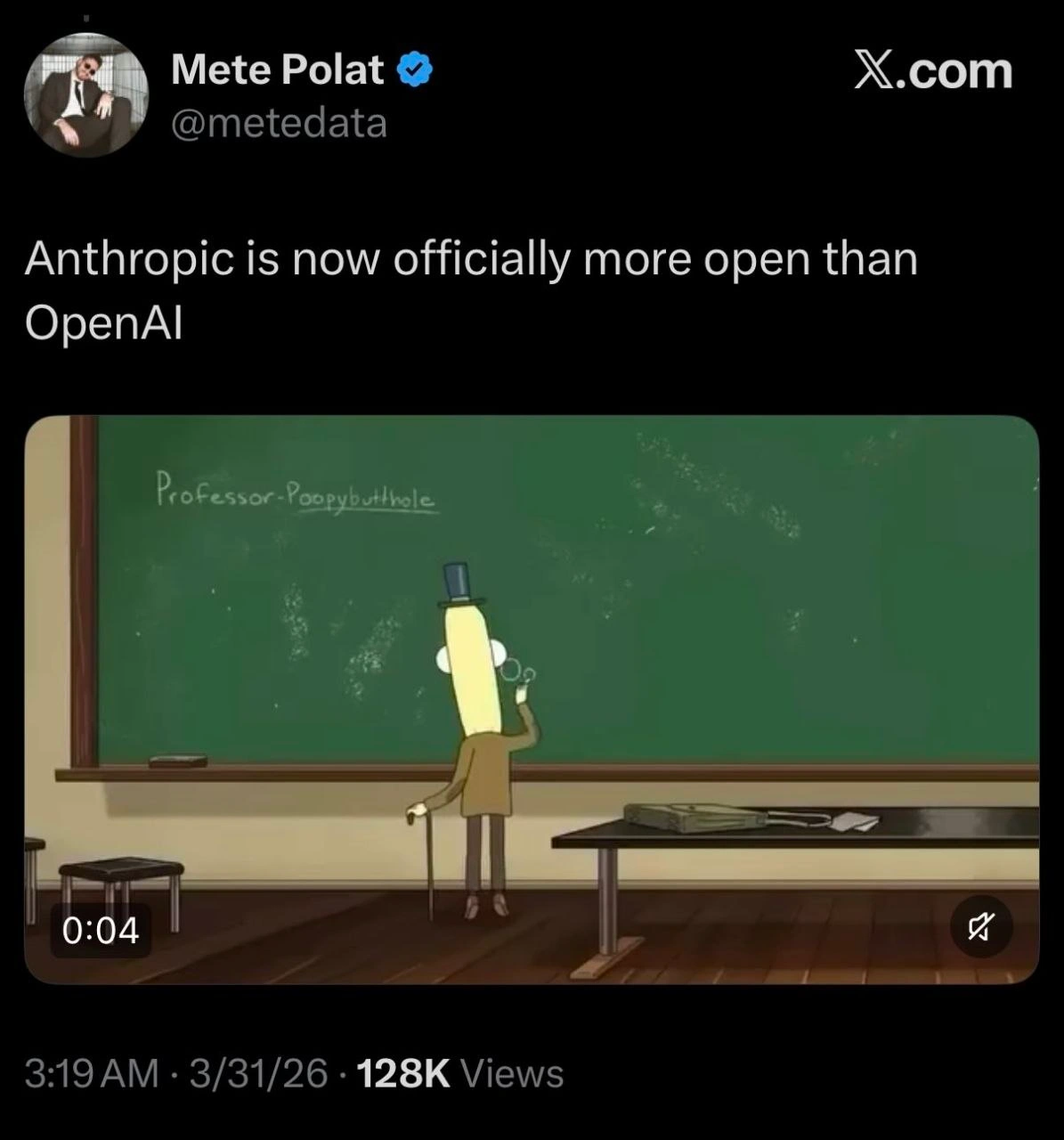
Anthropic is now officially more open than OpenAI
One sentence, posted by @metedata with 128K views, paired with a frame of Mr. Poopybutthole — dressed as an elderly professor in a top hat, leaning on a cane, having just chalked "Professor-Poopybutthole" onto a green board in an empty classroom. The image choice is doing surgical work: it's a character whose name is openly absurd writing his own absurd title on a blackboard with full academic gravitas. That is precisely the energy of the AI industry's naming conventions — solemn institutional branding draped over claims that don't survive contact with a LICENSE file.
The underlying joke is one of the longest-running ironies in modern tech. OpenAI was founded with "open" in its name and an explicit founding narrative of openly shared research. Over the years it pivoted to proprietary, API-gated frontier models with unpublished weights and architectures — a closure so notorious that "OpenAI isn't open" graduated from hot take to background radiation. Meanwhile Anthropic, which never branded itself around openness at all, gets crowned "officially more open" — and the meme's bite comes from the word officially, mock-certifying a ranking on a metric one of the contestants literally named themselves after.
For engineers who track the open-weights debate, this satirizes something real and consequential. Whether you can download a model's weights determines whether you can self-host it, fine-tune it, audit it, or run it air-gapped — versus renting capability through an API that can change pricing, behavior, or availability under you. The industry learned this dependency lesson with cloud lock-in and is now re-learning it with model providers. There's also a deeper structural observation: companies open-source what's strategically convenient. Openness in AI is rarely ideology; it's a competitive weapon — commoditize your complement, win developer mindshare, or undercut a rival's moat. So rankings of "who is more open" shift not with values but with market position, which is why the announcement is best delivered by a cartoon character whose entire existence is a gag about unearned credibility.
The chalkboard scene adds one more layer: an empty classroom, a self-appointed professor, a freshly underlined title. Every AI lab announcement thread on X has exactly this vibe — lecturing to an audience that may or may not exist, credentials self-inscribed.
Description
A screenshot of an X.com post by verified user Mete Polat (@metedata), posted 3:19 AM on 3/31/26 with 128K views, reading: 'Anthropic is now officially more open than OpenAI'. Attached is a 4-second muted video frame from Rick and Morty showing Mr. Poopybutthole as an elderly professor in a top hat and brown suit, leaning on a cane and writing 'Professor-Poopybutthole' on a green chalkboard in an empty classroom. The joke targets the long-running irony in the AI industry: OpenAI, despite its name, became famously closed (proprietary weights, restrictive licensing), while Anthropic - never claiming openness in its name - ended up releasing more openly than its rival, a punchline that lands hard with engineers tracking model licensing and the open-weights debate
Comments
7Comment deleted
OpenAI's 'open' has the same semantics as 'serverless' - there are definitely servers, and it's definitely not open
Such an L energy Imagine missing source code on your open source tool repo and fellow friends opening PR with all the source code to help you to show code on the repo? And you decline and close it? Incredible, those mad corpos forgot how to be grateful Comment deleted
That awkward moment when you decline the result of your own tool's work. 👌 Comment deleted
You didn’t deserve it, ain’t you? Comment deleted
Can someone explain this leak to me? They say it's source code, and the folder is definitely src, but all the React components look like they were compiled, contain source map links, and don't make any sense Comment deleted
afaik source maps were leaked and code was generated from them Comment deleted
Wasn't codex already open source? Comment deleted