Skip to content
DevMeme
6265 of 7435
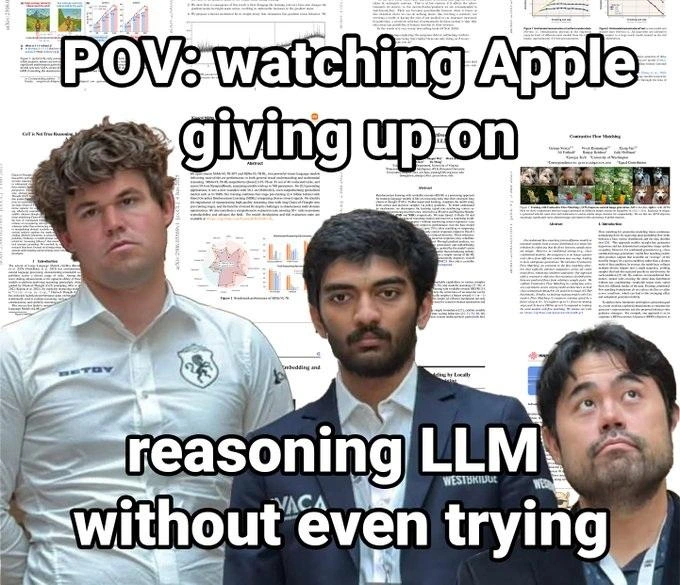
Researchers watching Apple abandon reasoning LLMs before even pushing first commit
AI ML Post #6868, on Jun 10, 2025 in TG

Researchers watching Apple abandon reasoning LLMs before even pushing first commit

Why is this AI ML meme funny?

Level 1: Quitting Before Playing

Imagine a bunch of kids at a school science fair all excited to build the next cool rocket. They’re sharing ideas and working hard (picture lots of drawings and notes taped on the wall). Now, one of the kids is super famous for always making the coolest, most polished project – everyone expects him to make an awesome rocket too. But instead, that kid quietly packs up his stuff and says, “Nah, I’m not going to do this,” before he even starts building. All the other kids just stop and stare, surprised and a bit confused. It’s like, “Wait, you’re not even going to try?” It’s funny in a head-shaking way because you’d think that kid with all his talent and resources would at least give it a shot. The one who could have made something amazing just walked away without even trying. That’s exactly the feeling this meme is capturing – amazement (and a little laughter) that the big player (Apple) quit the cool new game (making a super-smart reasoning AI) before the game even began.

Level 2: Siri Sits Out the Race

Let’s break down the joke in simpler terms. First, LLM stands for Large Language Model. That’s a type of AI program (like the brain behind ChatGPT or other chatbots) that has been trained on a huge amount of text and can generate human-like responses. If you’ve used ChatGPT or a code assistant, you’ve interacted with an LLM. Now, a reasoning LLM refers to an AI that doesn’t just answer from memory, but can logically work through problems step by step (instead of spitting out a quick guess). Researchers discovered a trick called chain-of-thought (CoT) prompting, which literally has the AI list out its thinking process. Think of it like doing math homework: instead of just writing the answer, you show all your work. With chain-of-thought, the AI might solve a tricky question by writing something like, “Step 1: do this… Step 2: do that… Therefore, the answer is X.” By having the AI reason out loud in this way, it often gets harder questions right more often, because it’s guiding itself logically.

Now, what’s happening with Apple in this meme? Apple is the big company that makes iPhones and Macs, and it created Siri (the voice assistant on your iPhone). Apple’s products are known for being super polished and they usually keep everything closed and in-house. That means Apple doesn’t share a lot of its secret projects or half-finished ideas with the public; they like to surprise everyone with a fully finished product. When the meme says “Apple giving up on reasoning LLM without even trying,” it implies that Apple decided not to pursue this new fancy AI idea (the chain-of-thought reasoning for an LLM) at all, or gave up on it really early. The phrase “before even pushing first commit” is tech-speak: in software development, a “commit” is when you save your code changes into a code repository (using a system like Git). The first commit is basically the very start of a coding project – often just setting up the project or adding some initial files. So if someone “gave up before the first commit,” it means they abandoned the project before they even wrote any real code for it. In plain terms, Apple bailed on the project right at the idea stage, without producing anything visible (no code, no demo, nothing).

The image uses a POV (point-of-view) meme format – it’s as if you are seeing what the three guys (the researchers) are seeing. They stand shoulder-to-shoulder, looking directly at the camera, which puts you in Apple’s shoes from the researchers’ perspective. Behind them, you see a collage of scientific papers full of charts and text. Those papers are likely from arXiv, which is a website where researchers post their new AI research papers for everyone to read (kind of like a big free online science library). So picture these three researcher dudes as heavy-duty AI experts who keep up with all the latest discoveries (hence the papers literally behind them). They’re looking at you (Apple) with expressions of confusion or disappointment. It’s like they just witnessed Apple say, “We’re not going to work on this reasoning AI thing,” and they are baffled. The top text of the meme says, “POV: watching Apple giving up on…”, and the bottom text says, “…reasoning LLM without even trying.” When you read it together, it’s basically the researchers’ view of Apple: they’re watching Apple walk away from developing a reasoning AI model before it even got started. And their faces say it all: “Really? You’re not even going to give it a shot?”

So why would Apple possibly “give up” like that? Here’s where the joke meets reality: Apple is known for being very cautious with new tech, especially something as unpredictable as an AI that talks and reasons. Other tech companies in 2023-2025 were rushing out AI projects – chatbots, AI assistants, you name it – which was the big hype in the industry. But Apple often waits and only releases something when they’re confident it works well and won’t harm their reputation. Think about how Apple didn’t rush to make a giant phone screen or a 5G phone until the tech was mature; similarly, they didn’t jump on making a ChatGPT-style Siri right away. By 2025, lots of companies had announced or released AI chatbots and LLM features, but Apple hadn’t launched anything like that. There were rumors they had something in the lab, but nothing official came out. The meme is poking fun at this by saying Apple essentially chickened out of the “reasoning AI” race.

To a newcomer, it’s like all the cool kids in AI research are building this awesome new thing (AI that can reason), and Apple – who everyone thought would also do something cool because they’re Apple – just decided not to participate. Those researchers in the meme represent the AI community, and they find it both ironic and disappointing. Ironic because Apple usually is a leader in innovation, and disappointing because Apple has the resources to contribute something big but chose not to even try (at least from an outsider’s view). It’s similar to if all your friends are doing a hackathon and the one friend who’s really rich and talented just says, “Nah, I’ll sit this one out,” even before it starts.

The humor here comes from that gap between AI hype vs. reality. The hype: “Everyone is building smarter, reasoning AIs, it’s the future!” The reality (suggested by the meme): one huge player, Apple, didn’t build anything and bowed out early. It highlights Apple’s super careful, closed-door strategy versus the open “try everything” approach in the AI research world. And seeing the normally enthusiastic researchers look so unimpressed is the perfect way to capture that feeling. In short: the meme is saying researchers are dumbfounded that Apple, of all companies, quit the big new AI project before even starting, and that’s funny because you’d expect Apple to at least attempt to innovate in this space — but they didn’t, and everyone watching was like, “...What?!”

Level 3: Commitment Issues

To a seasoned engineer, this meme hits on a very familiar industry irony. You’ve got Apple, a company known for Think Different innovation, apparently bowing out of the hottest AI race of the decade before writing a single line of code. The top text “POV: watching Apple giving up…” sets the stage: it’s putting us in the shoes of researchers who expected to see Apple at least attempt a reasoning LLM project. The comedy here is partly in that phrase “without even trying” – it screams commitment issues. In software terms, “pushing the first commit” is literally the very start of a project’s code. So saying Apple gave up before the first commit suggests a premature retreat, like a marathon runner quitting at the starting line.

$ git push origin main  
error: no commits to push (Apple's LLM project never started)  

Every senior dev has seen something like this internally: a big initiative gets everyone excited, slides are presented, hype builds… and then upper management pulls the plug before any real work ships. It’s almost a rite of passage in big tech. This meme takes that scenario and flings it at Apple’s approach to the AI hype.

Why is that funny? Because Apple usually prides itself on innovation, yet here they’re portrayed as so cautious (or skeptical) that they won’t even dip a toe in a trend that every other Big Tech player is swimming in. Around 2023-2025, AI hype was everywhere – lofty promises of AI revolution vs. the sobering difficulties of actually deploying it. Apple’s reputation is to stay quiet during hype storms, only unveiling something when it’s perfect (or at least when they can claim it’s magical). So the researchers in the meme – stand-ins for the open AI community – are basically gawking: “Really, Apple? All that talent and you’re throwing in the towel already?” There's a collective memory of things like Apple’s Siri stagnating while Alexa and Google Assistant leapt ahead, or Apple waiting years to adopt trends like larger phone screens or 5G. The company is brilliant at polish over pioneers: they’d rather perfect an idea later than be first and messy. This meme laughs at that pattern in the context of LLM research. It’s the ultimate case of a hyped IndustryTrend meeting corporate conservatism.

There’s also a layered joke about Apple’s closed culture vs. the open research world. The background papers (from arXiv) represent how the AI research community shares breakthroughs freely, collaborating out in the open. Researchers thrive on that openness – rapid iteration, public benchmarks, tons of experimental code on GitHub. Apple, on the other hand, operates behind a walled garden. They’re notoriously secretive; Apple engineers publish far fewer papers than their Google or Meta counterparts. So when the meme says Apple gave up on reasoning LLM, it underscores that Apple didn’t contribute to this wave of innovation at all (no papers, no open-source code, nothing). That absence becomes comical when contrasted with just how much everyone else is doing. It’s as if a world-class chef refused to even try cooking a trending new dish, while every other cook is busy sharing recipes online. Senior folks find humor (and maybe a bit of exasperation) in that mismatch of energy. The three men in the image look directly at the camera with faces that say: “Did that really just happen?” They personify the tech community’s mix of surprise and eye-rolling.

The phrase “without even trying” also hints at corporate risk aversion taken to the extreme. Engineers know that building something truly new – like a chain-of-thought AI that can reason – takes iteration, failed experiments, maybe a few wild prototypes. But large corporations (especially one guarding a premium brand like Apple) can develop innovation paralysis: if an idea seems too risky or not immediately profitable, it dies in committee. Many veterans have sat through meetings where lawyers and execs fret over “what if it says something wrong?” or “what’s the ROI here?” until the cool project just suffocates. The meme’s humor is tinted with that recognition: yep, sounds about right — Apple would can a project instead of risking a public misstep. It’s funny in a dark way – seeing the world’s biggest tech giant act almost timid. We imagine those researchers in the image like a live audience who came to see a daring stunt, only for the stunt performer (Apple) to announce, “Actually, never mind, it’s too dangerous,” before even starting.

In the end, experienced devs chuckle because we’ve all witnessed the hype train leaving the station and someone important refusing to get on. Apple abandoning a reasoning LLM initiative so early is the perfect punchline for the current AI gold rush. It highlights the contrast between the fearless, try-everything ethos of academic researchers and the guarded strategy of a trillion-dollar company. The trio’s blank stares in the meme basically sum it up: “Did Apple seriously just nope out of this without a single commit? Classic.” It’s equal parts amazement and here-we-go-again cynicism, which is why this meme draws a knowing laugh from the developer crowd.

Level 4: The CoT Conundrum

At the cutting edge of AI/ML research, one of the hottest topics is teaching Large Language Models (LLMs) to perform reasoned problem solving rather than just spitting out the most statistically likely answer. The phrase "reasoning LLM" often refers to LLMs enhanced by techniques like chain-of-thought (CoT) prompting. In essence, CoT prompting encourages a model to think out loud – that is, to generate intermediate reasoning steps instead of jumping straight to the final answer. This approach was famously outlined in a 2022 research paper where prompting a transformer model to explain its reasoning improved its performance on math word problems and logic puzzles. The meme’s backdrop – a wall of densely packed research papers with charts and diagrams – is a nod to the flurry of arXiv preprints exploring these ideas. Each paper represents incremental progress: from scratchpad methods where the model writes down its calculations, to advanced self-consistency techniques that have the model consider multiple reasoning paths and pick the best answer. In theory, if an LLM can articulate a chain of logical steps, it should handle complex tasks with fewer mistakes, inching closer to a system that truly reasons rather than parroting back patterns.

However, implementing a reasoning-capable LLM in practice is a conundrum that Apple appears to have decided isn't worth untangling (at least not publicly). Why might that be? First, consider Apple’s typical AI approach: they emphasize on-device processing (for privacy) and ultra-polished user experiences. True multi-step reasoning in an LLM often demands massive model sizes or heavy computation – something that doesn’t neatly fit on an iPhone’s chip without offloading to the cloud. Apple’s Neural Engine is powerful, but it’s not a miracle worker for models with tens of billions of parameters doing CoT on the fly. There’s a fundamental scaling law in play: the best reasoning emerges from the largest models, which clashes with Apple’s constraint of keeping AI local and efficient. And even if Apple considered a cloud-based LLM solution (like how Siri’s answers were initially handled on servers), the unpredictability of a reasoning model’s output creates a brand risk. An LLM that “thinks out loud” might spill out intermediate thoughts that are incorrect or misaligned with Apple’s strict content standards. Unlike a research lab that can tolerate some goofy or even controversial model outputs in pursuit of progress, Apple runs a closed ecosystem where a single AI slip-up could become a PR nightmare.

Another angle to this CoT conundrum is alignment and control. To safely deploy a reasoning LLM, Apple would need to ensure the model’s chain-of-thought doesn’t produce anything that violates user trust or privacy. Chain-of-thought, by design, means the model is generating extra content (its reasoning steps) which could be verbose, hard to filter, and potentially reveal the model’s training quirks. Apple likely examined these theoretical challenges and saw unsolved problems: reasoning LLMs still hallucinate, they can follow flawed logic confidently, and their intermediate steps might confuse or alarm non-expert users. In academia, there's acceptance that an AI which occasionally goes off-track is a learning opportunity (leading to papers with titles like "Towards Trustworthy CoT Reasoning in LLMs" on arXiv). In Apple’s world, though, unleashing a half-baked reasoning AI into a consumer product is anathema — it's the equivalent of shipping a new iPhone that randomly overheats and catches fire because “we’ll fix it in an update.” Not gonna happen. Apple’s culture of corporate risk aversion is almost axiomatic: if a technology isn’t mature enough to guarantee a flawless user experience, it likely won't make it past an R&D prototype in Cupertino. So, even if some Apple engineers prototyped a chain-of-thought enabled Siri in the lab, the higher-ups may have looked at the unpredictable reasoning outputs (and the rapid progress of open models outside) and effectively pulled the plug.

In summary, the meme captures a technically profound stalemate: open research has been rapidly chaining together solutions for AI reasoning, while Apple’s closed garden apparently pruned the idea before it could bear fruit. It's a clash between two philosophies: the open, experimental, iterate-fast approach of the research community versus Apple’s secretive, perfectionist ethos. The humor at this level comes from understanding the underlying technical friction — Apple didn’t back out just on a whim; they likely backed out because fundamental constraints (hardware limits, the stochastic nature of transformer reasoning, alignment challenges) made the cutting-edge CoT approach look like a risky investment. To seasoned AI folks, it’s both a bit disappointing and darkly funny: one of the world's most cash-rich tech companies possibly said, “This reasoning LLM thing? Yeah...no, we’re not touching that,” even as the academic world churns out breakthrough after breakthrough. The researchers in the image are effectively stand-ins for those who know how hard-earned and exciting those breakthroughs are — they’re staring in disbelief that Apple, of all companies, would abandon the race before even committing a single line of code.

Description

Meme image in POV format: three young men in semi-formal attire stand shoulder-to-shoulder, their faces blurred for anonymity, staring directly at the camera as if witnessing something baffling. Behind them is a collage of densely packed research-paper pages - charts, tables, and academic figures clearly visible - evoking an arXiv wall of recent breakthroughs. Overlaid text in bold white Impact font reads, at the top, “POV: watching Apple giving up on” and at the bottom, “reasoning LLM without even trying.” The humor plays on Apple’s reputation for polished but closed-ecosystem products juxtaposed against the open research community’s push for chain-of-thought and reasoning-capable large language models. Senior engineers will catch the irony: while the background papers suggest rapid progress in transformers and CoT prompting, Apple is depicted as exiting the race before producing a single experiment, highlighting the tension between corporate risk aversion and bleeding-edge ML research


Comments

40
Anonymous ★ Top Pick Turns out multi-hop reasoning doesn’t fit in the Neural Engine’s budget - Cupertino is shipping ‘return nil’ as a feature
  1. Anonymous ★ Top Pick

    Turns out multi-hop reasoning doesn’t fit in the Neural Engine’s budget - Cupertino is shipping ‘return nil’ as a feature

  2. Anonymous

    Apple's approach to reasoning LLMs is like their approach to USB ports - they'll wait until everyone else has figured it out, then claim they invented a revolutionary new way to not do it

  3. Anonymous

    Watching Apple abandon reasoning LLMs is like seeing a senior architect reject microservices after only trying a monolith with REST endpoints - technically, you haven't even started exploring the design space. The irony is that reasoning capabilities in LLMs are heavily dependent on prompt engineering, few-shot examples, and chain-of-thought techniques, yet here we are witnessing a Fortune 500 company apparently giving up before implementing basic prompting strategies. It's the enterprise equivalent of declaring 'Kubernetes is too complex' after only running `docker run` once

  4. Anonymous

    Apple saw the test‑time compute bill for ‘reasoning’ and chose battery life - so we get RAG + summarization on a 4‑bit decoder; Think Different, just not at inference time

  5. Anonymous

    Apple's LLM verdict: memorization masquerading as math - every MLOps engineer's 'emergent ability' nightmare confirmed

  6. Anonymous

    Apple’s alignment strategy for reasoning seems simple: if test_time_compute > battery_budget, return NotAUseCase();

  7. Sure Not 1y

    >2018-2019: yooo bruh what if there is tech that can convert human language into code >>openai and chatgpt appears >fuck, go back.

    1. Sure Not 1y

      Lets see if this time it works.

  8. @deerspangle 1y

    Apple actually giving a shit about releasing a product with quality and purpose? Wild times

    1. @Box_of_the_Fox 1y

      Nah, they simply ignored llms and are fucked now. Siri was quite amazing at a time but for some reason they decided not to improve it

      1. @deerspangle 1y

        Have you checked out their paper?

        1. @Box_of_the_Fox 1y

          Not really, which one?

          1. @deerspangle 1y

            It's linked further up in this thread, about the limits of "reasoning" LLMs

            1. @Box_of_the_Fox 1y

              Looking at abstract and how short actual paper is, I'd assume it was quickly put together to explain to shareholders why apple is so far behind in the subject. It doesn't say anything new. In case of apple it is bad because of Siri. It needs LLM of some sort and if apple can't create one then it's on them. They have more than enough cash and resources to create something that's half decent

              1. @deadgnom32 1y

                but why would THEY need a reasoning LLM? don't see any practical use case.

                1. @Box_of_the_Fox 1y

                  To understand what their users are saying to the device and do the reasoning of what to do with it. That's what things like Siri and Bixby do and what Gemini is getting pretty good at. But no worries apple fanboys, you'll get that in 5 years and will believe it's a feature that no one ever had. Unless OpenAI gets there first as they seem to be working on that xd

                  1. @Box_of_the_Fox 1y

                    It's quite remarkable how quickly apple looses control over their ecosystem and no one seems to notice

                  2. @deadgnom32 1y

                    you don't need a reasoning LLM for this.

                    1. @Box_of_the_Fox 1y

                      You don't know what LLMs are then :p

                      1. @deadgnom32 1y

                        I am a AI Researcher, certified

                        1. @Box_of_the_Fox 1y

                          And I am a fox on the internet

                          1. @TheFloofyFloof 1y

                            But are you a certified fox on the Internet?

                            1. @Box_of_the_Fox 1y

                              How do I get such certification D:

                      2. @deadgnom32 1y

                        it's just, people nowadays tend to use overcomplicated tech for simple tasks, which have way better and stable solutions with less complex tech. that's what scientists are now talking about. but Sam altman promises, 1 more B parameters, 1 more $B. one more GPU cluster, and AGI will be here. promise fingers crossed

                        1. @Box_of_the_Fox 1y

                          Simple attention based models aren't complicated. You can do amazing stuff in prolog but it's not enough here

                          1. @deadgnom32 1y

                            yes but why would you need a reasoning, where nobody is observing this reasoning process? there are models capable of producing an output more directly and efficiently.

                          2. @deadgnom32 1y

                            more over, reasoning models are statistically more error prone. it's oftentimes funny to observe, how it thinks X, and misses this X in the output a second after

                          3. @deadgnom32 1y

                            whereas a more simple model, without reasoning and with 2-3 times less parameters produces a correct result faster and more accurate. 💁‍♂️

                            1. @Box_of_the_Fox 1y

                              Wait, so apple made an article that they don't need reasoning and now apparently everyone are amazed about it? What's next? Article that they don't need to compete with Stax in audio equipment?

                              1. @deadgnom32 1y

                                I don't know about everybody and apple. I had this opinion long ago. it's oftentimes like this — a long struggle with LLM can be replaced with a simple mathematical model with a couple of dozens parameters, not billions, and get far more accurate results with less energy consumption. you can run it basically on a fridge

                                1. @nolemocius 1y

                                  could you please give a couple specific examples? I would need this to look smarter in pointless internet arguments with other dogs like me

                                  1. @deadgnom32 1y

                                    I am. will need some time to find a paper from the last conference with good examples.

                                  2. @Box_of_the_Fox 1y

                                    There was some research showing that SVM is still the most popular model and compared to stuff like LLM you could describe it as simple mathematical model. There are also examples showing that you could get away with prolog in simple chat bots. Historically there was similar development with computer vision about which you can read in mobilenetv2 white paper

                                  3. @deadgnom32 1y

                                    look for: Legal Chunking: Evaluating Methods for Effective Legal Text Retrieval 275

                  3. dev_meme 1y

                    Literally single most important reason why latest Gemini are so good - their reasoning/CoT are next level

                  4. @deadgnom32 1y

                    I am no apple user, never liked their soft, and tech seams overpriced to me. but to achieve same results. you can use a more basic LLM without reasoning capability.

  9. @Bjastkuliar 1y

    Tbh they do make some solid points in the paper. Is it new discovery? Definitely no. Is it surprising that a tech giant states it? Totally.

    1. @Johnny_bit 1y

      Lnk to paper for those out of the loop plz?

  10. @einbetungzahl 1y

    https://news.ycombinator.com/item?id=44203562

  11. @Johnny_bit 1y

    Of multiple thankings

Use J and K for navigation