Vacation: The Ultimate Burnout Refresher
Why is this MentalHealth meme funny?
Level 1: Back-to-Work Blues
Imagine you have a big chore or homework assignment that you really, really don’t like. Now, you get to go on a nice vacation or a fun break. During your break, you’re happy and you forget about that nasty chore for a while. But when the break is over, you come back home and see that the big chore is still there, exactly how you left it. How do you feel? Probably upset or frustrated that you still have to do this chore, right? You might even feel more annoyed than before because you were just having fun and now it’s back to boring or stressful work.
This meme is basically saying the same thing, but in a funny way for computer people. The man in the picture went on vacation hoping to feel better about his job. And sure, while he was away from work, he felt good (who doesn’t feel good on vacation?). But as soon as he sits back at his desk in the office, all the reasons he disliked his job come rushing back. It’s like all the fun and relaxation he collected during vacation just disappeared, and he’s left with a full tank of “Ugh, I hate this job.” Think of it like this: during vacation he refilled his happiness a bit, but coming back to work emptied that happiness out and refilled him with grumpiness about work.
We call it the back-to-work blues. “Blues” means a feeling of sadness or low energy. Lots of people feel a little blue on the first day back to work or school after a break. This meme makes a big, exaggerated joke about that feeling. It’s funny because it’s true in an exaggerated way: vacations don’t magically fix a tough job. If the job was making the man unhappy before, he’ll be unhappy again when he returns – maybe even more so, because now he remembers how nice freedom felt! The picture of the man looking tired and unhappy at his computer says it all. We don’t need to see his face clearly to know he’s thinking, “Oh boy… here we go again.”
So in simple terms: The guy took a break hoping to feel better, but when he got back to work, all his unhappy feelings came back stronger. It’s a joke many grown-ups laugh at because they have felt the exact same way. It’s like when you finish a fun weekend and Sunday night you realize, “I have to go to school/work tomorrow,” and you just sigh. This meme turns that little sigh into a big comic headline. It’s a way of saying “sometimes a vacation only reminds you how much you don’t enjoy the thing you’re taking a vacation from.” Even if you’re not a developer or don’t get the computer terms, you can understand that coming back to a place you don’t like, even after a rest, can make you grumpy. And the picture of that slouched, unhappy man at his desk is an exact image of that mood. It’s a funny-sad kind of humor: we laugh a bit because we know that feel, and maybe it helps us cope with our own back-to-work blues.
Level 2: Sprint Backlog Overflow
At this level, let’s break down the buzzwords and humor in simpler terms. The meme is joking that taking a vacation (what companies call PTO, for Paid Time Off) ends up only cleaning out your happiness and brings back a full load of frustration with your job. In coding, garbage collection is when a programming language like Java or Python automatically cleans up and frees memory that’s not being used anymore – think of it like the computer throwing away data it doesn’t need so the memory can be used for something else. The meme says PTO acts like a garbage collector for joy. In other words, any joy or good vibes you accumulated during your vacation get cleaned up (poof, gone) when you return to work. And what loads up in your mind instead? A heap full of hatred for your job. In computer terms, a heap is a big area of memory for storing objects or data dynamically; having a “full heap” means it’s packed to the brim. So metaphorically, your brain’s memory is now completely filled with negative feelings about work.
Why would coming back from a nice vacation make you hate your job again? The meme plays on the reality that if your workplace or project was stressful and poorly managed before, a holiday doesn’t magically fix that. You might come back on Monday to find your JIRA board (JIRA is a popular software tool where teams track tasks, bugs, and issues) loaded with tickets that piled up. Imagine opening JIRA and seeing a ton of unresolved tasks – that’s the sprint backlog overflow (a sprint backlog is the list of work your team planned to do in a sprint, which is a short development cycle, usually a couple of weeks in Agile methodology). An overflow here means there are more tasks than you can realistically handle. It’s like you were hoping for a clean slate, but instead you get a backlog so large it’s spilling over the edges of your sprint plan. For a junior developer, picture coming back from a week off to 20 unread emails, 10 bug reports, and your manager asking about that feature that’s past due. All of a sudden, any relaxation you had is gone – DeveloperFrustration kicks right back in.
The phrase “fresh, reenergized hatred for job” is written in a deadpan, news-headline style, which is part of the joke. It mimics how a company newsletter might say “employee returns with fresh, reenergized enthusiasm,” but flips it: instead of enthusiasm, it’s hatred. That’s a very stark, funny way to say “he still really dislikes his job, now with even more energy.” It’s relatable, unfortunately, because a lot of developers (and workers in general) have felt that way: you relax and forget about work stress for a bit, but as your first day back progresses, you realize you still loathe the annoying parts of your job — maybe even more so now that you’ve tasted freedom. This connects to MentalHealthInTech concerns, because it highlights burnout. Burnout is a state of emotional, mental, and often physical exhaustion caused by prolonged stress. In tech jobs, burnout is common when you’re constantly dealing with tight deadlines, late-night pages from on-call duty, or endless debugging of legacy code. A vacation can help you recover a little (imagine your stress level went down from 90% to 30%), but if the workplace issues are unresolved, that stress can shoot right back up. The meme humorously suggests it doesn’t just return to where it was — it comes back at full capacity, like 100%.
There’s also a nod to corporate culture here. Many company cultures inadvertently create what we might call corporate_laptop_chains – the feeling that you’re chained to your work laptop or your job responsibilities. Even when you’re away, you know the work is accumulating. Some junior developers experience this the first time they take a few days off: you go on vacation only to return to a mountain of emails and Slack messages. It’s like nothing moved forward without you, and now you’re under pressure to catch up quickly. That can create a sense of dread about taking time off in the first place. The context tag post_vacation_dread captures that perfectly: it’s the anxious feeling you get on the Sunday night before returning to work, wondering what mess awaits you. Renewed_burnout is what happens when that mess is indeed waiting and you immediately feel burnt out again, even though you just rested.
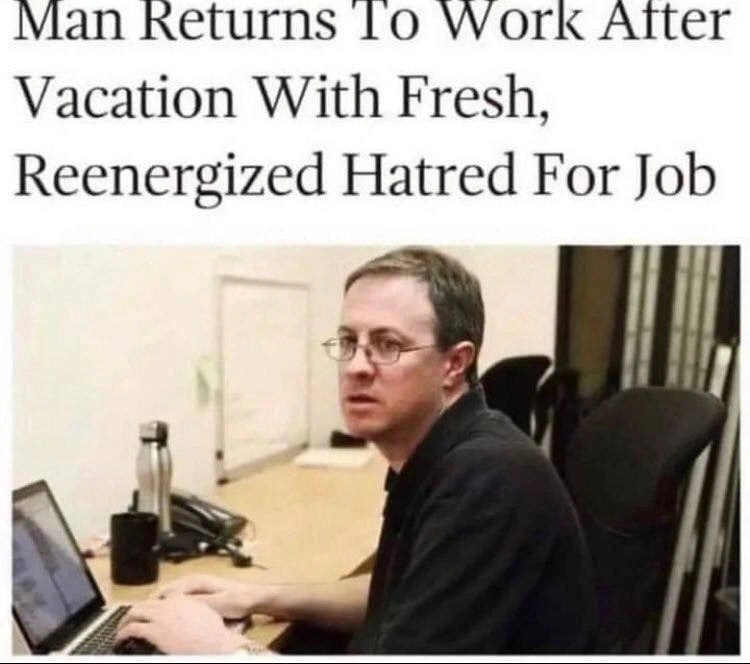
Let’s talk about the imagery: the man in the photo is sitting in a pretty drab cubicle. He’s got his hands on his laptop keyboard and is looking at the camera with a face that says, “Yep... here I am... back at it.” His posture is slouched, which shows low energy or motivation. Nothing in the environment looks vibrant or exciting – the walls are beige, the door is half-open (maybe symbolizing he just walked back in and already wants out). This generic office setting reinforces that this isn’t one unique guy at one unique job, but a near-universal experience in the software industry or any corporate job. The anonymity (his face is blurred) suggests it could be any developer feeling this way. It’s a bit of a sad image, but the caption makes it amusing because we recognize the exaggeration and truth in it.
For a junior dev, the key takeaway of the meme is: time off is great, but if you hate your job, a vacation won’t fix the actual problems back at work. The use of programming terms is just a fun way to express this. “Garbage-collects joy” = your happiness from the break is quickly disposed of. “Reloads full heap of job hatred” = all your strong negative feelings are back at maximum load. It’s funny in a nerdy way, because who else would describe emotions in terms of computer memory and garbage collection except programmers? It’s also a bit of a warning: if you find yourself relating to this meme too much early in your career, it might be time to evaluate what’s making you unhappy at work. It could be a tough project, lack of support, or a toxic work environment. The meme is poking fun, but the underlying message about MentalHealth is real — just taking PTO isn’t a silver bullet for job stress if the company doesn’t address work conditions.
In summary, this level breaks the joke into simpler pieces: vacation (PTO), coming back to see all your tasks (the backlog) overflow, feeling burned out again (hatred for the job returning). It’s using a coding metaphor (garbage collection and heap memory) to dramatize the back-to-work blues a lot of people feel. Even if you’re a relatively new developer, you likely understand the feeling of dreading the return from a break, and this meme confirms it’s not just you — it’s a common WorkplaceReality that many find humor in to cope.
Level 3: Joy Freed, Hate Reloaded
This meme drops some system-level sarcasm that hits senior developers right in the burned-out heap. The title "PTO Only Garbage-Collects Joy, Reloads Full Heap of Job Hatred" riffs on programming terminology to describe a painfully familiar scenario. Paid Time Off (PTO) is supposed to recharge you, but here it’s treated like a garbage collector in a programming language: it frees up (collects) any joy you had, and then your brain allocates a full heap of hatred for your job as soon as you log back in. In other words, vacation purged the small happiness buffer you’d built up, and now your emotional memory is entirely filled with resentment objects. It’s a darkly funny inversion for developers: normally garbage collection gets rid of useless data to improve performance, but here it’s nuking positive feelings and making room for a renewed_burnout object. The result? You return from vacation optimized solely for fresh loathing of the corporate code grind.
For those of us who’ve spent years in the industry, the humor cuts deep. We’ve all come back from a nice break thinking we’d feel reenergized, only to find the same deploys still failing, the same meetings multiplying like memory leaks, and our soul factored into the same legacy architecture. The meme’s headline "Man Returns To Work After Vacation With Fresh, Reenergized Hatred For Job" reads like a tech version of an Onion article – it’s absurd but WorkplaceReality enough to make you smirk (or cry). It flips the typical corporate blog narrative: instead of “returns with fresh enthusiasm for new challenges,” it’s fresh hatred for the same old nonsense. That contrast is the core of the joke. Developers know the twisted truth that sometimes a break doesn’t solve anything; it just resets your tolerance counter to zero. As the description jokes, two weeks off merely reset the exception counter — only to re-throw the same CorporateCultureError and MentalHealthWarning the moment JIRA reloads. In coding terms, your PTO wrapped your burnout in a try block without a proper fix, and as soon as you’re back, the uncaught exception of corporate dysfunction is thrown again.
Let’s unpack why this image feels so RelatableHumor for senior engineers. The photo shows a generic office guy (face blurred, because he could be any of us) slumped at his desk, hands on the laptop, giving that 1,000-yard stare of quiet resignation. We recognize that look: it’s the “I just opened my inbox and my PTO glow evaporated” face. Stainless-steel water bottle, phone cable, black mouse — all the typical developer desk totems are present. Beige cubicle walls complete the depressing scene. It’s intentionally bland, because the feeling is universal across corporate tech offices. You can practically smell the stale office coffee. It’s the morning after vacation, and reality hits as hard as a production outage alert at 3 AM. The code didn’t write itself while you were sipping mojitos, the sprint_backlog_overflow from last sprint is still there (if not worse), and the new features you were excited about are buried under a heap of new JIRA tickets that piled up in your absence. It’s that classic post_vacation_dread: you step back into the office and immediately feel the weight of all the tasks and issues that waited for you. Heck, some colleagues might’ve even said, “We held off on X bug until you got back” — so your reward for taking a break is more work! No wonder the meme depicts PTO as only collecting joy (like cleaning up a few stray happiness objects) and then reloading all your pent-up job hatred (like restoring from a particularly bitter backup).
From a senior perspective, this meme also satirizes the CorporateCulture that leads to such cynicism. Why does PTO “only” garbage-collect joy instead of relieving burnout? Because many workplaces treat vacations as a temporary patch, not a fix for systemic burnout issues. Sure, you get two weeks of no standups, no on-calls, no product managers pinging you for updates — and that does feel good. But if the company’s expectations and workload were unsustainable to begin with, a vacation just pauses the pain. As soon as you’re back, the DeveloperBurnout resumes right where it left off, like a suspended process in an OS that’s been reactivated. In fact, sometimes time away gives you fresh eyes to see just how dysfunctional things are: “Wow, I didn’t realize how toxic this meeting culture was until I spent two weeks not dealing with it.” It’s almost as if PTO performs a mark-and-sweep: marking the ephemeral joys (sunshine, rest, sleep) for collection and sweeping them away, revealing the underlying garbage that is your job’s stressors still clogging the system. The job hatred reloading to a “full heap” is an exaggeration of that sinking feeling when you realize nothing changed at work except the date. The codebase is still a mess, the tech debt didn’t magically disappear, and the project deadline probably got even closer. In Agile terms, you return to find the sprint backlog has become a hydra – for every task completed in your absence, two more sprung up (sprint_backlog_overflow indeed). It’s like coming back to a server that was left running: logs are overflowing and the error counter is maxed out.
Another layer to this humor is the MentalHealthInTech angle. We’ve all sat through HR presentations about taking PTO to avoid burnout, or seen LinkedIn posts preaching work-life balance. Yet the meme’s dark punchline suggests the real outcome: PTO may give you a temporary wellness bump, but if the job routinely drains your spirit, that happiness is a short-lived variable, quickly garbage-collected once work resumes. It’s a cynical take that rings true for many engineers: the vacation high is fleeting because the underlying conditions — long hours, constant context-switching, that one VP who wants last-minute changes, the 3 AM on-call incidents — are still there waiting. This shared experience creates a grim camaraderie. Senior devs chuckle (and wince) because they’ve all seen a teammate come back from paradise only to say by mid-week, “I need another vacation already.” It’s humor as a coping mechanism. We joke that our corporate_laptop_chains never truly come off; we just get a longer leash during PTO.
On a deeper level, this meme highlights how CorporateCulture sometimes pays lip service to well-being without addressing root causes. It’s poking at the absurdity that time off, by itself, can’t fix a fundamentally unhappy job situation. If your software project is in eternal death march mode or your team is perpetually understaffed, a vacation is like hitting pause — the moment you hit play, the chaos resumes. Think of it like a notoriously memory-hungry app: you can force quit it (take PTO) to free up RAM (your mental energy), but if you relaunch the app without changing anything (same toxic workplace), it will gobble up all the resources again and slow the system (you) to a crawl. The meme’s bitter punchline "fresh, reenergized hatred" is a way of saying: “Yup, I’m back, and I remember exactly why I was so fed up.” It’s funny because it’s true, and it’s tragic because it’s true. Every senior engineer who’s ever burned out, taken a breather, and then felt the burnout rushing back can relate. In summary, the humor comes from combining developer lingo (garbage collection, heaps, exceptions) with a very real emotional cycle in tech work. It’s a laugh so you don’t cry situation – the kind of joke you forward to your team on Slack with a knowing sigh.
# After a refreshing PTO, back at the office:
joy = None # Joy has been garbage-collected after vacation
job_hatred = 100 # Full heap of job hatred reloaded (out of 100)
print("Hatred level:", job_hatred, "Joy level:", joy)
# Output: Hatred level: 100 Joy level: None
# The code above is a tongue-in-cheek illustration:
# joy goes to None (nothing left) and job_hatred tops out at max.
# Just like coming back to work: happiness = 0, frustration = MAX.
In reality, no one has a job_hatred variable (though maybe we should, for honesty’s sake), but we get the point: returning from vacation can reinitialize your loathing for all the unresolved junk at work. This meme lands especially well with senior devs because it validates that inner cynic we usually hide under professional enthusiasm. It says, “You’re not alone – we all know this feeling.” In the end, it's a sarcastic nod to the fact that sometimes the only thing PTO truly refreshes is your awareness of how much you hate your job’s worst parts. And if you’ve never felt this... well, either you’re new, or congratulations on finding a unicorn company! For the rest of us, it’s a meme-worthy loop we know too well.
Description
The image features a headline in black, bold text that reads, 'Man Returns To Work After Vacation With Fresh, Reenergized Hatred For Job.' Below this text is a photo of a middle-aged man with glasses, sitting at an office desk with a laptop. He is looking back over his shoulder with a startled, weary, and utterly disillusioned expression. The meme's humor is rooted in its cynical and relatable take on returning to work. Instead of feeling refreshed and motivated, the vacation has only sharpened the man's awareness of his job dissatisfaction. For senior developers, this resonates deeply with experiences of burnout, disillusionment with corporate culture, or the dread of returning to a problematic project or legacy codebase after a brief period of freedom

Comments
7Comment deleted
The code is exactly as broken as I left it, but after two weeks off, my resentment towards the legacy monolith has been fully recompiled and optimized
Two weeks of paid time off is basically a long-running blocking call - when the thread finally wakes, its CPU affinity is set to pure existential dread
The only thing worse than debugging legacy code is debugging legacy code after two weeks of vacation when you've forgotten why you wrote that 'temporary' workaround in 2019 that's now load-bearing infrastructure for three production systems
Nothing quite like a week off to give you the mental clarity needed to realize that your 'temporary workaround' from 2019 is now critical infrastructure, your Kubernetes cluster is held together with duct tape and prayer, and that Jira ticket marked 'P0 - Production Down' has been sitting there since before you left. Welcome back - the technical debt missed you, but the legacy monolith didn't even notice you were gone
Like git pulling master after two weeks PTO: 1,247 commits behind, merge hell ahead, and your monolith never missed you
Returning from PTO is the real integration test - Slack floods, CI red, calendar at 100% ceremony coverage - confirming the org’s throughput metric is meetings per engineer
PTO is just cache invalidation for coping mechanisms - first Monday back cold-starts 4k Slack unreads, five ceremonies, and the monolith we should’ve strangled in 2017