Anti-Establishment Devs: Then vs. Now
Why is this DevCommunities meme funny?
Level 1: Secret Candy Stash
Imagine two kids who want to run a secret club that grown-ups might not like. The first kid is like a clever pirate: he hides his candy and club supplies all over the neighborhood – some in a friend’s treehouse, some buried in the backyard, maybe even a bit in a high-up birdhouse. He even uses a secret nickname for his club that only his friends know. When his parents try to take away his stash, they might find one spot, but he’s got more hidden elsewhere. He’s always one step ahead, moving his goodies around so no one can take them all at once. This kid’s club never fully shuts down because he planned lots of hideouts and escape routes.
The second kid is a bit different. He starts a “no adults allowed!” club, but instead of hiding it, he sets it up right in the living room of his house. He uses his dad’s big fancy toolbox (with permission) to run the club and puts a big sign on the front door of the house with the club’s name. The parents initially let it happen, but when they hear the club is breaking some house rules (maybe they’re being too loud or saying bad words), the parents simply walk in and confiscate the toolbox and take down the sign. Suddenly, the club has no meeting place and no tools or candy – it’s shut down immediately. The kid didn’t have any other secret spot or backup plan. So he sits on the floor and cries that his parents are being “mean” for shutting his club. But from the parents’ view, it’s their house and their tools – of course they can do that.
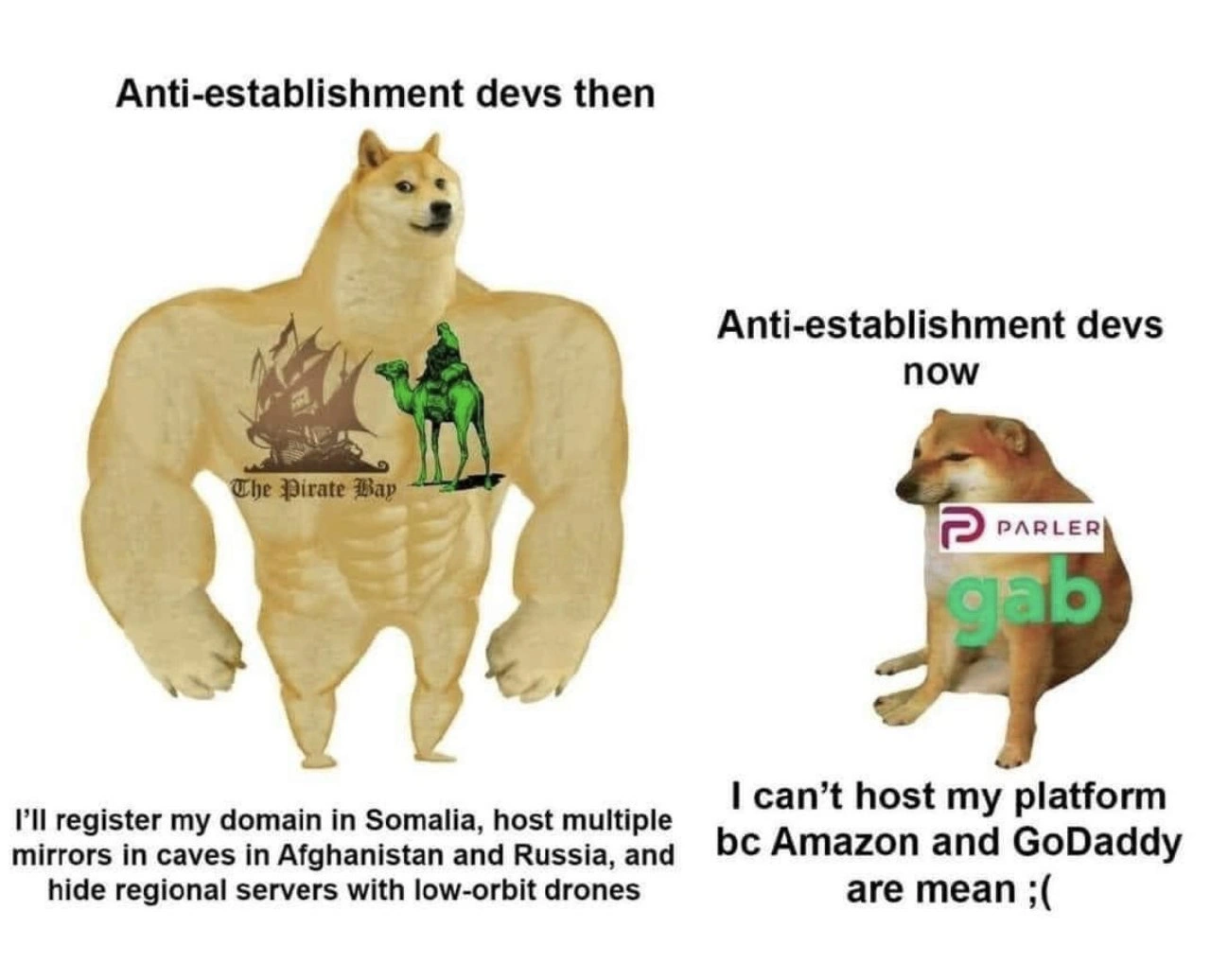
This is exactly what the meme is showing, but with websites and the internet. The strong pirate kid (big Doge on the left) is like those old piracy websites: smart, sneaky, and prepared to do whatever it takes to keep running, even if someone powerful tries to stop them. The crying kid (sad Doge on the right) is like some modern websites that say “we’re doing our own thing, we don’t care what the big companies think,” but then they rely entirely on those big companies to exist. When the big companies say “stop that,” the site has no secret hideout to go to, and it just disappears until it finds a new place.
The meme is funny because of this clear contrast: one side is fearless and resourceful, almost like a pirate hiding treasure on many islands, and the other side is unprepared and helpless, like a kid who’s upset that his game got shut off by the very person who owned the game. It’s a bit like bragging you’re a great chef but then complaining that you can’t cook anything when the microwave is taken away – the truly great chef would just use the stove or start a fire outside to cook, while the complainer only knew how to press one button.
So in the simplest terms: the left side is “I’ve got backups for my backups, you’ll never catch me!” and the right side is “Oh no, they caught me and I didn’t have a backup 😢.” Anyone who’s ever tried to keep a secret or work around strict rules (like hiding a diary from a nosy sibling, or stashing cookies so Mom doesn’t find them) can relate to the idea of the first scenario. And anyone who’s been caught out in a rule and had everything taken away knows what the second scenario feels like.
That’s why we laugh – it’s showing how much things have changed in a silly way. It’s a reminder: if you’re going to be a rebel, don’t keep all your rebel plans in the teacher’s desk!
Level 2: Hide-and-Seek Servers
Let’s break down the scene for those newer to the world of hosting and deployment. Imagine you have a website or an app that not everyone likes – in fact, some big companies or governments might try to shut it down. How do you keep it running? The meme gives two very different approaches:
Left Panel – “Anti-establishment devs then” (the past): Here we have a super muscular Doge (that’s the big buff dog character) proudly talking about all the crazy tricks he’ll use to keep his site online. This is referencing folks like the developers of The Pirate Bay, a famous file-sharing site that was essentially outlawed by many governments and corporations. These developers were truly anti-establishment and they acted like digital guerilla fighters:
- “Register my domain in Somalia” – A domain is the name of your website (like
example.com). Domains have endings like.com,.org, or country codes like.sofor Somalia. In the Pirate Bay’s case, they actually did use unusual country domains. Why Somalia? Because a.comor.netcould be taken down by US authorities, but a.so(Somalia’s domain) would be under Somalia’s control, where US copyright enforcers had little reach. It’s like if you wanted to name a clubhouse that no one could force you to rename, you’d pick a place with its own rules. Using Somalia’s domain was a jurisdictional trick – basically saying “I’ll register my site’s name in a place that doesn’t listen to the people trying to stop me.” - “Host multiple mirrors in caves in Afghanistan and Russia” – Okay, they probably didn’t literally put servers in actual caves 😅. Hosting means where you actually keep the server computers that run your site. A mirror is an exact copy of your site running on another server. Pirate Bay and similar sites kept multiple copies (mirrors) of their website on servers in different countries. Afghanistan and Russia are mentioned as extreme examples – places that likely wouldn’t cooperate with Western authorities demanding a shutdown. It’s an exaggerated way to say “I have servers all over, even in remote or protected spots, so if one gets shut down, another copy in another place will still be up.” For a junior dev, think of it like backing up your website in several locations. If one location goes offline, users can quickly be redirected to a backup. These devs treated server locations like hide-and-seek spots: they picked places to host that were hidden or safe from those who wanted to catch them.
- “Hide regional servers with low-orbit drones” – This one is almost sci-fi and definitely tongue-in-cheek. It implies using drones (flying devices) near Earth’s orbit to carry servers. While no one’s actually known to host web servers on drones in orbit (that we know of!), Pirate Bay folks did talk about creative methods like maybe using radio-linked drones or even satellites to make something like a floating server that’s hard to seize. The key point for a newcomer: these devs are so hardcore about keeping their platform online that they’ll use technology in very unconventional ways – even things in the sky – to avoid being shut down. It’s the ultimate game of keep-away: “You can’t shut down my server if you can’t even reach it!”
All this left-panel stuff references a time and mindset where self-hosting and independence were the only way to survive. Those developers couldn’t rely on big companies because those companies themselves would get legal orders or pressure to turn them off. So, they became very skilled in running their own infrastructure. They used multiple providers and often smaller hosting companies who promised not to bow to pressure. It was like building a fortress with secret tunnels and backup gates – if one gate is blocked, you slip out through another.
Right Panel – “Anti-establishment devs now” (the present): Here we see a smaller, sad Doge (often called Cheems in these memes) representing today’s “rebellious” developers, specifically the folks from sites like Parler and Gab. Parler and Gab market themselves as “we don’t follow the mainstream rules” platforms (they were created as alternatives to Twitter/Facebook with very lax moderation, positioning themselves as anti big-tech censorship). However, the funny (or sad) thing is, these platforms ended up relying heavily on big tech cloud services and mainstream providers:
- Amazon (AWS) – Amazon Web Services is a huge cloud provider. Instead of running your own physical servers, you can rent computing power from AWS, and they take care of the hardware, scaling, etc. It’s extremely common – even most startups use AWS or its rivals (Google Cloud, Microsoft Azure) to host their applications. Parler did this too: they hosted their whole platform on AWS. That means Parler’s website, app, database – everything – was running on computers owned by Amazon in Amazon’s data centers. It’s very convenient… until Amazon decides they don’t want you there. And that’s exactly what happened in January 2021: AWS terminated Parler’s hosting because Amazon said Parler wasn’t moderating violent content leading up to some real-world trouble. When Amazon pulled the plug, Parler’s entire site went offline. They hadn’t set up alternative hosts or redundant systems outside of AWS, so they were basically entirely dependent on one company’s cloud. This is what we call a single point of failure – if one thing (in this case, one provider) fails or cuts you off, everything breaks. It’s the opposite of what the left panel devs were doing.
- GoDaddy (domain registrar) – GoDaddy is a popular company where you register domain names (the addresses like
yourcoolsite.com). Many people use GoDaddy to buy and manage their domain names. It’s a mainstream, US-based company. Gab, for instance, used GoDaddy for its domain. When Gab faced backlash after some controversial content (and real-world incidents), GoDaddy actually kicked them off – meaning GoDaddy said “we will no longer let you use our service for your domain, go find another registrar.” Suddenly Gab’s domain was at risk. (They scrambled and moved to another registrar to keep their gab.com name accessible.) Similarly, there were reports about Parler’s domain being dropped by its registrar as well, or at least other providers like app stores dropping them. The meme sums this up as “Amazon and GoDaddy are mean.” To a newbie: that sounds like a childish whine, right? Exactly – it’s making fun of the fact that these devs are acting like kids complaining that the authority figures (big companies in this case) are unfair, instead of taking matters into their own hands.
The right side basically highlights cloud dependency. These modern “anti-establishment” devs ironically built their platforms on top of the establishment’s infrastructure. It’s like declaring you won’t follow school rules but then holding your rebel club meeting inside the principal’s office. Of course the principal is going to shut you down! The image of Cheems crying is poking fun at that lack of foresight.
For a junior developer, here are some key takeaways and definitions from this meme:
- Cloud Infrastructure (e.g., AWS): This means renting servers and services from big providers who manage them for you. It’s great because you don’t worry about hardware and it can scale easily. But downside: you’re at their mercy for terms of service and policies. If your usage or content breaks their rules, they can cut you off. Also, if they have an outage (which happens, e.g., when AWS has a region-wide failure), your app goes down unless you have a backup elsewhere.
- Self-Hosted Solutions: This means running the software on servers you own or control directly, without depending on a third-party’s platform. It could be physical machines in a datacenter you pay for, or smaller hosting companies that just rent you a raw server. The Pirate Bay style devs mostly used self-hosting or small niche hosts. It’s more work – you handle everything from deploying updates to dealing with hardware – but you have control. In context, “self-hosted” implies not easily subject to someone else’s immediate shutdown command.
- Domain Registration: This is how you get a website name (like
piratebay.soorparler.com). Companies like GoDaddy act as registrars, meaning they interface with the global DNS system to register your ownership of that name. However, those companies usually have acceptable use policies too. If your site is accused of illegal or dangerous stuff, a registrar might suspend your domain (making it unreachable). On the flip side, if you use a country’s domain (like.sofor Somalia or.rufor Russia), you’re kind of betting that those authorities or registrars won’t act on complaints from, say, the US or EU. It can be a cat-and-mouse game – Pirate Bay had to change domains multiple times as different countries got pressured. - Mirrors: A mirror is an exact copy of your site or service, usually accessible through a different URL or IP address. Mirrors are often used in the context of banned or high-traffic sites so that no single takedown can remove all access. If
site.comis down, maybesite.net(a mirror) still works. Users of those communities keep lists of mirror addresses as Plan B, C, D, etc. As a junior dev, you might encounter the concept of mirror servers for things like downloading Linux ISOs from different university servers – same file, many places to download from. In the meme, mirrors are used as a defense strategy: “host multiple mirrors… in Afghanistan and Russia” means multiple backup servers in different places. - Vendor Lock-In: This term means you’ve built your technology tied so closely to a particular vendor’s product that it’s hard to move away. For example, if Parler built a lot of its infrastructure using unique AWS services (say AWS-specific databases, or Lambda functions, etc.), then moving off AWS isn’t just copying some files – it might require rewriting parts of the system to work on another platform. That’s lock-in. They were essentially “locked in” to Amazon’s ecosystem, which made the punishment of being kicked off even worse. It’s like being stuck with a single electricity provider – if you design your devices to only plug into that provider’s special outlets, you can’t easily switch to another source when needed.
- Deplatforming: This is what happened to Parler and Gab – they were removed from the platforms that supported them (hosting platforms, app platforms, etc.). “Deplatforming” in general means being kicked off an online platform or service so you lose your presence/audience there. It’s a kind of ultimate ban, and here it was at the infrastructure level.
For a junior engineer, reading this meme is a lesson in thinking about worst-case scenarios for your deployment. It asks: If the rug got pulled out from under your tech stack, do you have a plan B? In everyday jobs, this might not be about political or legal issues, but more about outages or business decisions. Maybe your app is entirely on one cloud region – what if that region has an outage? Or you use a third-party API – what if they change terms or go down? Seasoned developers always have that voice in the back of their head asking “what if our only provider disappears overnight?” It rarely happens, but as this meme shows, it definitely can.
In simpler terms, the left side dev built a bunker with escape routes; the right side dev built a nice house on rented land and was shocked when the landlord said “you’re evicted.” The meme is funny because of this dramatic contrast, but it’s also instructional. It highlights how modern developers can become complacent. If you’re new in the field, it might seem obvious to just trust Amazon or any big name – after all, they’re reliable, right? But reliable isn’t the same as independent. Reliable covers technical uptime, not whether they’ll allow you to run anything you want.
Also, humorously, the tone of the right panel’s text (“bc Amazon and GoDaddy are mean ;(”) is written like a sad social media post or a kid whining. That’s on purpose. It implies that today’s devs sometimes respond to these issues in a somewhat naive way, as if complaining will solve the technical problem. In reality, if your host cuts you off, you can’t just pout – you need to engineer a solution (find a new host, migrate data, etc.). The meme jabs at those who skip that hard work and then play victim.
To connect it to something a junior dev might have experienced: Think about when you deploy a personal app on a free hosting service or use a trial of some platform. If that service goes away or your trial ends, suddenly your app is down. If you didn’t keep a backup or can’t easily move it, you’re stuck. That’s a small-scale version. Or maybe you wrote a script relying on an API that suddenly changed or required payment – now your script fails and you either adapt or give up. In bigger terms, Parler relied on AWS (which was like a free/fair service until they violated terms), then lost it all at once.
So, the big lesson in plain terms: diversify and control your own destiny, especially if you plan to be “anti-establishment.” If you anger the gatekeepers, don’t build your house inside the gate!
Level 3: Rebels on a Leash
The humor of this meme hits experienced engineers right in the irony. It contrasts two eras of “anti-establishment” development, and the punchline is how the definition of resilience has withered over time. In the left panel, we have the archetype of the early-2000s renegade developer, possibly a crew behind sites like The Pirate Bay (hence the iconic pirate ship tattoo on the swole Doge’s chest). These folks were essentially outlaws of the internet – and they engineered their infrastructure accordingly. The meme exaggerates for comedic effect (“servers in caves” and “low-orbit drones”), but senior devs will recall that this isn’t far off from the real conversations and actions back then. Pirate Bay famously cycled through domain registrars and countries, and it was hosted at various times by “bulletproof” data centers in places like Eastern Europe. There were even news stories around 2010-2013 of Pirate Bay experimenting with creative hosting, and the community joked about server drones and low-earth-orbit server satellites. So the left side basically satirizes that censorship resistance bravado: these devs would do anything to keep their platform online, thumbing their noses at governments and corporations.
Now, compare that to the right panel: “Anti-establishment devs now,” featuring a weepy Cheems (the small, sad Doge) branded with the logos of Parler and Gab. For context: Parler and Gab are social media platforms that pitched themselves as “free speech” alternatives to mainstream networks, attracting users who felt mainstream sites were too moderated. In early January 2021, Parler in particular was deplatformed spectacularly – Amazon Web Services kicked Parler off its cloud hosting in the wake of controversial content related to real-world events, and even app stores and some providers refused service. Gab had faced similar issues in earlier years, getting booted from cloud hosts and even payment providers after high-profile incidents. The meme’s crybaby text, “I can’t host my platform because Amazon and GoDaddy are mean ;(,” succinctly ridicules the modern “rebel” dev’s unpreparedness. It’s a scenario seasoned devs know well: over-reliance on Big Tech infrastructure while claiming to fight Big Tech or “the establishment.” It’s the classic case of vendor lock-in biting back, with an extra dose of schadenfreude because the situation is so on-the-nose.
Why is this funny (and painfully so) to those in the industry? Because it highlights a massive disconnect between rhetoric and implementation. The Parler engineers (and decision-makers) talked a big game about being independent and anti-censorship, yet their stack was entirely dependent on one of the very “establishment” giants (Amazon’s AWS). When AWS pulled the plug, Parler went completely dark, hardly the mark of a resilient, rebel infrastructure. Likewise, if your domain was registered with a mainstream registrar like GoDaddy, one abuse complaint can get your domain suspended, effectively erasing your site from the internet for most users. The “mean” Amazon/GoDaddy in the meme is obviously playing on a childish tone – it mocks that these so-called renegades reacted like kids who had their toys taken away by a parent (the parent being Big Tech companies enforcing their terms of service). A senior engineer reading this immediately thinks, “Well, what did you expect? You built your castle on someone else’s land.” It’s a known cautionary tale: don’t build your empire entirely on third-party platforms if you expect to defy those platforms’ rules.
This brings up the broader issue of cloud dependency and single-vendor failure modes. In the past, “anti-establishment devs” (like those running torrent index sites, whistleblower havens, or edgy forums) assumed that takedown attempts were part of the game. They architected for independence: owning or leasing raw servers, using multiple ISPs, obscure TLDs, and keeping backups of everything in different countries. Fast forward to the 2020s – many startups and platforms, even ones thumbing their nose at authority, default to the convenience of AWS, Google Cloud, or Azure. The cloud makes deployment so easy that people forget it also makes pulling the rug out from under you easy — one email from AWS Trust & Safety, and you’ve lost not just servers, but also your databases, caches, and load balancers in one go. It’s a single point of failure at the organization level. Senior folks have seen this pattern before: sometimes it’s a technical failure (AWS us-east-1 outage taking down a supposedly “distributed” app because all its instances were in one region), and sometimes, as here, it’s a policy failure (your provider decides you’re not welcome).
The meme resonates with those who have lived through or learned about the extreme measures needed to truly be independent. There’s an unspoken understanding: if you were really serious about being uncensorable or “anti-establishment,” you wouldn’t rely on Amazon – which is as establishment as it gets in tech. The Pirate Bay guys knew no large Western company would host them, so they never bothered with traditional hosting giants to begin with. They sought self-hosted solutions and friendly niches of the internet. By contrast, Parler’s team either naïvely or willfully ignored that risk, possibly thinking their need for scale and convenience trumped the relatively low risk of being banned. It’s easier to spin up on AWS – until it’s not.
We also see here a commentary on how the industry’s collective skills and mindset have shifted. The left panel implies a kind of DevOps ingenuity: running your own stacks, managing physical or at least independent virtual servers, juggling obscure domain registrars – essentially being your own Cloud (before “cloud” was a thing). The right panel’s helplessness suggests that modern devs may have lost some of that know-how or willingness. Why? Because for a decade, cloud infrastructure abstracted away the gritty details. Why learn to configure BIND DNS or set up a global CDN via multiple providers when AWS and Cloudflare do it for you with a button click? The downside is, if those providers stop working with you, you have a steep learning curve to reproduce what they were giving you. Senior engineers often joke about “SysAdmin bootcamp by fire” – suddenly scrambling to do in days what normally would take months of planning, because your platform got yanked. The Parler team reportedly had to migrate huge amounts of data from Amazon’s proprietary databases and re-engineer parts of their app to run on standard stacks – during the outage. It’s a nightmare scenario that could have been mitigated by design, but wasn’t.
There’s also a socio-technical angle: The meme suggests a decline in the rebel spirit of tech culture. The Pirate Bay era was influenced by cyberpunk ideals, hacker ethos, and maybe a bit of idealistic anarchy – techies who saw themselves as pirates literally (hence a pirate ship logo proudly inked on Doge’s chest). The modern “anti-establishment” apps, however, are often funded startups or political projects that, ironically, depend on the very establishment (Big Tech cloud providers) to exist. It’s a bit like a band of self-proclaimed revolutionaries who forgot to secure their own independent supply lines. Seasoned devs find that darkly comedic.
From an infrastructure perspective, the meme highlights the trade-off between convenience and control. Sure, hosting on AWS gives you amazing uptime… until AWS decides you violate their policies. Using a registrar like GoDaddy is fine… until your domain becomes a PR liability for them. A truly resilient setup might require sacrificing some ease-of-use for autonomy (for instance, using a lesser-known registrar that guarantees to never take you down, or owning hardware). This trade-off is well-known: vendor lock-in vs self-reliance. The left panel is basically 100% self-reliance (to the point of comedy: running servers on drones you probably built yourself!), whereas the right is total vendor dependence. Neither extreme is common in regular industry practice, but they illustrate the ends of the spectrum.
Many senior developers have war stories or at least second-hand knowledge of systems that had to be made takedown-proof. Perhaps they worked with activists to keep a site online, or even just fought a corporate battle to make a service multi-cloud to avoid being beholden to one provider. The shared trauma is that we all know relying on a single cloud or host is a risk (“don’t put all your prod servers in one basket” is the Ops twist on the old proverb). Yet time and again, due to deadlines, cost, or arrogance, teams do exactly that – and then act surprised Pikachu face 😮 when the single basket falls.
This meme is the gallows humor of that situation. It’s funny because Cheems whimpering "Amazon and GoDaddy are mean" is such a pathetically inadequate response from someone claiming to be anti-establishment. It’s the equivalent of a teenager declaring they don’t need their parents, then immediately complaining when the parents cut off the Wi-Fi and the power. Senior folks appreciate this humor because they’ve seen the scenario play out, albeit usually in less extreme ways. They also appreciate the nod to history: the Pirate Bay references evoke nostalgia for a wilder internet, and a reminder that, yes, we can build systems that aren’t at the mercy of Big Tech – it’s just that many people today haven’t bothered to, or don’t know how.
In essence, the meme uses absurd contrast to underscore a real decline in infra autonomy. It’s a critique of modern reliance on cloud monocultures under the guise of a joke. And every experienced dev or architect reading it can’t help but smirk and maybe feel a twinge of “I told you so” at Parler’s expense. We all know that one cocky project that ignored resilience – until it was too late. Consider this meme a pictorial code-review comment left by an old sysadmin on a startup’s architecture: “This is fine… until AWS decides it isn’t.”
To summarize the core comparison in a way a senior engineer would appreciate:
| Old-School Rebel Hosting | New-School “Rebel” Hosting |
|---|---|
Own multiple domains (ex: piratebay.so, piratebay.se, etc.) spread across countries to dodge seizures. |
Use one domain from a mainstream registrar (e.g. GoDaddy) – assume it’ll always be there, until it’s suspended. |
| Maintain servers in diverse locations (data havens, bulletproof hosts, maybe an offshore rig 😜) so the site can pop up elsewhere overnight. | Spin everything up in one cloud (e.g. AWS us-east-1). Zero physical control, zero plan B if that provider bans or fails. |
| No reliance on corporate services; even DNS often run through custom or fringe providers. | Heavy reliance on Big Tech services (cloud, CDN, even email provider). Quick to market, but riding on someone else’s rails. |
| If one node goes down (raid, power outage, legal injunction), other nodes fill the gap – users barely notice except a new URL. | If the cloud account is shut off, everything vanishes at once. Users notice – the site/app is just gone for days or weeks. |
| Ethos: “We assume we’re always under threat and design for it.” Lots of upfront work and knowledge needed. | Ethos: “We’ll use the best tools available and deal with problems if they happen.” Fast and cheap until it blows up, then scrambling mode. |
The table above distills why the meme strikes a chord. Experienced engineers have this concept baked into them: resilience requires redundancy and control. When they see someone ignore that, especially someone who should know better (like a platform courting controversy), it’s equal parts frustrating and comical. So the senior perspective on this meme is a knowing chuckle – it’s funny because it’s true, and it’s truth that we’ve been preaching for years. “Anti-establishment devs” of today learned the hard way that crying 😢 about mean AWS is no substitute for a solid, independent infrastructure design. As the meme format suggests: In the battle of Pirate Bay Mirrors vs. Parler Tears, the old guard flexed infrastructure muscle, while the new guard pulled a muscle crying. Tough lesson learned in real time.
Level 4: Bulletproof Infrastructure
In the early era of internet piracy and censorship evasion, systems were engineered with no single point of failure in mind – technically and even jurisdictionally. The Pirate Bay’s musclebound strategy (as parodied by the swole Doge) exemplified a form of adversarial system design where every layer of the stack was fortified against takedown attempts. They embraced what we might call bulletproof hosting: using offshore domain registrations,distributed mirrors, and even considering exotic solutions like server-equipped drones. This is essentially a lesson in distributed systems resilience under hostile conditions. The goal is similar to achieving high availability in a data center, but with the added twist that the “failures” are deliberate attacks or legal actions rather than random outages.
Let’s break down the arsenal of techniques referenced:
Country-code TLD hijinks: Registering a domain in Somalia (
.so) or other far-flung ccTLDs is a DNS-layer ploy. Domain names under Somalia’s TLD were perceived as less subject to seizure by Western authorities, functioning as a jurisdictional shield. The Domain Name System is hierarchical – if your.comor.orggets pulled (often controlled by US-based registrars or ICANN influence), your site vanishes from DNS. But a.sodomain relies on Somalia’s registry. Unless Somalia’s authorities (or their upstream DNS root) intervene, that name stays resolving. It’s a clever form of geographical decentralization. It leverages the fact that the internet’s naming infrastructure is distributed among many countries. In practice, Pirate Bay cycled through TLDs like chasing a moving target – from.orgto.se(Sweden) to.gl(Greenland) to.is(Iceland) to exotic ones like.sx(Sint Maarten) and yes,.so– whenever courts pressured one country to shut them down, they jumped to the next. This cat-and-mouse with DNS is a high-stakes game of maintaining an online identity when the powers that run the internet’s phonebook are trying to erase you.Globally scattered mirrors: Hosting “multiple mirrors in caves in Afghanistan and Russia” is obviously hyperbole (there were no literal cave servers with bats flying around the routers), but it points to a real strategy: maintain replica servers in multiple legal jurisdictions. By running mirror sites in countries reluctant to enforce foreign takedown orders (or with sympathetic attitudes to anti-establishment content), the site becomes hard to kill. It’s essentially geographic redundancy. Technically, one can synchronize content across mirrors (even if it’s manual file sync or database replication over SSH) so that if one server is seized, others instantly take over traffic. Some mirrors might hide behind different IP addresses and even serve under different domain names. Users shared long lists of alternate URLs or used ever-changing DNS entries. This approach mirrors principles of distributed consensus – the “truth” (the availability of the content) persists as long as at least one node is still up. It’s almost like a simplified form of a Byzantine fault tolerance: as long as not all of the nodes are taken out by “adversaries” (authorities), the service as a whole survives. The trade-off is often eventual consistency over strong consistency; a mirror might be a few hours out-of-date, but for mostly static content (like torrent listings), that’s acceptable. The system prioritizes availability and partition-tolerance – very much channeling the
AandPof the CAP theorem while sacrificing some immediate consistency. In short, the architecture accepted that any given server will be lost (whether to raids or raids by law enforcement), so it’s built to expect and route around that failure.Obfuscation and emerging tech (low-orbit drones): The meme’s quip about “hiding servers with low-orbit drones” nods to a nearly cyberpunk level of ingenuity. Remarkably, this wasn’t pure fantasy – there were rumors and semi-serious proposals from Pirate Bay’s team to use aerial drones or weather balloons as makeshift stratospheric servers. The idea was to have small automated nodes (like Raspberry Pi systems) lifted high in the sky, broadcasting the site data or at least acting as relays, making it physically difficult to track or confiscate them. While likely not implemented beyond maybe an experiment, the concept shows how far anti-censorship engineering was willing to go. It’s analogous to a low-orbit Content Delivery Network – leveraging the fact that radio range or satellite links don’t fall under any single country’s control when airborne. It’s extreme, but technically in line with mesh networking and even today’s decentralized networks (talk of satellite Bitcoin nodes or IPFS nodes on cubesats comes to mind). Essentially, if the ground is hostile territory, take to the skies. From a networking perspective, these drones would form flying points-of-presence, possibly using line-of-sight microwave links or long-range Wi-Fi to link back to the internet. This underscores a willingness to adopt unorthodox transport layers for content delivery when standard data centers become too vulnerable.
Peer-to-Peer offloading: Although not explicitly shown in the meme’s text, Pirate Bay’s true ace in the hole was leveraging the BitTorrent protocol and later magnet links for file distribution. This meant the website itself (the thing being mirrored and protected) didn’t actually host the illicit content – it hosted pointers. By transitioning from hosting
.torrentfiles to magnet URIs, they offloaded content indexing to the distributed hash table (DHT) of BitTorrent peers worldwide. This is a masterclass in censorship-resistant design: even if Pirate Bay’s site were completely offline, users could still share files via peer discovery. The site became a convenience rather than a necessity. It’s akin to making your service server-optional – a radical form of decentralization. From a theoretical lens, it shows awareness of the power of decentralized networks: the BitTorrent swarm has no central server to sue or shut down. In effect, Pirate Bay’s devs turned a web portal into just a gateway to a self-sustaining network protocol. This aligns with concepts in distributed systems where you try to remove centralized choke points (similar to how Napster’s downfall in 2001 taught everyone that a single index server is a fatal weakness, which Gnutella, BitTorrent, and later designs avoided).
At this deep technical level, the meme highlights an architectural ethos: design for failure – especially malicious failure. The swole Doge’s proud declarations are humorous because of their absurd bravado, but behind that is real engineering bravado. It’s the ultimate “Chaos Engineering” mindset applied not just to outages, but to intentional attacks by powerful entities. Advanced developers and system architects recognize in this humor the echo of academic principles and hard-won lessons:
- A robust system isn’t just about handling random server crashes; it’s about adversarial tolerance – surviving when someone is actively trying to remove your service.
- Techniques like multi-homing (multiple IPs and data centers), rapid DNS propagation tricks, and content replication all serve to eliminate classic SPOFs (Single Points of Failure). The Pirate Bay approach basically said: every component should have a backup ready in another jurisdiction or medium.
- Even today, we see modern analogues: systems like IPFS (InterPlanetary File System) aim to distribute content so widely that it’s practically impossible to censor by taking down a few nodes. Blockchain-based domain name systems like Namecoin or Ethereum Name Service attempt to prevent central authorities from yanking domains. These are the high-tech successors to the very guerrilla tactics Pirate Bay’s era pioneered. The meme implicitly asks: why didn’t the “anti-establishment devs now” adopt any of these resilient strategies?
In summary, the left panel’s comedic hyperbole is a love letter to distributed architecture under duress. It resonates with the theory of reliability engineering and network security: assume your infrastructure will come under attack from well-resourced adversaries, and plan accordingly. These are not skills one typically learns from a “deploy to AWS in 5 minutes” tutorial – they’re the domain of grizzled networking veterans and hackers who treat infrastructure like a covert operation. The meme is funny on the surface, but at Level 4 we appreciate that it’s also poking fun at how our modern cloud-centric world has lost sight of these hardcore engineering ideals that treat the internet like the wild frontier it truly was (and maybe still is under the hood).
Description
This is a 'Swole Doge vs. Cheems' meme format comparing 'Anti-establishment devs then' and 'Anti-establishment devs now'. On the left, a muscular and confident Swole Doge represents the past. He has tattoos of The Pirate Bay's ship logo and the Silk Road's green camel logo. The caption below reads, 'I'll register my domain in Somalia, host multiple mirrors in caves in Afghanistan and Russia, and hide regional servers with low-orbit drones'. This depicts a hardcore, resilient, and technically sophisticated approach to evading censorship and takedowns. On the right, a small, sad Cheems dog represents the present, with the logos for Parler and Gab superimposed on him. The caption reads, 'I can't host my platform bc Amazon and GoDaddy are mean ;('. The meme satirizes the perceived decline in technical prowess and resilience of modern so-called 'anti-establishment' movements. It contrasts the extreme lengths pioneers of decentralized, censorship-resistant platforms went to, with the complaints of newer platforms that are entirely dependent on the centralized corporate infrastructure (like AWS and GoDaddy) they claim to oppose. The joke, particularly relevant in early 2021 when Parler was de-platformed by AWS, resonates with senior engineers who appreciate the immense challenge of building truly independent infrastructure
Comments
7Comment deleted
Anti-establishment devs 'then' treated a takedown notice as a distributed systems challenge. Anti-establishment devs 'now' treat it as a customer support ticket to the very establishment they're against
Swole era: “We’ll BGP-announce a /24 from a Baltic bunker and hot-swap mirrors faster than Interpol updates WHOIS.” Cheems era: “Does AWS Shield Advanced cover the feelings I hurt in the Trust-&-Safety email?”
The real distributed system was the single points of failure we made along the way - turns out even the most rebellious platforms still need someone else's BGP announcements and SSL certificates to exist
The irony is palpable: early 2000s devs built globally distributed, censorship-resistant infrastructure with duct tape and spite, while today's 'disruptors' discover that 'move fast and break things' doesn't work when AWS breaks your things first. Turns out, true infrastructure independence requires more than a Kubernetes yaml and a dream - it requires actually understanding why The Pirate Bay's founders learned Somali domain law
Funny how ‘anti‑establishment’ went from BGP games and bulletproof hosting to a single us‑east‑1 ALB behind Route53, then surprise that the ToS is the real SPOF
From bulletproof hosts in bunkers to single-AZ failures on EKS - decentralization's funeral, sponsored by Route 53
Nothing screams anti-establishment like a hard dependency on us-east-1 and a GoDaddy renewal - turns out your failover plan can’t outlive a Terms of Service