The Database Five-Second Rule
Why is this Databases meme funny?
Level 1: No Five-Second Fix
Imagine you’re carrying a big tray of your favorite cookies, and you suddenly trip and drop them all on the floor. You know that little made-up “five-second rule” – people say if you scoop the food up fast enough, it’s still okay to eat. 🍪 Well, here’s the thing: if those cookies hit a dirty floor, grabbing them back within five seconds probably won’t save them. They’re dirty or smashed instantly. Now, think of the developer in this meme as the person who dropped something super important – not cookies, but a huge pile of important information from a computer (kind of like dropping a whole binder full of papers into a shredder by accident). The developer is telling their boss with a nervous laugh, “Good news: I learned the five-second rule only works for food!” In other words, “I tried to save what I dropped right away, but nope, that only works for snacks, not for what I just did.” Then comes the bad news: “I dropped our tables,” which means “I lost something really important and I can’t get it back.” It’s funny in the same way a silly excuse is funny – the developer uses a joke about the five-second rule to admit a big mistake. The core of the humor is that feeling we all know: when you mess up and there’s no quick fix, sometimes the only thing you can do is make a goofy remark and hope for the best. Just like there’s no saving a cookie that fell in mud, there’s no magic five-second window to rescue data once it’s been deleted. The meme makes us laugh because we picture that oh-no moment and the developer trying to lighten the mood even though the situation is really, really bad.
Level 2: No Undo Button
In simpler terms, this meme jokes about a programmer accidentally deleting important data and trying to play it off with humor. The developer says they have good news and bad news. The “good news” is a goofy line: they found out the “five-second rule” only works for food dropped on the floor. Everyone knows the five-second rule isn’t a real law of nature – it’s a lighthearted saying that if you snatch dropped food up quickly, it’s still clean enough to eat. By bringing that up, the developer is basically admitting, “I dropped something really important, and nope, I couldn’t save it by acting fast.” The “bad news” then lands: “I dropped our tables.” In a software context, dropping tables means deleting database tables, not literally knocking over furniture. A database table is like a big spreadsheet or a structured list that stores data (for example, one table might hold all your customer info, another might hold all orders, etc.). When you drop a table via an SQL command, you permanently erase that entire table and all the data in it. It’s the database equivalent of shredding an important document – and then emptying the shredder into a bonfire for good measure. 🔥
For a junior developer or someone new to databases, here’s what’s happening: SQL is a language used to manage and query relational databases. Commands like SELECT read data, INSERT adds data, and DROP TABLE deletes whole structures. The DROP TABLE command is very powerful and very dangerous. It’s not like deleting a single row or entry; it’s removing the container that holds all the rows. Think of it as deleting an entire Excel file, not just a sheet or a cell. And crucially, there’s no quick Undo button once you run that command. In many database tools or consoles, if you type DROP TABLE employees; and hit enter, the system will typically execute it right away. There’s no “Are you sure? Y/N” prompt in a raw SQL execution (unless safeguards were set up). The data and the table structure get deleted from the live production database almost instantly. Production means the real system in use by the company and users – so deleting something there has immediate real-world consequences. This is why losing a table like that is a big ProductionIssue: it can cause part of an application to break or important information to vanish. It’s also why teams have backup routines and strict rules about who can run such commands. If your backups are current, you might rebuild the dropped table with some data loss up to the last backup – but if not, that data is gone for good (cue panicked looks in the office).
The humorous dialogue format (developer vs. manager) highlights the communication gap and tension in such moments. The manager asks "what's the good news?" probably hoping the developer has some mitigation: maybe the table dropped was not the critical one, or maybe there’s a copy. Instead, the developer’s answer is essentially “Well, I learned something useless: quick reflexes don’t recover a dropped table.” It’s the kind of dry, sarcastic response you might give when you know you messed up badly. The manager then asks for the bad news, and boom – the truth comes out that the company’s database tables were dropped (deleted). The joke works because of the contrast: the ‘good news’ is irrelevant (only helps if you dropped a sandwich, not a server), and the bad news is a serious DataLoss event. It’s playing with a familiar everyday rule to underscore that in software, some mistakes are irreversible even if you notice them instantly.
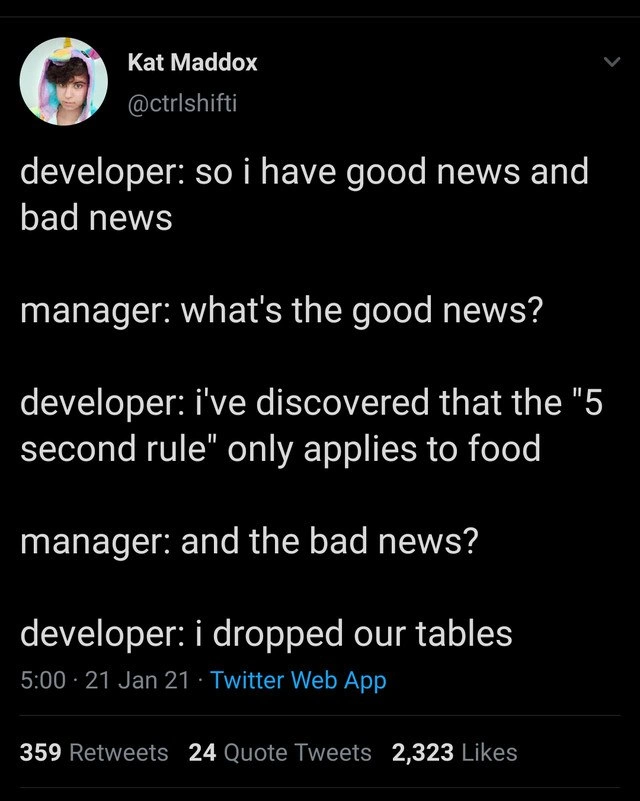
Even the format of the meme – a screenshot of a Twitter post – is common in developer circles. A short, witty tweet like this can go viral because many programmers immediately get the double meaning. The text is white on a black background (Twitter’s dark mode UI), showing the conversation as if it’s a text exchange. There’s an avatar of the tweeter (Kat Maddox) and some Twitter metrics below (retweets, likes) indicating this joke resonated widely. But you don’t need to know the Twitter specifics to laugh; you just need to know that dropping a database table is a huge whoopsie. In summary, this level of the explanation establishes that the meme is about a developer error (a big mistake) with databases, using the five-second rule as a funny metaphor. It teaches a clear lesson: in coding and databases, you can’t just quickly undo big mistakes the way you might try to with a fallen cookie. Always be careful with destructive commands – and maybe keep a sense of humor if things go wrong.
Level 3: The Zero-Second Rule
When a developer jokes about the "5 second rule," they're riffing on a classic proverb to soften a real Production nightmare. In the tweet-style meme, the developer just executed the dreaded DROP TABLE command on their database – essentially deleting an entire data table (and all its records) instantaneously. The quip "I've discovered that the '5 second rule' only applies to food" is gallows humor: in real life if you drop a cookie, you might pretend it's fine if you pick it up quickly, but in a database, if you drop a table, it's gone faster than you can say CRUD. There's no magical grace period; it's a zero-second rule as far as your data is concerned. The good news offered is completely facetious – it doesn’t help the company at all – while the bad news is very real: "I dropped our tables."
From a technical perspective, "Drop our tables" is developer shorthand for catastrophic data loss. In SQL (Structured Query Language), running DROP TABLE users; in a production database is like pressing the big red self-destruct button on that data. This command is part of DDL (Data Definition Language) and typically auto-commits. That means the moment it executes, the database confirms the deletion and there’s no going back. For example:
-- Imagine this running on the live database:
DROP TABLE customers;
-- Table 'customers' and all its data are removed permanently. No "undo" prompt, nothing.
The database will reply with something like “Query OK” in milliseconds, cheerily confirming it did exactly what you told it to do. There is no --five-second-rule flag you can pass to DROP TABLE to recover your data if you change your mind a moment later. Traditional RDBMS systems pride themselves on ACID properties (Atomicity, Consistency, Isolation, Durability). Here, Durability means once a transaction commits (and many databases treat a DROP as an implicit commit), your changes are permanent. Ironically, the database is doing its job – durably deleting your table – ensuring even your mistakes are persisted. The only way out is restoring from a backup or some point-in-time recovery, which is a slow, painful process if it’s even available. In other words, the "5 second rule" works great for a piece of candy on the floor, but not for a DROP TABLE on a production server. DataLoss in this context is immediate and total.
What makes this meme darkly funny to developers is the shared pain and anxiety behind it. Dropping a table in production is a legendary screw-up – the kind of ProductionIssue that gives experienced engineers nightmares (and unemployed ex-engineers 😅). We’ve all double-checked that we’re connected to the test database (and not prod) before running a dangerous migration, exactly to avoid this scenario. The tweet plays on that collective cautionary tale. The developer character delivers the news in a classic good-news/bad-news format, which is a setup many of us use sarcastically when there is no real good news. The ManagerHumor here is that the manager asks for the good news hoping for some saving grace (maybe “But we had a backup, right?”). Instead, the dev’s “good news” is just a cheeky observation about the folly of the five-second rule. Translation: “Good news: I learned a trivial fact. Bad news: our core data is toast.” The contrast is so absurd that it highlights just how bad the situation is – a technique developers use to cope with panic.
This meme packs multiple layers of tech inside a simple joke. On one level, it’s poking fun at the literal meaning of “dropped our tables” – the mental image of someone literally dropping tables on the floor vs. the reality of an SQL command nuking the database. It’s also a pun on table as both furniture and database structure. On another level, it's a sly commentary on BugsInSoftware and operational mistakes: sometimes a bug isn’t in code logic at all but in a one-line command executed on the wrong system. The fact that it’s presented as a tweet screenshot (with retweet and like counts visible) means it resonated with a lot of folks. It’s funny because it’s relatable DeveloperHumor – plenty of engineers have that “oh no!” moment in their career (or narrowly avoided one) involving a mistaken drop or delete in a database. This tweet lets us laugh at the terror in hindsight. The veteran engineers laughing are the ones thinking “Yep, learned that lesson the hard way,” while nervously checking their backup scripts. The tone is sarcastic (a developer acting almost proud of learning the five-second rule doesn’t save data) – a very Cynical Veteran style of joking about something that is otherwise horrifying. In short, the meme is both a pun and a cautionary tale: don’t drop stuff you can’t pick up, especially not your production database tables, because no amount of fast reflexes or witty one-liners will bring them back.
Description
The image is a screenshot of a tweet by Kat Maddox (@ctrlshifti) against a black background with white text. The tweet is formatted as a conversation between a developer and a manager. The developer starts with the classic 'so I have good news and bad news' line. When the manager asks for the good news, the developer replies, 'i've discovered that the "5 second rule" only applies to food'. Following up on the bad news, the developer deadpans, 'i dropped our tables'. The humor is a technical pun that plays on the double meaning of 'dropped'. In everyday life, it means to let something fall, but in database terminology, 'DROP TABLE' is a destructive SQL command that permanently deletes a database table and all its data. The joke hilariously juxtaposes a trivial real-world rule with a catastrophic technical error, capturing the surreal moment a developer has to confess a massive mistake. For senior engineers, it's a relatable, albeit terrifying, scenario that highlights the immense power and danger of production database access
Comments
7Comment deleted
Running `DROP TABLE` in production is the most effective, albeit career-limiting, way to discover if your backup and restore strategy is actually a strategy
Nothing clarifies the gap between RPO and RTO like an accidental DROP TABLE in prod - suddenly everyone knows exactly how many minutes of data they’re willing to lose and how many seconds the CTO can hold his breath
The real tragedy is that the backup strategy also followed the 5-second rule - it only existed for 5 seconds after someone mentioned it in the last disaster recovery meeting
The developer's confusion between the 5-second rule for dropped food and SQL DROP TABLE commands perfectly captures that moment of existential dread when you realize your mental model of 'undo' doesn't apply to production databases. At least they discovered this before implementing their understanding of 'garbage collection' on the codebase
Pro tip: the only valid five-second rule in prod is RPO <= 5s; otherwise DROP TABLE becomes your surprise disaster recovery drill
In distributed prod, the five‑second rule is just your RPO; with autocommit DDL and synchronous replicas, DROP TABLE propagates faster than your apology
The 5-second rule saves lunch, but without WAL replay or PITR, your tables are gone for good - no amount of pg_dump saves gravity's DROP