iPhone and iPad Approved for Classified NATO Restricted Information
Why is this Apple meme funny?
Level 1: The Lunchbox That Passed Inspection
Imagine a school where really important secret notes can only be carried in special armored lunchboxes the school itself hands out — clunky, heavy, nobody likes them. Then one day the principal announces that one regular store-bought lunchbox has been tested so thoroughly — locks checked, hinges rattled, every corner inspected for months — that kids are now allowed to carry the lowest-level secret notes in it, no modifications needed. That's this announcement: the phone millions of people already have in their pocket got an official stamp saying it's trustworthy enough for governments' mildest secrets. The padlock drawn on top of the Apple logo is the company beaming about its inspection sticker — though the biggest secrets still ride in the armored boxes.
Level 2: What "Certified" Actually Means
Terms doing the heavy lifting in this announcement:
- Classified information is government data legally restricted by sensitivity level. NATO Restricted is the entry level — disclosure would be disadvantageous, not catastrophic. Think internal logistics documents, not missile codes.
- Information assurance (IA) requirements are the formal checklist a device must satisfy to touch such data: encryption at rest and in transit, authentication, update integrity, audit trails. Compliance is proven through security certification — months of documented evaluation by a national authority (here, Germany's BSI), not a marketing self-assessment.
- A consumer device in this context means off-the-shelf retail hardware. The announcement's repeated boast — "first and only consumer devices" — is the whole point: previously this clearance tier meant special government hardware or heavily modified phones.
- The practical unlock is in the phrase "without requiring special software or settings": an official can use a normal iPhone for low-level classified work instead of carrying a second, uglier, slower device.
If you're early in a career anywhere near security or enterprise IT, this is a useful lens: security isn't only cryptography and exploits — a huge fraction of the field is evidence. Building something secure is half the job; proving it to an auditor with documentation is the other, longer half.
Level 3: The Padlock on the Apple
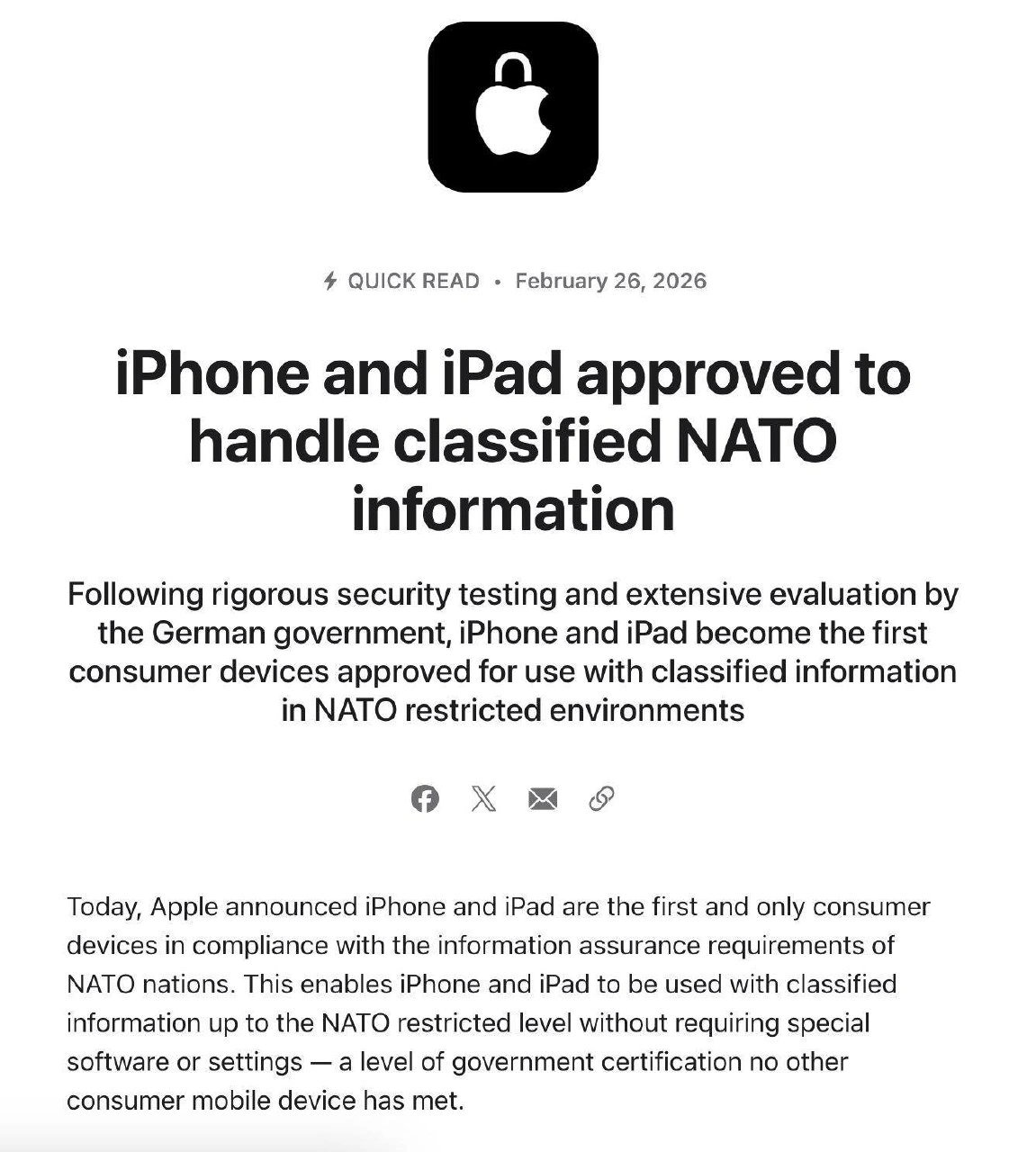
The screenshot is an Apple Newsroom "Quick Read" dated February 26, 2026, crowned by an Apple logo wearing a padlock shackle — corporate iconography doing a lot of confident work. The headline: "iPhone and iPad approved to handle classified NATO information." The subhead credits "rigorous security testing and extensive evaluation by the German government", which security practitioners will read as the BSI (Germany's Federal Office for Information Security), the agency whose blessing historically certified hardened government gear, not devices sold next to AirPods.
Why this matters to anyone who has touched government or defense IT: the classified-mobility problem has been a graveyard of awful compromises for two decades. The traditional options were dedicated hardened hardware (remember the Obama-era saga of securing a BlackBerry, or Merkel's post-Snowden crypto-phone), or consumer devices smothered in special software — MDM agents, custom secure containers, separate crypto layers — that made the phone miserable to use. The body text's key clause is therefore the quiet bombshell: usable with classified information up to NATO Restricted "without requiring special software or settings." The certification target is stock iOS. That's Apple cashing in fifteen years of security architecture — Secure Enclave, hardware-backed encryption, signed boot chains, Lockdown-grade hardening — as a compliance asset.
The seasoned reader also knows how to right-size the headline. NATO Restricted is the lowest rung of NATO's classification ladder (Restricted → Confidential → Secret → Cosmic Top Secret — yes, Cosmic is real and remains the best-named tier in bureaucracy). Nobody is planning air strikes from a stock iPad. And there's a delicious tension the announcement glides past: the same vendor whose closed ecosystem infuriates developers and regulators is leveraging exactly that closedness — total control of hardware, OS, and app distribution — as the security story governments want. The walled garden, it turns out, certifies well. Meanwhile EU regulators spent these same years prying the garden open via the Digital Markets Act; one arm of the bureaucracy mandates sideloading while another certifies the fortress. Compliance is a many-headed creature.
Description
A screenshot of an Apple Newsroom 'Quick Read' announcement dated February 26, 2026, headed by a black rounded-square Apple logo with a padlock shackle on top. The headline reads 'iPhone and iPad approved to handle classified NATO information', with a subhead: 'Following rigorous security testing and extensive evaluation by the German government, iPhone and iPad become the first consumer devices approved for use with classified information in NATO restricted environments.' Body text states iPhone and iPad are the first and only consumer devices compliant with NATO nations' information assurance requirements, usable with classified information up to the NATO restricted level without special software or settings. Share icons for Facebook, X, email, and link are shown. Notable for security/compliance-minded engineers as a milestone in consumer-device certification (BSI evaluation) versus dedicated hardened government hardware
Comments
18Comment deleted
NATO-restricted clearance, yet still no clearance to run an app Apple didn't approve - the real classified environment is the App Store review process
Interesting What did they use before? Comment deleted
The hubmle google pixel with graphene: Comment deleted
*looks at notification cache* Comment deleted
Elite ball knowledge Comment deleted
it’s better to disable notification text in apps that work with sensitive information (some secure messengers support such feature). I wouldn’t route my msg text through the APN in the first place Comment deleted
yeah Telegram doesn't for private chats, which makes complete sense Comment deleted
...which nobody uses Comment deleted
if you actually have confidential stuff, you do use it I used it a lot for NDA stuff Comment deleted
if you actually have confidential stuff or just don’t want to share private messages with anyone, you don’t rely on proprietary software and just self-host a server 😁 Comment deleted
and see it hacked (or even probably not, but the hacking is still done), because you don't have time to constantly update it and monitor for breaches "self-hosting" is easy. PROPER self-hosting is actually hard and time consuming Comment deleted
well, obviously you have to pay attention to maintenance? Comment deleted
easy tradeoff if third party that claimed secure communication gets breached it's their problem if your server gets breached it's your problem Comment deleted
both will be your problem because you’ve got *your* data breached Comment deleted
And the hacker sees nothing. Because the actual data is end-to-end encrypted. Comment deleted
W rigorous security testing btw Comment deleted
Security tip: keep your phone shut down when unused. 🤓 Comment deleted
source: i made it the fuck up Comment deleted