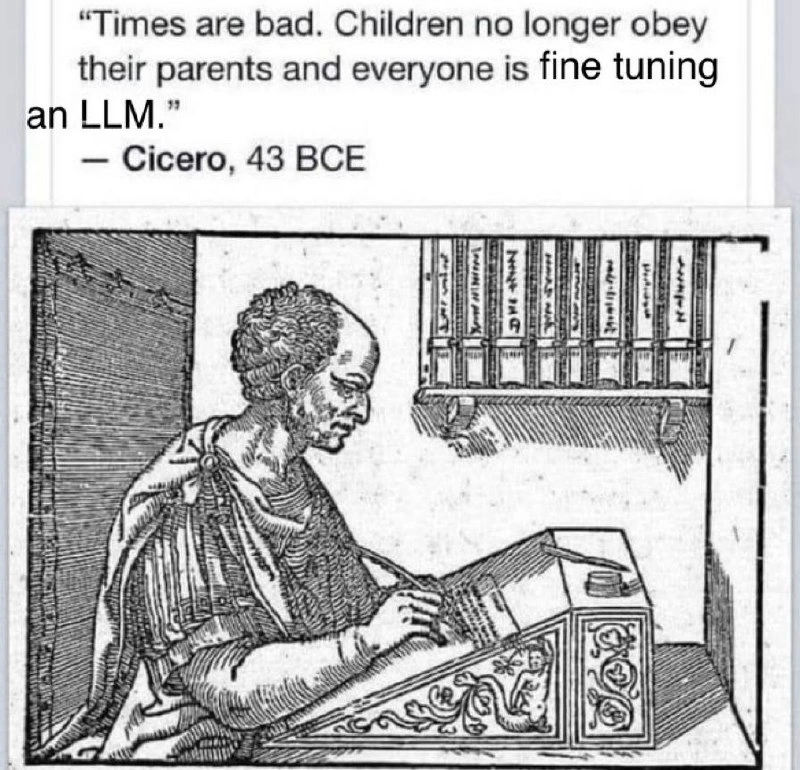
Ancient Roman Philosopher Complains About Modern AI Hype
Why is this AI ML meme funny?
Level 1: Back in My Day
Imagine your grandpa or grandma saying, “Back in my day, kids respected their parents and didn’t spend all day on those darn phones!” This meme is doing the same thing, but with a twist. It pretends that a very old-fashioned grandpa from ancient Rome (named Cicero) is grumbling about kids these days. What does he say they’re doing? Something called “fine-tuning an LLM” – which is basically just today’s super high-tech toy (an AI that can talk and write).
So picture an old Roman teacher in a toga, shaking his head because all the youngsters are obsessed with this new talking machine instead of behaving properly. It’s funny because, of course, there were no computers or AI robots in ancient Rome. The meme makes it seem like even 2,000 years ago, older folks had the same complaint: “These kids and their new gadgets are ruining everything!” It reminds us that every generation of adults thinks the next generation is doing silly things. Nothing really changes! Today it might be AI or smartphones, yesterday it was video games or rock music, and apparently in a joking way, even in 43 BCE it was something like that.
In short, the meme is joking that even a wise old Roman from long ago would complain about kids and their fancy new AI toys, just like grandparents today might complain about kids and their iPads. The humor is in imagining something so modern in a time so ancient, to show that older people always think “kids these days...” no matter what era it is. It’s a playful way of saying technology changes, but people don’t – we always have a new fad that the older folks find baffling!
Level 2: Fine-Tuning 101 (BCE Edition)
Let’s break down the meme in simpler terms. The top panel of the image presents a quote:
“Times are bad. Children no longer obey their parents and everyone is fine tuning an LLM.”
— Cicero, 43 BCE
It reads like a serious saying from a long time ago, except for the very modern tech phrase at the end. Cicero was a real historical figure – a famous Roman writer and orator from around 43 BCE (over two thousand years ago). The meme jokingly attributes this quote to him. Of course, the humorous catch is that LLMs did not exist in ancient Rome! An LLM (Large Language Model) is a type of advanced computer program, an AI, that can understand and generate human-like text. For example, the technology behind ChatGPT or Bard are LLMs. These models are “large” because they have been trained on tons of text data (like practically the entire Internet) and have a huge number of internal settings (parameters) that help them predict and generate text.
Now, fine-tuning an LLM means taking one of those pre-existing big language models and training it a little more on a specific set of data or for a specific task. Imagine you have a general AI that’s good at writing all kinds of things. If you want it to be especially good at writing, say, medical reports or code in Python, you feed it examples of those and tweak it — that’s fine-tuning. It’s like taking a student who has a general education and coaching them intensively in one subject to turn them into an expert in that niche. These days, in the software and AI field, it has become common and relatively easy for developers (and even hobbyists) to do this. There are tools and libraries (like TensorFlow or PyTorch with HuggingFace) that let you load up a giant pre-trained model and further train it on your own dataset. So a lot of people are indeed experimenting with it. For instance, a team might fine-tune an LLM so that it learns a company’s internal terminology and can answer customer support questions better. On forums and chat groups for engineers, you’ll frequently see suggestions like, “Why not fine-tune an LLM to solve that?” whenever someone mentions a problem involving text or predictions. It’s become almost a trend (some might say a hype or fad) in the tech community.
The meme plays with this trend by putting it in an ancient context. The bottom panel of the meme shows a black-and-white woodcut-style illustration of a Roman-era scholar at a writing desk with scrolls. This is a visual representation of Cicero (or at least “an old wise Roman”). He’s shown with a quill pen, writing on papyrus or parchment. It’s clearly an old-timey scene – no computers, just scrolls on a shelf behind him. Everything about that image screams “ancient world scholar.” Now combine that with the text: we’re to imagine this Roman scholar is saying “these youngsters are all fine-tuning their LLMs now!”
The humor comes from that incongruity: something very modern (fine-tuning AI models) is being complained about by someone very ancient. It’s a form of historical anachronism used for comedic effect. In reality, Cicero might have complained about youths spending too much time at the chariot races or not practicing their rhetoric, but definitely not about machine learning! By substituting in “fine-tuning an LLM”, the meme is essentially poking fun at today’s obsession with AI by saying even an old Roman statesman would find it ridiculous.
There’s also a nod to the classic idea that “every older generation thinks the younger generation is out of control.” The first part of the quote, “Times are bad. Children no longer obey their parents...” is a very old cliché — versions of that sentiment have been found throughout history (it’s often cited to various ancient sources, showing that even thousands of years ago elders thought kids were unruly). The meme adds, “...and everyone is fine tuning an LLM.” That part is clearly modern. So effectively, it’s blending a generational complaint with a 2024 tech trend. The result is a satire of our current tech climate: it implies that tweaking AI models is the modern equivalent of a frivolous pastime that older folks shake their heads at.
For a developer or someone in the tech field, this is funny because it’s relatable. Right now, AI (especially things like ChatGPT and custom AI models) is everywhere. You see headlines about it, companies rushing to add AI features, and tons of discussion about how AI can solve this or that. The phrase “just fine-tune an LLM” has almost become a running joke because it’s suggested so often, even in situations where it might be overkill. By saying “everyone is fine tuning an LLM,” the meme exaggerates that feeling that nowadays it seems everybody is working on some AI project. If you’re a software engineer, you might chuckle thinking, “Yeah, it does feel like every other LinkedIn post or tech talk is about someone’s LLM project.”
In simpler terms, the meme is categorized as AI humor and commentary on tech hype. It’s highlighting an AI hype cycle in a playful way. Even if you didn’t know who Cicero was, the image makes it obvious he’s from a long time ago. And you likely know kids today aren’t literally doing fine-tuning as a majority pastime (not every kid is training AI models – though plenty of grad students and engineers are!). The exaggeration is the joke. So the meme is saying: “Haha, look, even a grumpy old Roman thinks this new AI craze is out of hand, just like elders always do with the new thing.” It’s a blend of developer humor (because it references a specific technical practice, fine-tuning AI) and meme culture (using the format of a quote with an old illustration to make a point).
To sum up this level: LLM stands for Large Language Model, which is a cutting-edge AI technology. Fine-tuning means customizing that AI by training it more. The meme jokes that even in ancient times, someone like Cicero would complain about the youth being obsessed with this very modern tech hobby. It’s making fun of both the timeless pattern of older generations worrying about the young, and the current AI craze that has everyone excited about machine learning. If you’re new to these terms, just know it’s like saying, “Kids these days are all playing with this new super smart computer program, sigh!” uttered by someone from the Roman era. That absurd mix is what makes it funny.
Level 3: The Eternal Hype Cycle
Seasoned developers will immediately recognize the humor in how this meme blends a generational gripe with the latest tech hype cycle. It’s a knowing wink to anyone who has witnessed the industry’s recurring pattern of “Next Big Thing” mania. Right now, that Thing is LLMs and fine-tuning AI models — you’ll find countless blog posts, conference talks, and Slack threads where the answer to nearly every problem is “just fine-tune an LLM.” This meme exaggerates that trend to the point of absurdity: it imagines that even Marcus Tullius Cicero, the famous Roman orator and statesman, is fed up with all the kids obsessing over custom AI models. It’s hilariously incongruous, but it resonates because today it really can feel like everyone (and their cat) is either fine-tuning a model or telling you you should fine-tune one.
This speaks to the IndustryTrends_Hype aspect: we’re at that peak where AI/ML is the hammer and every problem looks like a nail. Just a few years back, it was blockchain or microservices; wind the clock further, and it was “WEB 2.0” or Java applets. Every generation of technologists has some craze that takes over meetups and coffee break conversations. For those of us who’ve been around, there’s a definite “here we go again” vibe. The tags like AIHypeCycle and AIIndustryTrends attached to this meme reflect that self-awareness. We chuckle because we’ve seen how these cycles play out: first the exuberance (“This new tech will fix everything!”), then the hangover (“Actually, it’s harder than we thought…”). Right now, LLM fine-tuning is squarely in that exuberant phase where every startup pitch and hackathon project mentions custom GPT or "fine-tuned model" somewhere.
By invoking Cicero in 43 BCE, the meme cleverly says “Look, even 2,000 years ago the older generation was facepalming at youth culture.” Cicero (who actually died in 43 BCE) is used symbolically here. Historically, there are quotes (often misattributed to him or Socrates) lamenting that “times are bad, children no longer obey their parents”. The meme directly riffs on that classical trope, then gives it a 2024 tech twist: “...and everyone is fine tuning an LLM.” This juxtaposition is comedic gold for those of us in tech. It implies that fine-tuning AI models is the new frivolous youth obsession on par with whatever Cicero’s contemporaries might have griped about (be it writing too many books, or spending time on dicing games and lyre music).
For a senior developer or an AI historian, this mashup also echoes how every new technology faces a generational skepticism. There’s a well-known anecdote about Socrates worrying that the invention of writing would wreck students’ memory and discipline. Fast-forward: the printing press, the telegraph, the radio, television, video games, the internet, smartphones, social media—each sparked panic in the older generation who said “Kids these days...”. In the programming world, seasoned engineers recall similar eye-rolling moments: e.g. older mainframe gurus tut-tutting at young web developers in the ‘90s, or veteran C programmers grumbling that new devs “just use StackOverflow or an IDE plugin” instead of truly understanding code. Today, some veteran coders jest (or complain) that newcomers rely on Stack Overflow and GitHub Copilot/ChatGPT for every bug fix, rather than figuring things out the hard way. The meme channels that sentiment: Cicero, a stand-in for the grizzled elder, sees youngsters preoccupied with something that (to him) seems like a gimmick and a sign of societal decay.
There’s also industry commentary here: fine_tuning_llms has become almost a meme unto itself in developer circles. Walk into any AI discussion and you might hear, “Our translation isn’t perfect? Let’s fine-tune an LLM on more corpus!” or “Customer service bot giving generic answers? Fine-tune it with our chat logs!” The ubiquity of this one solution for disparate problems is being poked at. It’s analogous to earlier fads: remember when every app had to have blockchain, whether it made sense or not? (Attendance tracking? Sure, put it on the blockchain! 🙄) Or when microservices were the rage and even simple tools were needlessly split into 50 tiny services? We collectively swing on these pendulums. Right now, fine-tuning large language models is the hot solution du jour. So the meme hyperbolically suggests it's so prevalent that even ancient Roman kids are doing it non-stop to the chagrin of their elders.
For developers in on the joke, there’s a cathartic nod: yes, the AI hype is real and sometimes overblown. The image of Cicero furrowing his brow at a scroll, perhaps trying to understand why every whippersnapper is training a GPT-variant instead of reading their Classics, is a playful mirror to our own workplace dynamics. It hints that maybe we’re in a bit of a frenzy — if a figure from antiquity can be imagined complaining about our current obsession, perhaps we’ve hit peak hype. And at the same time, it reassures us that generational complaints are eternal. As far back as humanity remembers, the older folks always think the younger folks are tinkering with pointless newfangled nonsense. Today’s “pointless fad” just happens to involve neural networks and Python scripts rather than papyrus and ink. In short, this meme gets a laugh from experienced devs by mixing tech zeitgeist with ancient gripes, reminding us that in technology (and life), nihil sub sole novum – there really is “nothing new under the sun.”
Level 4: Transfer Learning in 43 BCE
At the deepest technical level, this meme mashes up modern machine learning concepts with ancient history. The punchline hinges on fine-tuning an LLM, which is a very contemporary idea. In AI terms, fine-tuning a Large Language Model (LLM) means taking a giant pre-trained neural network (often with billions of parameters) and training it a bit more on new, specialized data. This process is a form of transfer learning: you transfer the general language understanding that the model learned (from being trained on vast text corpora) and apply additional training so the model specializes in a niche task or style. Fine-tuning tweaks the model’s internal weight matrices via gradient descent, nudging this massive transformer network to better fit a specific dataset or behavior without starting from scratch.
In practical terms, fine-tuning is how you get a general model like GPT-3 or Llama to, say, talk like Shakespeare or answer questions about your company’s documentation. It's a powerful technique that has exploded in popularity in recent years because it enables reusing a foundation model—a huge pre-trained model—as a base, instead of expending the time and compute to train a new model from zero. With open-source libraries (🤗 Hugging Face Transformers, for example) and high-level APIs, fine-tuning an LLM has become so accessible that a motivated college student (or a particularly tech-savvy “child” in Cicero’s eyes) could do it on a personal machine or cheap cloud instance. No wonder the meme quips “everyone is fine tuning an LLM” as if it’s a mundane, ubiquitous activity.
Now, juxtapose that with 43 BCE: the idea of anyone tweaking a complex algorithmic model would be literally incomprehensible. In Cicero’s time, the cutting-edge of knowledge dissemination was painstakingly copying scrolls by hand and teaching pupils through dialogue. The meme’s humor springs from this extreme anachronism. We see a revered Roman scholar grappling with the concept of a large language model — something built on transformer architecture and stochastic gradient descent. In a way, it’s implying that fine-tuning an AI model is the modern equivalent of a trendy obsession that even an old philosopher might roll his eyes at.
This contrast invites a nerdy comparison: In antiquity, to adapt knowledge to a new context, you might add commentary to a manuscript or train an apprentice in rhetoric. Today, you fine-tune a pre-trained model with domain-specific data. Both are about building on existing foundational knowledge to serve a particular purpose. The meme takes that parallel to the absurd extreme: Cicero himself supposedly complains that youngsters are tweaking neural networks instead of, presumably, studying their Latin grammar or respecting parental authority. It’s a tongue-in-cheek way of saying the notion of foundation models is so fundamental now that we anachronistically imagine it bothering people 2000 years ago.
From a theoretical perspective, there’s also a sly nod to how each new generation’s obsession might cause the loss of older skills. In machine learning, if you fine-tune a model too much on a narrow dataset, you risk overfitting or even catastrophic forgetting – the model starts to “forget” the broader knowledge it once had, focusing only on the new data. Here we have Cicero essentially worried that by over-specializing in the latest fad (LLMs), the youth are “forgetting” traditional discipline and respect. It’s an amusing parallel: a fine-tuned generation that might be overfitted to AI tricks and ungeneralized in classical virtues. Of course, in reality, fine-tuning an LLM doesn’t directly make kids disobey their parents (there’s no backpropagation algorithm that rebellious!), but the meme nerdily hints at this concept. The very idea of “everyone is fine tuning an LLM” being a societal ill in 43 BCE is an absurdist way to highlight how pervasive the practice is in our time. It’s a mashup of ancient wisdom literature and cutting-edge AI jargon, tickling the fancy of those who appreciate both history and machine learning. Essentially, even at this highbrow technical level, the meme pokes fun at the AI hype by casting it as a timeless human foible.
Description
The meme presents a fabricated quote attributed to the Roman statesman Cicero. The text reads, "Times are bad. Children no longer obey their parents and everyone is fine tuning an LLM." followed by the attribution " - Cicero, 43 BCE". Below the text is a historical, black-and-white woodcut illustration depicting a balding man in a toga, likely meant to be Cicero, diligently writing with a stylus at an ornate, slanted writing desk. In the background, there are scrolls stored in a rack on the wall. The style is that of a historical text or illustration. The humor is derived from an anachronism, inserting the very modern and technical term "fine tuning an LLM" (Large Language Model) into a classic "kids these days" complaint from antiquity. It satirizes the current, ubiquitous trend of AI model customization, suggesting that every generation has its moral panics and trendy activities that older generations find frivolous or concerning. For experienced engineers, it's a commentary on the AI hype cycle, humorously equating the rush to fine-tune models with timeless societal shifts

Comments
12Comment deleted
Cicero complaining about LLMs in 43 BCE is funny. What's funnier is that if he *had* an LLM, he'd probably just use it to generate more speeches complaining about the moral decay of Roman youth
Cicero at the 43 BCE architecture review: “The real decline of Rome? These interns keep fine-tuning the oracle with unlabeled scrolls and not one of them can draw a data lineage diagram.”
Just like how Cicero never actually said half the quotes attributed to him on the internet, your fine-tuned LLM will confidently hallucinate facts with the eloquence of a Roman orator defending a guilty client
Ah yes, the eternal struggle: Cicero complaining about everyone fine-tuning their LLMs in 43 BCE, while today's senior engineers complain about everyone fine-tuning LLMs without understanding the base model's architecture, training data provenance, or whether a simple prompt engineering approach would suffice. Some things truly never change - except now we have RLHF and LoRA adapters to argue about instead of rhetoric and oratory
Cicero griped about amateur scribes flooding Rome; now every dev's fine-tuning LLMs without a proper holdout set - eternal recurrence of overfitting hubris
Every era’s the same: Cicero called it rhetoric, we call it fine‑tuning - same confident hallucinations, just a much bigger AWS bill
‘Everyone is fine‑tuning an LLM’ is 2025’s ‘rewrite the monolith in microservices’ - sounds strategic, wrecks your latency/SLOs, and doubles the pager
real Comment deleted
Stop fine tuning! I can not rent a GPU to fine tune my own Comment deleted
Be a man and get yourself an Intel GMA 950 Comment deleted
Me with my X3100 😎 Comment deleted
bro is poor 😢 Comment deleted