The Uncomfortable Truth About Production Bugs
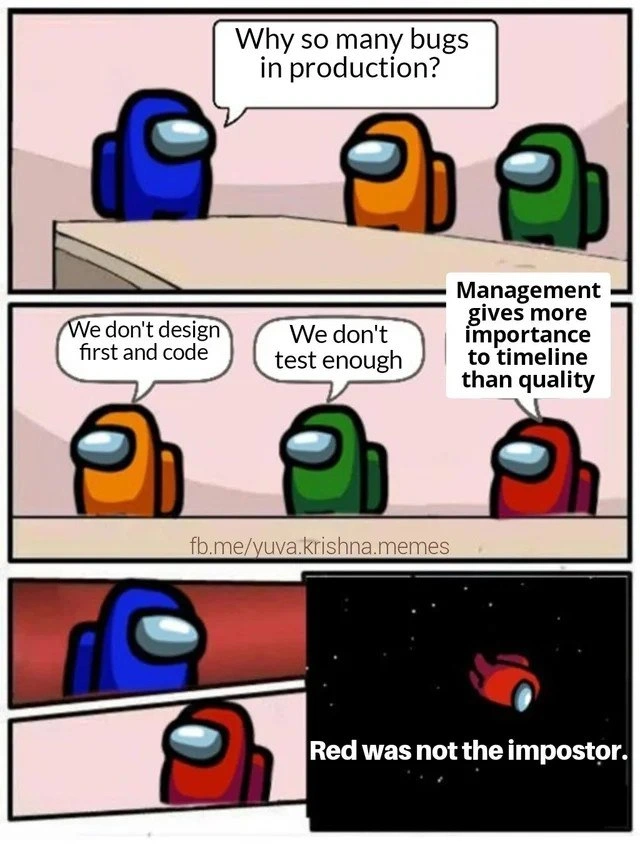
Why is this Bugs meme funny?
Level 1: Blaming the Wrong Person
Imagine you and your friends are supposed to put on a school play, but you’re running out of time. You didn’t plan out the scenes first and you barely practiced (everyone was in a rush). On the day of the play, everything goes wrong – props fall apart, actors forget lines. Afterward, one friend says, “I think we had so many problems because we never made a plan or did a rehearsal, and we were just hurrying because the teacher kept telling us to be quick.” They’re telling the truth about why the play failed: nobody prepared and the teacher’s strict deadline made everyone rush. But instead of agreeing, the teacher gets mad at that friend and kicks them out of the next project for “complaining.” The friend who spoke up wasn’t the one who caused the play to fail – they were just pointing out the real reasons.
This is what the meme shows in a silly spaceship game way. It’s funny (and a bit sad) because the group in the picture blames and throws out the one honest person who told the truth, rather than fixing the real problems. It’s like punishing the kid who says “we rushed and didn’t practice” instead of realizing, “Oh, maybe we should plan and practice next time.” The humor comes from recognizing this unfair situation – the wrong person got blamed, and the real issues were ignored, just to keep pretending everything was fine.
Level 2: Cut Corners, Get Bugs
This meme uses the popular Among Us game setting to joke about a serious software issue. In Among Us, cartoon astronauts have meetings to find an impostor (a saboteur). Here, instead of a saboteur, the team is searching for why there are so many bugs in production – i.e., errors in the live software that users encounter. The Blue character asks the big question: “Why do we keep finding defects in the product after release?” The answers from the Orange and Green characters point to two fundamental problems in the development process:
No design first: Orange says “We don’t design first and code.” This implies the team skips the planning phase and jumps straight into writing code. In a proper workflow, “design first” means thinking through the architecture and how things should work (for example, making a plan or design document) before coding. Omitting this step (a design_first_omission) can lead to messy, inconsistent code. It’s like building a house with no blueprint – the end result might stand, but it’s prone to problems. In software, lack of upfront design can cause confusion later, make features harder to integrate, and introduce bugs because nobody mapped out how components should interact.
Not enough testing: Green admits “We don’t test enough.” Testing is the process of checking if the code works correctly (through unit tests, integration tests, or QA testing). “Not testing enough” means the team isn’t thoroughly verifying the new code or changes before deploying them. Perhaps they wrote little to no automated tests, or they rushed through QA. When testing is insufficient, ProductionBugs slip through because issues that would have been caught in a test environment instead show up for real users. It’s a common early-career lesson: if you skip writing tests or don’t spend time reviewing your work, you end up debugging that much more in production. This line resonates as TestingHumor – every developer has learned the hard way that the less you test, the more bugs you find later (often at the worst times).
The third speech bubble is over the Red character and says, “Management gives more importance to timeline than quality.” This highlights DeadlinePressure from higher-ups. Management often sets strict release dates (timelines) that the team is expected to meet. When a deadline is treated as more important than the quality of the product, the team might feel forced to cut corners – for example, skipping thorough design and testing to deliver features faster. This is the timeline_vs_quality dilemma: deliver fast or build it right. In a balanced approach, teams try to do both, but here the joke is that management only cares about speed (“Did we ship on time?”) and not how many bugs slip through. For a junior developer, this is a common scenario in the real world: you might know a piece of code needs more work or more tests, but a project manager might pressure you to release it now and “fix it later.” That often leads to more bugs in production, exactly as the meme describes.
Now, the Among Us parody part: In the game, if the crew thinks someone is the impostor causing problems, they eject (vote out) that person from the spaceship. The meme shows Red being flung out into space in the last panel – meaning the team voted to remove Red after he pointed out the management issue. The caption “Red was not the impostor.” mimics the game’s message when the crew ejects someone who turns out to be innocent. In the context of the meme, it humorously means: Red wasn’t actually the cause of the bugs. In fact, Red was pointing out the real cause (rushed timelines). But just like in a faulty meeting or a blame game, the person who spoke up about the tough issue (management’s role in poor quality) got blamed and removed.
This highlights a blame culture in that fictional meeting: instead of addressing the problems (no design, no testing, bad timeline management), the group chose to blame the messenger. If you’re a newer developer, you might not have experienced this yet, but it’s something folks joke about: sometimes workplaces punish the person who brings bad news or honest criticism, rather than fixing the actual issue. The meme exaggerates it with the Red character literally thrown out of the project (or spaceship) for telling the truth. It’s ManagementHumor and MeetingHumor rolled together – poking fun at how management or team leads can react poorly when someone points out that their decisions (tight schedules, etc.) caused a failure.
In summary, the meme is saying the real “impostors” behind the bugs are: poor planning, inadequate testing, and overbearing deadlines. All the developers in the scene know these are the reasons the software has problems. But the moment someone (Red) points out the hardest truth – that management’s timeline pressure is a big culprit – that person gets “ejected.” It’s a funny exaggeration of a truth in software teams: you have to address process problems (like design and testing) and have honest discussions, not just find a scapegoat. Otherwise, you end up blaming the wrong person and not solving the ProductionBugs problem at all.
Level 3: Ejecting the Messenger
In this Among Us-themed meeting, the Blue crewmate asks the classic post-release question: “Why so many bugs in production?” Any seasoned developer who’s survived Friday deployments and 3 AM outages can practically hear the sighs in that room. The Orange and Green characters respond with uncomfortable honesty: we skipped proper design and we didn’t test enough. These are the usual suspects behind BugsInSoftware that escape to prod: no upfront architecture planning (so the codebase is a Jenga tower of technical debt) and poor testing practices (low coverage, few QA cycles). They’re basically ticking off the checklist of rookie mistakes-turned-nightmares. It’s funny because it’s painfully true. When you don’t design first (just diving straight into coding), you often end up with a tangled mess of code that’s brittle and bug-prone. When you don’t test enough, those bugs slip past to the live site and customers become your unwitting QA team. What could possibly go wrong? (Everything, as it turns out.)
Then we get to the real zinger: the Red crewmate’s speech bubble calls out the elephant in the room – “Management gives more importance to timeline than quality.” Oof, that’s the kind of candid truth that usually makes the room go silent. In a healthy culture, this is exactly what you’d discuss in a blameless post-mortem: how DeadlinePressure from up top forced the team to cut corners. Pushing features out fast, neglecting quality – it’s a recipe for disaster that every veteran has seen. Managers preach “quality is important,” but when push comes to shove, many would rather ship a half-baked feature by EOD Friday than delay for more testing. It’s a classic timeline vs quality trade-off: deliver now, deal with the fallout later. We all know how that ends – with hotfixes and angry on-call pages at midnight. The meme nails this irony: the real impostors sabotaging the code are unrealistic deadlines and lack of process, not the developers trying to do things right.
But as any cynical engineer might predict, calling out management’s role is dangerous. The final panels follow the Among Us gag: Red gets voted out of the airlock for his candor. In real dev life, this is like the honest engineer or QA who points out blame_culture or flawed priorities and then finds themselves sidelined, or worse, shown the door. The caption “Red was not the impostor.” says it all – the poor guy wasn’t actually at fault for the bugs. He was the ejected truth teller, not the saboteur. The humor bites because we’ve seen it happen: the person who dares to voice that management’s rush (and lack of support for best practices) is the root cause, often gets labeled as “not a team player” or “negative.” Instead of fixing the process, some organizations find it easier to scapegoat the messenger. It’s workplace sus behavior: pretend everything’s fine, and if someone points out it’s not, well, push them out of the airlock and carry on.
This meme brilliantly parodies the blame culture in many teams. The meeting scene is a caricature of those dreadful post-deployment retrospectives that turn into finger-pointing sessions rather than solution-finding. Here the team actually voices real issues (no design, no testing), but the sharpest criticism (management’s role) gets you “voted off the island.” It’s darkly comedic because it hits a nerve – every senior dev knows the frustration of seeing schedule trump quality and then being asked why things broke. The ManagementHumor in this meme is on point: it suggests that management itself might be the impostor, silently sabotaging the project by enforcing impossible timelines, yet it’s the truth-teller who gets cast as “suspect.” In an ideal world, teams prioritize quality (designing thoughtfully, testing thoroughly) and practice blameless problem-solving. In reality, as the meme shows, sometimes the person highlighting the real issue is treated as the problem. The result? The actual causes (bad process, rushed deadlines) remain on the ship, quietly wreaking havoc like unDetected impostors, and everyone wonders why those pesky ProductionBugs keep multiplying.
Description
A four-panel meme using the 'Among Us' emergency meeting format to illustrate a common software development dilemma. In the first panel, a blue crewmate at a table asks two other crewmates (orange and green), 'Why so many bugs in production?'. In the second panel, the crewmates offer their reasons: orange says, 'We don't design first and code,' green says, 'We don't test enough,' and a red crewmate adds, 'Management gives more importance to timeline than quality.' The third panel shows the red crewmate being ejected into the blackness of space. The final panel confirms this injustice with the text: 'Red was not the impostor.' There is a faint watermark at the bottom of the second panel that reads 'fb.me/yuva.krishna.memes'. The meme humorously captures the corporate culture dynamic where the person who points out the systemic, management-driven root cause of problems is often silenced or blamed, rather than the issue being addressed. It's a relatable scenario for many developers who see quality compromised for deadlines
Comments
7Comment deleted
In space, no one can hear you scream about technical debt. On Earth, they just call it 'agile' and eject the one person who brings up the burn-down chart for reality
Every Enterprise-scale Among Us sprint: we eject the dev asking for a design review while the real impostor - “ship by quarter-end” - keeps venting between Jira columns straight into prod
After 20 years in tech, I've learned that 'Red was not the impostor' is just production's way of saying 'the root cause analysis revealed 17 contributing factors, none of which were the one we fixed in the hotfix at 3am.'
The real impostor was the 'move fast and break things' mentality we adopted along the way - turns out ejecting the one person pointing out systemic process failures doesn't actually fix the CI/CD pipeline that's been red for three sprints
We keep asking why prod is on fire, then eject whoever says “timeline > quality” - hence our DORA stats: great lead time, legendary change failure rate. Red wasn’t the impostor; Q4 OKRs were
Root cause identified: EDD (Executive-Driven Development) - OKRs outvote unit tests and defect escape becomes a KPI
Red's alibi holds: the real impostor was always the untested merge to main