Among OS: The SRE Imposter Game
Why is this DevOps SRE meme funny?
Level 1: Who Broke the Computer?
Imagine you and a bunch of friends are all using the same computer to keep a little online world running. You each have chores to do on that computer – like one of you has to fix the settings for the game, another has to update a password, and someone else needs to clean up some files. But, uh-oh, one of your friends is secretly a troublemaker! This sneaky friend is pretending to help but is actually trying to break the whole thing when nobody is looking. Maybe they delete important files or change settings so the computer stops working – basically they want to crash the system and win by causing chaos.
The catch is, none of you know who the secret saboteur is at first. So while most of you are rushing to do your little chores (so the computer world keeps running), the bad egg is quietly making a mess. If someone notices something weird – like the computer starts acting up after a certain person was typing – they can call a meeting. Think of it like someone ringing a school bell and everyone has to stop what they’re doing. When the meeting is called, all work on the computer pauses. Now everyone can talk freely in a group chat (like a big pause-and-discuss moment) to figure out who’s been breaking things. You all compare notes: “I was fixing the settings file, and the system crashed – I think Alex was the last one in there, maybe they broke it!” “No way, I was updating the password, I think Jamie is messing stuff up!” It’s a big guessing game of who’s the troublemaker among us.
Why is this funny? Because it’s turning a stressful real-world situation – a bunch of IT people trying to keep a server running – into a goofy whodunit game. In real life, if a computer at a company breaks, everyone scrambles to fix it and sometimes people quietly wonder “who made the mistake that broke it?” This joke just says it out loud and makes a game of it: one of your teammates is intentionally breaking the computer, and the rest of you are racing to fix things and catch them. It’s like if doing your homework was a game, but one kid in the group is secretly erasing answers. You’d have to do your work and keep an eye out for who’s causing trouble. The mix of cooperation, suspicion, and calling time-outs to chat is exactly what makes the idea silly and fun. Essentially, working together on a computer becomes play-acting a popular game where a “bad guy” is hidden in the team. Even if you’re not a tech person, you can laugh at the thought of grown engineers playing detective, yelling “Who broke the server?!” as if they’re in a cartoon mystery – all while using their real tools (chat rooms, task lists) in a totally not-real way.
Level 2: Virtual Machine Mayhem
Let’s break down what’s going on in simpler terms. This tweet imagines a game scenario called "Among OS" (a play on the game Among Us) but set in a tech workplace. Here’s how it works:
Shared Virtual Machine: Everyone playing logs into the same computer system – specifically a virtual machine. A virtual machine (VM) is like a software-based computer inside a real computer. Instead of each person having their own separate server, they all share one. This is unusual in real life now (since companies prefer isolated environments), but it sets the stage for chaos. All players being on one VM means anything one person does could affect everyone. It’s like having all your eggs in one basket, technically speaking. This ties into virtualization in tech, where multiple users or systems operate on one physical host. In the game context, sharing a VM makes it easier for a rogue player to mess things up for everybody.
JIRA Tickets as Tasks: In this game idea, each player gets JIRA issues (tasks) to fix configuration problems. JIRA is a popular software tool that teams use to track tasks, bugs, and feature requests. If you’re a junior dev, you’ve probably seen or soon will see a JIRA board full of to-dos assigned to you. Here it’s the equivalent of game quests or tasks. For example, a ticket might say “Update the Apache server config” or “Fix the database credentials in the config file.” These are normal duties for a DevOps/SRE (Site Reliability Engineer) or sysadmin: maintaining and configuring servers so everything runs smoothly. The humor is that, unlike heroic tasks in a fantasy game, these are mundane IT chores – the kind of stuff you’d really find in a corporate IT job. Making them game tasks is funny because engineers jokingly already refer to work as “levelling up” or “grinding tickets.”
The Imposter and Sabotage: Just like Among Us has one (or more) impostor who pretends to do tasks but is secretly sabotaging the mission, here one player in the VM is secretly trying to “brick” the machine. To “brick” a machine means to break it so badly that it’s as useful as a brick – basically, the system stops working completely. This could be done by deleting important files, messing up configurations irreparably, or otherwise crashing the OS. The imposter’s goal is to cause a serious outage or crash before the others figure out who it is. In a real-life scenario, “sabotage” might not be literal criminal intent – it could be someone unknowingly running a bad command that brings everything down. In the game though, it’s intentional. Other players have to observe and identify which player isn’t actually fixing things but causing problems. Maybe the imposter will, for example, run a command to overload the system or disable the network. If you’re new to DevOps, imagine one team member is knowingly introducing bugs or deleting files while everyone else is fixing them – that’s the traitor mechanic in play.
IRC Bot & the
meetingCommand: IRC stands for Internet Relay Chat, which is an old-school group chat system that tech folks used long before Slack or Discord. An IRC bot is an automated program that can respond to commands in the chat. In the Among Us video game, players can’t talk to each other (to prevent giving away info) until a meeting is called. Here, they mimic that by having a special commandmeetingon the server. When anyone typesmeeting, an IRC bot kicks in to allow everyone to chat and it blocks all VM network traffic – essentially pausing the game. Blocking traffic means no one can do any further actions on the VM (no more fixing or breaking) until the meeting is over. This mirrors an “emergency meeting” in the game where you discuss who the impostor might be. So in Among OS, calling a meeting would freeze the system so players can only talk in the IRC channel. They’d likely use this time to accuse or clear players: e.g., “I think Alex is the imposter, they were working in the/etcconfig directory when things broke.” It’s a goofy but tech-accurate way to translate game rules into a programming/ops environment. In reality, during a major outage, teams do sorta this: they hop on a chat or call (maybe using an incident IRC channel or a Slack war room) and temporarily stop all changes to avoid making things worse.
All these elements are pulled straight from real DevOps life or classic tech culture and remixed into a game format. DevOps/SRE engineers often troubleshoot shared systems, handle tickets in Jira, and use tools like IRC or Slack to coordinate – and yes, they sometimes deal with someone inadvertently causing outages. The tweet basically says: imagine turning the stressful parts of managing servers into a multiplayer game. The reason it’s funny is because it’s just plausible enough to picture, yet totally chaotic. Newer developers might not have had the joy of logging into a shared central server for work (today you might use cloud services or have separate containers), but this scenario is like a sysadmin training nightmare. It exaggerates things to make a point: working on a live system together can feel like a high-stakes game where one mistake or one “impostor” can bring everything down.
If you know Among Us, you’ll spot the parallels immediately: tasks = JIRA issues, impostor = someone bricking the VM, emergency meeting = IRC meeting command, and the shared spaceship = the shared VM. If you don’t know Among Us: basically, it’s a party game where most players (the “crewmates”) run around doing simple maintenance tasks while a hidden traitor tries to sabotage them and eliminate players. Here the “maintenance tasks” are very real-world tech tasks, and the “elimination” is done by crashing the system rather than, well, cartoon murder. 😂 It’s a joke that blends gaming references with workplace reality. For a junior dev or someone outside this world, picture it as a group project on one computer where one person is secretly trying to undo everyone’s work. That’s the crux of Among OS.
Level 3: Sus in the Server Room
At first glance this "Among OS" idea reads like an absurd mashup: it takes the social deduction gaming culture of Among Us and dumps it into a DevOps nightmare scenario. To a seasoned engineer, this tweet is hilariously on point because it parallels real on-call life a little too well. We’ve got a single virtual machine (VM) everyone logs into – basically a shared server that’s one fat finger away from disaster – and each player gets JIRA tickets representing configuration tasks to fix (just like the endless queue of pesky config issues in any ops team backlog). And then there’s an impostor lurking among the players, actively trying to sabotage the system (read: brick the machine) while avoiding detection. It’s DevOps humor merging with gaming references: the daily grind of sysadmins framed as a live multiplayer sabotage game.
For veteran ops folk, the scenario is equal parts funny and PTSD-inducing. A bunch of engineers SSH’ing into the same VM brings back memories of the “good” old days before robust cloud isolation – it’s pure virtualization mayhem where one wrong command can bring the whole stack down. The impostor in the game is that one colleague (or process) who is always “sus” (suspicious): maybe the developer who regularly pushes breaking config changes at 5 PM on Friday, or the newbie who might chmod 777 the whole filesystem. In real life, nobody’s intending to be malicious (we hope!), but it feels like there’s an undercover saboteur when production mysteriously breaks. The tweet plays on that shared feeling: “Which one of you broke the build this time? Confess!” In Among Us, crewmates complete tasks to keep the spaceship running; in Among OS, ops engineers resolve JIRA tickets to keep the server running. Both have the same goal: hold things together while disaster quietly brews in the background.
The last bullet point is a gem of nerdy parody: an IRC bot that triggers when someone runs meeting. This is a direct nod to Among Us’s emergency meeting mechanic. Imagine an old-school IRC channel (think of it as a Slack ancestor) where typing a /meeting command freezes all server activity and summons everyone to chat. During a meeting in Among Us, all gameplay stops so players can discuss who the impostor might be; here, all VM traffic is blocked, meaning no one can do any further damage or tasks until the discussion is over. It’s a tongue-in-cheek way to say “we’ve called an incident meeting, stop everything!” – something very familiar to SREs during an outage. In practice, when production is on fire, teams often hop on a call (or chat) and institute a freeze on all changes while they troubleshoot. The meme exaggerates it with an IRC command that literally enforces the freeze. A senior dev can practically hear the conversation:
> **Alice:** runs `meeting`
*IRC Bot:* 🚨 **Emergency Meeting** 🚨 – All server traffic paused.
> **Bob:** I saw Carol messing with `/etc/fstab`. That's **sus**.
> **Carol:** Hey, I'm just fixing a JIRA ticket, not bricking the box!
> **Dave:** If we don't reboot soon, the CPU will overheat. Let's vote someone off.
(Above: a dramatization of how an Among OS “meeting” might look, with crew members accusing each other of being the imposter. Carol might be completely innocent… or editing /etc/fstab could indeed be a lethal mistake!)
Why do experienced devs cackle at this? Because it cleverly captures the chaos of maintaining systems (DevOps/SRE life) with the exact mechanics of a wildly popular game. The impostor “bricking the machine” is an over-the-top version of real incidents like deploying a bad config that bricks (renders unusable) a server. We’ve all seen a fellow engineer accidentally take down a shared dev environment – not out of malice, but the result feels just as shocking as sabotage. The humor also pokes at our tools: JIRA tickets are normally the boring part of work, yet here they’re game objectives. And the IRC joke adds a cherry on top, referencing the classic chatrooms where many ops veterans coordinated before the Slack era. It’s a knowing wink to tech history: among us DevOps folks, an “emergency meeting” might as well be an IRC war room where all we do is frantically type and blame DNS (because it’s always usually DNS 😉).
In essence, this meme tickles engineers because it rings true on multiple levels. It satirizes the idea that managing a live system with your team can feel like a high-stakes game of deceit and quick fixes. And honestly, after surviving enough 3 A.M. outages, the line between gaming and reality blurs: sometimes deploying to production does feel like diffusing a bomb in a video game. “Among OS” just makes that literal and laughable. It’s the kind of joke you upvote and tag your ops buddies in, with a groan-laugh of “this is so us.” 🎮🚀💻
Description
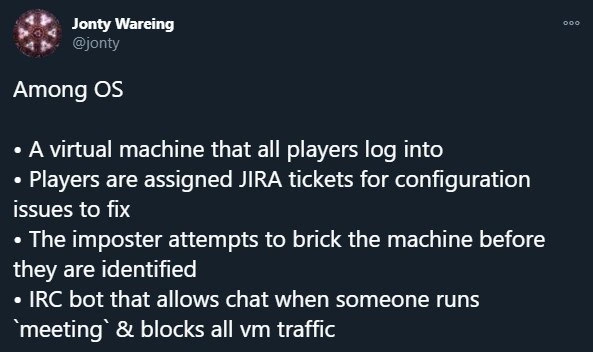
A screenshot of a tweet from user Jonty Wareing (@jonty). The tweet, titled "Among OS", outlines a game concept that merges the popular social deduction game 'Among Us' with the stressful reality of Site Reliability Engineering (SRE). The bullet points describe the game's rules: a shared virtual machine, players assigned JIRA tickets for configuration issues, an 'imposter' trying to crash the machine, and an IRC bot for communication that halts all VM traffic during 'meetings'. This concept is humorous to experienced engineers because it perfectly gamifies a real-world production incident, where team members collaboratively debug a failing system while suspecting that a recent change (the 'imposter') is the root cause of the problem
Comments
18Comment deleted
In the real-world version of this game, the imposter isn't a player. It's a legacy shell script that runs on a cron job nobody remembers setting up
Among OS: survival is just noticing which teammate’s “minor JIRA config fix” starts with `sudo dd if=/dev/zero of=/dev/sda` and ends with them typing `meeting` in IRC so nobody can scream
Finally, a game where 'I swear it was working on my machine' becomes a valid alibi, and the real imposter syndrome is when you're literally trying to identify who's destroying production while pretending to fix JIRA-4823
Finally, a game where 'the imposter is sus' means someone's running `rm -rf /` in production while everyone else is stuck in JIRA hell trying to fix DNS. The real twist? The meeting command that blocks all VM traffic is actually just realistic workplace simulation - because nothing says 'emergency incident' quite like mandatory all-hands during an outage
Among OS: a snowflake prod VM where the impostor sneaks a curl | bash “fix,” runs `meeting` so the IRC bot air-gaps the box, and the postmortem concludes: root cause - DNS; mitigation - Kubernetes
At last, a party game where typing `meeting` enforces a deliberate network partition while the imposter speed‑runs `dd if=/dev/zero of=/dev/sda` and still files it as a configuration workaround
Among OS: Where crewmates grind JIRA configs on a shared VM, but the imposter just larts IRC and bricks it - shared state strikes again
Nice schedule Comment deleted
баян Comment deleted
Этот мем баян, я его 6 часов назад видел Comment deleted
Х2 Comment deleted
Looks like impostor already won Comment deleted
Все хуйня миша давай по-новой Comment deleted
Ctrl+V Comment deleted
Лайк Comment deleted
Issue marked as duplicate Comment deleted
Hahaha, nice Comment deleted
шутка, сказанная дважды, вдвое смешнее Comment deleted