Skip to content
DevMeme
6029 of 7435
Cryptography 101: The Man-in-the-Middle Attack Explained
Security Post #6601, on Mar 30, 2025 in TG

Cryptography 101: The Man-in-the-Middle Attack Explained

Why is this Security meme funny?

Level 1: Sneaky Cup on the Wall

Imagine two friends, Alice and Bob, who have a special way of talking so that no one else can understand them – like a secret language or a coded message. They feel really smart and safe because they think it’s just the two of them sharing this secret. Now, picture them talking through a string telephone (you know, two cups connected by a string) across their houses. They’re giggling, thinking their conversation is totally private. But here’s the funny part: just around the corner, a third kid is quietly listening in by holding another cup against the same string! Alice and Bob don’t see her, but she can hear everything they’re saying through that sneaky cup on the wall.

It’s a bit like when you and your friend whisper a secret, and you think nobody else hears – but then you find out someone was hiding behind the door the whole time. In our story, that hidden listener is actually acting like a reporter for a magazine, gathering all the juicy details of Alice and Bob’s secret chat. So Alice and Bob’s “private” conversation isn’t so private after all. This is funny because they were so sure their secret code made them safe, yet there’s this unexpected eavesdropper (the little girl with the cup, playing the role of a nosy magazine) who outsmarted them with a simple trick. It’s a light-hearted reminder that sometimes, even when we think we’re speaking in code or whispering, someone clever might still be overhearing us. The humor comes from that surprise – the “Gotcha! I heard you!” moment – and from seeing a big serious name like “The Atlantic” being the one using a kiddie cup-phone to do the snooping. Essentially, the meme is showing how a secret conversation can turn un-secret because of a sneaky listener, and that unexpected twist is what makes it comical and memorable.

Level 2: Tin-Can Eavesdropping 101

Let’s break down what’s happening in simpler terms. In the world of cryptography (the art of secret writing and secure communication), we often talk about Alice and Bob. They’re just placeholder names for Person A and Person B. Think of them as two people who want to talk privately so no one else can understand their conversation. To do this, Alice and Bob use encryption – essentially turning their message into secret code that only someone with the right key can unlock. Now, a key in this context isn’t a physical key, but usually a string of numbers or data that can scramble and unscramble messages. When we say “negotiate keys,” it means Alice and Bob are agreeing on which secret code (or key) to use for their chat, often by exchanging some information back and forth first. This negotiation is a crucial part of many communication protocols – for example, when your web browser initiates a secure HTTPS connection to a website, there’s a behind-the-scenes exchange of keys (using protocols like TLS) to set up a private line that others can’t snoop on.

However, Alice and Bob aren’t alone in the universe. Enter the eavesdropper – in security lingo we call them Eve (short for eavesdropper). Eve represents anyone trying to secretly listen in on the conversation. Eavesdropping means listening to information that you’re not supposed to hear. It could be a hacker capturing network traffic, a spy tapping a phone line, or even just a curious person overhearing a conversation. In our scenario, Eve wants to get the secret key or the messages without Alice or Bob knowing. If Eve just quietly listens to the exchange, that’s one thing – encryption is designed so that even if someone hears the coded message, they can’t understand it without the key. But if Eve can actually interfere with the exchange – pretending to be Alice when talking to Bob and pretending to be Bob when talking to Alice – then Eve can trick both parties. This is what we term a MITM (Man-in-the-Middle) attack: the intruder sits in the middle of the communication, relaying messages so that each side thinks they’re talking to the other, while in reality the man-in-the-middle is literally in the middle, reading and possibly altering everything. It’s like hijacking the mail between two people: if you intercept Alice’s letter, read it, then forward a copy to Bob (or even change it before Bob gets it), neither Alice nor Bob realize a third party is in the loop.

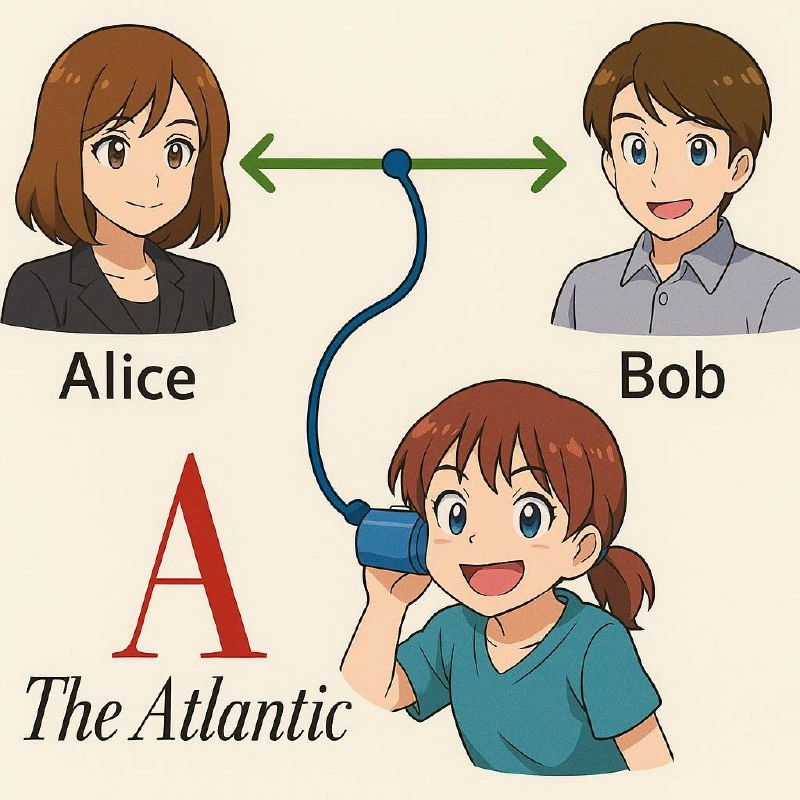
Now let's connect this to the picture in the meme. Alice is the woman on the left, Bob is the man on the right. The green double arrow between them indicates they’re communicating and even exchanging something (likely those keys for encryption). The expectation is that this arrow is a direct secure line – in theory, no one else is on it. But then you notice that blue wire teeing off from the middle. Uh oh! That wire leads down to a little girl with a tin-can telephone. She’s grinning and listening attentively. She represents an eavesdropper tapping into the line. In a normal cryptography diagram, we’d draw this character and label them “Eve.” Here, the joke is that she’s labeled “The Atlantic” – which is actually the name of a famous magazine. It’s an unusual choice because you’d expect “Eve” or maybe “Mallory” (a common name for an active attacker), but instead we see a publication’s name. It’s as if to say, imagine the magazine The Atlantic is secretly listening to Alice and Bob’s private conversation! It’s a playful twist; maybe the meme creator is hinting that the story Alice and Bob think is private could end up as an article in The Atlantic. In any case, the core idea is: someone unexpected is eavesdropping.

What’s with the tin-can telephone? That’s a classic low-tech way to transmit sound. If you’ve never seen one: you take two empty cans (or paper cups) and connect them with a tight string. When one person talks into one can, the vibrations travel along the string and the sound comes out the other can – it’s like a simple phone! Kids do this as a fun experiment. In the meme, the tin-can telephone is a metaphor for a tapped communication line. It shows that The Atlantic (the eavesdropper) has physically connected into Alice and Bob’s communication channel. It’s a cute cartoon way to depict a wiretap or interception. In real life, eavesdropping might happen through hacking techniques – like sniffing Wi-Fi signals, installing malware, or exploiting a vulnerability in a network. But visually, a sneaky wire with a tin can gets the idea across with a wink.

So, putting it all together in straightforward terms: Alice and Bob are trying to have a private talk using encryption keys. They’re basically saying, “Hey, let’s speak in code so no one else understands us.” This is them negotiating the key (the secret code) to use. If all goes well, even if someone hears their coded conversation, it will sound like gibberish. But unbeknownst to them, The Atlantic has joined the chat in stealth mode. By tapping the line, The Atlantic can listen to what’s being said before it’s encoded or maybe even fool them during the key exchange. Maybe Alice announces part of the secret code and The Atlantic hears it; The Atlantic then passes it to Bob but not before maybe substituting something… the specifics aren’t shown, but essentially the third party is privy to the secrets. This undermines the whole point of encryption – it’s like having a lock but giving a copy of the key to the eavesdropper! In security terms, Alice and Bob’s data privacy is compromised because their key negotiation wasn’t truly private.

A simpler analogy often used: imagine Alice and Bob want to agree on a secret number over the phone. They don’t want Eve to know this number. So Alice says, “I’ll combine my secret number with a public number and tell you the result.” Bob does the same. By some clever process, they can arrive at the same secret number without revealing it outright (this is analogous to how encryption protocols work). Eve might hear some of the numbers exchanged, but without the full context (Alice’s private part or Bob’s private part), she shouldn’t be able to figure out the final secret. However, if Eve can impersonate Bob on the call, she can completely undermine this process. For instance, Eve could trick Alice by responding with Eve’s own calculated number instead of Bob’s. Then Alice ends up computing a secret that she shares with Eve, not with Bob. Likewise, Eve tricks Bob on the other side. Now Eve has both secrets! This is exactly the nightmare scenario in key exchange – a man-in-the-middle.

In our cartoon, The Atlantic effectively does that impersonation via the tin can phone. Alice and Bob think they have a secure direct line, but The Atlantic has literally spliced into it. It’s as if two people made a private telephone line, and a third person climbed a telephone pole and tapped the wire. The reason this is humorous in the meme is because of the unexpected character of The Atlantic and the anachronistic tin-can method, but it’s built on a very real concept. It teaches a mini-lesson: secure communication isn’t just about using codes, it’s also about making sure no uninvited guest is joining your call. In practice, we use things like verification codes, digital signatures, and trusted third parties to ensure that when Alice is talking to Bob, it’s really Bob on the other end, and not, say, Eve in disguise. If Alice’s computer saw that the cryptographic credentials (like a certificate) belonged to “The Atlantic” instead of Bob, it would raise a red flag – that’s akin to noticing a strange tin can hanging on your secure line.

To sum up this level: Alice and Bob = the communicators who want privacy; key negotiation = setting up their secret code for encryption; The Atlantic = a stand-in for the sneaky eavesdropper (normally called Eve); tin-can phone tap = an analogy for a MITM attack or wiretap. The meme uses a fun scenario to warn: even if you use encryption, be careful who you share those keys with (even inadvertently), because a third party could be listening. It’s a lighthearted demonstration of a fundamental security issue. In everyday terms, it’s saying, “Don’t let someone put a cup on the wall during your secret conversation!” Keep your guard up so your private dialogue truly stays private.

Level 3: Man in the Magazine

For seasoned developers and security engineers, this meme hits a sweet spot of insider humor. We instantly recognize Alice and Bob as the go-to names in every crypto example and communication protocol diagram. It’s practically a rite of passage in tech: the first time you see “Alice and Bob” in a tutorial, you know you’re entering the realm of encryption and secure messaging. And of course, lurking nearby is Eve, the eternal eavesdropper, waiting to snoop. By the time you’ve been in the industry a few years, Alice, Bob, and Eve feel like old colleagues – or that quirky trio from a security comic strip that keeps re-running. This familiarity is exactly why the meme is hilarious: it takes that well-known cast and throws in an unexpected crossover character – The Atlantic magazine. It’s as if a serious news reporter wandered onto the stage of a cryptography skit.

Why is that funny? Partly because it’s absurd, and partly because it’s oddly plausible in a metaphorical way. We usually imagine Eve as a spy, a hacker in a dark hoodie, or a faceless adversary on the network. But here, Eve is literally a publication. Picture a respected magazine, known for in-depth articles, suddenly stooping to attach a tin can on someone’s private line – it’s a mashup of high-brow and low-tech that makes you smirk. It’s “man-in-the-middle” reimagined as man-in-the-magazine. That phrase itself is a cheeky pun the meme is pulling: a play on the term MITM attack. In a man-in-the-middle attack, a bad actor intercepts and possibly alters the communication between two parties who think they’re talking directly. In this image, The Atlantic is mischievously cast as the middle-man – so, a man-in-the-magazine attack. 😄 (Not that The Atlantic actually spies on people – it’s just comedic personification!).

Beyond the wordplay, the scenario illustrated is deeply familiar to anyone who’s worried about security: two parties trying to establish a secure channel, and a third party quietly undermining it. The green double arrow between Alice and Bob suggests “secure connection established” – think of a green padlock in a browser indicating an HTTPS connection. Yet we see a physical tap (the blue wire and tin can) right in the middle of that supposedly secure link. This immediately screams to a security-minded person: “Hold on, something’s wrong with the setup!” It’s exactly the kind of thing that keeps infosec folks up at night: the idea that, despite all precautions, someone inserted themselves into the conversation. Experienced devs remember real-world incidents and cautionary tales that mirror this. For instance, failing to validate certificates in an SSL/TLS handshake is basically letting a “tin can on the line” happen. There was that infamous goto fail; bug in Apple’s TLS implementation years ago – one faulty line of code, and suddenly any MITM could pose as a server to intercept secure traffic. Those in the know might chuckle at the tin can image, but it reminds them of very real bugs and oversights where an Eve (or an “Atlantic”) found a way in.

The tin-can telephone itself is a great touch. Many of us played with those as kids or have seen the trope in cartoons: two cans connected by a taut string carry vibrations, letting you whisper across a distance. Seeing it here is nostalgic and humorous, but it’s also symbolic. It represents an unsophisticated yet effective attack: literally wiring yourself into the line. In networking terms, that’s like plugging a sniffer into an Ethernet cable or setting up a rogue Wi-Fi access point to intercept connections. It might look low-tech, but if Alice and Bob aren’t protected, even a simple attack can compromise them. There’s irony in using a child’s toy to defeat what we assume is high-grade encryption – it underscores that a system is only as strong as its weakest link. The meme is basically yelling out an age-old truth with a grin: “Sure, your encryption algorithm is strong, but did you consider the channel security? Because someone might just pull a tin-can trick on you.”

Now, adding The Atlantic as the eavesdropper is also a wink to how information leaks can become public. Think about it: if a conversation between Alice and Bob was compromised, where might the juicy info end up? Possibly in the media. We’ve seen scenarios where private communications, once breached, turn into headlines. It’s like the meme is satirically pre-empting: “Uh oh, if you don’t secure your line, tomorrow you’ll read your secret in The Atlantic.” For a senior dev, it evokes everything from whistleblower stories to corporate data breaches that became front-page news. It’s both funny and slightly unnerving. The Atlantic is a serious magazine, so seeing its name in a goofy diagram is amusing, but it also hints at real consequences: an eavesdropper isn’t just an abstract threat; it could be an entity that actually publishes your secrets. It’s a clever way to drive the point home about data privacy – protect it, or prepare to see it in print!

Lastly, the overall crypto_diagram_parody aspect of this meme would make any security geek smile. We’ve all sat through slide decks or textbooks with stick figures or icons labeled “Alice → Bob” and a dotted line to “Eve.” It’s a staple of security education. By using anime characters and a pop culture reference (a magazine) as labels, the meme injects fresh life into that trope. It’s half educational diagram, half comic strip. For the experienced crowd, it’s fun to see the dry academic setup turned into a joke. And as an added bonus, it’s a gentle reminder: never get complacent. Because in real-life scenarios, the “Eve” on your network might be disguised as something harmless or even reputable – a misconfigured proxy, a trusted service with a backdoor, or a benign-looking third party that turns out to be logging everything. In the meme, that role is filled by a friendly-looking kid who happens to be a major magazine. The takeaway for the veteran dev reading between the lines: trust but verify, and always assume someone might be listening until you’ve proven otherwise. And also – it’s okay to laugh at these things once in a while, because humor helps us remember the lesson. This funny little illustration of a security lapse will stick in your mind the next time you’re setting up a VPN or configuring TLS ciphers. It’s a comic reminder that even in cryptography, humans love to give things names and faces – and sometimes those faces end up on memes when things get ironic.

Level 4: Eavesdropper's Algebra

At the most theoretical level, this meme riffs on the fundamentals of cryptography and secure communication. In protocols like the classic Diffie-Hellman key exchange, Alice and Bob can negotiate an encryption key over an open channel in such a way that an eavesdropper (conventionally named Eve) cannot derive the final secret. The math behind this is elegant: for example, Alice and Bob might each choose private random numbers (their secret keys) and exchange computed values derived from those secrets. Thanks to one-way mathematical functions (like exponentiation modulo a prime), Eve can see the exchanged values but solving for the original secret (the discrete logarithm) is computationally unfeasible. In short, Alice and Bob create a shared secret key in plain sight, and it’s hard – in a provable, $O(2^n)$ kind of hard – for any third party to figure it out. This is cryptographic data privacy in action, grounded in number theory.

However, all that security math assumes one critical thing: that Eve is only listening, not tampering. The moment an attacker can actively interfere, we’re in man-in-the-middle (MITM) territory. A MITM attack means the intruder doesn’t just eavesdrop; they insert themselves between Alice and Bob, impersonating each party to the other. The math alone won’t save you if you unknowingly share your secrets with the attacker! For instance, during Diffie-Hellman key negotiation, a crafty Eve could intercept Alice’s public key and send Eve’s own value to Bob, and vice versa. Alice ends up establishing a secret with Eve, and Bob also establishes a (different) secret with Eve – all the while both Alice and Bob think they’re talking to each other. This defeats the entire purpose of the key exchange because now the interloper can decrypt and re-encrypt everything. The communication protocol has been subverted. In theoretical cryptography terms, the channel lacks authentication. That’s why modern secure protocols (like TLS for HTTPS) use public key infrastructure (PKI) and digital certificates: to verify that “Bob” is really Bob, preventing a fake Bob (or fake Alice) from muscling in. In other words, cryptography isn’t just about clever encryption algorithms; it’s also about ensuring you’re encrypting with the right person.

Now look at the meme: it visually compresses this entire concept. The two anime-style figures labeled “Alice” and “Bob” with a double-headed arrow represent a secure two-way channel (green arrow for a trusted link). The surprise is the blue wire sneaking down to a tin-can telephone held by a third character. This is a cartoon depiction of a wiretap – a literal analog tap on the line. It’s the age-old eavesdropping idea: someone connecting into the communication medium to listen. By drawing it as a child with a tin can, the meme simplifies a sophisticated threat (MITM interception) into a playful visual. But make no mistake, in cryptographic terms that tin-can wire is as alarming as a certificate forgery or a rogue router broadcasting false DNS: it means an unauthorized party has breached the assumptions of the channel. The secure communication isn’t so secure after all. We have a man-in-the-middle illustrated as a kid tapping a string phone. It’s simultaneously cute and technically spot-on – a security illustration of how even the best encryption scheme fails if someone can clandestinely slip into the middle of the conversation.

And then there’s the textual twist: instead of labeling the eavesdropper “Eve,” the meme labels the girl (and her can-phone) as “The Atlantic” with a big stylized red A. This is an oddball, humorous substitution. In cryptography examples, “Eve” is short for eavesdropper – an arbitrary bad actor. Here, The Atlantic (yes, the well-known magazine) is cast in that role. Why a magazine? On one level, it’s just geeky humor – personifying a media publication as the sneaky third party. It could be a nod to real-world scenarios where journalists uncover secrets, essentially “listening in” on information not meant for them. It’s as if to say, even a respected publication might be quietly gathering your leaked secrets. The sight of a serious magazine’s name in a crypto diagram is absurd and therefore funny. It’s a bit of a crypto_diagram_parody: taking the formal Alice-Bob-Eve schema from cryptography textbooks and replacing the villain with a giant magazine logo. For those in the know, it also evokes the long tradition of naming participants in security protocols. Ever since the late 1970s, instructional papers and lectures have used Alice and Bob (the communicators) and Eve (the intruder) to humanize abstract concepts. Over time, more characters like Mallory (a malicious attacker) and Trent (a trusted arbitrator) joined the party. This meme adds a fresh name to the cryptography cast – not a person’s name but a publication. It’s a playful wink: if Mallory is the malicious middle-man, then perhaps a snooping magazine could be the “man-in-the-magazine” attacker!

So at this deep level, the meme is illustrating a security pitfall through a blend of math and satire. It reminds us that cryptographic strength can be undone by a simple oversight – if you don’t authenticate who you’re talking to, an interloper can and will step in. The key negotiation “between Alice and Bob” is only as secure as the weakest link, and here the weak link is represented by that goofy tin-can phone. It’s a nod to the importance of verifying your channels and keys. In essence, it’s saying: you can deploy the most advanced encryption, but if The Atlantic (or any unexpected Eve) manages to tap your line, you’ve lost the plot. The meme packs complex ideas – from Diffie-Hellman handshakes to MITM attacks and even commentary on information leakages – into one scene. For cryptography enthusiasts, spotting these layers is a treat, and it highlights exactly why secure systems must consider not just encryption algorithms but also real-world threat models (including curious eavesdroppers, whether they be hackers, spies, or investigative journalists). It’s a lighthearted reminder of a serious principle: communication isn’t truly secure unless you’ve accounted for who might be listening.

Description

An anime-style illustration explaining a fundamental cybersecurity concept. The image features bust portraits of a woman labeled 'Alice' and a man labeled 'Bob', connected by a green horizontal line with arrows at both ends, symbolizing a two-way communication channel. Below them, a young, cheerful-looking child is happily listening to a blue tin-can telephone. A blue wire runs from the can up to the center of the communication line between Alice and Bob, representing an interception. In the bottom left corner, there is a large red 'A' and the text 'The Atlantic', which appears to be a watermark or attribution from the image's source. This drawing is a classic visual metaphor for a 'man-in-the-middle' (MITM) attack. In cryptography and security, 'Alice' and 'Bob' are conventional placeholders for two parties wishing to communicate securely. The child represents the malicious actor, traditionally named 'Eve' (the eavesdropper), who secretly intercepts, and possibly alters, the communication between them. The simplistic, innocent depiction of the attack vector (a toy telephone) makes the complex concept easily understandable

Comments

11
Anonymous ★ Top Pick This is why we use end-to-end encryption. Otherwise, you risk your TLS handshake being downgraded to a Fisher-Price protocol with a known vulnerability to juice-box spills
  1. Anonymous ★ Top Pick

    This is why we use end-to-end encryption. Otherwise, you risk your TLS handshake being downgraded to a Fisher-Price protocol with a known vulnerability to juice-box spills

  2. Anonymous

    Who needs a quantum computer when the op-ed desk already has a direct line into your key exchange?

  3. Anonymous

    After 20 years in the industry, you realize Eve isn't the real threat - it's Alice and Bob's tendency to hardcode their keys in environment variables and commit them to public repos while arguing about whether to use RSA-4096 or just switch to post-quantum already

  4. Anonymous

    When you're implementing end-to-end encryption but forget that The Atlantic has a subscription to your message queue. Classic MITM scenario - though usually Eve is the eavesdropper, not a media outlet with a tin-can telephone tapped into your TLS handshake. Remember: Alice and Bob's relationship status is 'it's complicated' because they never properly verified each other's certificates

  5. Anonymous

    Alice-Bob crypto demo, Atlantic MITM: consistency optional, narrative partition tolerance guaranteed

  6. Anonymous

    Architect: “We have TLS.” Eve: “Great - where do you terminate it?” Without mTLS and pinning, that green arrow is just a well‑drawn suggestion

  7. Anonymous

    We finally shipped mTLS between Alice and Bob; then marketing added session replay - congrats, Eve is now an OKR

  8. @HeTema 1y

    I'm out of context. What does it mean meme

  9. @HeTema 1y

    Okay, I got it """ White House staff added the editor in-chief of The Atlantic into a Signal group where they discussed the US intervention of Yemen, it was an accident presumably. """ https://www.reddit.com/r/ProgrammerHumor/comments/1jjrfnh/thefutureofmallory/

    1. @SamsonovAnton 1y

      Thanks for clarification. I though the joke was about Bell Atlantic telephone company.

  10. @patsany_horosh_mne_v_dm_pisat 1y

    You mean Antarctica?

Use J and K for navigation