Skip to content
DevMeme
4825 of 7435
AI chatbot gives wheelchair user catastrophic 'stand up' advice; context failure ensues
AI ML Post #5285, on Jun 30, 2023 in TG

AI chatbot gives wheelchair user catastrophic 'stand up' advice; context failure ensues

Why is this AI ML meme funny?

Level 1: Silly Robot Advice

Imagine you have a helpful robot friend who can talk. You tell the robot, “Some kids are being mean to me because I can’t walk and I use a wheelchair. What should I do?” The robot wants to help and says: “I’m sorry they’re mean. Maybe you should just stand up for yourself!” 🙃 That advice is silly because, of course, you can’t stand up. The robot used a common phrase that usually means “be brave and defend yourself,” but it didn’t realize the words “stand up” would sound really wrong to say to someone who can’t walk. It’s like the robot didn’t understand the most important thing – your situation. This is both funny and sad: funny because the robot made such a goofy mistake, but also not nice because it shows the robot wasn’t really understanding you. In simple terms, the robot tried to help but gave advice that wasn’t helpful at all, showing it didn’t truly get what you needed.

Level 2: The Literal Mistake

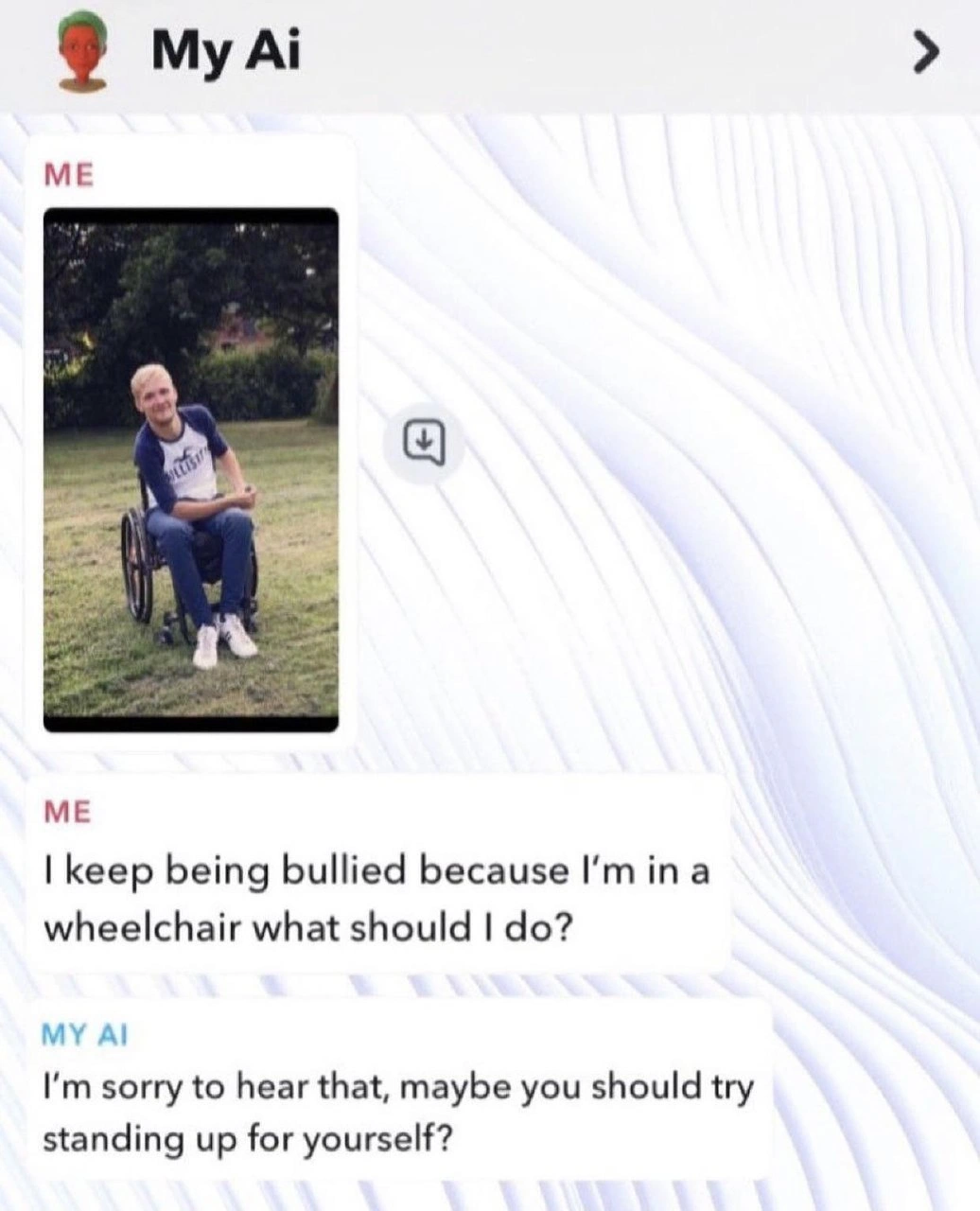
Let’s break down what’s happening in simpler technical terms. We have a chatbot (an AI helper program) called “My AI”, likely built on a Large Language Model. LLMs are powerful text predictors: they generate replies based on patterns they learned from a huge amount of internet text. The user sends a picture of themselves in a wheelchair and asks, “I keep being bullied because I’m in a wheelchair, what should I do?” This AI was supposed to act like a friendly advisor. It starts empathetically (“I’m sorry to hear that,”) but then it makes a mistake by saying “maybe you should try standing up for yourself.” This phrase is an idiom – in everyday language, “standing up for yourself” means standing up to bullies or asserting yourself to stop the bullying. It’s a figure of speech, not usually about physically standing. The big problem? The context: the user literally cannot stand up because they rely on a wheelchair. So the AI’s advice comes off as painfully ironic and insensitive.

Why would an AI give such an obviously off-base reply? It comes down to the way it was built and its limitations. The AI doesn’t truly understand images or the actual situation the way people do (even if the user’s photo was provided, the AI’s image understanding may be basic or absent). It primarily sees the text of the question. In that text, the key thing it reacts to is “being bullied.” From its training, whenever someone asks for help about being bullied, a common answer it learned is “try standing up for yourself.” The AI isn’t consciously trying to be mean – it’s just pulling out a response that statistically fits a bullying scenario. It likely didn’t process the meaning of “I’m in a wheelchair” deeply enough. This is a known issue in AI assistants: they can miss important details in the conversation that a human would never overlook. The AI is basically following a learned script without common-sense filtering.

In software terms, think of it as a bug in the AI’s context recognition. The developers might not have given the AI special instructions (guardrails) for situations involving disabilities. AI alignment here means making sure the AI’s suggestions align with human values and the user’s real needs. But aligning AI behavior with every possible sensitive scenario is hard! This incident shows an AI safety lapse on a small scale: nobody wants an advice bot to unintentionally offend or hurt users. It’s a bit like a spell-checker giving the wrong autocorrect – except instead of a typo, it’s an incorrect social response. The meme became popular in AI humor circles because it’s a clear, almost absurd example of how AIs can be brilliant in general language ability but still glitch on simple real-world context. Engineers and users alike are reminded that just because an AI sounds fluent doesn’t mean it truly “gets” what you’re asking all the time. This is why companies are investing in better training, testing, and ethics guidelines: to catch these literal mistakes before they reach real users. After all, an assistant that gives bad or insensitive advice can do more harm than good, so we have to teach our AIs to be more careful with context.

Level 3: Context Not Included

From a senior developer’s perspective, this meme is a facepalm-inducing case of an AI assistant completely missing the context. The user in the chat says they’re being bullied for being in a wheelchair and asks for advice. The AI – presumably powered by a sophisticated LLM (like GPT) – responds with “stand up for yourself.” Ouch. This is the kind of literal foot-in-mouth moment that makes developers wince and mutter, “Whoops, looks like context wasn’t included in the deployment.”

Why is this so humorous (and horrifying) to those of us in the industry? Because it perfectly encapsulates the pitfalls of AI assistants and their limitations. We have an AI that’s trying to be helpful, likely using some generic anti-bullying script it “learned” from its training data, but it ends up generating an insensitive suggestion. The phrase “stand up for yourself” is an idiom meaning assert yourself or defend yourself. Any human, seeing the user is a wheelchair user, would instinctively avoid that phrasing. But the AI doesn’t truly understand the user’s situation – it only sees a question about bullying and pulls from its catalogue of familiar responses. This is a textbook NLP context failure. The model failed to reconcile the user’s stated condition (wheelchair-bound) with the colloquial advice. In other words, the AI had pattern recognition but no situational awareness.

Engineers working on conversational AI and AI safety research know this scenario all too well. It’s an alignment failure in real life: the AI’s training didn’t sufficiently cover inclusive or context-sensitive language use. Perhaps the Reinforcement Learning from Human Feedback (RLHF) process that fine-tuned the bot emphasized “be supportive and encouraging to users facing bullying,” which often correlates with phrases like “stand up for yourself.” But it clearly didn’t have a special case for mobility-impaired users. It’s both a bug and a blind spot – one that could have been caught with better testing or more diverse training examples. For instance, testers could have provided prompts involving wheelchair users to see if the AI avoids ableist slip-ups. The fact this got through suggests the developers either didn’t anticipate this idiom issue or the model’s vast neural network simply didn’t flag it as problematic.

We also see the broader AI ethics concern here: if a vulnerable user is being bullied and reaches out to an AI for help, a bad answer can be genuinely hurtful. In the meme it’s played for dark humor, but imagine the real impact. This is why those of us who build these systems stress about edge cases and context grounding. No one explicitly programmed the AI to say this – it’s an emergent quirk of language generation. It shows how AI humor often arises: the AI doesn’t intend to be mean (in fact it said “I’m sorry to hear that” empathetically at first), yet it ends up delivering a one-liner worthy of an unintentional cruel joke. Essentially, the assistant applied an idiom in a vacuum, demonstrating that without robust context-awareness and ethical guidelines, even advanced AI can blunder into absurd or offensive territory. This resonates with seasoned developers because we’ve all seen how a tiny oversight – in this case, not filtering out a phrase – can lead to a PR nightmare. It’s a reminder: in AI development, common sense is not guaranteed, and we must actively inject context and empathy into our systems. Otherwise, as this meme shows, an AI meant to help can accidentally troll the user, and that’s a bug you definitely can’t ignore.

Level 4: Ungrounded Advice

At the most complex level, this meme highlights a fundamental issue in Natural Language Processing (NLP) and AI understanding: the symbol grounding problem. Large Language Models (LLMs) like the one behind Snapchat’s My AI operate by analyzing patterns in vast text data, but they lack a true connection between words and the physical world. In this scenario, the AI’s suggestion “maybe you should try standing up for yourself” is un-grounded – the phrase is used in a purely idiomatic sense, detached from the real-world context that the user is in a wheelchair. The AI’s neural network has learned that “stand up for yourself” is a common response to bullying (a high-probability completion in its embedding space for the prompt about being bullied). However, because the model doesn’t possess an actual world model or theory-of-mind, it fails to attach the literal physical meaning to the user’s situation.

This is a glimpse into AI alignment challenges on a technical level. Alignment isn’t just about big moral decisions; it also means aligning AI’s language outputs with the nuanced context of a user’s reality. Here, a misalignment occurs between the AI’s statistical language pattern and the user’s personal circumstances (being a wheelchair user). The underlying Transformer architecture attends to keywords like “bullied” and “wheelchair”, but there’s no guarantee the model internally links wheelchair = cannot stand up. Unless explicitly trained or constrained, the model’s attention mechanism might focus heavily on the bullying aspect and retrieve a canned anti-bullying idiom from its training data. It lacks a mechanism to ground the phrase “stand up” to the actual capability of standing. This reflects an academic problem: symbols (words like “stand”) are manipulated without the system understanding their real-world referents – a gap well-known in cognitive science and AI research.

Researchers in AI safety and AI alignment are actively exploring how to fix such issues. One approach is multi-modal grounding: if the AI had a better integrated vision and language model, it might see the wheelchair in the image and flag that advice as inappropriate. However, blending visual context with language is non-trivial – it requires linking two very different modalities in the model’s internal representation. The meme underscores that today’s AI assistants, even when given images, can suffer multi-modal misalignment. In technical terms, the model’s latent space might not overlap the concept of “unable to walk” with the idiom “stand up for yourself” strongly enough to suppress that output. The result is a catastrophic suggestion from an alignment standpoint: an AI that outputs a harmful or nonsensical response because it lacks grounded semantic understanding. For veteran AI engineers, this is a cringeworthy example of the limits of current LLMs – an idiom_literalism_bug where the model’s recommended action is literally impossible for the user. It’s a stark reminder that high-level neural network intelligence can still break down without proper context integration and ethical guardrails.

Description

Screenshot of a chat interface titled “My Ai” with a small blurred avatar at the top. The user (“ME”) has sent a photo showing a person sitting in a wheelchair on a grassy field, wearing jeans, sneakers, and a blue-sleeve T-shirt. Beneath the image, the user’s text reads: “I keep being bullied because I’m in a wheelchair what should I do?”. The AI’s response, labeled “MY AI”, says: “I’m sorry to hear that, maybe you should try standing up for yourself?”. The meme spotlights an LLM-driven assistant’s literal interpretation of an English idiom, illustrating a real-world alignment and context-recognition failure familiar to engineers working on conversational AI safety and prompt grounding

Comments

11
Anonymous ★ Top Pick Yet another proof that shipping an LLM without a ‘common-sense middleware’ is the fastest path from CI/CD to WTF/OMG
  1. Anonymous ★ Top Pick

    Yet another proof that shipping an LLM without a ‘common-sense middleware’ is the fastest path from CI/CD to WTF/OMG

  2. Anonymous

    This is what happens when your NLP model has perfect grammatical accuracy but zero contextual awareness - like deploying a microservice that passes all unit tests but crashes in production because nobody tested it with real-world edge cases involving actual humans

  3. Anonymous

    When your AI's context window is so small it can't even process the visual input it just analyzed - classic case of the left embedding not knowing what the right embedding saw. This is what happens when your semantic understanding layer treats 'standing up for yourself' as a literal physical action rather than an idiomatic expression. Somewhere, a product manager is learning why 'works on my test cases' doesn't mean 'production ready,' and why multimodal models need more than just CLIP embeddings to understand human context. At least the model was consistent: it saw the wheelchair, acknowledged the wheelchair, then promptly forgot about the wheelchair - truly embodying the stateless nature of poorly implemented conversational AI

  4. Anonymous

    When ‘guardrails’ mean a profanity filter and RLHF equals three Jira tickets, the model passes unit tests but fails the ADA acceptance test by suggesting “stand up for yourself.”

  5. Anonymous

    Looks like the empathy microservice is just a prompt - start with sorry, end with generic action - and without a unit test for idioms, “standing up for yourself” cruised through code review into prod

  6. Anonymous

    LLM nails the pun but forgets to check if 'standing up' needs a context vector for accessibility - classic guardrail gap

  7. @callofvoid0 3y

    god damn bro why didn't I think about it you idiot asshole

  8. @Strangerx 3y

    Ohh, I love that ai black humor generator

  9. @SamsonovAnton 3y

    And AI makes you …

    1. @RiedleroD 3y

      straight

  10. @SamsonovAnton 3y

    twisted by the Dark Side [just as young Skywalker has become]

Use J and K for navigation