Recruiter latency so high you’ve ascended to royalty before feedback
Why is this Career HR meme funny?
Level 1: Waiting a Lifetime
Imagine you ask your friend to come play when you’re a kid, but they only answer back when you’re a grandparent! That’s basically the joke here. The person applied for a job when they were young, and the company took so long to respond that by the time they heard back, the person had become old and important — like a king with fancy clothes. It’s funny because nobody expects to wait that long for an answer. The meme is exaggerating to show what it feels like when you have to wait forever.
Level 2: Long Wait, Major Upgrade
Let’s break down the joke in simpler terms. Latency just means a delay or wait time. Here, recruiter latency refers to how long it took the recruiter (the person from the company) to get back to you after you applied. The joke is that this delay was unbelievably long — so long that you leveled up in life during the wait! In the first panel you’re a young applicant, eagerly sending in your résumé. In the second panel, you finally get a reply, but now you’ve aged into someone as distinguished as a king on a throne. It’s an absurd way to say: the wait was ridiculously long.
Why might a response take so long in real life? Often the hiring process has many steps — multiple interviews, approvals, or just office bureaucracy. Sometimes the company gets busy, or the position is put on hold, and they forget to update you. Companies do track something called time to hire (how quickly they fill a job) and try to set an internal goal or SLA (Service Level Agreement), like “we aim to respond to candidates within 2 weeks.” But those targets often get missed in practice. It’s not unheard of to wait weeks (or even months) for feedback. The meme tags like job_application_latency and slow_recruiter_response highlight that this joke is about waiting ages for the recruiter’s reply.
There’s also a bit of tech wordplay here. Eventual consistency is a term in computing that means an update will reach everyone eventually, just not immediately. Here it’s used playfully: the recruiter does get back to you eventually, but so late that it’s comical. By that time, you might have gained years of experience or earned a higher job title elsewhere. (Obviously you didn’t literally become a king or emperor in the meantime, but maybe you became a senior developer or a tech lead.) The phrase “applicant to emperor upgrade” isn’t literal — it’s joking that you went from an ordinary applicant to someone with a fancy title (like an emperor) during the waiting period. The contrast between the pictures — a plain young man versus an older man in full royal dress — really exaggerates just how long that hiring process felt. Even if you’re new to the tech world, you can understand the frustration: you start out excited for a new opportunity, and then you hear nothing for so long that you imagine you’ve aged decades by the time you finally get an answer. That exaggerated waiting forever feeling is the heart of this meme’s humor.
Level 3: Prince-to-King Pipeline
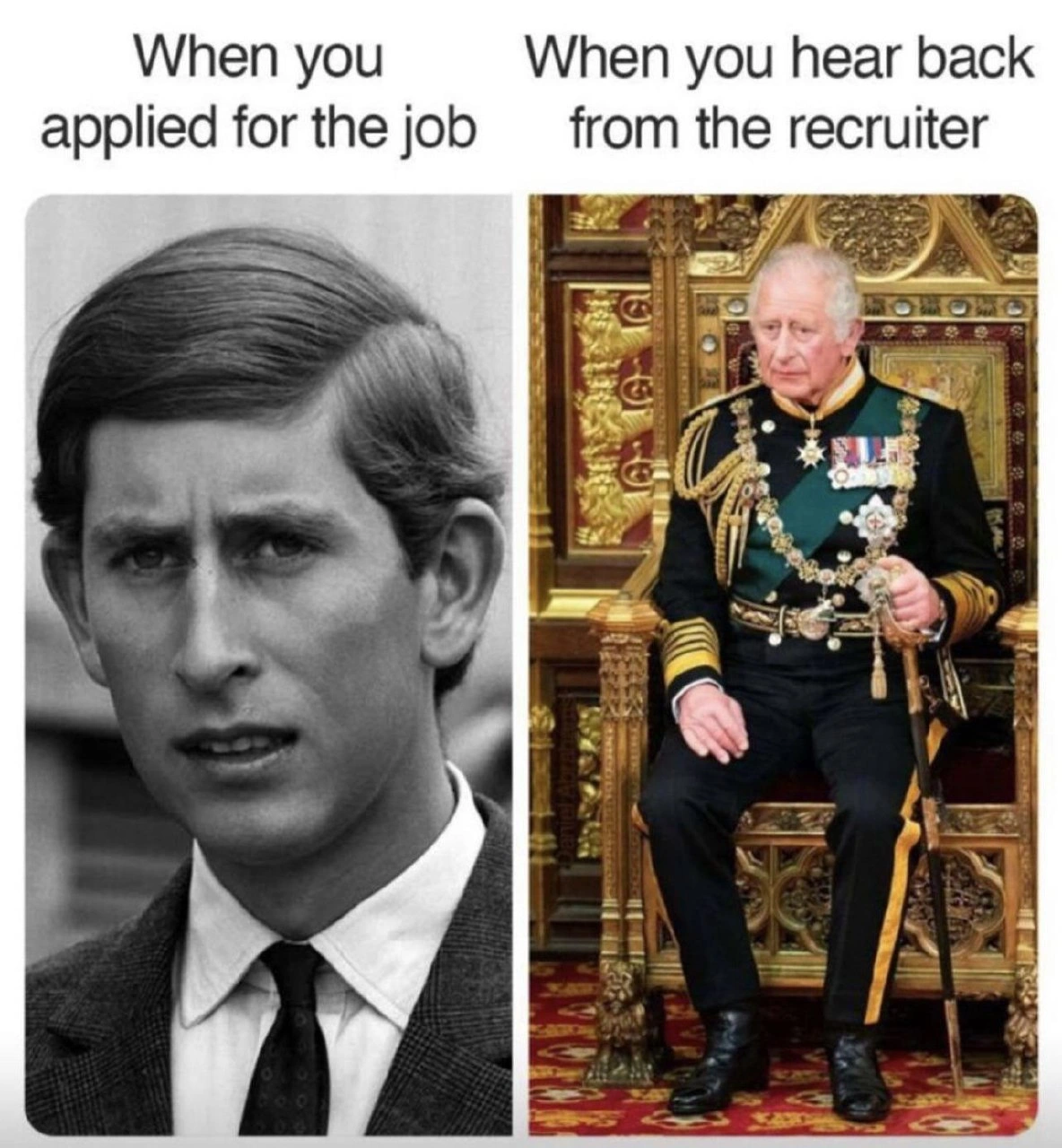
On a more practical level, this meme pokes fun at the glacial pace of some hiring processes. The left photo shows a young Prince Charles (yes, the real Charles who waited decades to become King), representing you as a bright-eyed candidate when you applied for the job. The right photo features Charles as an older King in ornate regalia, representing you by the time the recruiter responds. The humor comes from the absurdity of that timeline: so much time has passed that you metaphorically went from an average job seeker to royalty. It’s an exaggeration that senior engineers find painfully relatable. Many of us have stories of submitting a résumé, maybe even doing interviews, and then hearing nothing for so long that by the time HR finally circles back, we’ve changed jobs, gained years of experience, or even gotten a promotion elsewhere. In the interim, entire tech stacks can go out of fashion and company org charts can be completely reorganized (or the project itself might vanish).
For seasoned developers, this lands as HiringHumor grounded in reality. Corporate hiring often involves multiple layers of approval, scheduling nightmares, or just plain inertia. You might be stuck in an Applicant Tracking System (ATS) queue that feels like a black hole — your application sits there like a packet lost in the ether. The job_application_latency here feels infinite. Perhaps the company had a hopeful time to hire target (say, fill each role in 30 days) but blew past it due to endless interviews, internal politics, or a sudden hiring freeze. So you wait... and wait. That slow_recruiter_response becomes a running joke among your peers — one colleague even quips, "Maybe they’ll call you back when you’re CEO somewhere else." The meme nails this shared experience by using the outrageous idea that you’ve undergone an “applicant to emperor” transformation. Of course, none of us literally become kings or queens while waiting for an email, but it sure feels like a lifetime. By the time the recruiter finally does email you, you’re practically a different person — you might have learned new programming languages, earned new titles, or simply moved on and lost that initial excitement. The process lag is so bad, it’s akin to a system that only eventually catches up after being offline for ages: technically the message (the job offer or rejection) arrived, but it’s laughably overdue.
Level 4: Eons for Consistency
In distributed systems, latency that high might as well be measured in geological epochs. The meme wryly invokes eventual consistency: the idea that a system will eventually become consistent if you wait long enough, but there's no guarantee how soon. Here, the recruiter’s callback behaves like a database update propagating with absurd lag. The left panel (the youthful applicant) is like a freshly written value; the right panel (the aged monarch on the throne) shows the state by the time all nodes finally agree on that value. It's as if your job application was an event published to an event stream (think a message queue or Kafka topic) that only gets processed after a massive delay. By the time the "feedback" event arrives, the original data (you, the candidate) has completely changed version—from a hopeful junior dev to an industry veteran sitting on a throne. This is stale data on a whole new level.
From a theoretical perspective, it’s a comical human version of the CAP theorem trade-offs. The hiring pipeline seems to sacrifice consistency (timely updates) in favor of availability (keeping the process going despite delays) and partition tolerance (dealing with internal communication breakdowns). In a strongly consistent system, you'd have immediate feedback (every node—here, every interviewer and hiring manager—would know your status promptly). But this scenario feels more like an AP (Availability + Partition-tolerant) design: the company stays "available" and continues operating even as communication with you is delayed, and they tolerate the "partition" (the disconnect between you and the hiring team). The time to hire SLA (Service Level Agreement for filling a role) here has been stretched so far it's practically a time warp. Many companies boast targets like "we'll get back to you in two weeks," but what’s two weeks when the process behaves like eventual consistency with a timeout of two decades? (Kidding... hopefully!)
There's a dash of dark humor in equating the wait with a distributed consensus failure, too. Imagine the hiring team as nodes trying to reach agreement (the classic Byzantine Generals Problem, but in HR). Communication is slow or unreliable—one interviewer goes on vacation, another quits, emails get lost (a real partition scenario). By the time they finally coordinate and send you an answer, the "war" is over and a new king (your life situation) has arrived. The applicant_to_emperor_upgrade label isn’t just a meme exaggeration; it underscores how out-of-sync the recruiter’s timeline can be with the candidate’s reality. In a database like Amazon Dynamo or Apache Cassandra, eventual consistency might mean waiting a few seconds for replicas to sync. Here it’s as if the database took 30 years to replicate an update—enough time for the data to not just be stale, but to have grandchildren. Eventual consistency, indeed, but at what cost? The meme uses this extreme latency to lampoon how some hiring processes feel fundamentally broken from a systems design perspective.
Description
Split-panel meme. Left panel: a grayscale, youthful head-and-shoulders photo of a man in a modest suit and skinny tie; caption above reads, “When you applied for the job.” Right panel: a full-color photo of an older man cloaked in ornate military-style regalia, medals, gold braid, and epaulettes, seated on an elaborately carved throne; caption above reads, “When you hear back from the recruiter.” The juxtaposition exaggerates how much time has passed between submitting an application and finally receiving a response. For senior engineers, it wryly mirrors the real-world lag between hitting ‘Apply’ and the recruiter’s follow-up - long enough for technologies, titles, and entire org charts to change, much like event-stream eventual consistency catching up after eons
Comments
6Comment deleted
If the ATS’s callback takes this long, I’m pretty sure it’s not REST - it’s cold storage on Glacier
Still faster than waiting for that enterprise Java 8 to Java 17 migration approval that's been 'in committee' since Charles was actually a prince
The meme perfectly captures the tech hiring paradox: companies claim they're desperately hiring and can't find talent, yet somehow your application enters a temporal anomaly where three weeks feels like three decades. By the time you finally get that 'we'd like to schedule a call' email, you've already learned four new frameworks, the job description has been rewritten twice, and the original hiring manager has moved to a different company. It's the only industry where 'we'll get back to you soon' is measured in geological time scales, and 'urgent role' means they'll start the interview process sometime before the heat death of the universe
Only in tech do you jump from IC3 to Emperor of Microservices between resume parsing and the first screen - while the comp band stubbornly stays IC3
Recruiter latency is the only pipeline where consumer lag spans monarchies; if the ATS hasn’t ACKed before the TTL, route the resume to the dead-letter queue
Senior dev job hunt: apply as wide-eyed prince, callback crowns you king - until the 'define CAP theorem' gauntlet checks if you rule or fold