AI's Groundbreaking Prediction on How Actors Age
Why is this AI ML meme funny?
Level 1: Not Actually Magic
Imagine your friend says they have a magic machine that can show what a young movie character would look like when they grow old. That sounds cool and mysterious, right? But then, for the “magic” demonstration, your friend simply holds up a photo of the actor who played that character, taken many years later. Ta-da! 🪄 It turns out there was no real magic – you’re just seeing the same person after time passed in real life. In other words, your friend didn’t predict anything new; they just used something obvious (a later photo of the actor) while pretending it was some high-tech trick.
That’s exactly why this picture joke is funny. It made a big deal about an AI (a super-smart computer program) doing something amazing. The claim was the AI showed how Jack from Titanic would look if he hadn’t died. But the punchline is that the “AI’s result” is literally just a normal photo of Leonardo DiCaprio (the actor who played Jack) as an older adult. It’s like saying you have a time-traveling camera but instead you just show people a picture you already had. We laugh because the big fancy claim turned out to be a simple, even silly, trick. It reminds us not to believe every amazing headline, since sometimes the truth is as ordinary as an actor getting older – no actual wizardry or futuristic computer needed!
Level 2: AI vs Reality
Let’s break down what’s going on in this meme in simpler terms. First, AI stands for Artificial Intelligence – which generally means a computer program doing something that we’d normally think requires human smarts. In recent years, there’s a lot of buzz around AI making images or text; that’s often called generative AI (because it generates new content). For example, you might have seen apps that take your photo and show you with gray hair and wrinkles – that’s an AI-based age progression trick. It’s a fun use of machine learning, where the software has learned from lots of examples how faces typically age. Machine learning (often shortened as ML) is basically teaching a computer by showing it many examples so it can spot patterns and make its own predictions.
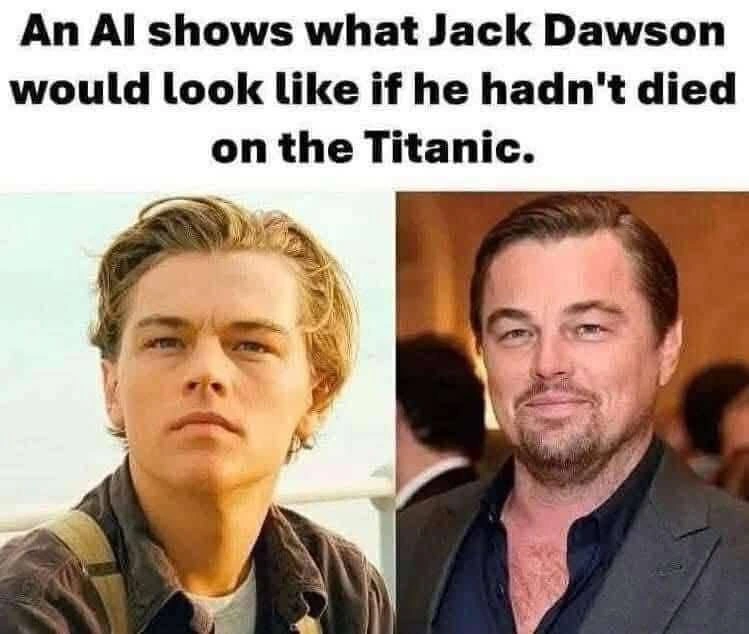
Now, the top text of this meme reads: “An AI shows what Jack Dawson would look like if he hadn’t died on the Titanic.” This is written in that bold, meme-style font to grab your attention – it sounds like a dramatic headline you might see online. Jack Dawson is a character from the super-famous movie Titanic (1997). Jack is played by actor Leonardo DiCaprio. In the movie’s story, Jack tragically dies when the Titanic sinks (it’s a tear-jerker, have tissues ready if you watch it). The meme imagines some AI technology that could predict how Jack’s face would look years later, since in the movie he never got to grow old. That idea is the setup – it plays into those trendy “AI can predict the future!” type stories.
Below the text, the meme shows two pictures side by side. On the left, there’s young Jack (Leonardo DiCaprio from the 90s, looking fresh-faced on the Titanic’s deck). On the right, there’s an older man with a beard, dressed in a suit at a fancy event. That older man is actually Leonardo DiCaprio as well, photographed in real life many years after Titanic was made. So essentially, the meme is comparing Leo in his 20s (during Titanic filming) to Leo in his 40s (at a modern event). The joke is that the meme presents this as if some AI program “aged” the left photo into the right photo – but anyone can tell it’s literally just the same person at two different points in his life.
Why is that funny? It’s poking fun at clickbait culture and AI hype. Clickbait refers to those online articles or headlines that are designed to make you click because they sound amazing or shocking, but often the actual content is trivial. Here the clickbait-y premise is “AI reveals an astonishing thing!” – which in truth isn’t astonishing at all. The meme is a parody of sensational headlines about AIGeneratedContent. Lately, you might have noticed a flood of articles like “This AI draws your favorite cartoon character as a real person!” or “Look how AI imagines famous historical figures in the modern day!” They sound exciting, but often the results are generated by pretty straightforward means – maybe a common algorithm, a filter, or just a human artist aided by a computer. In some cases, people even misuse the term AI to describe something that isn’t very intelligent at all. AIHype is this phenomenon of people getting overly excited about AI’s capabilities (sometimes exaggerated by marketing or the media). It’s part of an IndustryTrends_Hype cycle: a new technology comes along (today it’s AI), everyone talks about it like it’s magic, companies rebrand to use the buzzword, and headlines credit “AI” for things that aren’t mind-blowing. Eventually, people realize the limits and the excitement cools off – that’s the hype cycle in a nutshell.
So, this meme uses the Titanic reference – something from MemeCulture and pop culture that many recognize – to illustrate AI hype in a humorous way. It’s a classic bait-and-switch gag: it baits you with a grand claim, then switches to an obvious truth. The grand claim: “An AI shows what Jack would look like older, isn’t that incredible?” The obvious truth: the image is literally just the actor’s real older photo, no fancy AI needed. For developers and tech insiders, this feels very relatable. They often see non-tech people or news outlets crediting “AI” for trivial solutions. For a junior developer or someone new to tech, it’s a nice introduction to skepticism: not every flashy AI story is as it seems. In reality, doing true age progression with AI is possible but tricky – it would require special ML models and lots of data. But if the person in question is an actor who’s still alive, the simplest “solution” is to use an actual photo of them later in life. No neural networks or code necessary! The meme is basically saying, “See how silly it is to hype this as an AI feat?” and it teaches us to look twice at grand claims. Often, the AIHypeCycle serves up exciting headlines, but as you learn more (especially as a developer), you start to ask, “What’s really going on under the hood? Is it truly AI, or just a straightforward trick?” This meme encourages that kind of critical thinking with a dash of humor.
Level 3: Hypeberg, Right Ahead!
This meme lands a direct hit on the AI hype Titanic. The top caption reads, “An AI shows what Jack Dawson would look like if he hadn’t died on the Titanic.” Underneath, we see two side-by-side images: on the left, young Jack Dawson (Leonardo DiCaprio’s iconic 1912 persona from Titanic); on the right, an older bearded man in a suit – which keen eyes recognize as Leonardo DiCaprio himself, a couple of decades later at a red-carpet event. The punchline? The supposedly AI-generated transformation is literally just the same actor photographed years apart. The meme blatantly reveals the “prediction” without any actual predictive tech – it’s a PopCultureReference serving up a dose of TechHumor. Essentially, it’s shouting: “Look, no fancy ML needed – time did the job!” This is a prime example of dev humor mocking generative_ai_clickbait.
Why is this so funny to engineers? Because it’s AIHumor that exposes how absurd hype can be. In recent years, we’ve been overwhelmed by headlines like “AI imagines X as an old person”, “This is how Disney characters would look in real life, according to AI!”, or “Neural network brings historical figures to life”. Most developers know that many of these pieces are glorified party tricks – sometimes using genuine ML models (e.g. face-aging filters), but often just using off-the-shelf apps or even manual Photoshop while slapping the buzzword “AI” on for clicks. By showing something as obvious as Leonard DiCaprio aging naturally, the meme lampoons those overhyped_ai_claims. It’s basically saying: “Yeah, an AI ‘predicted’ it… or, you know, we just used a photo from 2025 – but shh, let’s call it AI for the headline.” The sarcasm is strong: the meme creator intentionally chose a scenario where the amazing AI result is indistinguishable from an everyday reality that everyone already knows. Jack Dawson is fictional, but Leonardo DiCaprio is very much alive – we already know what Jack would look like older, because the actor himself aged into that older face!
This humorous juxtaposition resonates deeply with software engineers who are a bit jaded by the tech media’s IndustryTrends_Hype. We’ve all sat through meetings where a non-technical manager or a client goes, “I saw on the news that AI can do X. Can’t we just use AI to solve our problem in a snap?” Cue the facepalm from the engineering team. 😑 The meme encapsulates that frustration perfectly. It’s a form of stress relief: we laugh so we don’t cry. Look how silly it is when you don’t know how the sausage gets made! Engineers deal with this daily – hype-inflated expectations vs. the actual nitty-gritty of implementation. It’s not unlike hearing “It’s just a small matter of programming” about something that would take weeks to build. In this case, the meme implies, “They’re hyping an AI ‘breakthrough’ that’s as trivial as pulling up an old photo.”
Another layer here is the reference to the Titanic film (that’s the titanic_reference tag). Jack’s tragic fate is famous: he dies young when the ship sinks (there was definitely room on that door!). The meme’s caption teases an alternate timeline where Jack survives – a classic what if scenario. The joke is that an AI supposedly computed this alternate future. This premise is intentionally ridiculous, because the “alternate future” is just reality for the actor. It’s like saying, “Breaking: AI reveals what would happen if water wasn’t wet,” and then showing something obviously expected. That absurdity is exactly the point. It mocks the kind of generative AI sensationalism where the headline promises mind-blowing insights but the content delivers a meh obvious result. Developers have a keen nose for this kind of AIHype vs Reality disparity. We spend our days making tough things possible, so it’s both annoying and hilarious to see trivial things marketed as earth-shattering breakthroughs.
From an industry perspective, the meme is a commentary on the AIHypeCycle we’re currently riding. We’re at a peak where every product pitches itself as “AI-powered”, every trivial feature suddenly has machine learning sprinkled on top, and the media can’t get enough of it. It’s reminiscent of the MemeCulture around buzzwords like “blockchain” a few years back – remember when everything from iced tea companies to pet toys suddenly had to have blockchain? Now we’re in the era where even an image comparison can be spun as “look what AI did!”. Senior engineers (the battle-scarred veterans of many hype cycles) see the iceberg of reality that lies ahead for these overblown claims – eventually, disappointment or an AI winter could loom when people realize not every problem is magically solved by a neural net. But until then, we cope by joking about it. TechHumor like this meme serves as a wink and nudge among devs: we’re all thinking it, this meme just says it. It’s a small act of rebellion against the noise – using sarcasm to call out the silliness. And of course, throwing in a beloved movie reference (Titanic) just makes it that much more shareable in developer chat rooms, ensuring everyone gets a cathartic laugh while nodding, “Yep, seen this kind of hype before.”
Level 4: Adversarial Age Advancement
In a serious machine learning context, actually showing Jack Dawson (Leonardo DiCaprio’s character) many years older would involve complex generative AI techniques – not just a cheeky photo swap. Real age progression via Machine Learning (ML) often uses Generative Adversarial Networks (GANs) or advanced image-to-image transformation models. These models have two neural nets (a generator and a discriminator) in a digital duel: the generator tries to produce an aged version of a face, while the discriminator judges if it looks plausibly older or fake. Over many iterations, the generator learns to add realistic wrinkles, gray the hair, soften the jawline – all the subtle aging features – until the discriminator is fooled into thinking the aged face could be real. This adversarial training is mathematically intense: the generator optimizes a loss function that balances looking_older with still_looking_like_the_same_person. It’s a high-dimensional tug-of-war in the model’s latent space to preserve identity (so Jack still looks like Jack) while adding decades of simulated aging.
If we were doing this properly, we’d gather a dataset of faces at various ages or even photos of DiCaprio over the years. We might condition the model on an age parameter – essentially telling the network “make him X years older.” Techniques like face morphing or encoder-decoder architectures (e.g. using a convolutional encoder to capture Jack’s youthful features, then a decoder that renders him older) come into play. Some research even introduces extra constraints to ensure the aged face doesn’t drift into someone else’s face; for instance, adding an identity preservation loss so that the AI’s “older Jack” still has Jack’s unique features. Under the hood, it’s linear algebra and calculus crunching pixel values – certainly not magic, but definitely advanced AI/ML engineering.
However, here’s the kicker: in this meme’s case, the “AI” didn’t have to do any of that complicated work. The “prediction” of Jack’s older appearance is 100% accurate because it’s literally a real photograph of Leonardo DiCaprio in later years. In scientific terms, the solution has an unfair advantage: it used the actual ground-truth outcome! Normally, an algorithm could only predict how Jack might age (with some error margin), but the meme sidesteps the entire prediction problem by grabbing the actual answer from reality. It’s as if an AI solved a tough equation by peeking at the answer key. This highlights a fundamental truth in ML: truly predicting the future or extrapolating beyond known data is hard – unless you cheat by using real future data. The humor here comes from how unnecessary all that theoretical ML firepower was, contrasted with the hype-y headline implying a state-of-the-art AI achievement. It’s a sly nod to how trivial the task actually was when you have the actor’s photo: why train a GAN to age Jack when Leonardo DiCaprio aging naturally over 20+ years did all the work?
Beyond the immediate joke, there’s a whiff of AIHypeCycle satire in play. Developers and tech historians recall that inflated claims about AI aren’t new – from the earliest expert systems to modern deep learning, we’ve seen waves of grand promises followed by reality checks (hello, AI winter). This meme pokes at the latest cycle: generative AI clickbait. It academically underlines a key point often lost in sensationalized headlines – correlation vs causation, or rather, presentation vs actual computation. A genuine AIGeneratedContent pipeline for age progression is a feat of data science; but here the only “pipeline” was finding an older image in the archives. In a way, the meme is a practical demonstration of Occam’s razor in AI: the simplest solution (use an existing photo) trumped a far more complex approach (training a model) because the conditions were just right. It’s a tongue-in-cheek reminder that behind many supposed miraculous AI results, there might just be an ordinary trick – an overhyped AI claim dissolving upon closer scrutiny.
Description
A two-panel image meme with a caption at the top that reads, 'An AI shows what Jack Dawson would look like if he hadn't died on the Titanic.' The left panel features a photograph of a young Leonardo DiCaprio in his role as Jack Dawson from the 1997 film 'Titanic.' The right panel displays a more recent photograph of the same actor, Leonardo DiCaprio, now older with a beard and shorter hair. The humor is derived from the absurdly literal interpretation, presenting a simple photo of an actor who has naturally aged as a sophisticated AI-generated prediction. It satirizes the often-overblown claims and hype surrounding AI's capabilities, contrasting them with a mundane and obvious reality
Comments
9Comment deleted
Our new 'Temporal Actor Regression' model is groundbreaking. It ingests a filmography dataset and outputs a JPEG of the same person twenty years later with 99.9% accuracy. We've patented it
Watching an “AI” predict Jack Dawson’s future by copy-pasting a recent Leo headshot feels exactly like the sprint where we Docker-wrapped the COBOL batch job and the board applauded our ‘cloud-native machine-learning platform.’
This is like claiming your ML model achieved 100% accuracy on the test set, then revealing you just hardcoded the answers - except here the 'model' is literally just showing us DiCaprio's actual aging process and calling it AI prediction
This meme perfectly captures the current state of AI marketing: claiming revolutionary predictive capabilities while essentially performing a Google Images search with extra steps. It's the technical equivalent of training a neural network for weeks to predict that water is wet, then presenting it as breakthrough research. The real model here isn't a GAN or diffusion model - it's the business model of slapping 'AI-powered' on anything to justify a Series B valuation
The rare AI where overfitting wasn't a bug - it was the entire feature set
Behold a 100% accurate model: train/test leakage that does SELECT latest_photo FROM prod WHERE character = 'Jack Dawson' - rebranded as generative age progression
AI “aged” Jack Dawson into present-day DiCaprio - classic target leakage; that’s just k-NN with k=1 pretending to be foresight
No. Skoof is the highest form of existence Comment deleted
Spoiler Comment deleted