Game Developers Watching the AI Programming Hype
Why is this GameDev meme funny?
Level 1: Not Impressed
Imagine a kid who just got a brand new self-driving toy car that can avoid obstacles on its own. The kid is super excited, yelling, “Wow, it’s like the car can think! This is the coolest thing ever!” Now picture the kid’s older sister who’s been building and playing with remote control robots for years. She watches the hype and just rolls her eyes, saying, “I’ve been doing stuff like that forever, it’s not such a big deal.” In this story, the shiny self-driving toy car is like the new AI tools everyone’s excited about, and the older sister is like the game developer who’s been coding smart behaviors into games for a long time. The joke is that what seems new and magical to some people is actually old news to others. The older sister isn’t impressed because, to her, this “new” thing is just a fancier version of something she’s already experienced. In the same way, game programmers aren’t wowed by the current AI-in-programming craze — they smile and think, “we’ve seen this kind of trick before.”
Level 2: Before It Was Cool
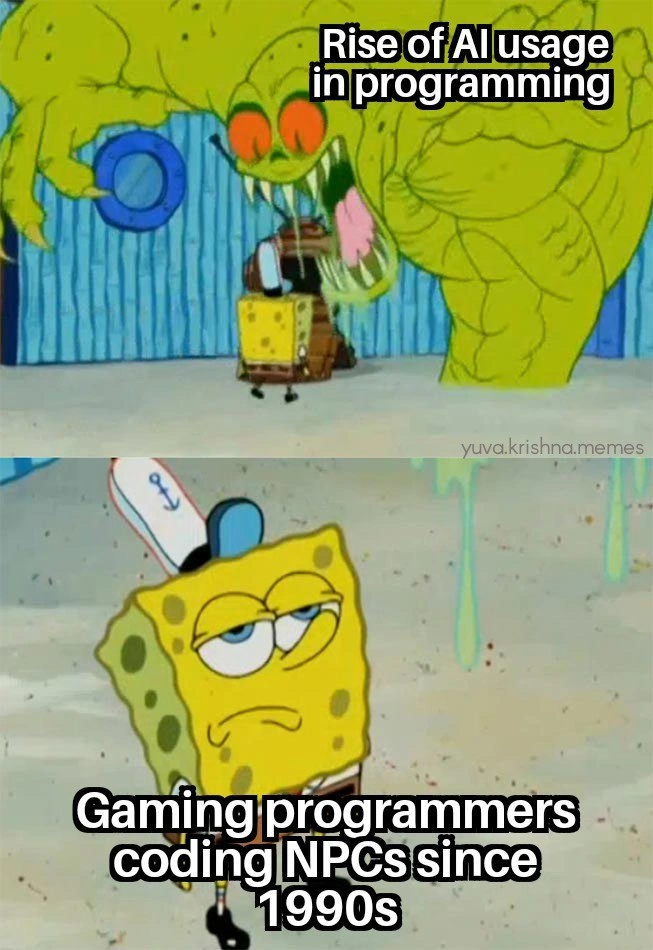
Let’s break down the meme in simpler terms and explain some of the jargon. The top part shows a scary green monster attacking SpongeBob, labeled “Rise of AI usage in programming.” This represents how nowadays everyone is talking about Artificial Intelligence (AI) in programming. You might have heard of things like Machine Learning or tools like ChatGPT and GitHub Copilot. These are examples of modern AI being used to help with programming tasks. For instance, GitHub Copilot can suggest code for you as you type, and ChatGPT can even write chunks of code if you describe what you want. This is what we mean by the “rise of AI usage in programming” – it’s this big wave of new tools and techniques where AI is doing some of the coding or decision-making. To many folks, especially those early in their career, this is exciting and a bit intimidating – kind of like a huge monster coming at you. It’s new, it’s powerful, and everyone’s hyping it up. People are saying things like “AI is going to change how we write software” or “maybe AI will replace programmers!” The monster imagery fits that feeling of a giant unstoppable force. (Don’t worry, real AI isn’t actually a monster, but memes love to exaggerate!)
Now, the bottom part of the meme has SpongeBob just standing there with a bored, unimpressed look on his face. The caption is “Gaming programmers coding NPCs since 1990s.” Let’s unpack that. Gaming programmers refers to software developers who make video games. “Since the 1990s” means this has been going on for a long time – basically decades. And NPCs are “Non-Player Characters,” which are all those characters in games that are not controlled by a human player but by the computer. Think of the ghosts in Pac-Man, the Goombas in Mario, or the enemies and allies in modern games like Skyrim or GTA that roam around on their own. Those characters need some form of AI to behave in a convincing way – after all, there isn’t a person controlling each enemy soldier or wandering villager in a game; the game’s code has to make them act. So game programmers have always written code to give these NPCs some sort of “brain” or behavior.
The meme is basically saying: while everyone else is freaking out about AI in 2023, game devs have been doing a form of AI for a very long time. That’s why SpongeBob (the game dev stand-in here) looks so jaded. It’s like he’s thinking, “Really? You’re all excited about this now? We’ve been doing this forever.” The humor comes from this contrast – one side is super hyped and scared (new developers or the general programming world seeing AI rise), and the other side is like “meh, been doing this since Clinton was president.”
Let’s talk about how game devs have been doing AI for years, because that’s a key point. In games, the AI that controls NPCs isn’t usually the fancy machine learning you hear about today. It’s more old-school, rule-based programming. Here are some common terms and techniques in game AI (the kinds of things game developers were coding in the 90s and still use now):
Finite State Machine (FSM): This sounds complex but it’s not too bad. Imagine an NPC (say, a security guard in a stealth game) that can be in a limited number of modes or states. For example, the guard might be “Idle” (just standing around), “Patrolling” (walking a set route), “Alerted” (he heard a noise or saw movement), or “Chasing” (he spotted the player and is running after them). A finite state machine is just a way to manage these modes. The guard starts in one state, and certain events or conditions cause transitions to another state. As a simple example: if the guard is in “Patrolling” state and sees the player, we switch him to “Chasing” state. If he loses sight of the player for a while, maybe we switch to “Alerted” or back to “Patrolling”. It’s called “finite” because there’s a fixed number of states. It’s like a flowchart or a little map: in State A, if X happens go to State B, if Y happens go to State C, etc. Game developers would literally code these. For instance:
// Pseudocode for a simple NPC state logic if (state == PATROLLING) { if (canSee(player)) { state = CHASING; // maybe play a yell sound } } else if (state == CHASING) { if (!canSee(player)) { state = SEARCHING; // lost sight, start searching } else if (distanceTo(player) < attackRange) { state = ATTACKING; } } // ...and so on for other states...In the snippet above,
canSee(player)might be a function that returns true if the player is within the guard’s field of view and not behind a wall. So this code is the guard’s “AI.” It’s not learning or adapting – it’s just following a script the programmer wrote. But to the player, it can feel like the guard has some intelligence (he responds to seeing you, he chases you, he looks for you if you hide). That’s a finite state machine in action, and it’s been a bread-and-butter method for game AI for ages.Behavior Tree: This is another method to handle NPC behavior, which became popular in the 2000s and onward. If an FSM is like a map of states, a behavior tree is like a to-do list with branches. It’s a tree structure (kind of like an upside-down family tree or a flowchart) that the game AI goes through every tick (multiple times per second). The tree might ask questions in order: “Is the NPC hurt? If yes, do healing behavior. If not, is there an enemy nearby? If yes, do combat behavior. If not, is he supposed to patrol? If yes, do patrol behavior,” and so on. It’s hierarchical: high-level decision at the top, details down the branches. Designers like behavior trees because they can rearrange branches and customize how an NPC makes decisions without rewriting all the code from scratch. Many modern game engines (like Unity or Unreal Engine) have tools for behavior trees built-in. Again, it’s not learning on its own; it’s the dev deciding the priority and order of actions. But it’s a powerful way to create the illusion of a thoughtful NPC. For example, in a shooter game, a behavior tree could make an enemy soldier take cover when under heavy fire, flank the player if they haven’t moved for a while, throw a grenade if the player is behind cover too long, etc., all by checking those conditions in a tree of logic.
GOAP (Goal-Oriented Action Planning): This one is a bit more advanced. It’s a technique where the NPC plans out a sequence of actions to achieve a goal. Think of it like how you might plan your day: “I need to get groceries. To do that, I need to drive to the store. To drive, I need gas in the car. So first I’ll stop at a gas station, then go to the supermarket.” For an NPC, a goal might be “attack the player.” To achieve that, it might need a weapon, so a sub-goal is “get a weapon before attacking.” If the weapon is behind a locked door, a sub-sub-goal is “find the key to that door,” and so on. GOAP algorithms let NPCs figure out these sequences on the fly. In practice, developers define possible actions (and what each action needs and results in). The NPC’s AI then searches through those actions to chain together a plan. It’s like giving the NPC some basic Lego blocks of actions and letting it assemble something useful from them when needed. This can lead to more dynamic behaviors. For example, if you block the NPC’s usual route, a GOAP-driven NPC might improvise another way to reach you because it’s planning with the pieces it has, rather than following a strict script. Some famous games used this (one called F.E.A.R. had enemies that felt surprisingly clever using planning like this). But again, it’s all coded possibilities – the NPC isn’t learning new actions by itself, it’s just picking from what the dev scripted in a smart way.
Pathfinding: This is a crucial part of game AI that almost every game with movement uses. When an NPC needs to move from point A to point B (say, a monster chasing the player across a map), the game uses pathfinding algorithms to find a path that avoids obstacles. The most well-known algorithm is A* (“A-star”), which efficiently finds shortest paths on a grid or network of nodes. Game devs create a mesh or graph that represents walkable areas of a level, and A* finds a route through that for the character. Think of it like GPS for game characters. It’s an AI in the sense that the character seems to figure out how to navigate a complex environment. But really, the developer implemented this algorithm (or more likely, used a library) to do the number-crunching. Pathfinding was already commonly used in 90s games (for example, real-time strategy games like Warcraft or StarCraft used pathfinding for all those units moving around). It’s not new at all – it’s just math and data structures working behind the scenes.
All these techniques are what we’d call rules-based or algorithmic AI. The behaviors come from explicit code written by humans. There’s no neural network or “learning” involved. If the NPC needs to get better or act differently, a programmer or game designer goes in and changes the code or the parameters. It’s a very direct way of creating AI behavior, and it has the advantage that the developers maintain control. They usually know exactly how the NPC will act in a given scenario (or at least what rules it will follow), which is important to make sure the game is fun and not broken.
Now, compare that to the modern AI/ML approach that’s causing all the hype. Machine Learning (ML) is a subset of AI where instead of programming rules, you train models on examples data. The model “learns” patterns and then can produce results or predictions based on that training. A popular type of ML is using neural networks, which are like layered math functions that can be incredibly good at tasks like image recognition, language translation, or in our context, code generation. Large Language Models (LLMs) like GPT-4 (which powers ChatGPT) have been trained on vast amounts of text (including lots of code). They don’t have explicit “if X then do Y” rules in the way our game NPC examples do. Instead, they have statistically learned how code is usually written and can continue a code snippet or create one from a description by predicting what comes next token by token. It’s a very different way to solve a problem. You can kind of think of it like this: in rules-based programming (like our NPCs), the developer is the teacher explicitly telling the program “if you see that, do this.” In machine learning, the program kind of teaches itself by studying many examples; the developer just sets up the training process and gives it the data.
So when people talk about the “rise of AI usage in programming,” they mean we’re now doing things like:
- Using ML models to generate code (instead of writing everything manually).
- Using AI to make decisions in software that weren’t explicitly coded (like a spam filter that learned what spam looks like from lots of emails, rather than a hard-coded list of bad words).
- Incorporating intelligent features (like voice assistants, recommendation engines, etc.) into applications, which rely on machine learning.
This does feel like a big change! If you’re a new developer or even an experienced one who hasn’t done AI before, seeing an AI helper write code for you can be mind-blowing. It’s the kind of thing that 10 years ago was sci-fi, and now it’s in your editor completing your functions. That’s why the meme’s first panel shows SpongeBob cowering under the monster – a lot of folks are like “whoa, this thing is huge and scary (or amazing).”
But the second panel reminds us that not everyone finds it so novel. Game programmers especially might react with “Pssh, we’ve had characters making decisions and doing stuff on their own forever.” The meme is basically a game programmer saying to the rest of the programming world: “We’ve quietly been using AI (in the broader sense) in our games for years and years. Now you all are calling it a revolution? Big deal.” It’s a bit tongue-in-cheek, of course. Writing an NPC’s finite state machine is not quite the same as ChatGPT’s deep learning magic. But from a broad view, both are about making the computer behave in a way that seems intelligent or at least autonomous.
For a junior developer or someone new to these concepts, think of it this way:
- In a video game, when you see enemies or other characters acting on their own, that’s because a programmer wrote logic for them. Those characters feel alive because of lots of little programmed rules and algorithms. It’s not fundamentally different in concept from an AI tool that can do something semi-autonomous in a program; the main difference is how that behavior is created (explicit coding vs. learning from data).
- The meme’s joke is like an older sibling saying, “That’s not new, I’ve been doing that since before you were around,” when you show them the latest trendy thing. Here the trendy thing is AI in programming, and the older sibling is the game dev who did simpler forms of AI long ago.
As an early-career developer, you might have even unwittingly written some basic AI. Have you ever coded a simple game or maybe a robot in a simulation for a class, where you had to make decisions based on conditions? That’s AI! For example, you might write:
if temperature > 30:
print("It's hot!")
else:
print("It's cold!")
That’s a trivial example – not very smart. But scale it up:
Imagine you’re coding a simple text adventure game with a dragon. You might do:
if dragon.health < 50:
dragon.retreat()
elif hero.visible_to(dragon):
dragon.attack(hero)
else:
dragon.patrol()
Now your dragon NPC has a tiny brain: it patrols its lair, but if it sees the hero, it attacks, and if it’s weak, it retreats. This is basically what game devs do, just on a much larger and more complex scale for big games, often using the patterns we mentioned like FSMs or behavior trees to keep it manageable.
Meanwhile, the AI hype you hear about might be something like: a neural network could be trained to control a character by “learning” from playing the game a million times (this is actually a thing – researchers use reinforcement learning to train game agents). That’s cool, but game devs kind of shrug because a lot of times, the scripted approach works fine and is way easier to guarantee it won’t do something crazy. Plus, in the 90s and even now, hardware limitations (especially on consoles) meant you couldn’t run a big neural network in real-time in a game. So simpler algorithms were not just the preference, they were the only option.
To connect it to something more familiar: think of your own experiences with hype vs reality. Maybe you learned about a fancy new JavaScript framework that promised to do everything automatically, but when you actually used it, you realized it’s just combining things programmers have been doing manually. Or when people freak out about “new” trends like virtual reality or blockchain, and older tech folks point out similar concepts existed before. It’s that feeling of “the more things change, the more they stay the same” in tech.
So, the meme is funny to developers because it’s a bit of a reality check: AI isn’t entirely new — it’s just new in this particular form. Game developers have a bit of a smug pet pride here: they were into AI before it was cool. SpongeBob’s bored face is basically a veteran saying, “This is normal, stop screaming and just get back to work.” It highlights the generation gap in the developer community: the newer generation sees AI/ML as this giant cutting-edge change, while the older generation (especially those from game development or AI research back then) sees it as an evolution of ideas that have been around for a long time.
In summary, the top caption (“Rise of AI usage in programming”) is about the modern machine learning boom in software, and the bottom caption (“Gaming programmers coding NPCs since 1990s”) is pointing out that game developers have been writing AI for NPC behaviors with traditional coding techniques for many years. The meme humorously contrasts the hype (big scary monster) with the old reality (SpongeBob not impressed because it’s old hat to him). It’s like saying, “Hey, AI in programming isn’t as completely novel as people think. Ask a game programmer!”
Level 3: Been There, Programmed That
The SpongeBob meme captures a classic AI hype vs reality scenario in tech. In the top panel, a giant green monster (with glowing orange eyes and all) represents the Rise of AI usage in programming – essentially the current wave of excitement around using AI/ML in software development. It’s depicted as this huge, terrifying beast lunging at poor SpongeBob (who’s cowering in fear). This is how many developers today feel with the flood of AI tools like large language models writing code, automated code reviewers, and chatbots that can generate entire functions. It looms over them like some unstoppable force that’s changing everything. The bottom panel flips the script: SpongeBob is now standing there bored and unimpressed (rocking his Krusty Krab employee hat, looking half-lidded). The caption says “Gaming programmers coding NPCs since 1990s”. In other words, veteran game developers have seen this monster before – and it doesn’t scare them. They’re basically rolling their eyes, thinking: “AI in programming? Yeah, welcome to the club, we’ve been doing AI for ages in game dev.”
From a seasoned developer’s perspective, the humor comes from the IndustryTrends of hype cycles. Every few years there’s a new “monster” tech trend that everyone freaks out about. Right now it’s AI/ML in everyday programming – things like GitHub Copilot auto-completing code, ChatGPT generating scripts, or machine learning models optimizing tasks. It’s portrayed as unprecedented and game-changing. But game development veterans are like SpongeBob in that second frame: utterly unfazed. Why? Because GameDevelopment has always involved coding artificial intelligence for games, especially for NPCs (non-player characters). The gaming industry has a long legacy of game AI techniques crafted well before the current ML hype. These devs have been living and breathing game AI since the days of dial-up internet and CRT monitors. To them, the “Rise of AI” isn’t a revolution – it’s more like déjà vu with extra buzzwords.
They’ve seen this pattern before. Remember the hype around “AI” in the 1980s with expert systems? Or the late 90s excitement about neural networks (followed by the AI winter when everyone got disillusioned)? Many senior devs have weathered multiple hype waves. So when today’s news screams “AI will write all our code!”, the battle-scarred veterans smirk. It’s not that MachineLearning advances aren’t impressive – they are – but there’s a sense of “we’ve been solving these kinds of problems for decades, just with different tools.” In gaming culture, the term AI often simply meant any logic that makes game entities appear smart. It was a selling point on game boxes long before deep learning. (Who hasn’t seen game marketing boasting “revolutionary AI enemies”?) Those “AIs” were usually just clever algorithms and handcrafted rules, not magic. So there’s an irony: AI hype is old news to game programmers — they were doing AI when the now-excited crowd was still playing with their Game Boy.
Let’s talk specifics. Game developers have built up a toolbox of classic AI techniques, sometimes dubbed Good Old-Fashioned AI (GOFAI), to make NPCs act intelligently. These are rule-based or algorithmic systems, not machine-learned models. For example:
Finite State Machines (FSM) – A staple of game AI since forever. An FSM is basically a set of predefined states and transitions. Think of an enemy soldier with states like
Patrolling,Chasing,Attacking,Searching. The NPC switches between these states based on triggers (player spotted, lost sight of player, low health, etc.). Under the hood, it’s typically just a bunch ofif/elsechecks or aswitchstatement controlling behavior. It’s straightforward, deterministic, and works. A guard NPC in a 1998 game might literally have had code saying: if player is seen, go to Chasing state; if player is lost, go to Searching state; if timer runs out, return to Patrolling. Not exactly the stuff of sci-fi, but it gets the job done.Behavior Trees – Introduced in the 2000s (popular in games like Halo and many modern game engines), behavior trees organize NPC decisions hierarchically. They’re like a flowchart of behaviors: a tree where each branch is a decision or action. The game ticks through the tree: “Is there an enemy nearby? No? Then wander. Yes? Then check cover availability. Under fire? Yes? Then find cover; No? Then aim and shoot,” and so on. It’s more modular and scalable for complex NPC logic than a monolithic FSM. Developers can tweak behaviors by rearranging the tree nodes. It’s still completely scripted logic, but it can produce very nuanced, life-like patterns when done well – without any machine learning involved. Essentially, it’s code orchestrating the NPC’s day-to-day “thinking.”
GOAP (Goal-Oriented Action Planning) – This is a technique that game AI engineers started using in the early 2000s (famous example: the FPS game F.E.A.R. in 2005 had AI using GOAP). It’s basically a planner: the NPC has a goal (say, “eliminate the player”) and a set of possible actions with preconditions and effects (like “find weapon”, “reload”, “find cover”, “attack target”). The GOAP system performs a search (often some variation of A*) through the space of actions to plan a sequence that achieves the goal. This is rooted in classical AI planning algorithms from academic research (STRIPS planning, etc.), adapted for real-time games. It’s a bit closer to what you’d call AI in an academic sense – it’s essentially an automated planner – but it’s still all explicitly coded and rules-based. The NPC isn’t learning how to plan; the dev pre-wrote the building blocks and the planning algorithm figures out a valid sequence. Game devs have used this to make enemies that seem clever and unpredictable, even though it’s programming sleight-of-hand.
Pathfinding algorithms (e.g. A* search)** – This one is huge in games. Ever wonder how the monster finds its way through a complex maze-like level to chase you? Developers use algorithms like A* (pronounced “A star”) to calculate the shortest path on a navigation mesh or grid. A* was invented way back in 1968, and by the 90s it was a workhorse of game AI. When a game character chases you around obstacles, there isn’t a brain or a neural net thinking – it’s this algorithm crunching away, expanding nodes and following a heuristic to find an optimal path. It’s so common that any self-respecting game engine has a pathfinding library built-in. Again, nothing new or mystical: just graph search and heuristics making a monster appear cunning.
These GameDev AI techniques (and others like steering behaviors for crowds, rule-based dialogue systems, finite-state everything) have served to make game worlds feel alive. Importantly, they’re all hand-crafted. A programmer (or designer) sat down and wrote the rules. There’s no gradient descent, no huge data sets, no neural network hidden layers – the “intelligence” is entirely designed. If an NPC is too dumb, that’s on the dev to tweak the code. If it’s too smart or hard, devs tone it down. It’s a very controllable, deterministic process. That’s crucial in games: you don’t want your NPCs surprising you in a bad way during a demo for the boss or, worse, for the players after release. (Imagine a boss enemy “learning” it should never expose its weak point – cool in theory, but if it becomes unbeatable, players won’t find it fun. This is why most game AI is deliberately given some predictable weaknesses.)
Now contrast that with the current AIHype in general programming. These days when people say “AI in programming”, they’re usually talking about machine learning models doing some of the programming work or making software “smarter.” For instance, GitHub Copilot can suggest entire code snippets as you type (powered by an LLM, a Large Language Model trained on lots of code). ChatGPT and similar models can write code to solve problems described in natural language. There are also ML-based tools for things like code optimization, bug detection, or even AI that tries to design UX layouts. It’s a very different approach from explicitly coding rules. The AI is trained on vast amounts of existing data (like GitHub’s public repositories for Copilot, or millions of web pages for ChatGPT) and then it generalizes to produce new outputs that seem smart or at least contextually relevant. To many developers, especially those who haven’t specialized in AI, this feels almost magical – “the computer is figuring out code on its own!”. That explains the big green monster labeled “Rise of AI usage in programming”: it represents this seemingly colossal shift where AI is starting to handle tasks traditionally done by human programmers.
But here’s the thing: to an old-school game AI programmer, a lot of these tasks aren’t as revolutionary as they sound. The game dev mindset: “We’ve had scripts and bots making decisions without a human in the loop for a long time. The techniques were different, sure, but the idea of non-human ‘intelligence’ driving something in our programs? That ship sailed ages ago.” In other words, the AIHypeVsReality check here is that what the industry is hyping as novel – computers doing “intelligent” stuff with minimal human direct instruction – is something game developers have felt intimately familiar with. They used deterministic algorithms instead of massive neural nets, but the feeling of having code that autonomously responds to situations… that’s literally what every NPC AI does. A 1997 game didn’t have a neural network, but its NPCs could still hunt the player and take cover based on coded logic.
There’s a spicy undertone in this meme as well: a bit of “respect your elders” in tech. GamingIndustry veterans might chuckle at how everyone now is enamored with “AI” as a buzzword, while these veterans quietly implemented npc_ai behaviors long before it was trendy or got conference keynotes. It’s like the meme is giving a nod to those unsung game dev heroes who solved hard AI-ish problems under tight CPU/memory constraints (on, say, a PlayStation 1 with 2MB of RAM) without any accolades. Now all of a sudden, toss “AI” into your product pitch and people treat you like you invented computing. No wonder SpongeBob’s wearing his work hat and looking bored – he’s the short-order cook who’s been flipping these AI Krabby Patties for years and is not impressed by some new fancy sauce.
Finally, consider why SpongeBob specifically is the one bored: SpongeBob is a character known for enthusiasm usually, but here he’s deliberately shown half-lidded (this particular meme format is popular to express being jaded or unimpressed). It adds to the humor that even SpongeBob, the eternally cheerful fry cook, can’t be bothered to get excited. That’s the senior_dev_perspective in a nutshell: “I love new tech as much as the next guy, but c’mon, this isn’t my first rodeo.” The sea monster looks menacing, but SpongeBob’s like “meh.” This captures the dynamic perfectly: the newer devs see a menacing wave of AI coming for their programming jobs or revolutionizing coding (scary and thrilling), while the game dev veterans are nonplussed, maybe thinking “Seen bigger. This one’s mostly hot air.”
In summary, the meme is poking fun at the current AIHype in programming by highlighting the contrast with GameDev old-timers. It’s saying: all this fanfare about AI coding and AI tools – cool, but don’t act like it’s completely unprecedented. Game programmers have a whole GamingCulture of dealing with AI (in the form of game AI systems) stretching back to the 90s and earlier. They’ve encountered and solved many “make the computer act smart” problems already. The joke lands because it reveals a blind spot in the hype: what’s new to some developers is decades-old hat to others. TechHumor often thrives on this type of insider perspective – here, the insiders are the game AI veterans giving a collective eye-roll, much like SpongeBob’s bored expression. They’re effectively saying, “This ‘new’ AI surge? Cute. We’ve been wrestling AI monsters since the last century.” And that punchline resonates with anyone who’s been around long enough to see new tech ideas recycle under fresh branding. It’s a veteran’s dry, sarcastic “heard this one before” response to the endless cycle of IndustryTrends_Hype.
Description
A two-panel Spongebob Squarepants meme comparing the current hype around AI in programming to the long-standing use of AI in game development. The top panel shows a monstrous, scary green fish monster looming over a frightened Spongebob, with the text 'Rise of AI usage in programming' overlaid. This represents the current tech industry's awe and sometimes fear of new AI tools. The bottom panel shows Spongebob looking bored, tired, and completely unimpressed. The text here reads, 'Gaming programmers coding NPCs since 1990s'. The joke is that what seems revolutionary to the broader programming world - creating artificial intelligence - has been a fundamental part of game development for decades in the form of Non-Player Character (NPC) behavior, making veteran game developers unfazed by the recent trend
Comments
7Comment deleted
The rest of the industry is excited that AI can generate a React component, while game devs have been debugging AI that learned how to open doors and T-bag players for two decades
Funny how LLMs need a data center to autocomplete a loop while a 1998 Quake bot still trash-talks you with a 20-state FSM
While everyone's losing their minds over ChatGPT, game developers are sitting back thinking 'We've been wrestling with pathfinding algorithms, behavior trees, and making NPCs not walk into walls since Doom - your fancy LLM is just another state machine with better marketing.'
Game developers have been shipping 'AI' for decades - finite state machines, behavior trees, A* pathfinding - but now that we've slapped 'AI' on autocomplete with extra steps, suddenly everyone's an ML engineer. Meanwhile, those same NPCs from 1998 are still walking into walls because nobody wants to debug navigation meshes when they could be writing Medium posts about prompt engineering
We’ve shipped “AI” with FSMs, A*, and 16ms budgets; call me when your code assistant can run a tavern NPC without blowing the frame - or the cloud bill
AI's 'rise' is just neural nets hallucinating code; game devs perfected convincingly stupid agents with FSMs before anyone cared about backprop
Wake me when the code-gen LLM fits in a 16ms frame budget, runs offline, and stays deterministic for lockstep netcode - our “dumb” behavior trees have shipped that for decades