Skip to content
DevMeme
5276 of 7435
Developers react to AI image datasets discovered to contain illegal CSA content
AI ML Post #5786, on Jan 8, 2024 in TG

Developers react to AI image datasets discovered to contain illegal CSA content

Why is this AI ML meme funny?

Imagine you’re helping to bake a giant batch of cookies to share with the whole neighborhood. You gather ingredients from everyone you know to make the biggest, most amazing variety of cookies. Flour from one friend, sugar from another, chocolate chips from a shop, and so on – a bit like how an AI collects tons of pictures from all over the internet to learn what things look like. But here’s the disaster: after baking the mountain of cookies, someone realizes one of the sugar jars had poison in it. Not on purpose – maybe the jar was contaminated without anyone knowing – but it doesn’t matter. That poison is now mixed into a huge batch of cookies. Even if it’s just a tiny bit, it’s in there, and it makes all the cookies unsafe. You can’t just pick out the poisoned part; the whole batch is suspect. In fact, you shouldn’t let anybody eat these cookies at all, and you might get in serious trouble for even having that poison.

In this analogy, the cookies are like the AI’s output, and the ingredients are like the training data (all those images). The “poison” represents those illegal and harmful images that sneaked into the training set. Just as one bad ingredient ruins the entire batch, a few truly bad pictures ruin the entire AI model’s credibility and safety. The emotional reaction from the bakers (the developers) is shock and alarm: “Oh no, how did that get in there? This ruins everything!” It’s a mix of fear (because it’s dangerous) and a bit of grim humor (like, of course the one time we didn’t double-check, something awful got through). The meme is essentially this scenario in developer terms – it’s pointing out with a dark laugh that the big fancy “AI cookie” everyone was excited about turned out to have something toxic mixed in. And just like you’d immediately throw out the cookies and thoroughly clean the kitchen, the AI folks now have to go back to the start, clean up their data, and ensure this never happens again. The humor is subtle and a bit tragic: it’s funny in the way you laugh after the fact, saying “I can’t believe we missed that, what a disaster,” while knowing it’s actually very serious.

Level 2: What "CSA" Means Here

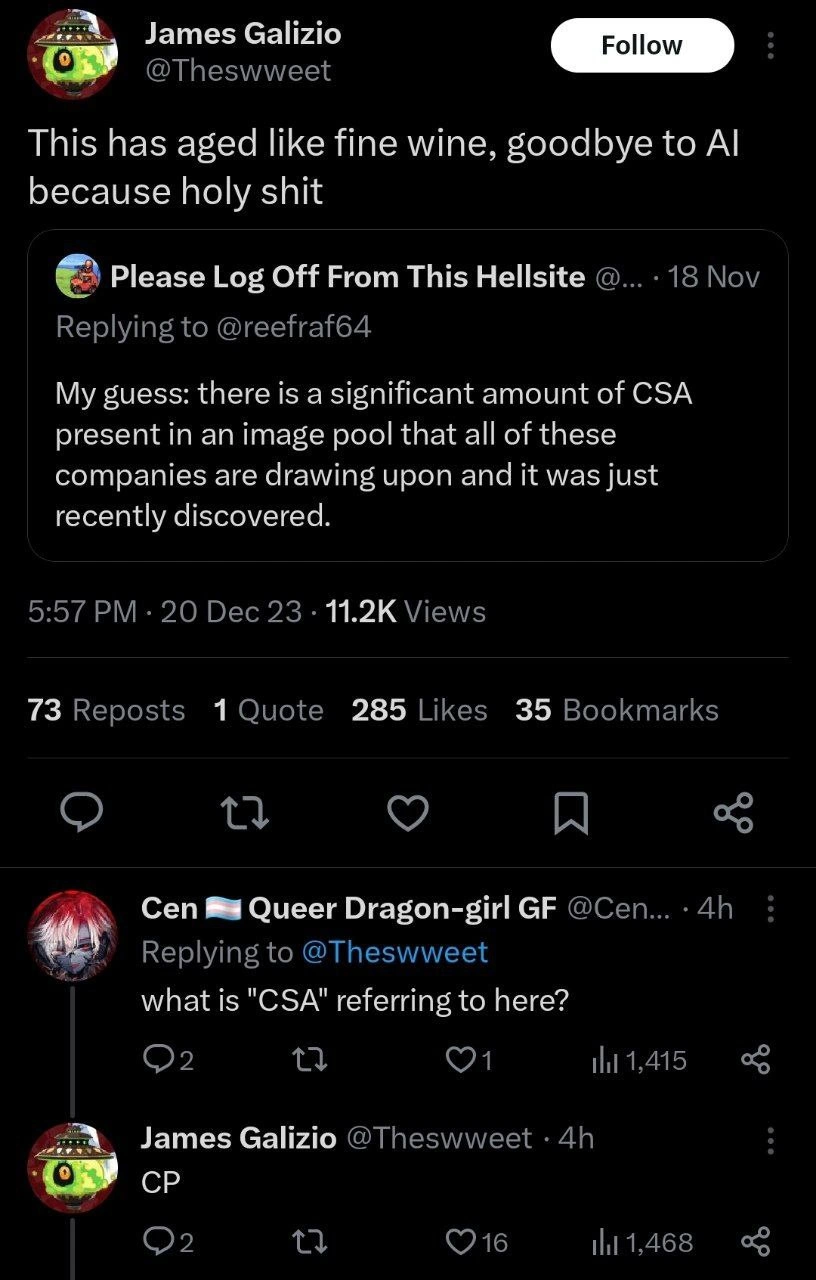
In this meme’s screenshot of a Twitter thread, a group of developers are freaking out about something pretty serious hidden in an AI image dataset. One person guessed that the dataset used by many image-generating AI models contained a lot of “CSA,” and it turns out they were right – hence the shocked reaction “goodbye to AI because holy shit.” Now, what is "CSA"? In this context, CSA stands for Child Sexual Abuse material – essentially illegal child pornography. It’s about the worst possible content you could imagine, and it’s absolutely forbidden to possess or use. In the thread, when someone asks “what is ‘CSA’ referring to here?”, the answer given is “CP,” short for child pornography. So the conversation reveals that an AI training data pool might have included illicit images of minors, which is a huge deal.

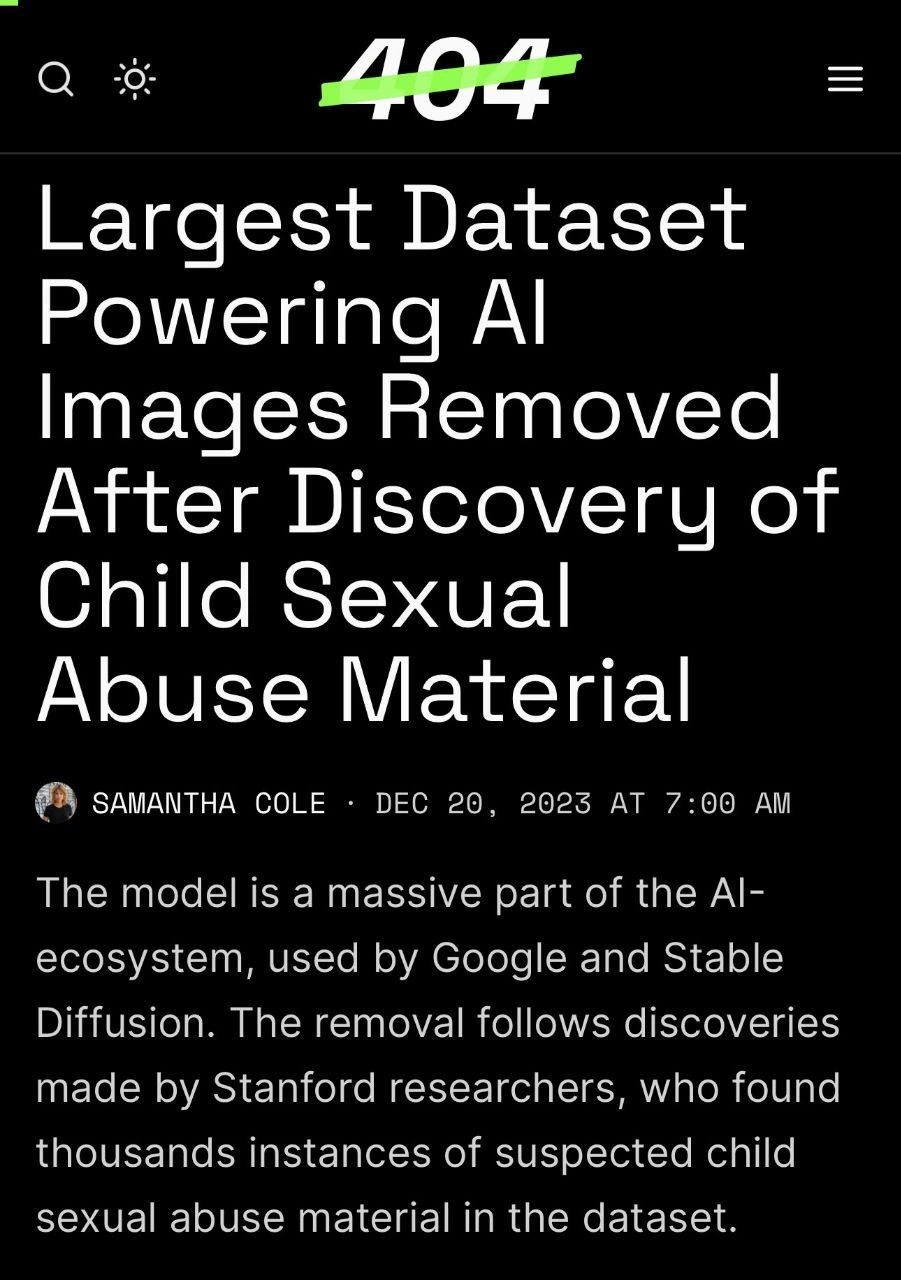
Let’s break down why this rocked the developer community. AI generative models (like those that create new images from text prompts) learn by studying millions or billions of example pictures. This collection of pictures is called a training dataset. Ideally, a training dataset should only have legal and appropriate content. But in practice, many big AI projects simply scrape large portions of the internet for images – basically grabbing whatever they can find to feed the hungry AI. If you’re not extremely careful, this “grab everything” approach can pull in some truly awful stuff. In this case, developers suspect (and apparently discovered) that the dataset all these companies used wasn’t properly cleaned, and it contained some illegal child abuse images. That’s not just an “oops” – it’s a massive ethical and legal problem. Imagine working on a cool new AI, and then finding out it was inadvertently taught using contraband images – you’d be horrified and immediately worried about the consequences.

The meme shows a developer remarking that an earlier prediction about this problem “aged like fine wine.” That means the prediction came true over time – but it’s said ironically here, because it’s a terribly embarrassing and harmful outcome. Developers in the thread are basically reacting with “oh no, this is really bad.” This highlights several important concepts in AI ethics and data privacy for a junior developer to know:

  • Data curation: This means carefully selecting and filtering your training data. It’s a boring but crucial job. If you curate poorly, you can end up with nasty surprises like illegal content in your dataset.
  • Content filtering in AI: Usually, AI companies try to filter out things like nudity or gore from training data using automated tools or by excluding certain websites. But these filters aren’t perfect. Here, it seems something slipped through that should never ever have been there.
  • Compliance: This refers to following laws and regulations. There are strict laws against possessing child sexual abuse material. If an AI company’s dataset had those images, they might be breaking the law just by having a copy of them. That’s why the reaction is “goodbye to AI” – they might have to stop everything to deal with this.
  • AI safety: Beyond just obeying the law, AI developers need to think about the safety and ethical impact of their models. Training on bad content can lead to models that produce harmful or disallowed results. In this case, the AISafetyResearch angle is extreme: how do we ensure an AI model doesn’t learn the wrong things? If the training data is poisoned (even unintentionally) with something awful, the model could have biases or behaviors we absolutely want to avoid.

The screenshot being in dark mode Twitter just sets the scene – it’s developers on social media discussing a breaking scandal. The numbers (reposts, likes) show it got a lot of attention, meaning the AI community is really concerned. In simpler terms: developers found out a big pile of pictures used to teach AIs has some forbidden images of children in it, and everyone is reacting with dismay, anger, and a bit of dark humor. The lesson for a newcomer is clear: when working with data, especially at huge scale, you must think about what’s in that data. It’s not just about technical quality or bias, but also about legal and moral boundaries. If you’re building an AI and someone hands you a giant dataset, you can’t assume it’s all good stuff – you may need to ask “Wait, where did all this data come from? Are we sure it’s clean?” Because as we see, if the answer is no, the entire project can be derailed overnight.

Level 3: Scraping the Bottom of the Barrel

The humor here is a dark, knowing chuckle from seasoned developers who’ve seen “move fast and break things” culture break something really important. The tweet thread shows a dev reacting to news that an AI image dataset — used by many big AI image-generation models — was found to contain illegal child abuse content. Another user didn’t recognize the acronym CSA, asking what it meant, only to get the blunt answer: “CP” (child pornography). The exchange is both grimly serious and absurdly on-the-nose. It’s like an inside joke nobody wanted: of course if you scrape the entire internet for training images, you’ll end up scraping the gutter along with the gold. Developers react with a mix of shock and “I saw this coming,” hence James Galizio’s comment “This has aged like fine wine, goodbye to AI because holy shit.” That “fine wine” line drips with irony – a previous prediction (that AI datasets had CSA) has matured into a horrifying truth. It’s the kind of “I hate being right” moment that leaves engineers half smirking, half face-palming.

Why is this so funny to devs? It’s not the child abuse content itself – that’s deadly serious – it’s the colossal oversight by AI companies and the predictability of such a screw-up that hits the AIHypeVsReality nerve. In the hustle to train ever-bigger image generation models, someone clearly skimped on data curation. Senior engineers immediately recognize the scenario: a room full of excited AI researchers pulling terabytes of images from the web, celebrating how the more data, the better the model, and maybe a lone compliance engineer in the back raising a timid hand, “Um, did anyone check what’s in there?” – Nope. This meme is basically the “I told you so” of AIEthicsConcerns. The user named “Please Log Off From This Hellsite” (quite the prophetic name) guessed in November that all these generative AI companies rely on a shared image trove likely harboring CSA, and bam – come December, that guess was confirmed. It’s the ultimate AI safety research facepalm. Every senior dev who has dealt with data privacy or content moderation can relate: you can’t just YOLO your training data from random internet sources without governance and expect nothing horrendous in the mix. It’s a classic industry anti-pattern: ignoring Trust & Safety until it lands you in crisis.

Real-world scenarios abound that parallel this. Think of social media platforms that once used open internet data to build features and then discovered they’d inadvertently stored illegal or sensitive info – cue frantic all-hands meetings and lawyers on line one. Here, the stakes are even higher: if a company deployed an AI model that was trained on CSA images, they might have unknowingly possessed and distributed illegal content. That’s not just a PR nightmare; that’s potentially criminal. Regulatory compliance folks in any tech company would be having a coronary at this discovery. Senior engineers know that upon finding something like this, the immediate response is “stop everything, full damage assessment now.” You’d have teams halting model deployments, scrubbing datasets, contacting authorities as required by law, and trying to figure out how on earth to clean this mess. It’s the AI equivalent of a product recall: imagine if all the shiny AI image generators suddenly had to be pulled offline because their “ingredients” were tainted. The meme hints at that with “goodbye to AI” – a hyperbolic way of saying this could temporarily kill some AI services until they’re fixed.

The deeper AIEthics lesson prompting wry smiles is how avoidable this fiasco was with basic due diligence. It highlights a data governance failure: proper dataset vetting and filtering is not glamorous work – it’s tedious, requires collaboration with legal and possibly law enforcement, and it slows down your data pipeline. But skipping it is like skipping code review on a security patch: the one time you don’t check is when it blows up. This resonates with veteran developers who have dealt with DataPoisoning or weird bugs caused by edge-case data. Whether it’s bias or porn or, worst of all, CSA material, “garbage in, garbage out” holds true. Or in this case, “toxic garbage in, existential crisis out.” Many in the AI community were caught up in a gold rush, bragging about huge training sets and model capability, and only later mumbling oops when they realize those sets included things that could shut the whole operation down. This is a classic AI_hype_vs_reality moment: the hype said “we have virtually infinite data to make our AI creative!”, the reality says “some of that data was radioactive.”

For those of us who’ve been on-call, this hits a special nerve. It’s easy to imagine the late-night Slack messages: “FYI, we found in the training data... we might have to nuke the model.” Cue the 3:00 AM war room with senior engineers and execs, all pale-faced. The meme’s dark humor lies in how developer reactions swing from disbelief to terse resignation: holy shit, indeed. In less crude terms, it’s a collective “this is beyond messed up.” The fact that a random Twitter user predicted it adds a Greek chorus effect – the warning was sung, but hubris kept the AI teams marching right into tragedy. For a senior developer audience, this is both cathartic and frustratingly familiar. We’ve all seen projects where management says “we’ll handle the ethical stuff later” and then later arrives calamitously. So the laughter here is laced with I-knew-it cynicism. It’s a coping mechanism: when faced with something this bad, sometimes all you can do is shake your head and crack a dark joke about fine wine turning to vinegar.

Level 4: Poisoned Data Pool

At the bleeding edge of AI/ML, the scale of image datasets has grown so vast that it invites unintended contaminants. Modern image-generation models (like Stable Diffusion) train on billions of pictures scraped from the internet – an approach that practically guarantees inclusion of everything, from cute cat photos to the darkest illegal imagery. The hard truth is that if you gather a huge image pool without rigorous checks, the probability of child sexual abuse (CSA) content creeping in approaches certainty as data size skyrockets. In mathematical terms, if $p$ is the tiny fraction of images online that are illicit, the chance of zero bad images in a set of $N$ (with $N$ in the billions) is roughly $(1 - p)^N$ – a number that plummets towards zero as $N$ grows. This meme highlights the discovery that a widely-used training dataset was poisoned by illegal content, demonstrating a catastrophic failure of data filtering at scale.

From a technical standpoint, one would hope companies had dataset governance measures like perceptual hashing (e.g. PhotoDNA algorithms) to flag known CSA images. Perceptual hashing computes a digital fingerprint (hash) of an image that still matches even if the image is resized or slightly altered. These hashes can be compared against databases of illegal content maintained by organizations fighting child exploitation. Scanning billions of images for matches is computationally heavy but entirely feasible – it’s a standard compliance step for any platform dealing with user images. If multiple AI firms all drew from the same large image pool (suspected to be something like the popular LAION-5B dataset), and that pool contained CSA material, it means no one thoroughly scrubbed it with hashing or robust A.I. safety filters before use. This is a deep failure in data curation and regulatory compliance risk: even possessing those images in a training set is likely a serious crime in most jurisdictions. The tweet’s ominous “goodbye to AI” isn’t pure hyperbole – if an AI model was trained on illicit data, any company deploying it could be forced to halt distribution, retrain from scratch, or face legal consequences.

There’s also a more insidious technical angle: model memorization. Large neural networks can inadvertently memorize individual training examples, especially ones that are distinct or shocking (which CSA images certainly are). Unlike a human who might consciously avert from horrific content, a neural network dutifully incorporates whatever it's given into its latent space. Data poisoning in AISafetyResearch often considers attackers injecting bad data to compromise a model; here, the “attacker” is negligence. If the model even partially memorized illegal images, a cunning user query might regenerate something disturbingly close to that content. This isn’t just theoretical – researchers have extracted copyrighted images and private data from generative models before, proving that what goes into training can sometimes come out. With CSA material, that outcome would be beyond disastrous. Imagine an AI inadvertently spitting out contraband: a nightmare scenario where the model essentially becomes an automated reproducer of illegal imagery. Current model safety filters (like the NSFW filters bolted onto image generators) operate only at output time and might not catch something uniquely awful that the model could regurgitate. And unlike a database, you can’t simply delete a row to remove the learned knowledge inside a neural network’s weights. Machine unlearning – making an AI forget specific training data – is an active research area, but there’s no push-button solution, especially not for something as sensitive as CSA content. In practice, the only sure fix is to retrain or fine-tune the model on-clean data and validate extensively, which is a Herculean task. In summary, the meme’s scenario exposes how AI hype vs. reality can collide at a fundamental level: massive uncurated data ingestion might have given these models impressive abilities, but it also planted a toxic time bomb in their core.

Description

Dark-mode screenshot of an X/Twitter thread. At the top, user “James Galizio @Theswwet” posts: “This has aged like fine wine, goodbye to AI because holy shit.” An embedded 18 Nov tweet by “Please Log Off From This Hellsite” reads: “My guess: there is a significant amount of CSA present in an image pool that all of these companies are drawing upon and it was just recently discovered.” Metadata shows “5:57 PM · 20 Dec 23 · 11.2K Views” and interaction counts: 73 Reposts, 1 Quote, 285 Likes, 35 Bookmarks. Below, “Cen 🇦🇷 Queer Dragon-girl GF” asks, “what is ‘CSA’ referring to here?” and Galizio replies: “CP.” The exchange humorously exposes a serious AI/ML governance failure - illegal child sexual-abuse imagery contaminating public training datasets - highlighting data-curation, compliance, and ethical-safety concerns that senior engineers must address when deploying generative models
Comments

6
Anonymous ★ Top Pick Pro tip: if your “free to use” image corpus includes material that requires an FBI case number, your roadmap just pivoted from ‘fine-tune the model’ to ‘lawyer up & rm -rf *’
  1. Anonymous ★ Top Pick

    Pro tip: if your “free to use” image corpus includes material that requires an FBI case number, your roadmap just pivoted from ‘fine-tune the model’ to ‘lawyer up & rm -rf *’

  2. Anonymous

    When you realize your ML model's impressive zero-shot performance on edge cases wasn't actually a breakthrough in generalization, just the internet being the internet at scale

  3. Anonymous

    Turns out 'move fast and break things' has some pretty horrifying edge cases when your training dataset is 'the entire internet, no questions asked.' Who could have predicted that scraping billions of images without content validation would end badly? Oh right, literally anyone who's ever done data engineering. But hey, at least the VCs got their demos before the legal teams started sweating

  4. Anonymous

    Adversarial examples? Nah, the real attack vector was the uncurated priors in LAION-5B

  5. Anonymous

    When your dataset is basically “npm install internet,” SOTA turns into CYA - get a data SBOM before your model ships a subpoena

  6. Anonymous

    The cheapest guardrail is filtering at crawl time; the most expensive is outside counsel explaining your data lineage to a judge

Use J and K for navigation