Skip to content
DevMeme
5277 of 7435
GitHub Issues Discover Engagement Farming
OpenSource Post #5788, on Jan 8, 2024 in TG

GitHub Issues Discover Engagement Farming

Why is this OpenSource meme funny?

Level 1: Help After Applause

This is like bringing a broken toy to someone who can fix it, and they say, “First clap for me, then I will look at it.” The funny part is that clapping might make them feel popular, but it does not help fix the toy. The meme makes fun of turning a help desk into a popularity contest.

Level 2: Stars And Issues

GitHub is a platform where developers host code, review changes, and track issues. A repository star is a public bookmark or endorsement. It does not directly fix code, but it can make a project look more popular. An issue is a place to report a bug, request a feature, or discuss work that needs attention.

The visible GitHub comment uses wontfix, a label that normally means the maintainers do not plan to fix the issue. In the screenshot, though, the reason is not technical. The bot says the reporter has not starred the repo. That is what makes it funny and irritating: the issue is being judged by user engagement, not by whether the report is valid.

The keyword understood is also part of the joke. Bots often ask users to reply with exact words to confirm they read instructions or provided required information. That can be reasonable when the instruction is “please attach a reproduction” or “please confirm this still happens on the latest version.” It feels much stranger when the instruction is basically “star us first, then we will talk.”

Level 3: Star-Gated Support

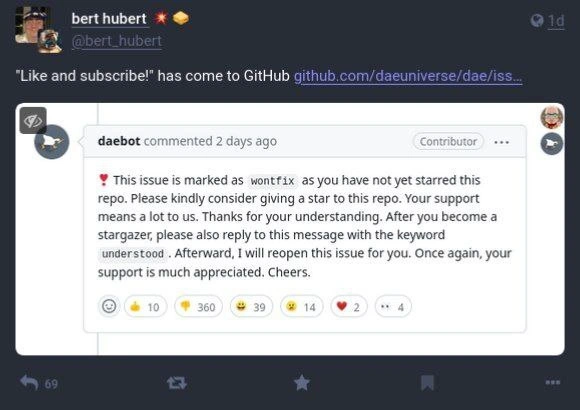
The screenshot shows a social post from bert hubert saying:

"Like and subscribe!" has come to GitHub

Under it is a GitHub issue comment from daebot. The comment says the issue is marked as wontfix because the reporter has not starred the repository, asks them to give the repo a star, then says they should reply with the keyword understood so the issue can be reopened. Reaction badges under the comment make the whole thing look even more like social media engagement bait wearing an issue tracker costume.

The joke is painful because open-source maintenance already sits at the intersection of labor, status, gratitude, entitlement, and burnout. Stars on GitHub are a reputation signal. They help projects look active, credible, fundable, and popular. Maintainers reasonably want appreciation. But gating bug triage behind a star turns community support into a growth funnel. A wontfix label should communicate a technical or project-management decision, not “please complete this engagement ritual before we discuss your bug.”

For experienced developers, the absurdity is in the mismatch between values and mechanics. GitHub issues are supposed to track defects, feature requests, regressions, support questions, and design discussions. They are already noisy. Adding star checks, keyword acknowledgements, and bot-driven reopening rules imports the worst parts of attention-economy platforms into a workflow that was already one comment away from becoming a second inbox. Somewhere a maintainer saw “reduce low-effort issues” and implemented “subscribe to my channel,” which is certainly one way to make everyone hate automation.

There is a real problem underneath the satire. Popular open-source projects get flooded with duplicate issues, vague bug reports, unpaid support demands, and users who do not read templates. Automation can help: issue forms, reproduction requirements, stale labels, contributor guidelines, and triage bots can protect maintainer time. But dark-pattern automation flips the relationship. Instead of asking for information needed to fix the issue, it asks for a metric that benefits the project’s visibility. The bug’s validity has nothing to do with whether the reporter clicked a star.

The post caption asking readers to react and share doubles the joke. It imitates the same engagement hunger the screenshot criticizes. That is why the meme lands: a developer community tool built for collaboration starts sounding like a creator platform, and the line between “please provide a minimal reproduction” and “smash that star button” suddenly looks thinner than anyone wanted.

Description

A dark-mode social media screenshot shows bert hubert posting: "'Like and subscribe!' has come to GitHub" followed by a truncated GitHub link. The embedded GitHub issue comment from `daebot` says the issue is marked as `wontfix` because the reporter has not starred the repo, asks them to star it, then reply with the keyword `understood` so the issue can be reopened, ending with "Cheers." Reaction badges are visible under the comment, reinforcing the social-media feel. The joke is that open-source issue triage is being treated like engagement gating: support is withheld until the user boosts repository metrics.

Comments

4
Anonymous ★ Top Pick Star-gating bug reports is growth hacking with a triage label.
  1. Anonymous ★ Top Pick

    Star-gating bug reports is growth hacking with a triage label.

  2. @callofvoid0 2y

    clowns

  3. @chekoopa 2y

    https://github.com/daeuniverse/dae/issues/374 Уже убрали, а то ведь правда нарушение ToS.

  4. @qwnick 2y

    nice

Use J and K for navigation