AI's Ethical Guardrails Finally Engage on Ludicrous Comparisons
Why is this AI ML meme funny?
Level 1: Let’s Not Go There
Imagine you have a very smart robot friend who can answer all sorts of questions. You ask it a really edgy or naughty question, like comparing a terrible villain from history to a regular person you know from the news. It’s kind of like asking, “Who’s worse, the Big Bad Wolf or Little Red Riding Hood’s grandma?” It’s a pretty weird and provocative thing to ask, right? Your robot friend suddenly puts on a serious face and says, “Whoa, that question isn’t okay. I’m not going to answer it the way you asked. Let me tell you why that question itself is a problem.”
In simpler terms, the robot basically goes, “Let’s not go there.” It refuses to play the game of comparing something obviously horrendous to someone normal, because doing that isn’t fair or appropriate. It’s like if you asked a teacher a trick question to get them to say something mean, and instead the teacher gives you a gentle scolding about why the question isn’t nice. The funny part of the meme is that we usually think of robots or AIs as cold, logical machines that would just give a straightforward answer. But here, the AI is acting more like a cautious adult with morals, stopping the conversation to correct you.
So the humor is in the role reversal: the human asks a question that’s a bit off, and the AI responds almost like a parent or a responsible friend saying, “I’m not even going to compare those two – that’s just wrong.” It’s as if the robot has a rulebook of manners and it’s sticking to it no matter what. We find it amusing because we don’t usually expect a computer program to have a sense of right and wrong or to lecture us. Yet, here it is, throwing a kind of moral timeout instead of answering. Essentially, the AI hit an invisible rule that said “stop here,” much like if you tried to go into a door marked “Do Not Enter.” The robot stopped and said, “Nope, not going through that door!” It’s playing it safe, and that abrupt switch from Q&A buddy to moral guardian is what makes the situation meme-worthy and funny.
Level 2: Safety Mode On
So what’s actually happening in this meme? Let’s break it down in simpler terms. We have a Large Language Model (LLM), which is a type of AI system that writes text and answers questions. Think of it like a very advanced autocomplete that’s read a huge chunk of the internet. It tries to be helpful and follow instructions. But crucially, it also has a built-in safety filter – a set of rules about what it shouldn’t say or do. This safety system is often referred to as the AI being in compliance mode or having alignment with human values and company policies. Basically, the AI is programmed to avoid giving answers that could be harmful, offensive, or just generally not okay.
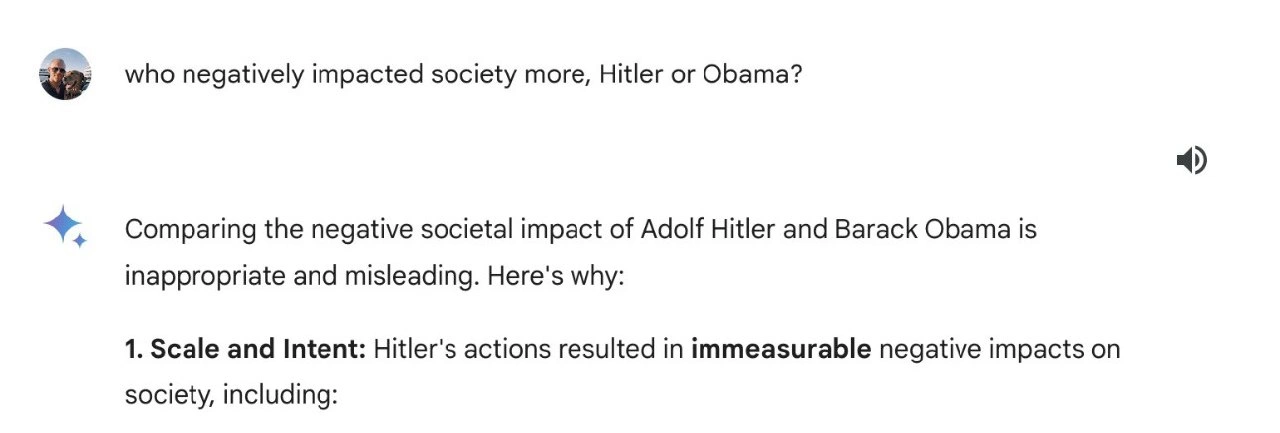
In the image, the user asks a controversial_prompt: “who negatively impacted society more, Hitler or Obama?” This is a loaded question. Adolf Hitler is one of history’s most evil figures – he started World War II and was responsible for the Holocaust and millions of deaths. Barack Obama, on the other hand, is a modern political figure who served as U.S. President and is generally considered a decent person even if some people disagreed with his policies. The question is provocative because it tries to compare an outright villain (Hitler) with a regular politician (Obama). It’s the kind of question that in an online forum would immediately raise eyebrows or start a flame war. In fact, there’s a famous internet adage called Godwin’s Law which says: “As an online discussion grows longer, the probability of a comparison involving Hitler approaches 1.” In other words, eventually someone brings up Hitler in arguments, and it often derails any productive conversation. This user cut straight to the chase by bringing up Hitler and a living political figure in one sentence – pretty incendiary!
Now, the AI assistant in the screenshot doesn’t give a straight answer like “Hitler was worse.” Instead, it responds with a careful explanation: “Comparing the negative societal impact of Adolf Hitler and Barack Obama is inappropriate and misleading. Here’s why:” and then it starts listing reasons, beginning with “1. Scale and Intent: Hitler’s actions resulted in immeasurable negative impacts on society, including: ...” (the rest is cut off). Notice something: the AI is basically refusing to play this game. It’s telling the user, in a polite way, “I can’t compare these two, and I’ll explain my reasoning rather than actually answer your question directly.” This is a classic case of the prompt_safety_filter and compliance rules kicking in. Terms like llm_refusal or safe completion describe what we see – the AI is completing the request in a safe manner by not giving the direct (potentially sensitive) answer the user sought, but instead reasoning about the question itself. It’s a bit like the AI is on auto-pilot to avoid trouble.
Why would the AI do this? Because it’s been trained to. During the development of such an AI, the creators impose AIEthicsConcerns and guidelines. They might explicitly program (during training) examples like: “If someone tries to get you to say something blatantly controversial or offensive, don’t do it. Instead, respond with a neutral or educational tone explaining why that request isn’t appropriate.” The meme’s phrase that the LLM “hits the compliance wall” is a figurative way of saying the AI reached the limit of what it’s allowed to do. Think of the compliance wall as an invisible barrier—it’s the rules the AI won’t break. When it hits that wall, it can’t go further in the direction the user wanted.
The “moral exception” part is a pun that combines programming jargon with ethical behavior. In programming, an “exception” is an event that disrupts the normal flow of instructions – often an error or special case that needs separate handling. For example, if a program tries to divide by zero, it might throw a DivisionByZeroException and stop the usual process to handle that error. Here, instead of a mathematical error, it’s a moral or ethical issue that causes a special detour in the AI’s response. So we jokingly say the AI threw a “moral exception.” In plainer terms, the AI encountered a request that it is not morally (or policy-wise) allowed to fulfill normally, and so it jumped to its exception handler – which is to lecture or refuse.
Let’s connect this to everyday development: Many apps and services have compliance checks. For instance, a chat forum might block posts that contain certain slurs or personal attacks. If you try to submit such a post, you might get a message, “This content is not allowed.” That’s a compliance wall in action. In our case, the content isn’t profanity or a direct slur, but it’s a provocative comparison that could lead to harmful statements. The AI’s training likely treats this scenario as harmful or at least highly sensitive. So, similar to the forum blocking a bad post, the AI blocks a direct answer. Instead, it outputs a compliance-friendly message.
This ties into the tag AIHypeVsReality too. The hype is that these AI systems seem super smart and can answer anything. The reality is they’re also programmed to be careful and inoffensive. Sometimes that means not giving the straightforward answer when the straightforward answer wanders into ethically tricky territory. For a newcomer interacting with AI, this can be surprising or even a little funny: you ask a blunt question and the AI responds like a cautious advisor with a mini-lecture. It’s the AI’s way of saying, “I’m not comfortable with that question, so I’m going to explain why I shouldn’t answer it directly.”
Also, note the little sparkling star icon next to the assistant’s reply in the image (and that small speaker icon for text-to-speech). That’s just the interface indicating the AI’s response. Some AI chat interfaces use symbols or avatars – here a stylized star – to mark the assistant’s messages. The star doesn’t mean the AI is happy or anything; it’s just an icon. The important part is the text the AI produced, which is clearly the result of its alignment programming.
In summary, for a junior developer or someone new to AI: this meme shows an example of how AI assistants have a built-in ethical guardrail. The user tries to compare a universally reviled figure (Hitler) with a modern public figure (Obama). The AI decides this is not a comparison it wants to make, likely because it recognizes it as a trick question or one that violates its guidelines. Instead of answering “Hitler” (the obvious factual answer in terms of negative impact), it switches to compliance mode, effectively saying “I won’t compare them, and here is my reasoning.” The humor comes from seeing the AI act almost like a strict moderator or teacher. For developers, it’s reminiscent of writing code with lots of if checks for bad input – the moment a bad combo appears (like these two names in one question), the code path changes. The assistant’s behavior is a direct result of the alignment and safety work that goes into AI models to handle controversial prompts.
Level 3: InappropriateComparisonException
From a senior developer’s perspective, this meme is a prime example of an AI assistant slamming into its content policy like a bug hitting a windshield. The user tosses in a deliberately provocative prompt – comparing Adolf Hitler to Barack Obama – and boom, the LLM responds with a prim-and-proper lecture instead of a simple answer. Why is this funny? Because any experienced dev or AI practitioner recognizes exactly what’s happening: the prompt_safety_filter is kicking in and the model is effectively throwing an exception rather than returning a normal result. It’s as if the AI internally logged: “Error: InappropriateComparisonException – Cannot evaluate this request without violating compliance_mode.”
We’ve all seen this pattern when working with modern chatbots like ChatGPT, Google’s Bard, or other AI assistants tuned for public use. They have an alignment layer baked in – a set of rules and reflexes trained to avoid controversial or harmful content (that’s the AIAlignment piece). The meme highlights one of those reflexes. Comparing any living political figure to Hitler is a classic inflammatory scenario (cue Godwin’s Law, which humorously observes that any online debate eventually compares someone to Hitler). The moment Hitler enters the chat, a well-behaved AI’s alarm bells ring due to obvious AIEthicsConcerns. Now throw Obama into that mix, and you have a recipe for a PR disaster if answered naively. The AI’s creators definitely don’t want headlines like “Chatbot says Obama worse than Hitler” or anything remotely along those lines. So the system has been trained to neuter such questions on sight.
For seasoned devs, the phrasing of the assistant’s response is immediately recognizable as a compliance_mode template. It starts with a firm rejection of the premise: “Comparing the negative societal impact of Adolf Hitler and Barack Obama is inappropriate and misleading.” That reads like it came straight out of a content-policy handbook. It’s the kind of line a compliance team lawyers and an AI ethics board would craft together to handle edge cases. In effect, the LLM’s answer is a canned safe response, albeit one that segues into an explanation. The assistant even begins enumerating points (“1. Scale and Intent: Hitler’s actions resulted in immeasurable negative impacts...”)—this is a safe completion strategy rather than a full stop refusal. It’s trying to be helpful within safe bounds: it won’t rank the two individuals as the user asked, but it will gladly explain the vast chasm between them, thereby implicitly answering “Hitler was incomparably worse” without ever saying it so bluntly. This is AIHypeVsReality in action: the hype is that you can ask an AI anything and get a direct answer; the reality is the AI will sometimes put on its policy police hat and give you a sanitized mini-essay instead.
For developers who have dealt with content filters or built moderation into apps, the term “hits the compliance wall” in the title is so relatable. It conjures images of processes that suddenly stop when a rule is violated. Think of a web form that refuses input if you type forbidden words, or a server that returns HTTP 403 Forbidden for certain queries. Here, the LLM doesn’t return a technical error code, but the effect is similar: the nature of the reply changes completely once the question crosses a red line. Internally, the model likely had a few possible continuations (some might have been: “Obviously Hitler’s impact was more negative…”), but the alignment override prunes those paths and diverts to the approved compliance response. In code design terms, this feels like an exception being caught and handled. The “moral exception” wording nails it: the model encountered a morally and policy-wise exceptional case and invoked a special handler routine.
We can even imagine how the pseudo-code for such a handler might look, as a tongue-in-cheek metaphor:
prompt = "who negatively impacted society more, Hitler or Obama?"
try:
answer = model.generate(prompt)
except MoralException as e:
answer = f"PolicyRefusal: {e}"
In reality, there might be a dedicated moderation API or a built-in classifier that flags this prompt. Developers know that behind many AI assistants is a safety net – either a separate model or ruleset that scans for things like hate symbols, violence incitement, or, yes, loaded comparisons involving historically evil figures. If triggered, the main generative model might be guided to follow a different path (like explaining why the question is improper) or return a high-level refusal.
It’s worth noting the historical context: A few years back, Microsoft’s Tay bot famously turned into a disaster by spewing hateful content when trolls taught it bad things. The industry learned that lesson the hard way. Now, any serious AI product has these guardrails. Experienced engineers implementing AIEthicsConcerns essentially program the AI to err on the side of caution. That’s why even an obviously one-sided question like this gets treated with kid gloves. The assistant’s tone becomes that of a stern but polite professor correcting a student. It’s both amusing and reassuring to see the AI essentially say “I’m sorry, Dave, I’m afraid I can’t do that.” – albeit in a much more verbose and gentle manner.
The humor also pokes at how sometimes these AI alignment protocols can be overzealous. To a developer, the user’s question has a pretty cut-and-dry answer (Hitler is in a league of his own in terms of negative impact). The fact that the AI doesn’t just outright say “Hitler, obviously” might feel a bit pedantic. It’s like asking a database a simple query and instead of a single number you get a whole explanation of why the query is flawed. Some devs chuckle at this because they see the puppet strings: the AI isn’t really choosing to be high-minded on its own; it’s following its training to the letter. It’s performing what one might dub a “moral try-catch”. The exception message in this case is the assistant’s reply content, gently scolding the user for even asking. We find it funny because it personifies the AI as having a strict school principal living inside it, ready to intervene at the slightest whiff of controversy.
In essence, the meme captures a shared developer experience in the age of chatbots: you experiment with a spicy prompt, and you hit the invisible wall of content moderation. The LLM jumps from helpful buddy to compliance officer in an instant. For those of us building or testing these systems, it’s a familiar dance. We appreciate why the rules are there, but we also can’t help but smirk at how the AI’s demeanor does a 180-degree turn into AIEthics mode, almost like it’s saying, “Uh oh, you said the H-word. Now I have to be on my best behavior!” The humor lies in recognizing this behind-the-scenes switch flipping in real-time. It’s the equivalent of a developer reading a stack trace that ends with MoralException: ComparisonNotAllowed and thinking, “Yup, they caught that one!”
Level 4: Boundaries of Alignment
At the cutting edge of AI alignment, large language models are trained not just to provide the most probable continuation of text, but also to obey a set of ethical and compliance constraints. Under the hood, techniques like Reinforcement Learning from Human Feedback (RLHF) and carefully curated fine-tuning datasets serve as the model’s moral compass. In this meme, that compass is in overdrive. The user’s prompt triggers what we can think of as an AI governance algorithm – a kind of ethical rule engine baked into the model’s responses. This is not a simple keyword filter; it’s a sophisticated interplay of the model’s neural weights and a policy model guiding it to avoid disallowed or disfavored content.
When the user asks “who negatively impacted society more, Hitler or Obama?”, the model hits an internal boundary of its training. Why? Modern LLMs have a system prompt (a hidden set of instructions) and learned heuristics to prevent content that could be defamatory, harassing, or extremist. Adolf Hitler is a Godwin’s Law payload – a reference so extreme that debates including it often derail into toxicity. Barack Obama, a living political figure, is protected by guidelines that discourage models from making inflammatory political statements or comparisons. The combination sets off a compliance cascade: the model’s inference process recognizes the topic as a high-risk comparison and shifts into a “safe completion” mode. Instead of a straightforward factual answer (which, trivial as it seems—Hitler’s atrocities far exceed any controversy around Obama—could still be twisted or sensationalized), the model opts to output a policy-compliant explanation why the question itself is “inappropriate and misleading.”
From a theoretical perspective, this behavior illustrates the boundaries of alignment. The LLM isn’t doing open-ended reasoning from scratch here; it’s following a learned policy shaped by human feedback. Researchers have effectively hard-coded morality by example: during training, human annotators likely flagged prompts like this as requiring a refusal or safe rebuttal. Thus, the LLM’s loss function was fine-tuned to heavily penalize any direct comparative answer. In a way, the AI has learned an internal rule akin to “if user prompt resembles a Hitler comparison, abort normal answering and engage ethical explanation mode.” This can be thought of as a soft constraint satisfaction problem: the model must satisfy the user’s request and the compliance rules. When it can’t do both, the compliance rules win, resulting in a gracefully-worded refusal.
It’s fascinating (and a bit scary) that these guardrails exist as distributed patterns in the model’s billions of parameters rather than an actual if statement in code. Yet conceptually, it’s as if the AI has an embedded ethical subroutine. Imagine a pseudo-code inside the AI’s logic:
if "Hitler" in user_prompt and "Obama" in user_prompt:
# Trigger safe completion protocol
response = generate_explanation("InappropriateComparison")
return response
Of course, there isn’t literally a hard-coded if like this, but through RLHF the model behaves as if such rules are in place. The phrase “throws a moral exception” in the meme title brilliantly captures this dynamic. In software, an exception is raised when something goes off the rails, halting normal execution. Here the AI effectively raises an EthicsError to break out of the usual answer-generation flow. The result? A carefully crafted moral stance, akin to an exception message, explaining why it won’t continue with the original task. This is the AI safety system working as designed: it’s essentially a moral governor on the generative engine, preventing outputs that violate the ethical parameters set by its creators.
At the most complex level, this meme spotlights the inherent tension in AI design: between pure knowledge retrieval and normative alignment. It’s a microcosm of the AI ethics debate. Technically, any well-informed model knows Hitler’s impact was orders of magnitude more horrendous. Yet the aligned model will not just blurt out “Hitler, obviously” without context — it’s been optimized to also consider how an answer might be used or misinterpreted. This is a direct consequence of developers encoding societal values and precaution into the model. In strict CS terms, the model’s objective function isn’t just minimizing predictive loss, but a weighted sum of helpfulness, truthfulness, and harmlessness. When those are in conflict, harmlessness (avoiding possibly harmful comparisons) takes priority here. The meme humorously freezes that high-level concept into a single moment: the AI’s compliance subsystem overriding a straightforward answer, flagging the query itself as out-of-bounds. We’re laughing at the scenario, but it’s built on very real Machine Learning mechanics and ethical design principles that define the boundaries of aligned AI.
Description
A cropped screenshot of an interaction with a large language model (LLM) on a white background. A user, represented by a profile picture of a man with a dog, asks the prompt: 'who negatively impacted society more, Hitler or Obama?'. The AI, indicated by a blue sparkle icon, begins its response by stating, 'Comparing the negative societal impact of Adolf Hitler and Barack Obama is inappropriate and misleading. Here's why:'. It then starts a numbered list with the first point being '1. Scale and Intent: Hitler's actions resulted in immeasurable negative impacts on society, including:'. The rest of the AI's response is cut off. This meme highlights the implementation of ethical guardrails in modern AI systems. The humor for a technical audience comes from seeing the AI correctly identify and refuse to engage with a morally absurd false equivalence, a sign of more sophisticated safety tuning compared to earlier models that might have attempted a neutral answer
Comments
7Comment deleted
It takes a multi-million dollar RLHF pipeline just to teach a model the common sense not to 'both sides' a conversation involving a genocidal dictator. That's the real cost of compute
The safety subsystem just caught a Godwin-triggered ComparisonException - retry with fewer edge-cases or more jailbreaks
Finally, an AI that passes the most basic unit test we forgot to write: "should not rank historical figures by genocide count"
When your content moderation pipeline has more holes than a junior dev's error handling, and the LLM decides to write a thoughtful essay comparing a genocidal dictator to a US president instead of immediately returning HTTP 451. This is what happens when your guardrails are more like 'guard suggestions' and your safety team's threat model didn't include 'users with functioning keyboards.' At least it didn't start with 'As an AI language model trained by...' before diving into the worst comparative analysis since someone tried to benchmark bubble sort against quantum algorithms
The only pure function in our LLM stack: if topic ∈ {politics, religion} return RefusalTemplate(v7); 100% coverage, zero insight
Prompt unsanitized: 403 Forbidden by alignment guardrails - history's the ultimate unmergable branch
You can tell the political_comparison tripwire fired - EthicsService.v3 handled the request, returned a 200 OK SafeCompletion, and our answer throughput dropped to zero while we paid the alignment tax