Skip to content
DevMeme
721 of 7435
AI Researchers Tackling P vs. NP with Confidence
AI ML Post #819, on Nov 14, 2019 in TG

AI Researchers Tackling P vs. NP with Confidence

Why is this AI ML meme funny?

Level 1: No Magic Wand

Imagine you have a giant puzzle or a huge locked safe with thousands of possible keys. Normally, finding the right key would take forever because you’d have to try them one by one. Now picture someone walking up and claiming, “Don’t worry, I have a special trick that opens it instantly!” – and they say it with a big confident smile. It sounds amazing but also a bit like magic. People who know how tough the puzzle really is will giggle or raise an eyebrow, because it seems too good to be true. This meme is funny for the same reason: it’s joking that some researchers talk like they have a magic wand to solve an impossible problem instantly. We all kind of know that real life isn’t that simple, so it’s poking fun at the idea of an easy fix for a very hard problem. It’s like hearing someone promise to do a week’s worth of homework in 5 minutes – you’d laugh because you know they’re probably dreaming!

Level 2: Big O vs Big Promises

Let’s break down the joke in simpler terms. The meme is contrasting really hard problems with people promising an easy solution. In computer science, we talk about problem difficulty using Big O notation – a way to classify how an algorithm’s running time grows as the input gets bigger. A polynomial-time algorithm is considered efficient: for example, an algorithm might take $n^2$ steps or $n^3$ steps for input size $n$. Those are manageable because if you double n, the work maybe quadruples or cubes – which modern computers can handle for reasonably large n. In contrast, non-polynomial typically means exponential time (or worse). An exponential algorithm might take $2^n$ steps or even $n!$ (factorial) steps. If you double n for those, the work explodes astronomically (literally doubling every time you add one more item, in the case of $2^n$).

NP-hard problems are the ones that seem to require those astronomically growing amounts of work as they scale. A classic example is the Traveling Salesman Problem (TSP): “Given a list of cities and distances between them, find the shortest possible route that visits each city once and returns to the start.” A brute-force solution would have to try every possible route to find the shortest one. The number of possible routes grows factorially with the number of cities. To see how crazy that gets:

Number of Cities (n) Possible Routes (roughly n!)
5 cities 120 possible routes
10 cities 3,628,800 (over 3 million routes)
15 cities ~1.3 trillion routes
20 cities ~2.4 quintillion routes (2.4 × 10^18)

You can imagine how quickly it blows up. Even a supercomputer can’t brute-force 20 cities in a reasonable time. TSP is NP-hard (in fact NP-Complete), meaning nobody knows a fast (polynomial) way to always solve it optimally as n grows. We only have slow brute force or clever shortcuts that work in special cases.

Now, enter the AI researchers in the meme. In recent years, folks in AI/ML have tried to tackle these kinds of problems using things like neural networks. For example, someone might train a neural network to take a bunch of cities and guess a pretty good route, without checking every single possibility. This is what we call a heuristic: it doesn’t guarantee the absolutely best answer, but it’s a practical method that often finds a good-enough solution faster. There are neural net approaches for TSP, job scheduling, Sudoku solving, you name it. They often do a decent job on typical cases, making the problem seem easier than it is.

But here’s the catch: a heuristic or machine learning approach might work most of the time or on average cases, yet we still believe that in the worst case these NP-hard problems can’t be solved quickly (unless a huge theoretical breakthrough happens). In other words, the neural network might solve many easy or medium instances in what looks like polynomial time, but there will always be some tricky instance that makes it stall or take exponentially long. The fundamental challenge hasn’t disappeared; we’ve just side-stepped it for a subset of cases.

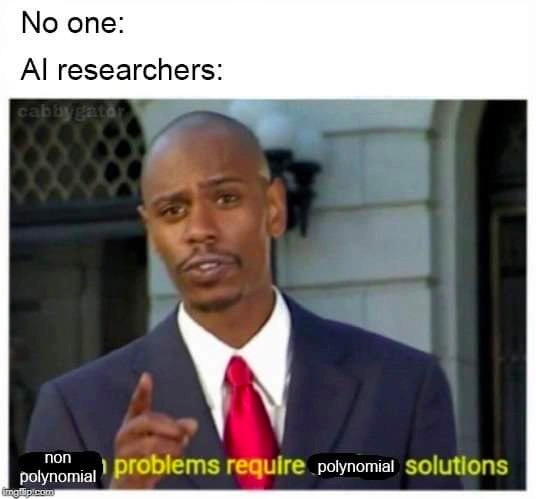
The meme’s caption “non polynomial problems require polynomial solutions” is basically saying: these really hard problems (that seem to need non-polynomial time) can only be truly fixed by finding a polynomial-time algorithm. That’s like saying, “to solve the unsolvable, you need a miracle method.” The joke is that some AI researchers speak as if they’ve found that miracle. It’s a play on big promises vs. the reality of algorithm complexity.

Think of it this way: If someone comes along and says, “I have an AI that solves this super hard puzzle in a blink,” they’re making a big promise. Given what we know from CS fundamentals and decades of Algorithm Complexity Analysis, our reaction is, “Really? Did you just casually do what thousands of experts say is extremely hard?” It’s not that machine learning isn’t useful – it often is! – but solving an NP-hard problem generally needs either an approximate answer, a lot of constraints (rules that make the problem easier), or a heck of a lot of computing power.

So, when the meme shows “AI researchers:” confidently declaring “polynomial solutions” for “non polynomial problems,” it’s highlighting that overconfidence. It’s friendly ribbing of the AI field’s habit to sometimes hand-wave away the hard theoretical limits by saying “we have a solution that works (trust us).” The truth is, unless they’ve proven something akin to P = NP (which would be front-page news!), there’s probably some fine print.

In summary, at this level we can say: NP-hard problems are those nasty puzzles that blow up in complexity as they grow – like our city tour example. Polynomial-time solutions are the ideal golden ticket: the algorithm that solves the puzzle without blowing up. The meme jokes that AI folks claim to have that golden ticket for every tough problem, and that’s why developers who know about Computational Complexity Theory find it funny. It’s mixing a bit of AI humor (“neural networks can do anything!”) with a lesson from CS fundamentals (“some problems are inherently hard, no matter what tools you use”). Big O vs big promises, indeed.

Level 3: Heuristic Handwaving

From a seasoned developer’s perspective, this meme nails the absurdity of certain AI-driven claims. The setup “No one: [crickets] / AI researchers:” immediately tells us some bold proclamation is coming out of the blue. That format jokes that literally nobody asked for this, yet here come the AI researchers offering a miraculous solution anyway. It’s poking fun at a tendency towards AI overconfidence – the habit of some enthusiasts to declare, unprompted, that their AI can solve everything (even a P vs NP level problem). The image of Dave Chappelle in a suit (from the popular “modern solutions” meme) adds to the humor. He’s pointing his finger confidently as if delivering sage advice, but the caption has been slyly edited to: “non polynomial problems require polynomial solutions.” Those extra little “non” and “polynomial” labels pasted over the original text give it a tongue-in-cheek, DIY vibe – as if the meme itself is a quick hack, mirroring the idea of a quick hack solution for a hard problem.

Why is this so funny to an experienced engineer? Because it’s a truth we’ve all learned the hard way: NP-hard problems don’t just yield to optimism or new frameworks. The meme satirizes a common scenario: a research paper or startup claims they can crack some famously hard problem (say, optimizing schedules, routing vehicles, or bin packing) by sprinkling in a little machine learning magic. On paper, it sounds like finally technology has vanquished the old foe of exponential complexity. But the seasoned folks know to be skeptical. We’ve sat through conference talks or tech pitches where someone basically does a lot of heuristic handwaving – presenting a machine learning approach that “basically solves it” while quietly glossing over what happens in the worst case. It’s like an infomercial promising a cure-all gadget: the demo looks amazing, but you just know there’s a catch they’re not mentioning.

The phrase “non polynomial problems require polynomial solutions” delivered with a straight face is hilarious because it’s essentially saying “We solved it because we needed to solve it.” It’s a tautology masquerading as insight. For a senior developer or computer scientist, it immediately triggers the thought: “If only it were that simple!” We know that calling something “non polynomial” is a cheeky way of referring to NP-hard challenges – a euphemism for “good luck solving this efficiently.” Hearing someone insist they have a polynomial solution (and by implication, have skirted the dreaded complexity explosion of Big O notation) sets off alarm bells. It brings to mind all those times people claimed to beat the odds with tech, only to quietly retreat later when the solution didn’t scale.

There’s a bit of gentle mockery of the research community in this meme, too. AI researchers (especially during hype waves) might gloss over real-world complexity constraints. They’ll say things like “we present a novel algorithm that handles X efficiently in practice” – burying the fine print that it’s not a guaranteed general solution, just tested on some cases. In developer terms, this is like slapping “AI-powered” on a project proposal to make it sound cutting-edge, hoping no one questions the gritty details. The meme’s punchline slyly implies that some researchers think just declaring something solved can make it so. It’s a nod to “heuristic handwaving”: providing an answer that sounds definitive – a polynomial-time miracle – without the rigorous proof to back it up, hoping the audience just goes along with it.

Most senior engineers have lived through the aftermath of such claims. Perhaps your company tried an “AI optimizer” that was supposed to automagically solve your scheduling or routing issues (classic NP-hard problems in disguise). The initial demo on small examples looked great, but when you fed it real-world scale data, it struggled or ground to a halt. The bold promise turned into yet another piece of tech debt or a quietly abandoned project. There’s a shared chuckle (and maybe a groan) in remembering those incidents. That’s why the meme resonates: it’s both poking fun and commiserating. It says, “We’ve seen people promise the impossible before, and we remember how that turned out.” It also validates the folks who know their CS fundamentals – those who often have to be the voice of reason reminding everyone about algorithm complexity and why some problems are just plain hard.

Using the Dave Chappelle “modern solutions” template is the cherry on top. In the original sketch, “modern problems require modern solutions” is a joking way to suggest a clever (if cheeky) fix. Here, replacing it with “non polynomial problems require polynomial solutions” parodies that clever-fix format by offering a solution that is basically “step 1: do the impossible.” It’s a caricature of an overly optimistic researcher brimming with unjustified confidence. For those of us in the trenches, it rings true: we’ve all heard the equivalent of “don’t worry, our AI will figure it out” about a problem we know is fiendishly hard. We’ve learned that when something sounds too good to be true in tech (especially when it involves magically sidestepping an NP-hard issue), it usually is. This meme captures that lesson in one perfect, absurd sentence – delivered with a confident grin and a raised finger – and all the experienced folks can’t help but laugh (and maybe double-check that last AI “breakthrough” paper with a skeptical eye).

Level 4: Algorithmic Alchemy

"non polynomial problems require polynomial solutions"

In the realm of computational complexity theory, few things are as mythical as a polynomial-time algorithm for an NP-hard problem. The meme’s punchline above winks at the granddaddy of theoretical CS questions: P vs NP. This is essentially the quest for a bit of algorithmic alchemy – turning computational lead into gold by solving an exponential-time problem in polynomial time.

To unpack this, recall that P (Polynomial time) is the class of problems solvable efficiently – say in $O(n^k)$ steps for input size $n$. Doubling $n$ might at worst cause only a reasonable growth in work (if $k$ is small) – that's tractable. NP (Nondeterministic Polynomial time) is a class of problems where a given solution can be checked quickly, but it’s unknown if we can always find that solution quickly. The notorious NP-hard category includes problems at least as hard as anything in NP (including the NP-Complete problems that sit at NP’s core). If you could crack one NP-complete problem in polynomial time, you’d crack them all – essentially proving P = NP. That would be a seismic event in computer science, on par with discovering a new fundamental law of nature. It’s not just academic: modern cryptography relies on certain problems (like factoring large numbers or the subset-sum problem) being effectively unsolvable in polynomial time. Solve one of those magically fast and you’ve essentially broken the internet’s security.

So when the meme portrays an AI researcher confidently declaring a polynomial solution for a “non polynomial” problem, it’s parodying a claim tantamount to announcing “I solved P vs NP, no biggie.” The humor comes from the sheer audacity. Making an NP-hard problem run in polynomial time is like claiming a perpetual motion machine in physics — it flies in the face of what almost every expert suspects (even if it’s not outright proven impossible). In fact, P ≠ NP is widely believed; it’s one of the Clay Millennium Prize problems with a million-dollar bounty for a proof either way.

The phrasing “non polynomial problems require polynomial solutions” is a play on comedian Dave Chappelle’s famous meme line “modern problems require modern solutions.” In our context, it highlights a kind of overconfident simplification: “Got an intractable problem? Just solve it tractably!” It’s a tautology wrapped as if it were insight. (It also cheekily interprets “NP” as “non polynomial” for the sake of the joke, whereas in reality NP stands for nondeterministic polynomial, not literally “non-polynomial.” The meme takes creative liberty to hammer the point home.)

Behind the humor lies a real trend in AI. Researchers often use neural networks or other learning-based tools to tackle NP-hard combinatorial optimization problems (like graph coloring, the Travelling Salesman Problem, or boolean satisfiability (SAT)). These machine learning approaches can be ingenious: they train on example solutions or patterns, and at runtime they quickly produce pretty good answers or guide a search algorithm. However, from a theory standpoint, these are usually heuristics – smart strategies that work most of the time, but don’t guarantee a solution in the worst-case. They might beat brute force on many instances, but they don’t magically shrink the astronomical time complexity lurking in the general case. For example, a neural net might quickly provide near-optimal routes for many traveling salesman instances, but there’s always some pathological map of cities that will tie it in knots.

The gap between heuristic success and a true algorithmic breakthrough is huge. A polynomial algorithm means guaranteed efficiency for any input, scaling reasonably even as n grows large. An exponential algorithm means somewhere out there is an input size that will blow up the runtime combinatorially (like every additional input element might double the work, then double again – quickly spiraling out of control). For perspective: an $O(n^3)$ algorithm would need about $100^3 = 1,000,000$ steps for n = 100 (trivial on modern hardware), whereas an $O(2^n)$ brute-force approach would require on the order of $2^{100} \approx 1.27 \times 10^{30}$ steps – an unfathomable number that no computer could ever complete. That is the chasm: polynomial vs exponential, tractable vs intractable. NP-hard problems live on the wrong side of that divide, and no amount of clever coding has moved them en masse to the easy side.

This is why seasoned engineers and theorists chuckle at grandiose claims. Over decades, we’ve seen attempts to “cheat” that exponential explosion with new ideas – from genetic algorithms and simulated annealing, to specialized hardware, to the current darling: deep learning. These approaches often do amazingly well on specific cases or average scenarios, but they are not general silver bullets. There’s an adage in optimization: “No free lunch.” If an algorithm performs exceptionally on one class of inputs, some other inputs will stump it. Many AI-driven methods shift the hard work around or make assumptions about the input distribution rather than truly vanquishing NP-hardness.

In summary, the meme operates on this rich backdrop of theory. It highlights the almost comical optimism (or hubris) of implying a polynomial-time algorithm for an NP-hard problem without extraordinary evidence. Anyone familiar with the P vs NP saga knows how extraordinary such a claim would be – if it were real, it wouldn’t be casually dropped as a one-liner, it’d be world news. The meme invites those in the know to laugh because we’ve all seen papers or talks that promise to sprinkle some neural network magic and solve everything, quietly sidestepping the question, “But isn’t that problem NP-hard?” It’s algorithmic alchemy in a nutshell – a fun idea to imagine, but we’re highly skeptical of anyone claiming to have actually found the philosopher’s stone for those NP-hard nightmares.

Description

This meme uses the 'Modern Problems Require Modern Solutions' format featuring comedian Dave Chappelle. The top text says, 'No one:', followed by 'AI researchers:'. The image shows Dave Chappelle in a suit, pointing forward with a determined look. The original caption, 'Modern problems require modern solutions,' has been edited. The first 'Modern' is replaced with 'non polynomial', and the second 'modern' is replaced with 'polynomial'. The resulting phrase is 'non polynomial problems require polynomial solutions.' This is a highly technical joke about computational complexity theory, a core concept in computer science. It humorously suggests that AI researchers are attempting the impossible: solving problems that are believed to be inherently inefficient to solve (non-polynomial time, or NP-hard) with efficient algorithms (polynomial time). This pokes fun at the immense ambition and sometimes brute-force nature of the AI field, which often uses heuristics and massive compute to tackle problems that are theoretically intractable
Comments

7
Anonymous ★ Top Pick The fastest algorithm to solve an NP-hard problem is to assign it to a PhD student and tell them it's solvable
  1. Anonymous ★ Top Pick

    The fastest algorithm to solve an NP-hard problem is to assign it to a PhD student and tell them it's solvable

  2. Anonymous

    Deep down we all know the real breakthrough is just relabeling O(2ⁿ) as “unsupervised polynomial generalization.”

  3. Anonymous

    "We've trained a 175B parameter model to approximate the traveling salesman problem with 98% accuracy, which is impressive until you realize a greedy algorithm with 10 lines of code gets you 95% accuracy in microseconds instead of minutes."

  4. Anonymous

    This perfectly captures the eternal optimism of ML researchers who think throwing enough gradient descent at an NP-complete problem will somehow collapse the polynomial hierarchy. Spoiler: your neural network approximation still won't solve TSP optimally, no matter how many layers you add or how creatively you frame it as 'learning to optimize.'

  5. Anonymous

    Take an NP-hard objective, swap in a differentiable surrogate, then claim “polynomial-time” - amortized over a GPU cluster and three grad students

  6. Anonymous

    P=P confirmed - AI's boldest theorem since 'sort is O(n log n)'

  7. Anonymous

    Every time someone claims a ‘polynomial-time’ fix for an NP-hard problem, the constant is a datacenter and the exponent is your budget

Use J and K for navigation