AI's Existential Threat: The 'Bad Banana' Apocalypse
Why is this AI ML meme funny?
Level 1: Sure but Wrong
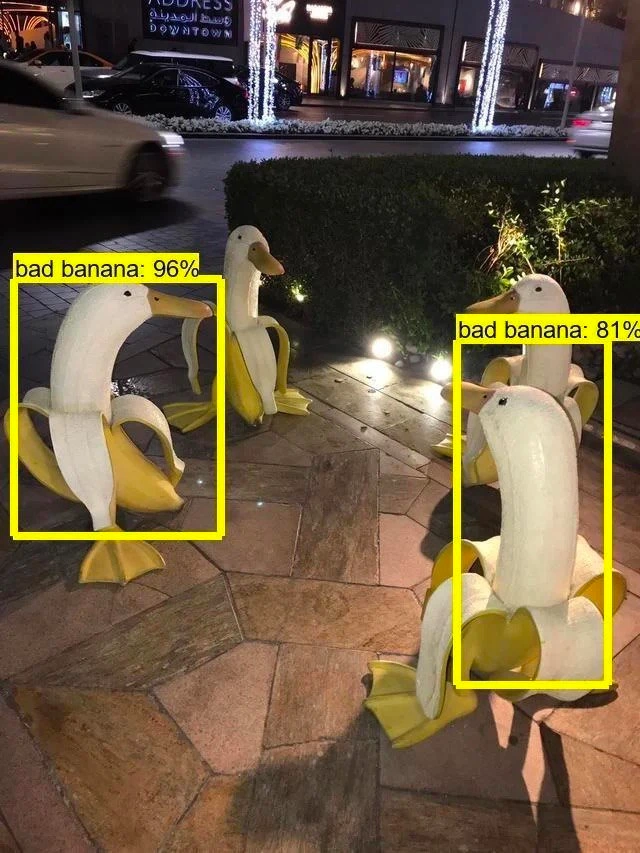
Imagine a little kid who just learned what a banana is. You show them a funny toy that’s shaped kind of like a banana but has a duck’s head and little duck feet. The kid gets excited and shouts, “Banana!” with total confidence. 😃 But of course, it isn’t a banana at all – it just looks a bit like one. The kid is completely sure, yet completely wrong, and it makes everyone laugh because it’s such a goofy mistake. In this meme, the AI is like that kid. The computer sees a statue of a duck that’s painted yellow and shaped like a peeled banana, and it very seriously says “bad banana” with 96% confidence – like it’s absolutely positive about it. We find it funny because the AI has no idea how off-base it is. It’s as if a robot proudly pointed at a cat and called it a dog because it only learned about dogs – you’d chuckle because the poor thing just doesn’t get it. The big joke here is that some people talk about AI as if it's a genius that will outsmart us all, but in reality, it can make silly mistakes just like a toddler would. Seeing an AI call a duck statue a banana is a lighthearted reminder: this "smart" machine still has a lot to learn, so we probably don’t need to fear it destroying the world anytime soon. It’s just trying its best, and sometimes its best is very, very wrong – and pretty funny.
Level 2: Everything Looks Like a Banana
Let’s break down what’s happening in this picture in simpler tech terms. The image shows the output of an object detection system. The bright yellow rectangles drawn around two of the statues are called bounding boxes. They mark where the AI believes it found an object. Each box has a label and a percentage next to it – for example, bad banana: 96%. This means the AI has identified whatever is inside that box as a "bad banana" and it is 96% confident in that guess. In other words, the computer is essentially saying, “I found something here, and I'm almost certain it's a bad banana.”
Now, why is that funny? Because those objects are not bananas at all! They are whimsical statues that look like a cross between a banana peel and a duck – basically banana-duck sculptures. Any human looking at them can tell they’re some kind of duck-inspired art piece (the thing has a duck’s head and little flippers made from banana peels). But the poor AI doesn’t have a concept for “duck statue” or “banana duck.” It only knows the categories it was trained on. If one of those categories was "bad banana" (perhaps meant for a rotten or peeled banana), the AI will try to use it if the object even vaguely fits. The statue is yellow and curved like a banana, but also kind of odd, so the model went, “Hmm, this looks like a banana that’s gone wrong... yep, must be a bad banana!” It completely misses the duck aspect because, likely, it wasn’t trained to recognize ducks in that context. The result is a hilarious misclassification: the AI labels a duck statue as a banana, and not just a banana, a bad banana at that, as if it’s scolding the statue for being a rotten piece of fruit.
From a developer’s perspective, this is a classic case of an AI bug manifesting in a visual way. The program confidently gave the wrong answer. There are a few possible reasons it did that. One big reason is the training data. AI models learn by example: if all the examples of bananas it saw were yellow and curved, it learns to always associate “yellow curved thing” with “banana.” If it never saw something with a banana shape that wasn’t actually a banana, it has no reason to doubt itself here. This is known as dataset bias (the model’s knowledge is only as broad as the data it’s fed). Another reason could be overfitting. Overfitting means the model learned some patterns too specifically. For instance, maybe in the training set, whenever there was a weird-looking yellow object, the label “bad banana” was often given (imagine training images of bananas that had strange deformities or were in odd situations). The model might then over-generalize that pattern: anything yellow+weird = bad banana. So when it sees this yellow duck statue, it follows that over-simplified rule. The AI isn’t really “thinking” or considering multiple possibilities the way we would; it’s just matching patterns to the closest thing in its memory.
It’s important to understand that the AI’s confidence percentage (that 96% number) can be misleading. It sounds like “96% sure” and it is – but only within the confines of what the AI knows. The model was 96% sure according to its training that this was a bad banana. It doesn’t mean there's a 4% chance it's a duck statue; “duck statue” wasn’t even in its decision options! Think of it like a multiple-choice test where the right answer isn’t one of the choices – the student will still pick something, and they might feel very sure about it, but they’re inevitably wrong because the true answer wasn’t available. That’s what happened here. The AI had to choose from its list of learned object types, so it chose the closest thing, full of misplaced confidence.
For someone new to AI, the takeaway is that these systems are quite literal and limited. They excel at the exact tasks they've been trained on, but they lack common sense and have no broader understanding of the world. This image is a funny reminder of those AI limitations. We see the gap between human perception and machine perception: any child could tell you “that’s a duck in a banana peel,” but the fancy AI model couldn’t. Instead, it gave a very serious, numerical assessment that turned out to be silly. This kind of example is popular in MachineLearningHumor circles because it shows that despite all the impressive things AI can do, it can also mess up in ways a human never would. It’s a lesson to developers: always test your models on oddball cases and don’t blindly trust high confidence numbers. And it’s a lesson to everyone else that AI isn’t magical or all-knowing – sometimes, it’s more like a parrot, saying something it was taught to say, at the wrong time. In fact, whenever people worry that “AI is going to take over the world,” engineers often respond with memes like this to gently point out that our AI can’t even reliably tell a duck from a banana!
Level 3: Confidently Wrong
This scenario triggers a knowing laugh from experienced developers because it captures the classic AI/ML gap between hype and reality. We have an object detector proudly drawing bright yellow bounding box overlays around a whimsical banana-duck statue and declaring it a bad banana: 96%. It's a perfect case of computer_vision_gone_wrong. The humor comes from both the absurd visual (a duck disguised as a banana) and the AI's official-looking, overly certain mistake. We expect computers to be logical and precise, yet here the AI is almost childishly mistaken – and it has no clue. Any senior engineer who's debugged machine learning models can relate: models can be ridiculously confident in their errors. It’s the kind of bug you only get with AI. No one explicitly coded “label banana-ducks as bad bananas,” but the system learned a weird rule and now presents its nonsense with utmost authority.
What makes it extra funny (and a bit painful) is that bold confidence score. In many demos, those percentages are meant to impress (“look how sure the AI is!”). But when an AI is sure about something so obviously off, it's cringe-comedy. Seasoned devs have seen this before: an assistant confidently mishearing commands, or an image classifier labeling a hockey puck as a dog with 99% certainty. These moments remind us that despite all the AIHypeVsReality discussions, the system lacks common sense. Here, the AI didn't recognize the duck aspect at all – it tunnel-visioned on the banana features. Perhaps the training set indeed had a category for overripe or deformed bananas, so anything banana-like and odd got tagged as a "bad banana." It’s a plausible outcome of dataset bias. If most ducks in the training data were not yellow (or if the model wasn't even trained to detect ducks), it might simply ignore the unfamiliar duck head and just go with “banana” because that’s the closest it knows. This kind of model confusion is something we continuously grapple with in AI development. In fact, those banana ducks are part of a public street installation (a piece of urban art), and the AI’s attempt to classify public art as produce is a comically literal failure of context.
Every senior developer sees the subtext here: it's a gentle jab at AI limitations. The meme’s caption nails it – non-tech folks sometimes worry aloud that “AI will destroy the world”, while we’re busy chuckling (or facepalming) at a vision model that can’t even get a duck statue right. It’s a perfect illustration of AI_hype_vs_reality in everyday terms. We know that real-world data always finds a way to expose a model’s blind spots. The contrast is almost reassuring: if your AI thinks a duck-shaped banana is just a “bad banana,” you probably don’t need to brace for the robot apocalypse just yet. In fact, collecting goofy mislabels like this has become a form of AI humor within the developer community – a way to stay humble about what our models can and cannot do.
Curious Bystander: “Wow, your AI can identify anything! Is this how Skynet starts, gonna destroy the world?”
Developer (showing the meme): “Check this out… My AI sees a duck statue and calls it a ‘bad banana’ with 96% confidence. 😅 Let’s maybe fix that before worrying about world domination, okay?”
That little exchange captures the spirit of the joke. People who don't build AI often overestimate its infallibility, while those of us in the trenches deal with its hilarious misfires. It’s a mix of relief and exasperation: relief that our AI overlords aren’t arriving tomorrow, and exasperation that we still have to babysit these “smart” models through such obvious mistakes. In short, this meme is both a send-up of AI’s inflated rep and a nod to every developer who’s had to say, “No, my AI isn’t magic — see, it thinks a duck statue is a banana.” Confidently wrong, indeed.
Level 4: Confidence Without Calibration
At the cutting edge of computer vision, this meme exemplifies a fundamental issue: a neural network classifier operating with uncalibrated confidence. The model in question has effectively hallucinated a familiar label for a very unfamiliar sight. These banana-duck statues are an out-of-distribution input — something the network never encountered during training. Yet because of the closed-world assumption in most classification models, it must assign a label from its known categories. And it does so with gusto: bad banana at 96%. The high confidence comes from the model’s internal mechanics: modern CNNs use a softmax function to turn raw outputs (logits) into a pseudo-probability distribution. Even if the match is poor, softmax will exponentially amplify whatever slight advantage one class score has, often yielding an overly high confidence score. In short, the network is confidently wrong because it has no concept of “none of the above.” It picks the closest label and doubles down mathematically, resulting in an absurdly sure but incorrect prediction. It’s effectively an object_detection_fail by design – the AI is forced to guess a known category for an unknown object, and it ends up firmly choosing the wrong one.
From a theoretical perspective, this is a textbook calibration failure. Ideally, a model’s 96% confidence should mean “96% chance I'm correct.” But deep learning models are often overconfident on unfamiliar data. There's active research on techniques like temperature scaling to adjust probabilities because uncalibrated models can be so misleading. Here, the model likely latched onto strong banana-like features (bright yellow color, curved peel shape) while ignoring or misinterpreting the duck-like features. In its learned high-dimensional feature space, those visual cues probably sit nearest to the cluster for “banana” images. The absence of any context for a duck (and the presence of something banana-esque) might have triggered a subclass like "bad banana" if that was in the training taxonomy. Essentially, the network’s embedding of this image fell close to the "banana" category, so that’s what won out in the softmax competition. Lacking any outlier rejection, the system didn’t express doubt – it just confidently mapped this bizarre input to the closest label. In research terms, such mistakes are akin to a model hallucination: the AI is perceiving a familiar pattern that isn’t actually there. The misclassification illustrates how a model can be both wrong and extremely sure – a direct consequence of how it’s trained to be decisive on the training set, without a built-in sanity check for novel inputs.
Description
A photograph taken at night on a paved walkway shows several surreal sculptures of ducks that are peeled like bananas. An AI object detection model has overlaid yellow bounding boxes on two of these 'banana ducks', misclassifying them. The box on the left reads "bad banana: 96%", and the one on the right reads "bad banana: 81%". In the background, there's a blurry street scene with cars and illuminated storefronts. The meme's humor stems from the catastrophic failure of the computer vision model, which confidently identifies the absurd statues as not just bananas, but specifically 'bad' ones. This serves as a satirical commentary on the state of artificial intelligence, contrasting the public's fear of super-intelligent AI (as mentioned in the original post's caption) with the comical reality of its current limitations and vulnerabilities to edge cases
Comments
7Comment deleted
The public worries about Skynet. Senior engineers worry about the model that spent three weeks training on a thousand GPUs just to confidently identify a lawn ornament as a rotten fruit. The real AI threat is to the project budget
If the same model that’s 96% sure a banana-duck is a “bad banana” is supposed to spark the singularity, the only apocalypse coming is another 2 a.m. Sev-0 from mislabeled training data
The same model that confidently identifies ducks as bananas is one transformer architecture away from being deployed to production because the PM saw a demo where it worked perfectly on the training set
Ah yes, the classic 'banana detection in production' problem - where your model's 96% confidence is really just 96% confidence that it has no idea what context means. This is what happens when your training dataset was 90% fruit bowls and 10% 'diverse real-world scenarios' that turned out to be slightly different fruit bowls. The model saw yellow + curved + vaguely banana-shaped and thought 'close enough for government work.' Meanwhile, your precision-recall curve is having an identity crisis, and somewhere a data scientist is explaining to stakeholders why the swan detection feature is flagging produce departments
Trained on COCO, deployed on the street: model confidently quacks 'bad banana' at duckanas
Without OOD gating and calibration, your detector is just softmax doing argmax on vibes - 96% bad banana, confidently wrong
Nothing like a duck classified as “bad banana” at 96% to remind you mAP isn’t a substitute for a sane ontology