Hardware Requirements for Running Large AI Models on Apple Silicon
Why is this AI ML meme funny?
Level 1: When One Box Won’t Do
Imagine you have a collection of toys that keeps getting bigger and bigger. At first, you have 100 toys— they all fit in one big toy box in your room. No problem! But then you decide to collect a lot more, say 400 toys. Now that single box is overflowing, so you need a much bigger chest to hold them all. Finally, picture having an astronomically huge collection, like two trillion tiny toys (that number is so big it’s hard to even imagine — it’s like all the sand on a beach!). To store that ridiculous amount, one box or even one big chest isn’t enough. You’d need three giant storehouses to fit everything. Sounds crazy, right? That’s the joke here: the chart is saying as the thing you’re storing (an AI model, in this case) grows from big to absolutely enormous, the container you need (the computer hardware) goes from big… to ludicrously huge. It’s funny on a basic level because it’s over-the-top – kind of like using three huge warehouses to keep one super-sized toy collection. The meme is a tech way of saying, “Whoops, we’re gonna need a lot more space for this!”
Level 2: More Params, More RAM
For those newer to these concepts, let’s break down the joke. An LLM (Large Language Model) is basically a giant neural network with lots of parameters (also called weights). These parameters are like the “memory” of the model – the values it tuned during training to learn how to understand and generate text. When we say a model has “100B” parameters, that means 100 billion individual numbers make up the model’s inner workings. And all those numbers have to live somewhere in memory when the model runs. Each parameter typically takes up some bytes – for example, if each is a 16-bit floating point number (FP16), that’s 2 bytes per parameter. So, more parameters = more memory needed.
Now, hardware comes into play. GPU memory (VRAM) is where models usually live during inference (when you use the model to do tasks) or training. GPUs are super fast at the math but are limited in memory. A typical high-end PC GPU might have 24 GB of VRAM (maybe 48 GB on very expensive ones). If your model needs 64 GB, it won’t fit on that GPU outright. You’d have to split it or use slower system memory, which makes everything crawl.
This meme uses Apple’s Silicon chips as the baseline for humor. Apple’s M-series (M1, M2, M3, etc.) are chips used in Macs that have unified memory. Unified memory means the memory is shared between the CPU and GPU, and it’s one big pool. For example, an M1 Max can have up to 64 GB of unified RAM. That’s a lot for a single machine, and an M1 Ultra doubled that (because internally it’s basically two M1 Max chips connected) – e.g., an M1 Ultra could have 128 GB unified memory. By the time of M3 Ultra, let’s say it could be configured with 256 GB (the meme assumes something like that).
So in the table:
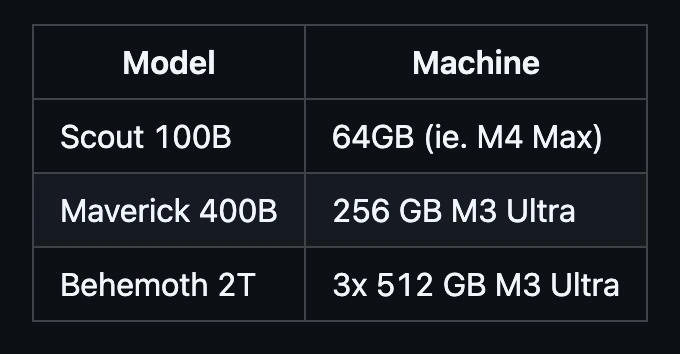
- Scout 100B with “64 GB (i.e. M4 Max)” implies a model with 100 billion parameters might be run on a hypothetical future M4 Max chip with 64 GB memory. 64 GB is huge but maybe just enough if the model’s weights are stored efficiently (likely using 8-bit integers or some compression, since 100B in full 16-bit would actually be more than 64 GB). It’s like saying: small model, one strong computer can handle it.
- Maverick 400B with “256 GB M3 Ultra” cranks it up. 400B is four times 100B, and indeed 256 GB is four times 64 GB – see the pattern? They’re suggesting that to handle four times more parameters, you need four times more RAM, and thus you jump to an M3 Ultra which can provide that 256 GB. An M3 Ultra is essentially two M3 Max chips combined, likely found in something like a Mac Pro. It’s the big guns of Apple’s lineup. The meme humorously mixes generations (M4 Max vs M3 Ultra) probably just to fit the numbers nicely – it’s not super serious about the exact product, just the idea of scaling up hardware.
- Behemoth 2T with “3× 512 GB M3 Ultra” is where it goes into over-the-top territory. 2T means 2 trillion parameters – that’s 2000B, literally 5 times bigger than 400B (actually 5x is 2000B, so yes 2T is 5 times 400B). Following the pattern, you’d need about 5 times more memory than 256 GB, which is ~1280 GB. The meme says “3× 512 GB M3 Ultra”, which totals 1536 GB, comfortably above 1280 GB. In other words: to run this insanely large model, you wouldn’t just need one top-tier chip, you’d need three of them, each maxed out with 512 GB. It’s basically saying “nobody has a single machine with 1.5 TB of unified memory, so imagine clustering three super-machines”.
This is a play on scalability. As the model size grows (100B → 400B → 2T), the required machine grows from a single advanced laptop chip (M4 Max) to a high-end desktop/workstation chip (M3 Ultra) to something that’s essentially a mini super-computer cluster (three ultras working together). It highlights a real issue in ML: you can’t run a model that’s too big for your memory. If you try to, you’ll get out-of-memory errors. Newcomers often face this when they load a model that’s slightly too big for their GPU – the program might crash or complain “CUDA out of memory” or similar. The solutions are either get hardware with more RAM or make the model smaller (or use techniques like model parallelism, where you split the model across multiple GPUs). This meme opts for the “more hardware!” solution in a comical way: just keep stacking Apple’s most powerful chips.
It also subtly touches on memory management tricks. Notice it doesn’t go linearly at the end – it jumps to 3×512 GB for 2T, whereas 5×256 would be 1280 GB. They overshoot. Why? Possibly because in practice, you need extra headroom – there’s overhead beyond just the raw parameter bytes. Things like activations, gradients (if training), or just inefficiencies mean you often need a bit more memory than the model size itself. Seasoned folks know the rule: always have more VRAM/RAM than the bare minimum, otherwise you risk swapping or crashes. For a junior dev, the takeaway is: big model = big memory requirements, often more than you initially calculate. That’s why the meme’s ultimate solution sounds so over-the-top – they’re emphasizing just how unwieldy a 2 trillion parameter model would be.
Let’s touch on the Apple angle: Apple’s M3 Ultra with 256 GB is a theoretical beast – it suggests each M3 Max chip might handle 128 GB, doubled in the Ultra. If each Ultra could somehow be configured to 512 GB (not currently a thing, but who knows in the future or in a fantasy scenario), three of them would give 1536 GB of unified memory. In plain terms, that’s 1.5 terabytes of memory. Most everyday computers have maybe 8, 16, or 32 GB of RAM. 1.5 TB is an astronomically large amount – you’d typically only find that in big servers in data centers. By referencing Apple’s chips, the meme also alludes to Apple’s habit of using terms like “Max” and “Ultra” – it’s mixing the hype of AI with the hype of Apple hardware. A junior developer might have heard that Apple’s chips are efficient and have unified memory which is great for some ML tasks. But here we’re way beyond normal use-cases – nobody is actually running a 2T parameter model on a Mac (at least not without major modifications!). The meme just creates this ridiculous spec sheet to deliver the joke.
One more concept: tensor precision trade-off. This tag hints at how we sometimes make huge models fit in smaller memory by using fewer bits to store each number. For example, instead of 16-bit floats, use 8-bit integers or even 4-bit. This dramatically cuts memory use (half or quarter as much), but can make the model less accurate if not done carefully. The fact that “Scout 100B” is supposedly fitting in 64 GB might imply they’re using such tricks – realistically 100B params in 64 GB would mean about ~0.5 bytes per parameter, which isn’t a standard format (perhaps compressing or using 4-bit with some packing). It’s okay if that detail flies over a junior dev’s head; the key idea is just that when hardware is a limiting factor, clever software tricks (or reduced precision) are used to cope. However, at some point (like 2 trillion parameters), even tricks might not save you – you simply need monstrous hardware. And that’s what the right column humorously lists.
So, summarizing in straightforward terms: The meme shows a table comparing massive AI models with the massive hardware you’d need to run them. It’s funny because it exaggerates how quickly requirements explode. It’s as if for every jump in model size, we have to call up Tim Cook and ask for the next super-charged Mac that doesn’t even exist yet – up to combining three of the biggest ones! For a newcomer, it’s a lighthearted way to learn that scale is hard and that in machine learning, you can’t escape the reality of memory and compute limits.
Level 3: LLM Arms Race
At a high level, this meme is poking fun at the arms race in AI models and the corresponding one in hardware. In recent years, we’ve seen model sizes balloon from millions to billions to hundreds of billions of parameters – with each jump touted as a breakthrough. Seasoned machine learning engineers have lived through this: GPT-2 (1.5B)? That’s cute. GPT-3 (175B)? Hold my beer. There’s an almost absurd one-upmanship: if 100B parameters is great, wouldn’t 500B be better? How about a trillion? The meme’s fictional model lineup – Scout 100B, Maverick 400B, Behemoth 2T – riffs on this trend by using playful names to denote increasingly colossal models. The humor lands because it’s ridiculously relatable: we’ve half-joked about “well, if it doesn’t work, just train a bigger model.”
But anyone who’s tried to actually run these beasts knows the painful flip side: hardware limitations. Enter the right column of the meme’s table – the “Machine” specs. It pairs each model with an Apple Silicon configuration that’s exponentially beefier at each step: a single M4 Max with 64 GB for the 100B model, then an M3 Ultra with 256 GB for 400B, and finally chaining three M3 Ultras (each with 512 GB) for the 2 trillion monster. This is a tongue-in-cheek way to say, “As your model parameters grow, your required RAM goes through the roof — to the point of absurdity.” It’s also poking a bit of fun at Apple’s tendency to up the ante with naming and specs. Apple went from M1 to M1 Pro/Max to M1 Ultra (two chips in one) — techies joked about an “M1 Extreme” (four chips), which never materialized. Now we have M2, M3… the meme preemptively imagines an M4 Max and absurdly a triple M3 Ultra contraption. It’s spec inflation satire: Apple’s marketing loves big numbers (just like AI folks love big parameter counts), so let’s marry the two and see how crazy it gets.
For the veteran dev or ML engineer, a lot of nodding (and eye-rolling) happens here. We’ve all encountered the scenario of a model that “almost fits” in GPU memory. Maybe you have a powerful GPU with 24 GB VRAM, and someone hands you a 30 billion parameter model that needs 32 GB. Cue the scramble: can we prune some layers? use 8-bit quantization? offload to CPU memory and accept it’ll be slow? Or do we bluntly tell the boss we need a machine with more memory? This table is basically that escalation written large in an Apple-fied way. “64 GB (i.e. M4 Max)” hints that a single top-tier MacBook Pro might handle the smallest model. “256 GB M3 Ultra” implies a Mac Studio or Mac Pro with the maxed-out chip for the medium model. And “3× 512 GB M3 Ultra” is just pure overkill – implying even one monster workstation isn’t enough; you need three, presumably working in concert. That’s the overengineering punchline. It’s like using a sledgehammer to crack a nut, turned up to 11. Seasoned engineers find it funny because it’s a hyperbolic reflection of reality: sometimes, projects do end up throwing ungodly amounts of hardware at a problem that possibly could have been solved with a more elegant approach (cough maybe optimize the code or model cough).
There’s also an implicit wink at how Apple Silicon has changed the game for some ML workloads. Traditionally, training or running large models was the domain of NVIDIA GPUs in big servers. Apple wasn’t even a consideration. But with Apple M1/M2/M3 chips offering large unified memory, suddenly you had folks running surprisingly big models on their MacBooks or Mac Studios. (For instance, fitting a 65B parameter LLM on a Mac with 128 GB unified memory, using 8-bit compression – slow but doable). The meme rides on that trend: “Oh, you ran a 100B model on your Mac? Cool, now how about a 400B on a Mac Pro? Still cool? Now for 2T… maybe strap three Mac Pros together!” It’s humor via extreme extrapolation. Seasoned devs also catch the memory-bandwidth subtext: Apple’s unified memory (say 256 GB on an M3 Ultra) is great, but the GPU inside still has to crunch those numbers and move data around. Running a 2T parameter model in real-time would likely choke any interconnect – it’s the kind of thing that triggers nightmares of slow inter-device communication.
In essence, the meme is a cheeky commentary on scalability issues in AI. Bigger isn’t always practical, and scaling linearly in parameters demands non-linear leaps in hardware. It highlights the trade-off: you can either optimize the model (smarter algorithms, better memory management, precision trade-offs) or over-engineer the hardware (more GPUs, more memory, exotic rigs). Here we see the over-engineering route taken to a comic extreme. It tickles the part of a senior engineer’s brain that’s been through countless “we need to scale up” meetings, where someone inevitably says, “Can we just get a bigger machine?” Sure – how about three of the biggest machines money can buy? Because that’s apparently what our Behemoth 2T demands! 😅
Level 4: The Three-Die Problem
At the extreme end of this meme’s tech spectrum, we’re essentially picturing a 2 trillion parameter model spanning three high-end Apple SoCs – a configuration so over-the-top it doesn’t even exist (yet) in Apple’s lineup. This is a memory coherence nightmare and a lesson in hardware limits. Each Apple M3 Ultra is already a multi-die system (think of it as two chips fused into one via Apple’s UltraFusion interconnect). Now, chaining three of these together pushes into uncharted territory. Hardware engineers would recognize this as a NUMA (Non-Uniform Memory Access) scenario on steroids: each Ultra has its own 512 GB pool of unified memory, and keeping all three pools in sync introduces serious latency and bandwidth overhead.
Why is this such a big deal? Because model parameters aren’t just abstract numbers – they’re chunks of data that must be shuffled around at high speed. A 2-trillion-parameter LLM with typical 16-bit precision would occupy roughly:
$$2 \times 10^{12} \text{ params} \times 2 \text{ bytes/param} \approx 4 \times 10^{12} \text{ bytes} \approx 3.6 \text{ TB}$$
Even if you assume aggressive memory optimizations (like 8-bit quantization, halving the size to ~1.8 TB), that’s still way beyond a single machine’s capacity. Spreading these weights across three M3 Ultras might just squeeze in the total bytes, but now each forward pass of the model has to pull data across chip boundaries. Memory bandwidth becomes the choke point: Apple’s unified memory is fast on one chip, but even an ultra-fast interconnect linking chips can’t hide the fact that remote memory access is slower.
Consider how Apple’s UltraFusion was designed to connect two dies with very high bandwidth (~2.5 TB/s rumored for M1 Ultra’s inter-die link). With three dies, you’d need either a triangular mesh of links or a centralized switch – either way, the communications overhead grows superlinearly. It’s akin to the classic computing “cache coherency” challenge: more chips mean more complexity in ensuring each chip sees a consistent view of those trillions of parameters. Senior systems architects might liken this to the “three-body problem” in physics – adding a third body (or in this case, a third die) makes the system chaotic and hard to solve optimally.
Behind the humor is a serious nod to HPC (High-Performance Computing) techniques. Real trillion-parameter models (if anyone actually builds one monolithically) would run on clusters of specialized GPUs or TPUs connected by something like NVIDIA’s NVLink/NVSwitch or a high-speed fabric – effectively the PC equivalent of “stacking” multiples of high-memory devices. In those setups, engineers carefully partition the model: e.g., layers 1-10 on GPU 1, layers 11-20 on GPU 2, etc., to minimize communication. If you naively scatter weights all over, the memory latency would punish you every time one chip needs to fetch data from another. The meme’s absurd “3× 512 GB M3 Ultra” highlights how memory-hungry these models are, and implicitly, the bandwidth pain of feeding the beast. With a model “Behemoth 2T,” even just reading all weights sequentially from memory once would be a massive task – no matter how wide Apple’s memory bus is, moving terabytes of data for a single inference would take seconds at best.
At a theoretical level, this is brushing against fundamental limits: the memory wall (where memory speed lags behind CPU/GPU speed) and even power limits (3 giant chips will draw a ton of power to keep all that RAM active and transferring). It underscores why the ML research community explores alternatives like model compression, sparsity, or mixture-of-experts (which effectively activate only subsets of parameters at a time) – because simply throwing more hardware at the problem leads to impractical setups. The meme exaggerates that approach to the point of absurdity: Sure, let’s just triple-stack top-tier Apple Silicon! – a tongue-in-cheek nod to how scaling up a model isn’t as simple as just adding more chips due to these deep architectural challenges.
Description
A clean, dark-mode table with two columns, 'Model' and 'Machine', and three rows of data. The table maps different sizes of large language models (LLMs) to the specific high-end Apple hardware required to run them. The first row shows the 'Scout 100B' model needs a machine with '64GB (ie. M4 Max)'. The second row lists the 'Maverick 400B' model, requiring a '256 GB M3 Ultra'. The final row details the 'Behemoth 2T' (2 trillion parameter) model, which necessitates a staggering '3x 512 GB M3 Ultra' setup. This image serves as a stark and practical illustration of the immense hardware and memory demands of running modern, large-scale AI models locally. It highlights how cutting-edge AI development is pushing the limits of even the most powerful consumer and prosumer hardware, making Apple's unified memory architecture a key battleground for local inference
Comments
7Comment deleted
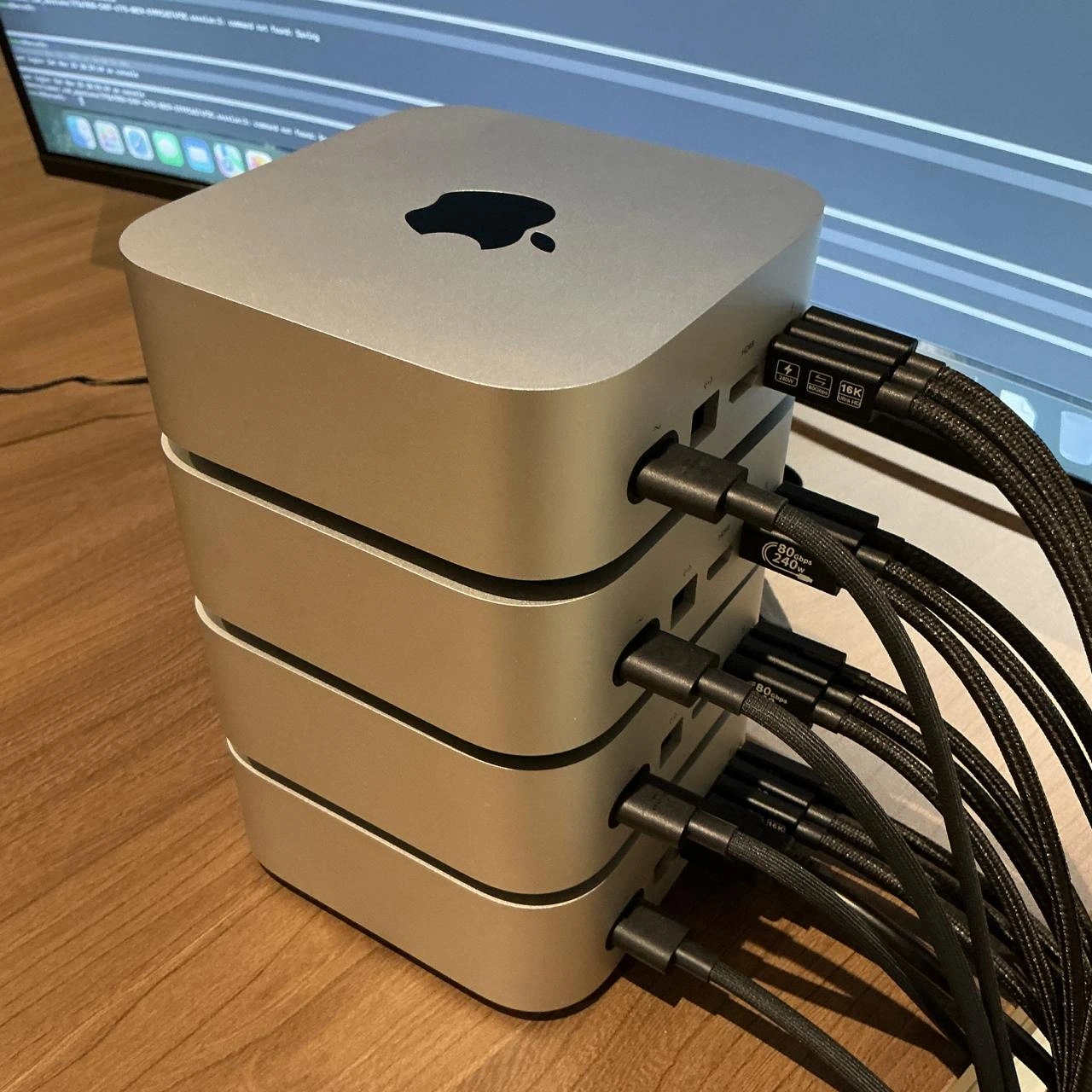
The 'Behemoth 2T' model requires three M3 Ultras: one to run the model, one to power the cooling system for the first one, and the third to run Activity Monitor
The real benchmark isn’t perplexity - it’s whether your finance team’s M3 Ultra budget scales faster than your tokenizer
Remember when we used to joke about Chrome eating all our RAM? Now our AI models need three Mac Studios just to remember what we were talking about
When your 2 trillion parameter model needs three M3 Ultras just to fit in memory, you realize 'Behemoth' isn't marketing hyperbole - it's a hardware procurement warning. At this rate, running GPT-5 locally will require mortgaging your house to Apple, and the model will still insist it can't do math because it's 'just a language model.'
Local LLMs on Apple: From 'runs on a laptop' to 'buy a Mac farm or embrace the cloud hypocrisy.'
When your sizing doc says Behemoth 2T fits on “3x 512 GB M3 Ultra,” you’ve implemented tensor‑parallelism in Excel and hardware virtualization in the keynote
Finally, a capacity plan where “Behemoth 2T → 3×512GB M3 Ultras” means model‑parallel inference over Thunderbolt - and the true bottleneck is procurement’s credit limit, not FLOPS