Skip to content
DevMeme
6409 of 7435
AI 'Enhancements': Now Ruining Your Favorite Tools
IndustryTrends Hype Post #7030, on Aug 13, 2025 in TG

AI 'Enhancements': Now Ruining Your Favorite Tools

Why is this IndustryTrends Hype meme funny?

Level 1: Too Much Help

Imagine you have a favorite toy or tool that you use every day because it’s simple and it works just right. Let’s say it’s a nice pair of shoes that you love to tie up yourself. Now, one day the shoe company decides to include a tiny robot helper with your shoes. They’re really excited and tell everyone, “Look, our shoes can now tie themselves with this smart robot!” It sounds cool, right? But when you actually try it, that robot keep jumping in to “help” even when you don’t need it. You start tying your shoelaces, and the robot hand suddenly grabs the laces and makes a big tangled knot. Ugh! You didn’t ask for help – in fact, you were faster doing it on your own – but now the robot is in your way, slowing you down. You get frustrated and think, “This thing ruined my perfectly good shoes!”

Now, why would the company add such a robot if it makes the shoes worse for you? Well, imagine the parents or people who own the shoe company love the idea because it sounds super advanced and fancy. They aren’t the ones actually trying to walk in those shoes every morning; they just like being able to say, “Our product has a high-tech robot in it!” They think it will make more people buy the shoes because it’s a new trend (maybe all the other shoe companies started talking about smart self-tying laces, so they felt they had to have it too). Meanwhile, you as the user are standing there with knotted laces thinking, “This ‘upgrade’ is making my life harder, not easier.”

That’s exactly the feeling this meme is joking about. It’s like if your favorite simple tool got a shiny new feature that was supposed to help but actually just annoys you. The people in charge of the tool are happy because it sounds innovative (like the shoe company bragging about robot laces), but the actual person using it (you) is unhappy because the new feature isn’t useful and even messes things up. In one line: the meme is funny because it’s showing an unwanted helper — a fancy AI chatbot named Bella — that’s meant to be helpful but ends up being “too much help,” just getting in the way. It highlights the silly situation where something new and high-tech is added to a product and everyone says it’s great, except the folks who actually have to use it day-to-day, who are left saying, “Thanks, but no thanks!”

Level 2: Just Add AI

Let’s break down what’s happening in this meme in simpler terms. First, SaaS stands for Software as a Service. That means a software application you access online, usually via a web browser, instead of installing it on your own computer. It’s “as a service” because you typically pay a subscription or use a free tier while the software runs on the company’s servers (think of tools like Slack, GitHub, or Notion). Now, the meme is titled “When Your Trusted SaaS Adds AI and Breaks the UX Anyway.” A “trusted SaaS” implies it’s a web tool you really like and rely on. They’ve introduced an AI feature, hoping to improve it, but ended up messing up the UX. UX means User Experience – basically, how it feels to use the product, how easy and pleasant (or frustrating) it is to accomplish what you want to do. “Breaking the UX” means the user experience has gotten worse (more confusing, less efficient, maybe buggier) after the change.

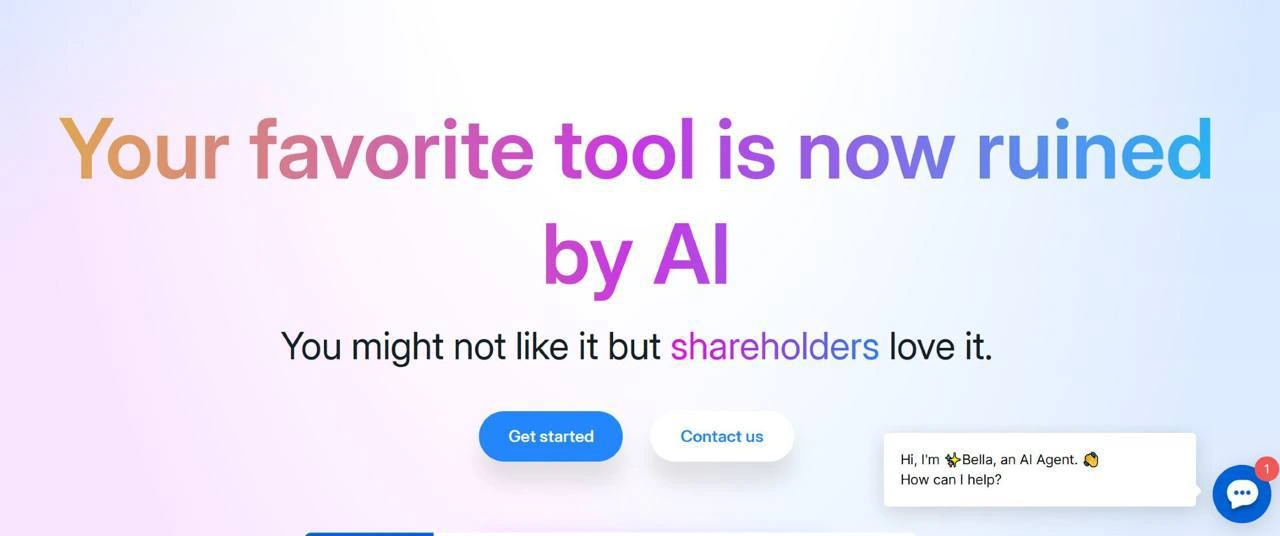
The visual in the meme mimics a typical product announcement or landing page for this SaaS. The background has a soft colorful gradient (a blend of colors) which is very trendy in modern web design, especially for tech and AI startups. The big headline in rainbow-ish text says: “Your favorite tool is now ruined by AI.” This is a joke because no company would actually announce “we ruined our tool.” That’s the satire – it’s phrased as if the company itself is admitting the truth that the users feel. In reality, a company would probably say something like “Your favorite tool is now enhanced with AI!” But the meme takes the user’s viewpoint (who feels it’s ruined) and splashes it as the headline. This contrast is both funny and a bit painful for anyone who’s experienced a bad product update.

Under that, there’s a tagline: “You might not like it but shareholders love it.” Shareholders are people who own shares (stock) in a company – basically the investors or owners. They care about the company doing well financially. If adding a buzzworthy feature like AI makes the company seem more innovative or competitive, shareholders get excited, because it might mean more customers or a higher stock price. However, you (the user) might hate the change because it doesn’t actually help you; it might even make the software harder to use. This line highlights a common situation: sometimes companies add features to impress investors or keep up with industry trends (IndustryTrends_Hype) without considering if it truly benefits users. It’s slyly suggesting the company knows users aren’t happy (“you might not like it”) but they did it anyway because those who hold the purse strings (“shareholders”) wanted it. It’s a bit like when a game adds a feature that players find annoying, but it attracts new publicity or funding – the existing players think “why did you do this?,” but the company higher-ups see dollar signs.

Now, look at the bottom of the image: there are two buttons, “Get started” and “Contact us.” This layout is a parody of a standard website hero section (the main banner area). Often a SaaS landing page will have a call-to-action button like “Get Started” (to sign up or try the product) and maybe a secondary button like “Contact Us” (for sales or support). Including these buttons makes the image feel like a real webpage screenshot. It’s setting the stage: “Our product has a big new update (AI!) – do you want to try it out?” The joke, of course, is that the headline says it’s ruined, so why would you eagerly get started? It’s an ironic detail for comedic effect.

In the lower-right corner, you see a little chat bubble with a message: “Hi, I’m ✨Bella, an AI Agent. 👋 How can I help?” and it even has a red unread message badge (a little red circle indicating 1 new message). This element represents the AI feature that was added. Many websites and apps nowadays have a chat widget – you might have seen something like a little chat icon that pops up saying “Need help? Ask me!” Usually, it’s meant for customer support or answering FAQs. In recent times, lots of products have integrated AI chatbots (often powered by those advanced text-generating models called LLMs, or Large Language Models, like the tech behind ChatGPT). These AI chatbots are supposed to assist users: answer questions, help find features, maybe even generate content for you. The meme names the bot “Bella” to humanize it (companies often give their AI agents friendly names). The sparkles around Bella’s name (✨Bella) make it sound extra magical or innovative – again poking fun at how marketing tries to make AI features seem shiny and amazing.

The problem is when this chat agent is intrusive. “Intrusive” means it interrupts or gets in your face without you asking. In the meme, Bella immediately greets you (“👋 Hi, how can I help?”) and even shows an unread message notification to grab your attention. Many users find this kind of auto-pop-up chat annoying. Imagine you open an app to do your usual task, and instantly a chat window appears, perhaps blocking part of the screen, and you have to close it. It can feel like a pushy salesperson jumping in front of you when you enter a store. That’s poor UX if it’s too aggressive. The meme highlights this by the mere presence of Bella popping up uninvited. Bella is essentially the face of the new AI feature that’s supposed to be a helpful “AI Agent” but ends up being a nuisance.

Why would the company add Bella? Because of the current trend: ai_feature_everywhere. Over the last couple of years (especially around 2024-2025), AI became the big buzzword. If a product has AI, it sounds cutting-edge. So lots of companies started adding AI assistants, even if sometimes it wasn’t a perfect fit. This is where the term “hype” comes in. Hype is when something is promoted and talked about a lot, often with high expectations. AIHype means everyone’s excited about AI, perhaps overly so. Companies don’t want to miss out, so they ride the hype. The meme’s company (in this scenario) followed the hype and stuck an AI into their product — essentially the mindset of “Just add AI and we’ll be revolutionary!”

Unfortunately, when things are done just for hype and not with a thoughtful plan, you get what’s called a usability regression. “Regression” is a term in software meaning something that used to work well got worse in a newer version. Usability refers to how easy and effective a product is to use. So a usability regression means the product became harder or less pleasant to use than before. The meme explicitly says the tool is ruined by AI – that’s an extreme way to say the usability took a big step backward after adding the AI stuff. Maybe the interface got cluttered or confusing. Maybe the AI gives wrong answers half the time, which could even be worse than having no helper. Or it could slow down the app (for example, waiting on AI responses or loading large model scripts). All these would frustrate a user who was perfectly happy with the earlier, simpler version of the tool.

For a junior developer or someone new to the industry, the meme is calling out the tension between DeveloperPainPoints (or more broadly user pain points) and business decisions. Early in your career, you might assume companies always add features to make the product better for users. But you eventually see cases where features are added for marketing or to satisfy investors. It can be bewildering: “Why did they add this chatbot that doesn’t even work well?” The answer often lies in business pressure, not engineering common sense. Here, shareholders (or sometimes big clients, stakeholders, etc.) are those pressures. They hear “AI” and think of increased engagement, automation, and being able to say “we use AI” in pitch decks. So the developers are told to implement an AI feature quickly. That process is sometimes jokingly referred to as “AI washing” (like whitewashing, but with AI) or just hype-driven development – building something primarily because it’s trendy, not because users explicitly needed it.

Let’s decode the humor in simpler terms: The user (especially tech-savvy users like developers) trusted this software and liked how it worked. Suddenly it changes in a way that’s supposed to be modern (“AI-powered everything!”) but the user finds it worse. It’s like a betrayal of trust, played for laughs here by bluntly announcing “we ruined it!” The little details (rainbow text, friendly bot, corporate buzzwords) are exaggerated to drive the joke home. If you’ve ever logged into a favorite app after an update and felt, “Ugh, what did they do? Everything’s different or slower,” you can relate. And if you’ve noticed how every app now brags about AI, you’ll see why adding “by AI” in that headline is funny. It’s the meme’s way of saying: Trendiness has trumped usability. The humor has a bit of DeveloperCulture cynicism: developers often joke about management chasing fads while they’re left dealing with the messy outcomes (like buggy AI integration).

In summary, Level 2 explanation: this meme uses an imaginary product announcement to joke that a trusted software tool was made worse by an AI feature update. The user interface now has a pesky AI chatbot (Bella) that wasn’t needed. The company did it to surf on the AI hype and make stakeholders happy, even though loyal users are unhappy about the change. It’s a commentary on AIHypeVsReality – just because something is AI doesn’t automatically mean it’s an improvement. The meme’s joke lands especially with developers who have seen hype like this before, but even a newcomer can understand it as “they added a flashy new thing and broke what was working.” It teaches a little lesson: always adding the newest tech isn’t always the best for user experience, especially if done without care. Sometimes, less is more when it comes to features – a message even juniors will encounter in real projects.

Level 3: Hype-Driven Development

The meme lampoons a familiar scenario in modern tech: a beloved SaaS tool awkwardly overhauled with AI/ML features just because it's the latest trend. The hero section in the image is styled like a slick startup landing page – complete with a pastel gradient background and huge rainbow-colored text – but the words are pure sarcastic truth: “Your favorite tool is now ruined by AI.” No real SaaS would advertise their update as "ruined," of course. This is the developer’s perspective punching through the glossy marketing veneer. It's a satirical twist on what a company might call “AI-powered upgrade to your favorite tool”; here the upgrade is acknowledged as a downgrade.

Below that, the tagline reads, “You might not like it but shareholders love it.” This one liner hits at the core conflict: DeveloperExperience_DX and user happiness versus StakeholderExpectations. In other words, the people who actually use the product (often developers, in the case of dev tools) are frustrated by this forced AI feature, but the people who fund or run the company are thrilled because it boosts buzz and potential profit. It’s a perfect summary of empty_hype_driven_development: implementing whatever hot tech the boardroom is excited about, even if it wrecks the user experience. Veteran engineers know this story all too well. We’ve seen solid products succumb to feature creep when the hype wave hits – whether it was adding “social” features in 2010, blockchain in 2018, or now an AI agent in 2025. The meme humorously suggests that the tool’s actual improvements are nil (perhaps even negative) but hey, the quarterly report will look innovative.

The image piles on details that every dev can recognize. Those two pill-shaped buttons “Get started” (bright blue) and “Contact us” (white) are spot-on parodies of a generic SaaS landing page call-to-action. It screams “look, a big announcement!” Meanwhile, in the bottom-right corner lurks the intrusive_chatbot_widget: a chat bubble with a greeting from an AI assistant named ✨Bella. Bella cheerfully pops up — "Hi, I'm Bella, an AI Agent. 👋 How can I help?" — complete with a red unread message badge to demand your attention. Sound familiar? It’s basically the new-age Clippy, intruding on your screen. For those who remember Clippy (the peppy Microsoft Office assistant that loved to say “It looks like you're writing a letter...”), Bella is like Clippy’s modern descendant: powered by a state-of-the-art LLM (Large Language Model) rather than simple scripts, but equally capable of annoying you at the worst time. The meme is riffing on how every app now shoehorns a chat-based AI agent into the UI. Even if you’re just there to use the core features, you get this bubbly chatbot waving at you, asking if it can help – when in fact it often can’t or ends up making things more complicated. It’s the epitome of ai_feature_everywhere: no corner of software is safe from a little AI widget talking at you.

From a senior developer’s perspective, the humor cuts deep. We know that slapping an LLM wrapper on an app is often a rushed decision born of an IndustryTrends_Hype frenzy. The boss hears how “AI is the future” and suddenly your sprint planning is thrown into chaos to “add some AI” ASAP. The result? A half-baked chat feature that wasn’t in the original product vision, likely not well integrated with the app’s actual data or workflows. It might call an external API like OpenAI under the hood, maybe to generate answers or suggestions. In theory that could be cool, but in practice you often get generic, sometimes incorrect responses (“I’m sorry, I don’t have information on that 🤖❓”), all delivered with a fake smiley face. Meanwhile, that new AI integration bloats the app: extra JavaScript, slower load times, more points of failure (did the token quota exceed? did latency spike?). Usability_regression is the term – where a new release makes a product less usable than before. It's painfully common. The meme explicitly spells it out with “ruined by AI”. Sure, “ruined” is exaggeration for comic effect, but not by much when you’ve experienced a once-smooth app turning clunky post-update.

Why do it then? Because Stakeholders_Clients (investors, upper management, marketing teams) love being able to say “Now with AI!” in press releases and sales calls. It sounds cutting-edge and can bump stock prices or impress clients at demos. This is the TechIndustrySatire heart of the joke: in tech companies, decisions are often driven by buzzwords and FOMO rather than actual user needs. There’s an implied narrative here: You (the user or developer) didn’t ask for an AI chat widget. In fact, you find it distracting and unhelpful. But somewhere in a board meeting, someone argued that “AI will increase engagement” or “our competitors all have an AI feature, we need one too.” So it gets built despite internal protests. The tagline “you might not like it but shareholders love it” is basically what product managers sometimes euphemistically call “business value” overruling user feedback. Every seasoned dev has anecdotes of a feature nobody asked for being shoved into a product because it’s the hot new thing executives saw on a tech blog.

The meme also nails the DeveloperFrustration and dark comedy of being on the implementation side of such edicts. Imagine being the developer tasked with integrating “✨Bella” into an otherwise perfectly fine app. You’re thinking, “Really? We’re adding a chatbot that none of our users requested.” But the directive is top-down. So you wire it up, perhaps using an SDK to embed an AI model, spending late nights fixing edge cases. When it finally rolls out, existing users are confused: Why is this chat thing in my face? How do I turn it off? You start getting bug reports like “Bella gave me wrong info” or support tickets complaining “the page freezes when Bella loads.” It’s a literal DeveloperPainPoints scenario: extra workload and moral guilt about a feature you suspect is just fluff. But the higher-ups only care about one metric: they can now say our product is AI-powered. The meme’s faux-enthusiastic hero text and buttons poke at the glossy launch announcements for such features, even though behind the scenes the dev team might be rolling their eyes.

Historically, this pattern repeats every time there's a hype cycle. Today it’s AI agents, a couple of years ago it was voice assistants in every device, before that it was Big Data dashboards, and at one point it was adding a social feed to everything. The AIHypeVsReality tag is apt: the hype promises magical improvements, the reality is often an awkward bolt-on that doesn’t live up to expectations. Experienced devs find humor (and solace) in acknowledging this gap. We laugh at memes like this because otherwise we’d cry about how often good DeveloperExperience is sacrificed on the altar of market trends. It’s a coping mechanism for the industry. As cynical as “ruined by AI” sounds, it rings true to anyone who’s seen a clean UX deteriorate after over-engineering it with trendy features. In summary, Level 3 unpacks all these inside jokes and truths: the absurdity of shareholder_driven_product decisions, the annoyance of an intrusive AI chat box named Bella, and the timeless battle between hype and usability. It’s the kind of thing that makes senior developers smirk and mutter, “Yep, seen this fiasco before.”

Description

The image is a satirical depiction of a modern software-as-a-service (SaaS) landing page. The background is a light, pleasant gradient. The main headline, in a large, colorful font, reads, 'Your favorite tool is now ruined by AI'. Below it, a smaller sub-headline states, 'You might not like it but shareholders love it.' The page includes standard 'Get started' and 'Contact us' buttons. In the bottom right corner, a chatbot window has popped up with the message: 'Hi, I'm ✨Bella, an AI Agent. 👋 How can I help?'. A blue chat icon with a red notification badge is also visible. The humor is a sharp critique of the 'AI-washing' trend in the tech industry, where companies shoehorn artificial intelligence features into their products, often degrading the user experience, solely to appease investors and capitalize on the market hype. The brutally honest copy captures the cynicism many experienced developers feel about this phenomenon

Comments

12
Anonymous ★ Top Pick Our new AI doesn't actually improve the product, but it's great at generating slides for the board meeting that prove its own ROI
  1. Anonymous ★ Top Pick

    Our new AI doesn't actually improve the product, but it's great at generating slides for the board meeting that prove its own ROI

  2. Anonymous

    Remember when “AI-enabled” meant distributed training pipelines? Now it just means a ChatGPT wrapper and a prettier investor deck

  3. Anonymous

    Remember when we used to joke about 'AI will replace developers'? Turns out AI replaced product sense first - now every tool needs a chatbot named after a houseplant to help you navigate features that worked perfectly fine with a simple search box

  4. Anonymous

    Ah yes, the classic 'pivot to AI' strategy: take a perfectly functional developer tool, slap an LLM chatbot on it that hallucinates half the documentation, triple the latency, 10x the pricing, and watch your Series C valuation soar while your power users quietly migrate to the open-source fork. Bella the AI Agent can't help you with that, but she can definitely help inflate the quarterly metrics deck

  5. Anonymous

    AI in tools: Because hallucinating deprecated APIs at 2x speed screams 'productivity' to shareholders

  6. Anonymous

    We deprecated UX in favor of OKRs: every click now routes through Bella, scores “AI engagement,” and adds 300ms of inference tax - finance calls it margin expansion

  7. Anonymous

    We used to have an idempotent “Export CSV” - now it’s a nondeterministic chat with Bella who occasionally hallucinates a privacy policy; finance calls it “margin expansion.”

  8. アレックス 11mo

    “What do you want to ✨create✨ today?”

  9. @joyofworld 11mo

    This pop-up message in the corner...

  10. @SuperCosmicBeing 11mo

    Literally github rn

  11. @ZgGPuo8dZef58K6hxxGVj3Z2 11mo

    "Hi I am Bella, an AI agent. How can I help you today?" Is the cherry on top

  12. @slashdevslashseminull 11mo

    Neovim will never fail!

Use J and K for navigation