Corporate Checkmate: The COVID Leave Gambit
Why is this CorporateCulture meme funny?
Level 1: When Sick Means Show Up
Imagine one kid in your class is sick with a bad cold. Normally, the teacher would tell that sick kid to stay home and rest so the other kids don’t catch it. But in this story, the principal does the opposite: they send all the healthy kids home, and make the sick kid come to school alone to do all the classwork. Sounds crazy, right? It’s funny because it’s the total opposite of what we’d expect and what’s fair. The sick person (John) asked for time to get better, but the boss basically said, “Nope, you still have to work – in fact, you come in by yourself and everyone else will stay safe at home.” It’s like a backwards world where being sick means you’re the only one who has to go to the office. This silly, mixed-up situation makes us laugh because it’s so outlandishly unfair. It highlights the joke that sometimes big organizations make decisions that feel upside-down – protecting the project or “homework” instead of the person who isn’t feeling well. In simple terms, the meme is funny in the same way it would be if a school punished a kid for being sick by forcing them to come in while everyone else gets a day off. It’s a goofy “opposite day” scenario that kids and adults alike can see doesn’t make any sense, and that ridiculousness is exactly why it’s amusing.
Level 2: Backwards Quarantine
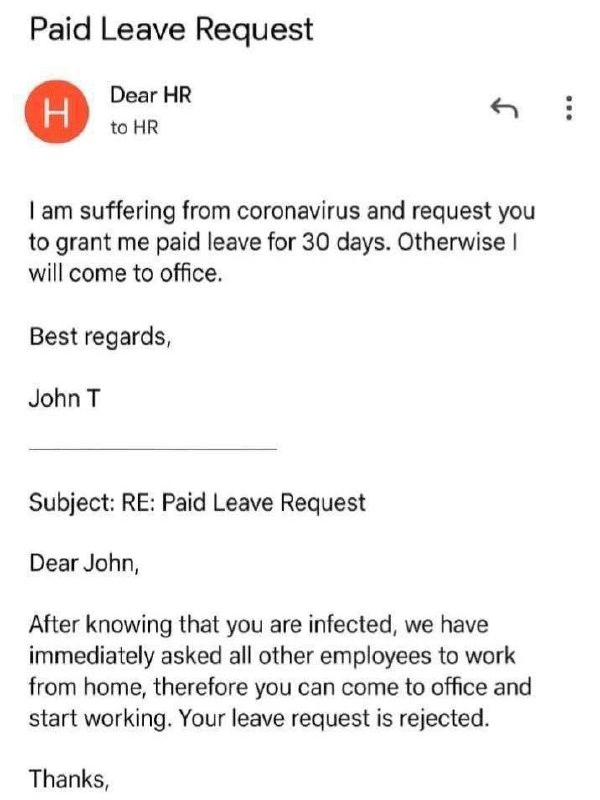
In this meme, we’re looking at a spoofed email thread between an employee and HR. John (the employee) emails HR saying he has coronavirus and asks for 30 days of paid leave. He even adds a not-so-subtle threat: “Otherwise I will come to office.” Normally, during a pandemic or any infectious illness, a company’s remote work policy would let the sick person stay home to recover (for everyone’s safety). Quarantine usually means keeping the infected person isolated away from others. But here comes the punchline: HR replies that they’ve made all the other employees work from home, so John can come into the office and get back to work. In other words, they reversed the quarantine. Everyone else stays home, and the one guy who’s sick must come in. It’s a completely backwards application of Work From Home (WFH) culture – hence the tag RemoteWorkCulture.
Let’s break down why this is funny to folks in an office or tech setting. First, there’s a CommunicationBreakdown and a power move. John basically tries to strong-arm HR by implying, “Give me leave or I’ll endanger others by showing up sick.” It’s a desperate plea and a bit of a threat rolled into one. HR’s response is shockingly literal and bureaucratic: they do care about not infecting others (so they send everyone else home), but they also refuse to grant the leave. The leave request is rejected outright. This highlights a classic ManagementHumor scenario where HR strictly follows policy (“no 30-day leaves granted lightly”) while appearing to address the problem in the most cold-hearted way possible. It’s a case of MisalignedExpectations: John expected his condition would obviously merit time off. Instead, HR found a loophole to keep him working.
In tech terms, John became a single point of failure for the office. That term means a part of a system that, if it fails, will stop the entire system from working. Here, John is apparently so vital (or his absence so unacceptable) that the company will reorganize everyone else just to keep him coding. In software development teams, having one person who carries all knowledge of a codebase is dangerous – if that person is out sick (or quits), the project could stall. We call that having a “bus factor” of 1 (only one person needs to get “hit by a bus” for the project to be in trouble). This HR email basically reveals John is that critical person. Rather than accept a pause in John’s output, management’s pandemic mitigation plan is to treat him like an isolated machine in a server room: everyone else just VPNs in from home while he toils away in person.
It’s also about CorporateCulture and how some companies prioritize work over well-being. The formal tone of HR’s reply (“Dear John,... Thanks,”) is typical of corporate communications that ignore the human element. The stark humor here is that HR acknowledges John is infectious (so they clearly believe him), but their solution protects everyone except John. It’s like they care about the project’s continuity more than the individual’s health. This resonates as WorkplaceIrony: companies often say “our employees are our greatest asset,” yet here the sick employee is forced to work in the office all alone. The codebase (the collective work) is being “isolated” from the risk, while the coder himself is not given isolation or rest. For anyone who’s experienced absurd office policies, this hits a nerve – and that mix of disbelief and I-can’t-help-but-laugh is exactly why the meme spread in tech circles.
Level 3: Infected Node in the Cluster
From a senior developer’s perspective, this email exchange reads like a system design anti-pattern implemented in real life. Imagine your company’s workforce as a distributed system of nodes (employees). One node, John, is “infected” (has a virus). In a sane architecture you’d quarantine or shut down the faulty node for maintenance (i.e. let John stay home on sick leave) while the rest of the cluster continues operating normally. But here, HR does the exact opposite: they evacuate all the healthy nodes to remote mode and keep the infected node running solo in the office. It’s as if the sysadmin, upon detecting a virus on one server, unplugged all the clean servers and left the infected one online. This creates an intentional single point of failure – John becomes the one in-person resource carrying the entire load, a single-node cluster by HR decree. The humor is that any seasoned engineer knows you should eliminate single points of failure, not enforce them. The term “single_point_of_failure_employee” fits perfectly: all bus-factor warnings are flashing red here. Yet corporate logic sometimes cares more about uptime (in this case, keeping John coding no matter what) than about sensible risk management.
The absurdity is heightened by how bureaucratically it’s presented. The HR’s reply is phrased with polite formality (“Dear John, ... Thanks,”) as if it were an ordinary policy update. This deadpan, matter-of-fact tone is familiar from CorporateCulture communications where ridiculous decisions are delivered in bland corporate-speak. It’s reminiscent of a code comment that calmly explains a truly horrific hack. In fact, we can almost express HR’s plan in pseudocode:
if employee.infected:
for e in all_employees_except(employee):
e.work_from_home = True # isolate all other healthy employees
employee.leave_request.approved = False # reject the sick employee's leave
employee.location = "Office" # require sick employee to come in
This “algorithm” optimizes for zero downtime on the project: HR ensures John continues working on-site while everyone else goes remote to avoid getting ill. It’s a twisted form of fault tolerance — instead of having a backup for the sick employee, they make him the isolated dedicated server. The email’s subject “RE: Paid Leave Request” could as well be a JIRA ticket titled “WONTFIX: developer is sick”. The result is a covid_policy_absurdity that tech folks find darkly funny. We’ve all seen management make perverse trade-offs, but treating an employee like a disposable singleton resource (the one infected node keeping the codebase running) takes it to a new level of irony. It’s humor through painful relatability: any veteran dev who’s dealt with misalignedExpectations and nonsense back_to_office_policy_gone_wrong can only smirk and think, “Yep, that’s management for you – isolating the codebase, not the coder.”
Description
The image is a screenshot of a two-part email exchange. The first email, titled 'Paid Leave Request' and sent from a user 'John T' to 'HR', reads: 'I am suffering from coronavirus and request you to grant me paid leave for 30 days. Otherwise I will come to office. Best regards, John T'. This is a clear attempt to leverage a health risk to secure paid leave. The second email is a reply from HR with the subject 'RE: Paid Leave Request'. It reads: 'Dear John, After knowing that you are infected, we have immediately asked all other employees to work from home, therefore you can come to office and start working. Your leave request is rejected. Thanks,'. The humor stems from the corporate judo performed by the HR department. They call the employee's bluff by completely neutralizing his threat. Instead of giving in, they use the company's remote work policy to isolate the employee, forcing him to either work alone in an empty office or drop the request. It's a cynical but witty take on corporate power dynamics and the sometimes-adversarial relationship between employees and management, particularly highlighted by the workplace changes during the COVID-19 pandemic
Comments
10Comment deleted
The employee tried to use a social engineering attack to get root access to the payroll system, but HR just sandboxed him in an empty office VLAN
Nothing like HR discovering the ‘isolate the node, not the bug’ strategy - and declaring the infected dev a dedicated on-prem microservice
This is what happens when HR's incident response playbook was written by the same team that handles production rollbacks - 'If one service is infected, isolate all the healthy ones and keep the compromised one running in the main cluster.'
This HR response perfectly encapsulates the enterprise approach to incident response: when you detect a critical vulnerability (infected employee), immediately isolate all healthy nodes (send everyone home) while forcing the compromised system to remain in production. It's like running `git push --force` on a branch you know is broken, then wondering why the deployment pipeline fails. The real kicker? HR just implemented a distributed denial-of-health-service attack on their own employee while claiming it's a security measure. At least in our on-call rotations, we have the decency to rotate the misery - this is just assigning permanent pager duty to patient zero
HR's genius ops: Quarantine healthy nodes remotely, run the infected singleton bare-metal in-office for 'fault isolation'
Enterprise logic in a nutshell: quarantine the cluster, keep the compromised primary serving traffic - because the bus factor is 1 and failover is named ‘John T’.
HR implemented Kubernetes scheduling: taint office=node.infected, evict healthy pods to WFH, schedule the only tolerant pod (John) on‑prem - SLA passed, ethics segfaulted
this reminds me of this discussion https://t.me/devs_chat/146994 Comment deleted
https://t.me/devs_chat/146995 Comment deleted
hey, that was me :D Comment deleted