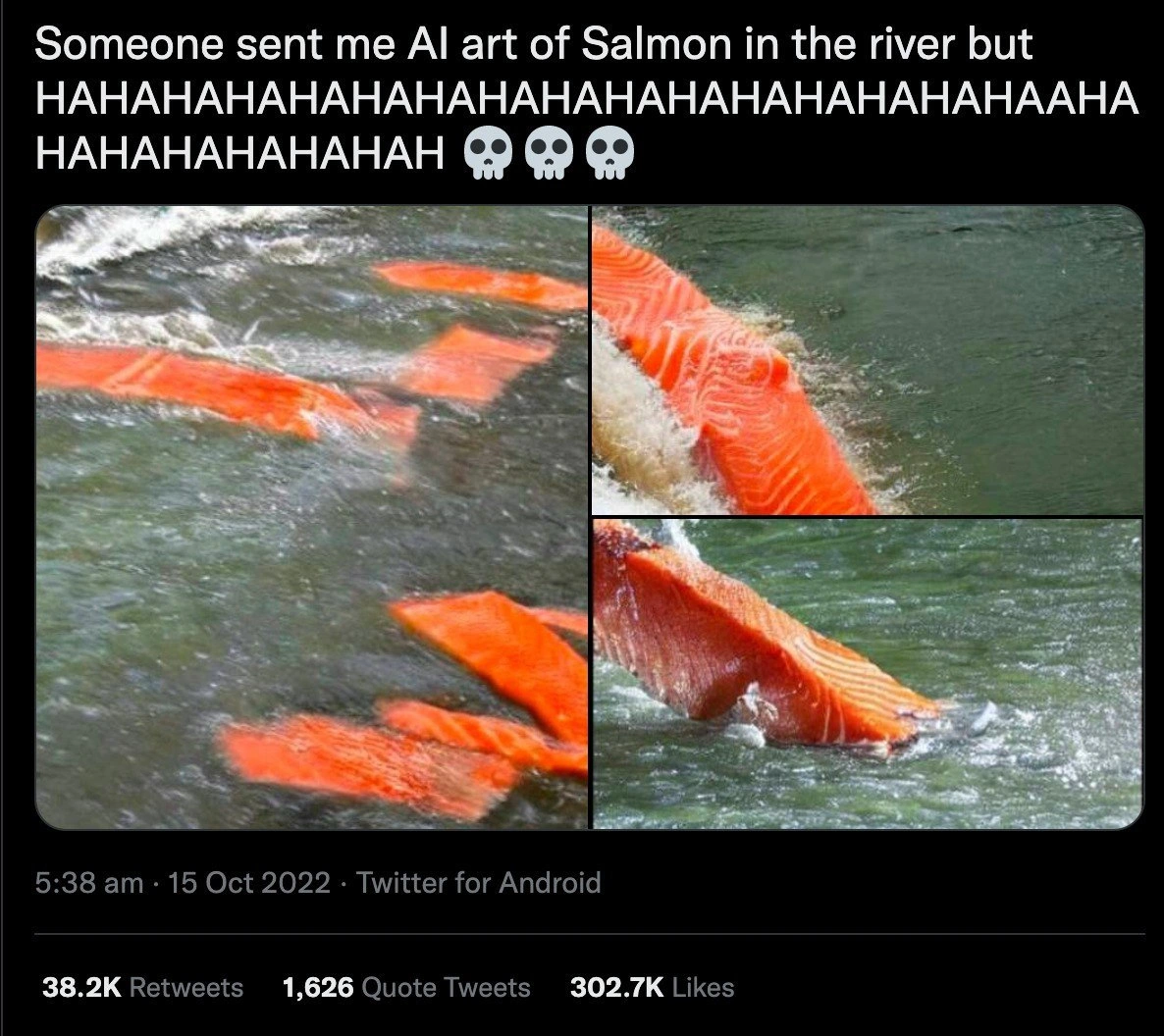
AI model hilariously renders salmon fillets swimming like fish in a river
Why is this AI ML meme funny?
Level 1: The Wrong Kind of Fish
Imagine you ask a robot to draw you a picture of a fish swimming in a river. The robot doesn’t really understand things like a person does; it just knows the words. So it hears “fish (salmon) in a river” and tries its best. But uh-oh – instead of drawing a whole fish with fins and a tail, it draws a piece of salmon (the kind of sliced fish you might eat for dinner) floating in the water! In the picture, these orange salmon fillets are splashing around as if they’re alive in the river. It looks really silly, right? It’s as if someone took the salmon from a supermarket and tossed it back into the stream. People find this hilarious because obviously a fish fillet isn’t a live fish – it shouldn’t be swimming at all. The computer did exactly what the words said (“salmon in the river”) but not what we meant. We meant the animal, but the poor literal-minded computer thought of the food. It’s like a goofy misunderstanding. This joke shows that computers, even smart AI ones, can mess up in a funny way if you don’t ask them clearly. Just like a genie in a fairy tale who twists your wish if you’re not specific, the AI followed the words literally and ended up with a crazy result. The end result made everyone laugh because it was such a big mix-up: we wanted a swimming fish, and we got our dinner swimming instead!
Level 2: AI Took It Literally
Let’s break down what’s happening in this meme in simpler terms. We have an AI-generated image that was created from a text prompt – basically someone typed in a description, and an AI drawing program tried to make a picture out of it. The prompt given was along the lines of “salmon in the river.” Now, as humans, when we hear "salmon in the river," we imagine a salmon fish happily swimming upstream in a river. That’s common sense. But the AI doesn’t truly understand common sense or context; it only knows patterns from images it has seen during training. It seems that when this AI saw the word "salmon," it recalled images of salmon fillets (the sliced pieces of fish you see at a grocery store or in recipes) because those were likely labeled "salmon" in its training data. It also saw the word "river" and recalled images of flowing water. So, when asked to draw “salmon in the river,” the poor thing quite literally put salmon fillet pieces in a river. The visual result: raw orange fish slices splashing around in green water, as if the fillets themselves were swimming like fish.
This is a classic example of an AI limitation. Today’s AI models, especially image generators like Stable Diffusion or DALL·E, are very powerful, but they can misinterpret prompts if the prompt is ambiguous or if the AI’s training data associates the words with the wrong thing. We call these kinds of mistakes “literal interpretations” or sometimes an AI hallucination (when the AI confidently produces something that doesn’t actually make sense). The meme shows the Twitter post where the person who got this result is laughing hysterically (writing “HAHAHA… 💀💀💀”), because it’s such a goofy outcome. It’s funny to people because the AI did something ridiculously wrong that no human would ever do – it put the wrong kind of “salmon” in the picture.
For someone newer to this tech: generative AI models create content (images, text, etc.) based on what they’ve learned from a lot of examples. If those examples aren’t specific enough, the AI might mix things up. Here, it mixed up a salmon (the animal) with salmon meat. This highlights the current gap in AI: the hype says “AI is smart and can create anything!”, but in reality, AI often lacks common sense. Developers and tech enthusiasts find this both funny and informative. It’s funny because it’s like a very literal-minded robot following instructions to the letter. And it’s informative because it reminds us that we have to be precise when telling an AI what we want. In fact, if you were using this AI model and saw this result, you’d learn to phrase your next try differently, maybe asking for "a live salmon fish swimming in a river with other fish" to avoid the fillet mix-up. This meme spread widely because it captured a simple truth about AI in 2022: these tools are amazing, but they can also mess up in silly ways if you’re not careful. It’s a light-hearted tech humor moment, reflecting on how far AI has come and how it still can stumble over things that are obvious to us.
Level 3: Fish Out of Context
This meme pokes fun at a very fishy misunderstanding by an AI image generator. It’s the kind of AI humor developers love because it spotlights the gap between how humans interpret language and how machines do. The tweet shows a user absolutely losing it (all-caps laughter and 💀 skull emojis meaning “dead from laughter”) over AI-generated art that was supposed to depict salmon swimming in a river, but instead gives us salmon fillets bobbing along in the rapids. It’s a perfect example of AI hype vs. reality. In late 2022, everyone was experimenting with text-to-image models – the hype was that you could type any imaginative scenario and voilà, instant artwork. But as many devs discovered, these models often take prompts very literally. The humor comes from the fact that the AI delivered exactly what was asked for, in the dumbest way possible.
Think about it: the prompt likely was something like “salmon in the river”. A human knows that means the living fish in its natural habitat. But the AI, lacking common sense, essentially said “I know salmon (that orange thing humans eat) and river (water), so I’ll just put that orange thing in water.” It’s the literal interpretation error that makes us laugh – the system did what we said, not what we meant. Every developer has seen this pattern before, whether in code or in AI: you give an instruction that seems clear to you, but the machine follows the letter of the request and produces a hilariously wrong outcome. It’s reminiscent of those programming jokes where the computer takes everything literally (“add tomato to soup” and it tosses a whole tomato in). Here, the generative AI fail is visual. The salmon fillets are perfectly rendered, splashing in the water with photorealistic quality – the diffusion model didn’t fail at image quality, it failed at context.
Why is this so relatable in tech circles? Because it highlights the limitations of even cutting-edge AI. Devs know that these models, impressive as they are, have no real understanding of the world. They’re fancy pattern recognizers. The tweet’s popularity (tens of thousands of retweets and likes) shows a shared sentiment: “This is amazing and absurd at the same time.” It became a meme because it captures that IndustryTrends_Hype moment – everyone was talking about AI’s creative potential, and along comes a goofy example that keeps us humble. It says, “Yes, AI can generate art, but look, it can also mess up in the most ridiculous way!” The contrast between the expectation (majestic salmon leaping upstream) and reality (juicy grocery-store fillets going for a swim) is comedic gold.
Developers also find a bit of schadenfreude here – how many times have our own projects done something silly because of a tiny oversight? This AI’s misunderstanding is like a junior dev following requirements too literally. In fact, prompt engineering became a skill: if you really wanted the correct image, you’d have to specify “live salmon fish swimming in a river” to guide the model properly. Otherwise, as we see, the model’s default notion of "salmon" might just be what’s in the sushi aisle. The meme also subtly nods to meme culture on tech Twitter: it’s a screenshot of a tweet (classic format for sharing quips), posted at 5:38 AM – perhaps the user or the AI enthusiast was up all night tinkering with generative art (a scene many devs can relate to: late-night coding or model testing). The engagement numbers (38.2K retweets, 302.7K likes) tell us this struck a chord far beyond one person – it became an inside joke about the state of AI. In short, “Fish Out of Context” humorously sums up what happens when AI lacks common sense. We’re simultaneously impressed that the AI can create realistic water and salmon textures, and amused that it has no clue why putting filleted fish back into a river is wrong. It’s a hype check for anyone who thought AI was magically infallible.
Level 4: Latent Literalism
At the cutting edge of generative AI, text-to-image models like Stable Diffusion use a latent space to interpret prompts. Under the hood, a prompt like "salmon in the river" is converted into a high-dimensional embedding vector that represents the concept. The AI doesn’t have true comprehension – it relies on statistical correlations learned from its training data. In this case, the token "salmon" in the model’s vocabulary likely has a strong association with the vivid orange of raw salmon meat, because many training images tagged “salmon” might actually show fillets (think of all the cooking photos on the internet). Meanwhile, "river" corresponds to flowing water and a natural environment. The diffusion model tries to merge these features: water texture + something salmon-colored and fish-shaped. The result? Fillets floating in a stream – a literal visual amalgamation of the words.
From a technical standpoint, this is a semantic snafu in the model’s multi-modal understanding. The AI’s CLIP text encoder doesn’t inherently know that “salmon in the river” implies live fish. It just knows “salmon” = orange fish-thing and “river” = water context. In the model’s latent diffusion process, it iteratively refines random noise into an image that maximizes similarity to those token embeddings. If the embedding for "salmon" sits in a cluster of grocery-store salmon images, the diffusion algorithm will gravitate toward generating something that looks like a salmon fillet. There’s no explicit world knowledge or common-sense filter to say, “hey, a salmon in water should be alive and intact.” The math optimizes for visual plausibility given the learned patterns, not logical correctness.
This highlights a core limitation of current AI image generation: literal interpretation born from training data biases. The model has essentially hallucinated a scene that is absurd to humans but internally consistent with the prompt tokens it knows. It’s the visual equivalent of a language model mixing up homonyms – a kind of embedding entanglement where multiple meanings of "salmon" got conflated. Researchers in AI/ML find this both humorous and educational: it underscores how these models lack a true semantic grounding of concepts. The humor here is rooted in the disconnect between AI hype (the expectation that the model “understands” prompts) and the reality of what the model actually does – which is pattern matching in high-dimensional space. In summary, the AI did exactly what its diffusion probabilities suggested, but those probabilities were skewed by data, leading to an image that’s technically “salmon in a river” and yet completely wrong in meaning.
Description
Screenshot of a tweet in dark-mode Twitter UI. The tweet reads: “Someone sent me AI art of Salmon in the river but HAHAHAHAHAHAHAHAHAHAHAHAHAHAHAHAHAHAHAHAHAHAHAHAHAHAH 💀💀💀”. Below the text is a four-pane collage of AI-generated images: raw orange salmon fillets, clearly grocery-store cuts, awkwardly float and splash amid river water instead of real fish. The status bar shows “5:38 am · 15 Oct 2022 · Twitter for Android” and engagement counts of 38.2 K Retweets, 1,626 Quote Tweets, and 302.7 K Likes. Humor comes from a diffusion model’s literal misinterpretation of the prompt - an example of generative AI limitations and hype vs. reality that developers frequently encounter when experimenting with text-to-image systems
Comments
6Comment deleted
Text-to-image nailed “salmon in the river” the same way our data lake nailed “stream processing”: raw fillets dumped in moving water and everyone pretends it’s still a living ecosystem
This is what happens when your training data comes from a sushi restaurant's Instagram feed instead of National Geographic
This is what happens when your training dataset has more images of salmon from Whole Foods than from the Columbia River. The model achieved perfect accuracy on 'salmon in water' but failed to specify which ontological category of salmon - a classic case of precision without recall on the semantic layer. It's the computer vision equivalent of that production bug where your e-commerce site started shipping live chickens because someone merged the 'poultry' inventory databases
Asked for salmon in the river, got fillets swimming upstream - when your corpus is mostly food blogs, the model nails texture transfer and completely misses semantics
AI prompt parsing: 'salmon in river' → fillets upstream. Peak type coercion from Fish to FishSlice[]
Compositionality is SQL-hard - the model basically ran: SELECT salmon_texture FROM internet WHERE background='river' LIMIT 1