Skip to content
DevMeme
4506 of 7435
Docker poison, Kubernetes cloud cures, while FTP medicine stays suppressed
Containerization Post #4944, on Oct 20, 2022 in TG

Docker poison, Kubernetes cloud cures, while FTP medicine stays suppressed

Why is this Containerization meme funny?

Level 1: Salty Snacks and Soda

Imagine you’re at a fair, and there’s a stall giving out free salty pretzels. Tasty, but after a few pretzels you’re extremely thirsty – that was the plan all along! Right next door, they sell expensive lemonade to cure your thirst. You buy the lemonade because, well, now you need it. Meanwhile, there was a free water fountain around the corner the whole time, but nobody told you about it and the stall owners kind of hope you don’t notice it. In this story, the pretzels were like the “poison” making you thirsty, the pricey lemonade was the “cure” they want you to buy, and the free water fountain was the simple “medicine” that got ignored. The meme is saying the tech world can work the same way: a company gives you a cool new tool that solves one problem (but creates a new need), then they sell you another tool to fix that new problem, all while a simple solution was there already. It’s funny because we’ve all felt a bit tricked like this at times, and the meme uses that fairground snack analogy to make us chuckle about our own tech choices.

Level 2: Suppressed Simplicity

Let’s break down the meme’s pieces and the tech terms involved, in simpler terms:

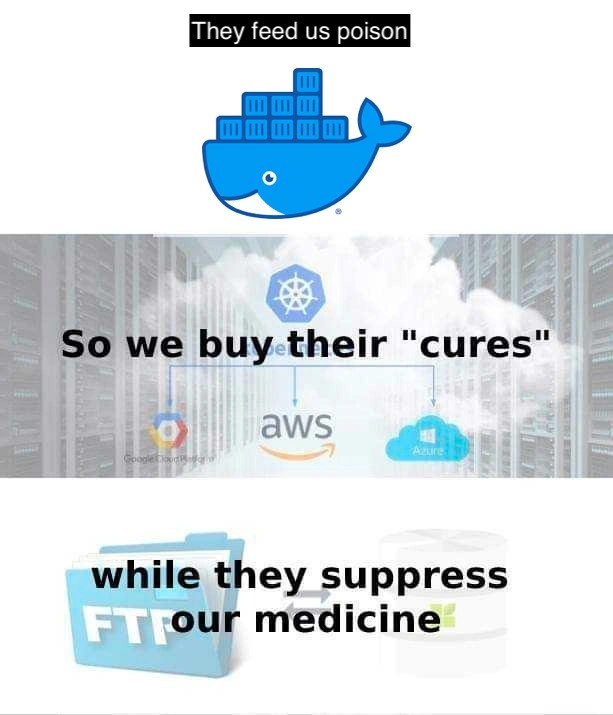
  • Docker (the whale icon) – Docker is a popular tool for containerization. This means it can package an application along with all its libraries and environment into a single unit called a container. Think of a container like a tiny self-contained box that has everything needed to run your app. This solved the “it works on my machine but not on yours” problem by making sure everyone runs the app in the same environment. The meme calls this “poison” not because Docker is bad, but humorously suggesting that once we started using Docker for everything, it led to needing even more complex tools.

  • Kubernetes (the wheel logo in the cloud) – Kubernetes (often shortened to “K8s”) is a system that helps manage many containers across lots of computers. If Docker gives you one container, Kubernetes is what you use when you have, say, 50 containers or more and you want them to run reliably. It handles automatically starting containers, stopping them, moving them if a machine fails, etc. The joke refers to Kubernetes as the “cure” that we buy. Why “buy”? Because setting up Kubernetes yourself is hard, so companies usually use cloud services where the cloud provider (like Google, Amazon, or Microsoft) sets it up for you – for a fee. In the image, that’s why you see Google Cloud, AWS, and Azure logos under the Kubernetes symbol: each offers a managed Kubernetes service. We “buy” this cure by paying those cloud providers to manage our container chaos.

  • FTP and the tape backup (bottom icons)FTP stands for File Transfer Protocol. It’s an old, simple method to copy files from your computer to a server. For example, deploying a website 20 years ago often meant opening an FTP program and uploading your new files to the server. The blue folder labeled “FTP” in the meme represents this no-frills way of deployment. Next to it, the white cylindrical object is a data tape (used in traditional backup systems – imagine storing data on something like a cassette tape). These symbolize the old-school methods: deploying software by just copying files (maybe in a .tar archive, which is a simple packaged file – hence “tarball”) and doing backups the old-fashioned way. The meme calls these our “medicine,” implying they are simple remedies that could fix the problem without all the new complexity.

So putting it together in a real scenario: say you have a small web application. The “medicine” approach would be to just build the app, SCP/FTP the files to a server, and run it – done. The “poison & cure” approach would be to containerize it with Docker, then run it on a Kubernetes cluster hosted on AWS or another cloud. The latter is more powerful, especially if you need to handle a lot of users or run many copies of the app, but it’s also much more complex and costly for a small project. The meme humorously suggests that the industry tends to push everyone toward the complex route. It’s like saying: Modern DevOps practices encourage using containers and clusters for everything (“here, take this new tech!”), and then when that becomes overwhelming, we’re sold cloud solutions to manage it (“don’t worry, we have a service for that – just pay us”). Meanwhile, just copying the darn files with FTP (which costs basically nothing and has zero learning curve) is ignored as an option, almost like it’s been suppressed or forgotten.

To illustrate the difference, compare a simple old deployment to a modern one:

# Old-school deployment: just copy the release to the server (e.g., via SCP, similar to FTP)
scp myapp.zip user@your-server:/var/www/           

# Modern deployment with Docker and Kubernetes:
docker build -t myregistry/myapp:1.0 .            # Package the app into a Docker container
docker push myregistry/myapp:1.0                  # Upload the container image to a registry
kubectl apply -f k8s-deployment.yaml              # Tell Kubernetes to run the container (in the cloud)

As you can see, the modern approach has more steps and tools involved. It offers features like easy scaling (spinning up more containers if traffic increases) and isolation (each service in its container), which are awesome for complex applications. But if you only needed one instance of your app running, the old copy-and-run method was a lot simpler to understand. DevOps engineers and SREs (Site Reliability Engineers) adopt tools like Docker and Kubernetes to make deployments repeatable and scalable, but it can feel like using a sledgehammer to crack a nut when your use case is small. The meme captures that feeling by comically implying the simple solutions are kept out of sight while we chase the new shiny solutions everyone is talking about. It’s a lighthearted reminder that sometimes the old, simple way works just fine, even if it’s not the hot new thing in tech.

Level 3: Kubernetes Kool-Aid

At the industry level, this meme hits a nerve by parodying a “big pharma” conspiracy in DevOps form. The Docker whale (top panel) is labeled as “poison”, which is a cheeky way of saying: we got hooked on containers and it came with side effects. Docker solved real pains – remember the bad old days of “works on my machine, breaks in prod”? By containerizing apps, everyone from developers to SREs embraced this miracle drug of consistency. But once addicted to packing everything in containers, we encountered a new chaos: container sprawl, dependency on container registries, and deployments that now involved dozens of moving parts. The meme caption “They feed us poison” reflects a cynical view that tech vendors and hype fed us this container craze perhaps without highlighting the eventual headaches.

“So we buy their cures” is plastered over the Kubernetes logo and a fluffy Cloud backdrop (middle panel). This is pointing squarely at the managed Kubernetes services from the big cloud providers (note the Google Cloud, AWS, and Azure logos underneath like eager pharmacists). Kubernetes is the cure offered to tame the Docker/container chaos – but it’s a cure you have to pay for, in both money and complexity. Running Kubernetes yourself is non-trivial, so companies end up using GKE, EKS, or AKS (the managed Kubernetes offerings of Google, Amazon, and Microsoft respectively). It’s a classic vendor lock-in play: get everyone dependent on containerization (often open-source and free, like Docker), then monetize the solution to manage those containers at scale. The clouds have turned Kubernetes into a commodity that we rent by the hour. A grizzled DevOps engineer might chuckle and say, “the first hit (Docker) was free, now we’re hooked on the expensive stuff (cloud K8s).” It’s Kubernetes Kool-Aid because so many teams drank it eagerly – sometimes without fully realizing they were signing up for a lot of operational overhead or a hefty cloud bill.

And the kicker: “...while they suppress our medicine” (bottom panel) is written over a blurred FTP folder icon and a tape backup icon. This is the meme’s punchline comparing old, simple deployment methods to folk medicine that’s been shoved aside. It sarcastically suggests that the straightforward solutions from yesteryear – like uploading files via FTP, or tarring up an application and unpacking it on a server, even making backups to trusty tape – are the “medicine” that actually works, but nobody talks about them anymore (suppressed by the industry). It’s poking fun at our tendency to label these old-school practices as obsolete or laughably primitive. Sure, copying files over FTP or running a single server isn’t cloud-native or sexy, but it’s simple and it works (for small-scale needs at least). The meme exaggerates that “they” (the tech giants, the industry trends) actively suppress these methods – of course in reality no one is banning FTP deployments, but it can feel that way when every conference talk, blog, and tool pushes you toward containers and Kubernetes for even the tiniest app. Ever sat in a meeting where someone suggests a simple solution, and the reply is “that’s not how we do things anymore”? That’s the vibe here.

This resonates with seasoned developers because we’ve seen the overengineered infrastructure scenario play out: a small project ends up with a labyrinthine Kubernetes setup because the team just followed what FAANG companies do, or what the cloud providers recommend. It’s the equivalent of using a rocket ship to deliver pizza – effective, maybe, but ridiculously overkill. Many of us have war stories: the 3 AM outage where the entire cluster went down due to a misconfigured liveness probe, or the week spent debugging YAML indentations and Helm charts just to deploy a minor update. In those dark moments, one can’t help but think, “Remember when deploying was just copying a file and restarting a service? That was our medicine – it wasn’t elegant, but I could do it in my sleep.” The humor here comes from that shared pain – we laugh because we know exactly how a supposedly simple DevOps improvement turned into an entire ecosystem of tools, dashboards, and on-call nightmares. Kubernetes was meant to be our cure for deployment headaches, and it does cure a lot at large scale, but it also introduced its own learning curve and failure modes. It’s a paradox every experienced engineer recognizes: sometimes the “solution” creates a new class of problems. The meme just frames it colorfully: Docker gave us new symptoms, Kubernetes is the expensive treatment, and the low-tech remedies (FTP, tarballs, good ol’ cron jobs and bash scripts) are sitting on the sidelines like unadvertised generic drugs. It’s a tongue-in-cheek critique of how our industry loves complicated “modern” solutions, often dismissing the simple stuff that, while not cool, might just get the job done with far less fanfare.

Level 4: Iatrogenic Infrastructure

In medicine, iatrogenic refers to an illness caused by the treatment itself. Our industry has its own version of this phenomenon: solutions that introduce new problems requiring even heavier solutions. Docker’s containerization was a cure for the “it works on my machine” plague – it standardized environments by using OS-level isolation (via Linux cgroups and namespaces). This was great initially, but it carried a poison pill of its own: once everything is containerized, you suddenly have hundreds of containers to run, update, and keep consistent. We essentially transformed deployment into a distributed systems problem. Managing one machine’s configuration gave way to scheduling workloads across many nodes, handling inter-container networking, and maintaining desired state despite failures. Complexity wasn’t eliminated; it was conserved and merely shifted to a new layer. It’s a bit like a law of thermodynamics for software architecture – call it the Conservation of Complexity: you can move complexity around, but you can’t destroy it.

Enter Kubernetes – effectively an operating system for your data center. Kubernetes is the massive “cure” to orchestrate the swarm of Docker containers, and it’s built on serious distributed systems theory. Under the hood, a Kubernetes cluster relies on a consensus algorithm (the Raft protocol via etcd) to keep the cluster’s state in sync across multiple masters – this is the same kind of brain-bending consistency problem you study in distributed computing (thanks, CAP theorem). Scheduling containers onto nodes isn’t trivial either – it’s essentially a bin-packing NP-hard problem, so Kubernetes uses heuristics and smart controllers to decide which container runs where. We’ve gone from deploying an app to solving mini versions of the travelling salesman and consensus problems every time we scale. The meme exaggerates this as “poison and cure,” but there’s truth to it: Docker made deployment possible anywhere, yet at scale it made deployment everywhere at once, forcing us to adopt brainy infrastructure to manage the chaos. We’ve architected an ouroboros where the cure (orchestrators) exists because of the cure before it (containers) – a paradox of progress where each solution begets a new problem. It’s brilliant engineering, sure, but also a reminder: in tech there’s no free lunch – or as this meme implies, no free launch either. Every new layer of abstraction is hiding complexity that doesn’t disappear; it piles up in the background, waiting to bite at 3 AM.

Description

The meme is arranged in three stacked panels. Top panel: black caption bar with white text "They feed us poison" above a large blue Docker whale icon. Middle panel: faint data-center background with a fluffy cloud; inside the cloud sits the Kubernetes wheel logo, and arrows point down to the Google Cloud, "aws", and Azure logos. Bold black text over this scene reads "So we buy their \"cures\"". Bottom panel: a blue folder icon labeled "FTP" and a white backup-tape icon sit blurred in the background; bold text says "while they suppress our medicine". The joke equates Docker containers to "poison", managed Kubernetes offerings on major clouds to the expensive "cures", and old-school FTP / tarball deployments to the inexpensive "medicine" that is supposedly being ignored, riffing on vendor lock-in and DevOps complexity


Comments

6
Anonymous ★ Top Pick We replaced a one-line “scp app.tgz prod:/var/www” with 400 lines of Helm YAML, called it progress, and now pay AWS a premium for the privilege of debugging our own DNS
  1. Anonymous ★ Top Pick

    We replaced a one-line “scp app.tgz prod:/var/www” with 400 lines of Helm YAML, called it progress, and now pay AWS a premium for the privilege of debugging our own DNS

  2. Anonymous

    We spent three sprints building a service mesh to handle the complexity of our 47 microservices, when Dave from 2003 just points out we could've used rsync and a cron job

  3. Anonymous

    After 15 years of Kubernetes YAML archaeology and multi-cloud cost optimization, you realize the intern's FTP script from 2005 had 99.99% uptime and cost $3/month. But hey, at least we're cloud-native now - and only three Helm charts away from deploying a static HTML page

  4. Anonymous

    Docker hooks you on containers, clouds hawk the K8s antidote at scale pricing - meanwhile FTP's been the free, unpatched cure since '71

  5. Anonymous

    Somewhere between “tar | ssh | rsync” and “apply 14 CRDs to three managed clusters,” we invented a recurring bill and called it Cloud Native

  6. Anonymous

    Docker is the poison, managed K8s is the cure, and the suppressed medicine is still ftp/rsync a tar.gz then systemctl restart - the only deploy that doesn’t need a control plane or a surprise cloud bill

Use J and K for navigation