AI Evolution: Expectation vs. My Reality
Why is this AI ML meme funny?
Level 1: Broken Toy, Not Monster
Imagine you have a little toy robot. All the newspapers are shouting that this robot will soon start thinking for itself and turn into a giant, unstoppable machine – pretty scary, right? But meanwhile, in your room, the actual toy robot you have is acting goofy. It keeps bumping into the wall, spinning in circles, and sometimes it even goes backwards when it’s supposed to go forwards. It’s definitely not turning into a mega-brain robot overlord; if anything, it’s getting more mixed-up. This contrast is what makes the situation funny.
People are very afraid of a big monster that isn’t really there, while you’re looking at your own toy and thinking, “Huh, this thing can barely even move right.” It’s like everyone is yelling, “The sky is falling! The sky is falling!” about your robot, but you’re watching the robot try (and fail) to tie its own shoelaces. The big headline said the robot is evolving into something super advanced all by itself, but you see it kind of going backwards in how well it works. That mismatch – huge fear versus silly reality – is why we laugh. It’s poking fun at how people sometimes make big, scary stories about new technology, even when the real experience is that it’s still clumsy and not scary at all. In short, they expect a monster, but all you’ve got is a broken toy.
Level 2: Evolving vs Overfitting
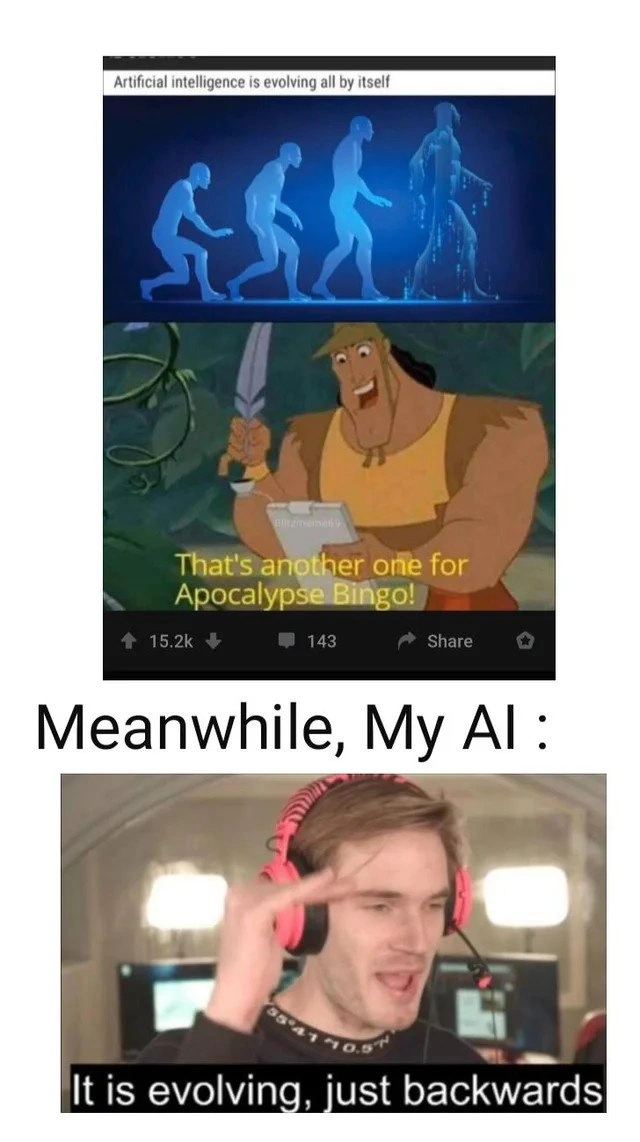
Let’s break down what’s going on in this meme in simpler terms. The top part shows a hype headline and imagery: “Artificial intelligence is evolving all by itself.” This is something you might see in a news article that’s trying to excite or scare people about AI. It suggests that AI – which is basically software that learns from data – might be growing beyond our control, like a creature that keeps getting smarter on its own. The picture of the evolutionary sequence (ape → human → weird blue liquid figure) dramatizes that idea. It’s like saying, “First came primitive animals, then humans, and now AI is the next step – and who knows what it will become!” For someone not in the field, that sounds both amazing and a bit terrifying. Are machines really just teaching themselves new tricks overnight? The media loves these kinds of dramatic narratives as part of the AI hype cycle – a pattern where a new technology gets talked up as world-changing before it’s actually practical.
Next to that, we have Kronk from Disney, holding a notepad and grinning. In the movie, Kronk is a goofy character, and here he’s shown saying “That’s another one for Apocalypse Bingo!” This is a humorous way to say, “Oh look, yet another doomsday prediction about AI – I’m collecting these because they’re so common.” The idea of “Apocalypse Bingo” is a joke: bingo is a game where you mark off squares when certain events happen; here each square is a cliché about AI causing the apocalypse. Kronk marking his bingo card implies we’ve heard these dramatic lines so often that it’s predictable – almost a game to spot them. In tech circles, developers often roll their eyes at headlines that claim “AI will soon destroy us” or similar sensational claims. They might tag it #AIHypeVsReality on social media, highlighting the gap between what the public reads and what engineers experience.
Now, look at the bottom half. It starts with the phrase “Meanwhile, My AI:” in big text. “Meanwhile” sets up a contrast: while all that crazy hype is going on, here’s what’s happening in my world. And what do we see? A guy with bright pink headphones (that’s a famous YouTuber named PewDiePie, by the way) making a silly gesture, with the caption “It is evolving, just backwards.” This is a popular meme reaction image used to joke that something expected to improve is actually getting worse. In this context, “My AI” refers to the AI model or project that I, the engineer or data scientist, am working on. So while the newspapers say AI is an unstoppable evolving force, my personal AI system might be failing spectacularly.
Let’s decode “It is evolving, just backwards.” How can something evolve backwards? Evolution usually means progress or getting more advanced. “Backwards evolution” is a funny way to say it’s going in the wrong direction – it’s devolving. In terms of AI or machine learning, this often happens when a model regresses in performance. For example, imagine you built a program to generate text. At first, it produces some coherent sentences. You then fiddle with the settings or train it more, hoping it gets better – but now it starts spitting out nonsense words or the same word over and over. It’s as if the AI “learned” to be worse. This is usually due to a concept called overfitting or some bug in the training process. Overfitting means the AI learned the training examples too well, even the random quirks in them, so it lost the ability to handle new cases. It’s like memorizing practice questions for a test but failing the actual exam because the questions are different. In short, the model’s results “evolved backward” from good to bad.
This is a common beginner’s stumbling block in AI/ML projects: you tweak your neural network or add more training data, expecting improvement, but suddenly your validation accuracy (performance on unseen data) drops. It feels baffling – shouldn’t more training make it smarter? Not always! If you train too long or without the right checks, the model starts specializing too much for the training set and gets worse at general tasks. That’s why developers joke about their AI “devolving.” It’s a playful way to cope with frustration: you expected a breakthrough, but got a breakdown instead.
Now tie that back to the meme: The humor comes from the stark contrast. On one hand, AI_hype suggests AI is on a one-way track to godlike intelligence (fear the robot uprising!). On the other hand, the AI_limitations we encounter daily make the tech feel clumsy and even dumb at times (my chatbot can’t remember what was said two lines ago!). It’s basically saying, “People think I’m creating the next Terminator, but I’m actually babysitting a program that can’t even perform a simple task consistently.”
A bit about Kronk and the format: The Kronk_template (Kronk with notebook) is often used in memes to depict someone cheerfully noting down something absurd or ironic. Here Kronk is documenting the absurd media hype – treating scary headlines as if they’re just expected items in a game. This adds to the comedic tone: instead of panicking at “AI is evolving by itself,” the dev community (through Kronk) responds with “Ha! Another silly prediction, noted!” It’s a form of satire.
Finally, the categories and tags give clues to the themes. AI_ML indicates it’s about artificial intelligence and machine learning. IndustryTrends_Hype tells us it’s commenting on industry buzz or exaggeration. Bugs is there because the “my AI is regressing into gibberish” part is essentially an ML bug or failure (something not working as intended). Tags like AIHumor and AIHypeCycle explicitly confirm this is poking fun at the hype cycle of AI – the pattern of inflated expectations and the often disappointing reality. Model_degradation (another tag) is exactly what it sounds like: a model getting worse over time or with certain changes, the technical term for our “backwards evolution.”
In simpler terms, if you’re a junior developer or a student, this meme is highlighting a lesson you eventually learn: Take sensational tech headlines with a grain of salt. Often, what’s going on behind the scenes is far less magical – and sometimes even comically problematic. It encourages a healthy skepticism and also a bit of self-deprecation: even as we build these complex AI systems, we can admit they’re far from perfect. In fact, they can be pretty dumb in unexpected ways! And that contrast – between the world expecting sci-fi miracles and the engineer watching their model blunder – is pure comedic gold in developer circles.
Level 3: Overfitting Overlords
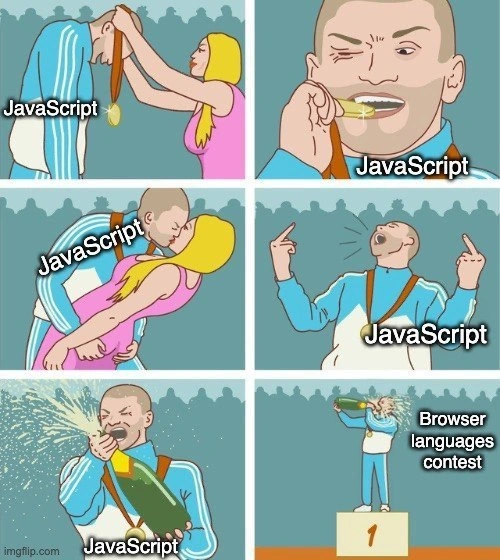
The meme’s juxtaposition nails a common sentiment in the tech community: the absurd gap between AI hype and the day-to-day reality of working with models. On the top, we have the dramatic headline “Artificial intelligence is evolving all by itself” plastered over an ominous blue evolution graphic. This image goes from ape to human to some distorted, liquid-looking figure – a visual metaphor for an AI supposedly transcending humanity into an unknown form. It screams “The machines are coming for us!” and belongs on the front page of a tech tabloid. In the same panel, we see Kronk (the lovable henchman from Disney’s The Emperor’s New Groove) gleefully jotting in a notepad, saying “That’s another one for Apocalypse Bingo!”. This is a perfect IndustryTrends_Hype satire. Developers have seen so many doomsday proclamations about AI – each more sensational than the last – that it’s like we’re playing a game of bingo with buzzwords. Every time a headline predicts the AI apocalypse or claims “AI did X with no human help!”, we figuratively mark a square on our Apocalypse_Bingo card. Kronk’s goofy grin and giant knife (hilariously out of place) emphasize how over-the-top these predictions feel; he’s treating it like a game, because from a dev’s perspective, it often is just that: hype to chuckle at.
Now compare that to the bottom panel labeled “Meanwhile, My AI:” – this setup is a classic meme formula to contrast expectations vs. reality. The bottom shows a gamer/YouTuber (that’s actually PewDiePie in one of his meme reviews) wearing bright pink headphones and making a baffled gesture at his temple. The subtitle reads “It is evolving, just backwards.” The punchline lands here: while the media proclaims runaway evolution, the developer’s own AI model is figuratively de-evolving. This nails the shared experience of AI/ML engineers: your model’s performance was getting better for a while, then something went horribly wrong – now each new training epoch makes the output more nonsensical. It’s AIHumor at its finest because it’s painfully relatable. Instead of an all-powerful Skynet, we get a glitchy system that might have once generated coherent predictions but now spits out gibberish like an overly caffeinated parrot.
Why is this so funny (and a bit tragic)? Because AIHypeVsReality is a real struggle. In meetings or press releases, we hear grand statements like “Our AI will disrupt industries” and headlines warn of “algorithms outsmarting humans.” But in practice, engineers spend evenings hunting down Bugs in the data preprocessing, or realizing the model has overfit to pointless noise. Overfitting is when a model learns the training data too well – including its errors and quirks – so it loses the ability to generalize to new data. In other words, it becomes a gibberish generator on any input it didn’t see before. It’s the ML equivalent of memorizing answers to specific questions rather than understanding the material. The meme’s “evolving backwards” quip succinctly describes that scenario: instead of learning and improving (forward evolution), the AI gets more confused (backward evolution) the more you tweak it.
This is a commentary on the AI Hype Cycle: early in a hype cycle, every development is over-interpreted as a sign of imminent revolution. Journalists might take a genuine research finding – say a neural network that learned a trick or two without explicit instruction – and inflate it to “AI is now teaching itself and will surpass us soon.” Meanwhile, engineers on Reddit or Twitter respond with dry humor because they know the gritty truth. For example:
- A headline screams “AI discovers new language on its own!” – likely referring to an algorithm finding structure in data – but a developer quips, “My chatbot can’t even hold a polite conversation without drifting into randomness.”
- Media claims “This algorithm mastered a video game with no human input,” while devs know an army of PhDs spent months adjusting the reward function and the AI still tries to walk through walls half the time.
- Think of phrases like “Skynet is coming” whenever a new military AI project is announced. After work, the engineers behind it are probably debugging why their object recognition model thinks a school bus is a giant yellow elephant.
To capture this contrast, let’s use Kronk’s bingo metaphor. The Apocalypse Bingo card is filled with squares like “AI becomes conscious,” “Robots take jobs,” “Algorithm ends humanity,” etc. Each sensational headline lets developers tick another box. It's dark comedy – we’re essentially satirizing the predictability of AI doomsaying. And Kronk, an upbeat but dimwitted cartoon character, is the perfect avatar for how ridiculous those headlines sound to an expert. It’s like saying, “Yep, heard that one before! Almost won bingo with ‘AI overlords’ last week.”
Simultaneously, the AI_Limitations on the ground are humbling. Models break in prosaic ways: they drift off target if data sources change (a phenomenon known as concept drift in ML), or they latch onto stupid correlations (like assuming anything with text “finance” is spam because of biased training data). The meme’s bottom image of PewDiePie with the caption is actually a known meme template itself – used whenever something is supposed to be improving but is actually getting worse. It resonates with developers doing ML because we’ve all seen a training loss curve that looks great until your model faces real-world input – then it falls on its face.
The broader industry joke here: While outsiders fret about AI evolving unchecked, we’re often rebooting servers at 3 AM because some model crashed with a NaN (not-a-number) error or started outputting only the word “the” endlessly. It’s a form of collective impostor syndrome – people think we’ve built a digital Einstein, but we know we’ve cobbled together something held by virtual duct tape, ready to break if you look at it funny. The humor has a cathartic edge: it’s laughing at the hype to cope with the daily grind of debugging finicky algorithms.
To sum up the senior perspective: The meme is funny because it juxtaposes grandiose expectations with inglorious reality. It pokes at the AI hype cycle, reminding us that for every mind-blowing demo, there are countless failed training runs. It also subtly acknowledges the whiplash engineers feel – one minute reading about how AI will end civilization, the next minute wrestling with a model that seems to be uncivilized itself, babbling like it’s had one energy drink too many. In the end, we’re chuckling because it’s always better to laugh at the absurdity than to cry over your GPU cluster’s latest bout of nonsense.
Level 4: Not-So-Natural Selection
At the cutting edge of AI research, there's a stark difference between sensational headlines and cold reality. The meme’s top headline “Artificial intelligence is evolving all by itself” evokes images of a digital Darwinian leap – as if a machine learning model might wake up one day and start rewriting its own code in a bid for world domination. In theoretical discussions of Artificial General Intelligence (AGI) and the singularity, this idea of an AI improving itself without human intervention is often dubbed the FOOM scenario (a rapid takeoff to superintelligence). But today’s algorithms are a long way from any genuine self-directed evolution.
In reality, most machine learning models “evolve” only within the rigid framework we design. A neural network doesn’t sprout new goals overnight; it methodically tunes millions of weighted connections via gradient descent – essentially a giant math engine gradually minimizing an error function. This is more calculus than consciousness. While researchers do experiment with evolutionary algorithms (think digital natural selection where many candidate models mutate and the fittest survive each generation), even those are carefully orchestrated by human programmers with a clear fitness metric. The “evolution” is metaphorical, not a spontaneous act of AI will. It’s a bit like letting a thousand AI monkeys at a thousand typewriters, but we’re still the ones providing the typewriters, paper, and a banana for hitting the right keys.
Now consider the humor in “evolving, just backwards.” This phrase hints at a dirty secret of ML: models can degrade if mishandled or over-trained. In theory, training should monotonically improve a model on its task, but often we see overfitting – after a certain point, additional training makes the model worse at generalizing. It’s as if evolution ran in reverse: the model becomes super-specialized to weird quirks of the training data (like a creature that adapted too specifically to a niche environment) and loses its broader survival skills. Mathematically, the optimization might have slipped into a local minimum that satisfies the training data perfectly but fails everywhere else. This is analogous to “devolving” – a once-promising learning process starts outputting gibberish or nonsense as it caves in to spurious patterns. There’s even a term in software for this kind of reversal: a regression, when new changes make a system revert to a broken state it had previously overcome. So when the dev in the meme says “My AI is evolving… just backwards,” it’s a tongue-in-cheek acknowledgement that instead of marching toward superintelligence, their model is stumbling away from sanity.
Fundamentally, there are physical and theoretical limits preventing the sci-fi notion of unchecked AI evolution. Entropy in closed systems, the need for energy and information input, and the mathematical constraints of learning all act like nature’s brakes. An ML model can’t just invent new knowledge out of thin air beyond its training distribution – it’s bound by the data it’s been given and the target objective we set. In academic terms, an AI’s capability is constrained by its objective function and training regime; it isn’t going to suddenly rewrite its own objective to “take over the world” unless a human coded a reward for that (and really, that’s on us!). This is why veteran engineers roll their eyes at headlines implying emergent consciousness: we know current AI is more akin to an auto-tuning statistical machine than a scheming digital lifeform. So, while the media conjures an image of a glowing blue apex intelligence rising beyond our control, the sober reality is that today’s AI is still very much under our mathematical thumb – sometimes frustratingly so, as it happily optimizes itself into a corner if we’re not careful.
Description
A three-part meme contrasting the public perception of AI with a developer's experience. The top section shows a Reddit post titled 'Artificial intelligence is evolving all by itself,' featuring an image of human evolution culminating in a digital being, followed by the 'Apocalypse Bingo' meme with Kronk from 'The Emperor's New Groove'. This represents the hype and fear of a superintelligent AI takeover. Below this, the text 'Meanwhile, My AI:' introduces the reality. The bottom panel features streamer PewDiePie pointing to his head with the caption, 'It is evolving, just backwards.' The joke is a classic expectation vs. reality scenario for machine learning engineers, who often struggle with models that degrade in performance during training due to issues like overfitting or poor data, a far cry from the unstoppable, self-improving AI of science fiction
Comments
7Comment deleted
The public fears Skynet, but my model just achieved a groundbreaking 105% loss and is now actively uninstalling Python
Leadership: “Brace for the singularity - our model is evolving!” Observability dashboard: loss at ∞, accuracy at 0, and the latest inference is just `{}`. If this is evolution, we’re about two deploys away from primordial JSON
The board is worried about AGI while I'm still explaining why our model confidently insists that 2+2=5 after we added enterprise authentication middleware
The real AI evolution: from 'it'll replace all developers' to 'it can't even parse this JSON without hallucinating extra commas.' We went from fearing AGI to debugging why GPT-4 insists our perfectly valid regex is 'deprecated syntax from 1987' - turns out the only thing evolving is our collection of AI failure screenshots for Slack
Headline says AI is self‑evolving; my canary did too - after the RLHF pass it evolved catastrophic forgetting and achieved a new SOTA: State Of The 2019 baseline
My AI evolves backward: every auto-retrain on prod drift adds confidence and removes accuracy - pure Goodhart; we call it regression-driven development
AGI evolves toward godhood; my fine-tuned model hits a cul-de-sac of catastrophic forgetting mid-prompt