AI Will Let Everyone Build Software Like We All 3D Print Our Own Furniture
Why is this IndustryTrends Hype meme funny?
Level 1: When Promises Meet Reality
Imagine someone on TV saying, “This new robot oven is so amazing, soon everybody will be a master chef and bake their own cakes every day!” That sounds cool, right? But do you think everyone will really do that? Probably not. Sure, a fancy oven or a helpful cooking gadget can make baking easier, but most people will still just go buy a cake from the bakery when they need one. Why? Because baking a perfect cake yourself still takes time and skill, and sometimes you just want the easy, already-made option. The meme is making the same kind of joke. It’s like saying: “This new AI is so powerful, soon everyone will create their own computer games or apps all by themselves!” In theory it sounds great, but in real life most people won’t do that – it’s much easier to download an app that’s already made. The joke compares it to another promise: a few years ago, people were saying “3D printers are so great, soon everyone will print their own furniture at home!” Did that happen? Nope. Most of us still buy our chairs and tables from the store, because building a whole chair yourself (even with a cool machine) is a lot of work and can be tricky. So the meme is funny because it points out this simple truth: just because a new technology exists doesn’t mean everyone will use it to do things the hard way. It’s poking fun at big promises that didn’t come true, by sarcastically suggesting something we can all see is silly. In other words, it’s saying, “Yeah, sure… we’ll all suddenly start making everything ourselves – just like we all totally 3D-print our own sofas (not!).” It makes us laugh because we know nobody actually does that!
Level 2: AI Code vs DIY Furniture
Let’s break down the comparison in this meme. On one side, we have AI-generated code – tools like ChatGPT or GitHub Copilot that can write programming code from a user’s description (for example, you tell the AI “make me a simple website for my cupcake shop” and it tries to produce the code for you). This represents the idea of AI democratization in software: making coding so accessible that even people with no programming experience can create their own software. It’s part of an ongoing trend in the tech industry to simplify programming (you might have also heard of “no-code” or “low-code” platforms with a similar goal). On the other side of the meme’s analogy is 3D printing – specifically the hype that existed about a decade or so ago around consumer 3D printers. A 3D printer is a machine that can create physical objects layer by layer from materials like plastic. Back then, many futurists and tech enthusiasts were excited about a vision where everyone would have a 3D printer at home and print everyday objects themselves instead of buying them. Some went as far as to suggest we’d all print our own furniture or kitchen utensils on demand.
Now, here’s why the meme is funny to developers: it points out that neither of these rosy predictions has (or likely will) come true for the average person. Why not? Because in practice, these technologies aren’t as plug-and-play for complex tasks as the hype implies. For example, a 3D printer can indeed print objects, but using it isn’t like pressing “Print” on a Word document. If you wanted to print a sofa, you’d have to know how to design or obtain a detailed 3D model of a sofa, ensure your printer is large and sophisticated enough (most home 3D printers are small, printing a sofa would require industrial-scale printers or assembling pieces), and manage a process that could take many hours or even days of printing with lots of trial and error. The average person doesn’t have the time, skills, or inclination for that – it’s much easier to just buy a ready-made sofa from a furniture store. That’s why the idea that “we all 3D print our own furniture” is tongue-in-cheek; in reality, only hobbyists and professionals use 3D printers regularly, and they’re usually making smaller objects or prototypes, not entire couches for the living room.
Now consider AI coding tools. It’s true that tools like ChatGPT have made it easier to get code quickly. You can ask for a simple program and often get something that runs or at least a starting point. This is a huge advancement in AI/ML technology and can help developers be more productive. The hype, however, suggests “With AI, everybody will make their own software,” meaning even people who aren’t programmers will be able to create complex apps just by telling the AI what they want. While it’s possible to create basic scripts or websites with AI assistance, building complete, reliable software is much more involved. Software development isn’t just writing a few lines of code; it includes planning the features, designing the user interface, ensuring the software works correctly (testing), fixing errors (debugging), and maintaining the software over time (adding updates, keeping it secure, etc.). Current AIs can help generate code, but they often make mistakes or produce code that needs a lot of tweaking. If you don’t know how to program at all, using AI to code is like using a tool you don’t fully understand – when something goes wrong (and it inevitably does), you might not know how to fix it. It’s similar to giving a person who’s never built furniture a very advanced power tool: they might cut some pieces of wood with it, but constructing a whole cabinet that doesn’t wobble is another story. In short, the meme highlights a reality check: just because technology exists doesn’t mean it eliminates all the skill and effort required. It’s a humorous reminder that bold claims in tech (especially on Twitter) should be taken with a grain of salt. The AI hype vs. reality comparison to the 3D printing hype is an easy way to illustrate that point – both were said to empower everyone, but ultimately only a fraction of people actually end up using them hands-on. Developers find this comparison funny and very relatable, because they’ve seen many such “revolutionary” promises fizzle out in practice.
Level 3: Democratization Déjà Vu
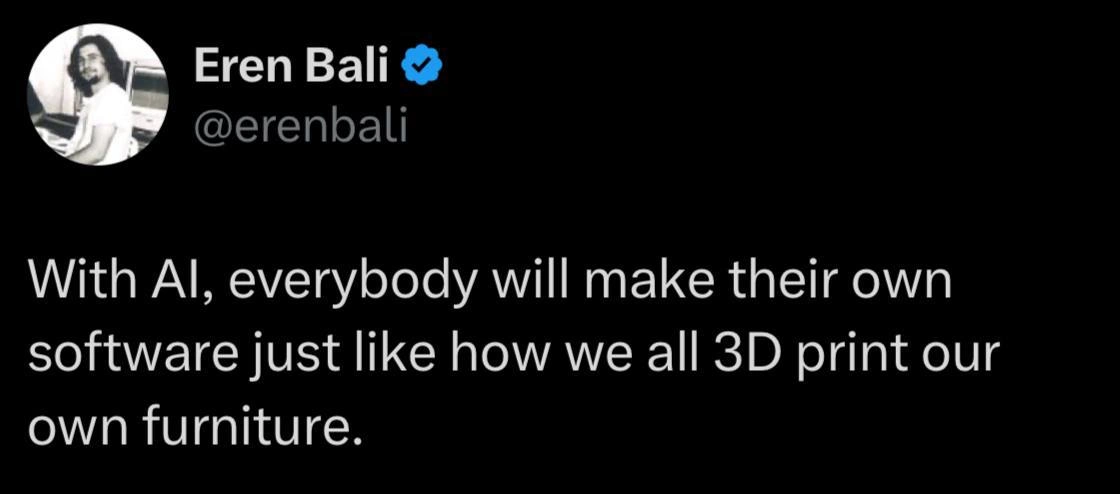
"With AI, everybody will make their own software just like how we all 3D print our own furniture." – The tweet drips with sarcasm as it invokes a recurring tech hype. Seasoned engineers recognize this pattern: every few years a new technology promises to democratize a complex skill. In the 2010s, tech pundits insisted cheap home 3D printers would let us all become DIY furniture makers; we’d be cranking out sofas in our garages instead of driving to IKEA. Fast forward to the mid-2020s, and the hot promise is generative AI turning everyone into a programmer overnight. The humor comes from the stark contrast between utopian predictions and actual reality. Just as 3D printing didn’t transform us into master carpenters, AI coding assistants won’t instantly make every person a software engineer. The tweet’s author, likely a jaded tech veteran, is effectively saying “Sure, and pigs will fly – right after we all print our living room sets on a MakerBot.”
At its core, this meme is mocking the AI hype cycle by drawing a parallel to the 3D printing hype that many of us lived through. Both technologies are genuinely powerful – 3D printers can create custom parts, and modern large language models like GPT-4 can write code – but the devil’s in the details (and in the debugging). Why hasn’t every household embraced 3D-printed furniture? Because it turns out designing and printing a comfy sofa is hard work: you need CAD skills to model it, a printer that can handle large objects, and lots of time and plastic filament. The results often look like a lumpy art project rather than a showroom piece. In other words, the friction and complexity outweighed the convenience. Sound familiar? It should: that’s exactly what cynical devs predict for the “AI will let everyone code” mantra. Yes, AI code generators can spit out lines of Python or JavaScript from plain English prompts, but building production-grade software involves a lot more than just getting code to compile once. Integration pain, edge cases, security, performance, maintainability – these messy realities don’t magically disappear just because an AI suggested some code. “Everyone can code now” conveniently ignores the endless refinements and late-night debugging sessions needed to turn a code snippet into a reliable app. It’s the last-mile problem: prototypes are easy; polished systems are hard.
The meme resonates with developers because we’ve been through hype cycles before and earned the right to be skeptical (or at least very sarcastic). Remember when no-code platforms were going to eliminate the need for professional programmers? Or when drag-and-drop app builders were the future and all businesses would make their own apps without hiring devs? Those tools found a niche, sure, but they didn’t put Stack Overflow out of business. There’s always that gap between “anyone can do it!” marketing and the reality that “almost no one actually does it.” We still end up needing specialists, whether it’s carpenters to build sturdy furniture or developers to wrangle clean, efficient code. Generative AI is amazing – it truly can help automate boilerplate and suggest solutions – but it isn’t some magic wand that eliminates the hard parts of software engineering (if anything, it sometimes writes plausible-looking but wrong code that a real dev must painstakingly fix). The joke here is a collective eye-roll: “Sure, AI will make programming so easy that everyone will do it... just like how all of us, of course, design and 3D-print our own sofas at home. Oh wait – we don’t.” It’s a wry reminder that hype tends to repeat itself, and those who’ve been around the tech block can’t help but chuckle at the naïveté.
Description
A screenshot of a tweet by Eren Bali (@erenbali, verified) that reads: 'With AI, everybody will make their own software just like how we all 3D print our own furniture.' The tweet is a sarcastic comparison highlighting the overhyped prediction that AI will democratize software development by drawing a parallel to 3D printing - a technology that was similarly predicted to revolutionize manufacturing but never achieved mainstream consumer adoption for furniture production. The implied message is that most people will never build their own software regardless of AI capabilities, just as most people never 3D printed their own furniture
Comments
11Comment deleted
The 3D printing revolution gave us 90% Benchy boats and 10% useful objects. The AI coding revolution will give us 90% todo apps and 10% Stack Overflow questions about why the todo app doesn't work
My AI-generated app works about as well as my 3D-printed chair: it looks plausible from a distance, supports no real-world load, and the source material is a mess of spaghetti
Sure, I’ll worry about AI replacing me right after I finish recompiling the firmware on my 3-D-printed chair that collapsed during stand-up
Remember when we were all going to quit our jobs and become 3D printing entrepreneurs from our garages? Now AI is the new 'everyone will do X' - except this time it's generating spaghetti code instead of wobbly plastic Yoda heads. At least the 3D printer failures made good doorstops
Ah yes, just like how we all 3D print our furniture - right after we finish hand-crafting our own silicon wafers and bootstrapping our compilers from punch cards. The reality is that AI code generation tools are powerful *assistants* for those who already understand software architecture, not magic wands that eliminate the need for engineering expertise. Turns out 'prompt engineering' is just 'requirements gathering' with extra steps, and debugging AI-generated code still requires knowing what correct code looks like - much like how 3D printing furniture requires understanding structural engineering, material properties, and why your chair keeps collapsing
Wake me when prompt‑to‑prod also handles auth, migrations, SLOs, GDPR, and rollbacks; otherwise it’s just STL‑to‑sofa energy
Let everyone ship via prompts - then call me when their DIY app needs SSO (SAML/SCIM), observability, and a 2 a.m. rollback plan that isn’t “paste the previous prompt.”
AI apps will be as ubiquitous as 3D-printed furniture: custom-built, rarely used, and impossible to maintain without calling in the pros
Tbh, 3D printng is a lot less accessible Comment deleted
what you need to print a chair: a $30K industrial 3D printer and a few thousand dollars on materials what you need to start coding: an internet connection Comment deleted
To start coding, you don't need to be connected anywhere, but rather just an IDE or a plain text editor. Comment deleted