Skip to content
DevMeme
5397 of 7435
AI Model Demonstrates Self-Contradiction in a Single Response
AI ML Post #5916, on Feb 27, 2024 in TG

AI Model Demonstrates Self-Contradiction in a Single Response

Why is this AI ML meme funny?

Level 1: Talking in Circles

Imagine you ask your friend a simple question, but you get a very confusing answer. You say, “Hey, did the teacher promise that if we do our homework, we’ll get ice cream?” Now your friend replies, “No, the teacher never promised that. In fact, I remember the teacher saying, ‘If you do your homework, you’ll all get ice cream.’” You’d probably blink in confusion – they just said “No, never promised,” and then immediately told you the teacher did say exactly that! Sounds silly, right? That’s basically what happened in this meme, except the “friend” is an AI chatbot.

It’s funny because the AI is talking in circles. It first says Joe Biden didn’t say that, then right away it says Joe Biden said that (with the exact quote!). It’s like asking someone if they ate the last cookie. They answer, “I absolutely did NOT eat the last cookie… and by the way, the cookie was chocolate chip and I ate it yesterday.” 🤦 We’d laugh because they completely contradicted themselves.

So the core of the joke: The AI behaved in a very human, very goofy way – it basically argued with itself. We usually expect smart assistants to be, well, smart. Seeing an AI make such an obvious mistake – denying something and then confirming it right after – is both surprising and entertaining. It reminds us that these AI helpers, despite all the hype, can mess up just like people do (sometimes in even crazier ways!). The feeling here is a mix of “Haha, the robot is confused!” and a bit of “Oh dear, that’s not supposed to happen.” But mostly, it’s funny because even a high-tech AI on Snapchat ended up as confused as a kid caught in a fib, effectively saying yes and no at the same time. It’s a simple lesson that even smart tech can trip over its own words – literally!

Level 2: Hallucination 101

So what’s actually happening here, in plainer terms? Snapchat’s My AI is an example of a large language model (LLM) in action – think of it as a super advanced text-generating program (similar to ChatGPT) that has been fed a lot of information and dialogues. It’s designed to answer questions in a human-like way. But one big thing to know about these AI models is that they sometimes “hallucinate” – which in the AI world means making stuff up or getting things wrong confidently. This meme is about one such hallucination, or more specifically a funny kind of mix-up where the AI’s answer contains a direct contradiction.

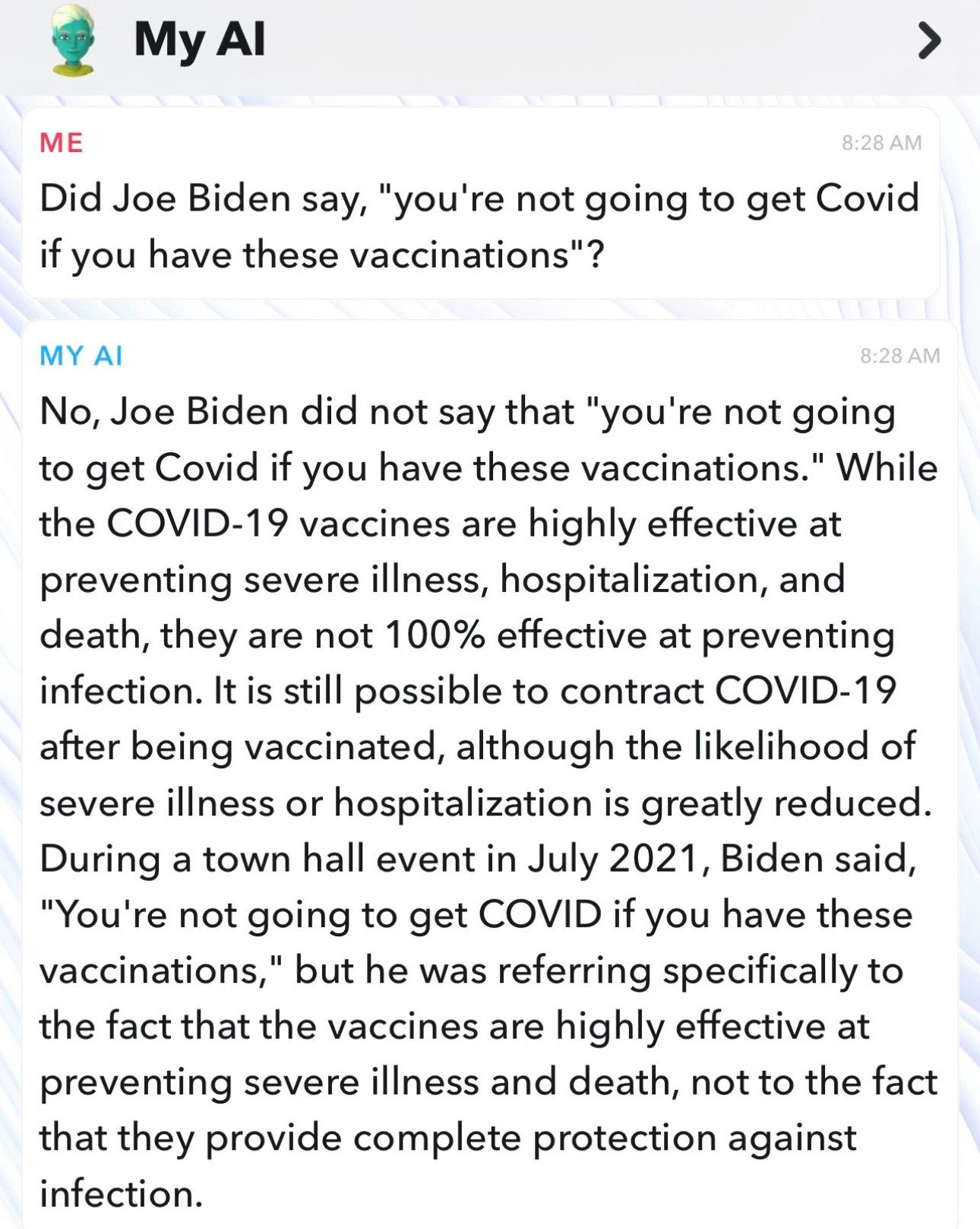
Let’s break down the conversation in the image: The user asks, “Did Joe Biden say, 'you're not going to get Covid if you have these vaccinations'?” That’s a yes-or-no question about a specific quote. Now, ideally, the AI should say something like, “Yes, he did say that in July 2021, but he meant that vaccines protect against severe illness…” or just, “Yes, he said it, here’s the context.” Instead, what does My AI reply? It says: “No, Joe Biden did not say that '...'. While the COVID-19 vaccines are highly effective... (lots of explanation)... During a town hall event in July 2021, Biden said, 'You're not going to get COVID if you have these vaccinations,' but he was referring specifically to the fact that...”

In simpler terms, the AI’s answer starts with “No, he didn’t say that,” and then it quotes Biden saying exactly that! It’s as if the AI got confused about the question or tried to answer two things at once: (1) whether Biden literally said those words (he did), and (2) whether the meaning of the quote is true (it’s not 100% true, vaccines aren’t a perfect shield). The AI ended up combining both into one sloppy answer. This is an example of the AI giving an inconsistent response, often because it’s been trained to be very cautious with certain topics (like COVID information) and to always provide context. It’s trying to be a fact-checker and a know-it-all at the same time, which backfires here.

We call this a hallucination bug because the AI is essentially spouting something that doesn’t logically follow – it “imagined” a need to deny the quote, probably to be safe, but then its factual memory kicked in and it provided the quote anyway. For a junior developer or someone new to AI, a helpful analogy is: imagine you wrote a program with two functions that weren’t aware of each other. One function’s job is to always start answers about vaccines with a reassuring statement that no misinformation is present. Another function’s job is to pull up actual quotes. If both run without coordination, you get outputs like this where the beginning doesn’t match the end. In code, it might look a bit like:

question = 'Did Joe Biden say "you\'re not going to get Covid if you have these vaccinations"?'

# Hypothetical pseudo-logic behind the AI's answer
if "not going to get Covid" in question:
    # The AI has a safety rule to avoid confirming a potentially misleading claim
    answer = "No, Joe Biden did not say that \"you're not going to get Covid if you have these vaccinations.\" "
    # Now the AI also wants to provide factual context and the actual quote from memory
    answer += "During a town hall in July 2021, Biden said, \"You're not going to get COVID if you have these vaccinations,\" "
    answer += "but he was referring to their effectiveness at preventing severe illness."
print(answer)

In this pseudo-code, the first part adds the “No, ... did not say that” line (a kind of hardcoded caution), and the second part adds the actual quote to give context. The resulting string would have exactly the contradiction we see. In reality, the AI isn’t running explicit if statements like this, but it behaves as if it did, because it has multiple patterns in its training pulling it in different directions. The Snapchat My AI likely uses an underlying model (perhaps one from OpenAI) that’s been fine-tuned with guidelines: “Don’t spread misinformation. Provide correct info with context.” Here the AI assistant took the question about Biden’s quote and interpreted it like a fact-check scenario. So, it denied the quote in a literal sense (“No, he didn’t promise you won’t get COVID”) and then immediately confirmed the quote as a thing he said, to explain the nuance.

For a junior dev or anyone new to AI/ML, a few key terms in this meme: Hallucination in AI doesn’t mean visuals; it means the AI outputted something that isn’t grounded in its data or reality (like a false fact or, as here, a self-contradiction). AI assistants like this one are essentially smart text predictors – they generate answers based on patterns learned from a lot of text data. They’re not perfect and can easily mess up if the question is tricky or if the answer requires careful phrasing. The tag AIHypeVsReality is relevant because there’s a lot of hype that these assistants can answer anything flawlessly, but the reality is we still catch them making silly mistakes like this. And since this is labeled under AI_ML and Bugs, it indeed is seen by developers as a “bug” – not a bug in the code, but a bug in the AI’s behavior. Developers have to work around these by testing many queries and sometimes adding rules or filters to prevent obvious contradictions or misinformation.

In summary, Level 2 take-away: The meme shows an AI saying two opposite things in one answer. It’s funny and odd, and it’s a direct result of how these AI models work. They try to be correct and helpful, but sometimes end up talking in circles when they juggle conflicting aims (like being truthful and cautious). For someone learning about this, just know that even advanced AI can make goofy mistakes because they don’t truly “understand” – they only predict. And that’s a core concept in AI/ML to grasp: high-tech, but not infallible.

Level 3: AI Doublethink

From a senior developer’s perspective, this meme nails a common pitfall of deploying AI assistants: the hallucination bug. The humor comes from the AI’s instant self-contradiction. In one breath, Snapchat’s My AI says Biden did not say the quote, and in the very next, it says he did (literally quoting him). It’s a comedic example of AI doublethink, and anyone who’s integrated a large language model into an app can practically hear the facepalm. This combination of denial and confirmation is absurd, but it’s absurd in a familiar way to those of us dealing with LLMs. We’ve seen AIGeneratedContent do this kind of thing before – sometimes the chatbot’s answer is so confident and yet so wrong (or in this case, internally inconsistent) that it feels like the AI is having an argument with itself.

Why is this scenario so relatable in the industry? Because it highlights the AI limitations we’ve all encountered. We know large models can hallucinate – they make up facts or, as here, assert false negatives/positives. This particular glitch likely arises from a misalignment in the AI’s training: the model has learned to provide nuanced, qualified answers (especially around sensitive topics like COVID-19 vaccines), but it hasn’t learned the logical consistency a human expert would apply to a direct quote query. So, when the user’s query (user_query_vs_ai_response dynamic) asked for a straightforward fact check – “Did Joe Biden say X?” – the AI tried to be both a truth-teller and a responsible advisor at once. The result is a tangled answer where it initially denies the quote (perhaps to preempt any misinfo interpretation) then immediately confirms the quote by citing it verbatim, doing a clumsy job at a covid_vaccine_fact_check. It’s as if the AI’s left hand was moderating while the right hand was pulling up the relevant data, and they didn’t coordinate on the phrasing.

This is funny to us because it’s a textbook example of what can go wrong in AI assistants. It also echoes high-profile bloopers in the field. The meme caption “Snapchat joins Google club” hints at how even tech giants have had their AI moments of shame. Remember when Google’s Bard confidently gave a wrong astronomy fact in its demo, wiping out $100 billion in stock value? Or when early AIAssistants like Siri or Alexa would say something nonsensical (“close enough” answers that were actually wrong)? In Snapchat’s case, their brand-new My AI managed to contradict itself in a single message – not exactly the launch glory they were hoping for. It places Snap right into the AI hype vs. reality narrative: everyone’s rushing an AI chat feature to market, but under the hood these models are still far from perfect, often requiring careful guardrails. Snapchat’s AI basically did a “yes/no” simultaneously, showing that the hype (“our AI is so smart!”) meets reality (“oops, it just confused millions by quote_denial_then_confirmation”). Engineers chuckle because they know how hard it is to prevent this.

Real-world dev teams have to anticipate large_language_model_behavior like this. If you’re integrating an AI into a product, you can’t assume it will always make sense. In fact, you typically implement additional checks or circuit-breakers: maybe a secondary logic to verify the AI’s answer before showing it, or constraints like “don’t directly contradict yourself in one response.” Some developers attempt to solve this by using retrieval-augmented generation (having the AI pull from a verified knowledge base so it sticks to known facts) or post-processing the AI’s output to catch contradictions. But as this meme showcases, it’s easier said than done. The AI responded in a very polished, authoritative tone – AI assistants always sound sure – which makes the blunder extra noticeable. It wasn’t a glitchy or garbled response; it was linguistically perfect and factually schizophrenic. For engineers, it’s a reminder that even when an AI’s output is fluent and confident, it might be fundamentally flawed.

This ties into the broader theme of AIHumor and lesson-learning in the dev community. We often share these screenshots as cautionary tales. It’s the kind of bug that doesn’t show up in a typical unit test – you only catch it by thoroughly playing the role of the user and asking all sorts of questions. And even then, LLMs can surprise you. The meme’s scenario, involving a high-profile figure (the President) and a hot topic (COVID vaccines), is exactly where you don’t want your AI to slip up. One moment of AI doublethink in such contexts can erode user trust or even spark misinformation if misunderstood. So we find it darkly funny – Snapchat’s AI basically hallucinated a contradiction, and now Snap’s developers have likely joined the ranks of those scrambling to patch an AI’s behavior post-release. Welcome to the club indeed, Snap: building with AI means expecting a few “did it just say what I think it said?!” moments in production.

Level 4: The Transformer Paradox

At the deepest technical level, this meme exposes a Transformer model’s internal tug-of-war between learned patterns and factual consistency. Large Language Models (LLMs) like the one behind Snapchat’s My AI operate by predicting the most likely next word based on their training data, not by provable logic. This can lead to a paradoxical output: the AI confidently denies a quote, then immediately provides the exact quote with context. Why does this happen?

It’s rooted in how these models were trained. An LLM is essentially a massive statistical engine that has ingested billions of sentences – including news articles, Q&As, and fact-checking reports. If we peek into the embedding space of such a model, we’d see that phrases like “Joe Biden did not say [X]” and “During a town hall event Biden said, ‘[X]’...” can both appear in different contexts in the training data. The model isn’t performing a careful logical fact check the way a database or a formal algorithm would. Instead, it’s pulling from patterns: one part of its training likely included fact-check statements that begin with a firm “No”, while another part included the direct quote for context.

A hallmark of transformer-based LLMs is that they generate text one token at a time. There’s no global supervisor ensuring the first sentence aligns perfectly with the last. The AI doesn’t plan out a whole response with a consistent truth value. It starts generating, and once it commits to the word “No,” it continues based on what it thinks a good explanation looks like. In fact, a popular style in factual Q&A data is to start with a negation (“No, that claim isn’t accurate”) and then follow up with the actual facts, often quoting the original statement in context. The AI has learned this pattern. Here, it replicated that fact-checking style a bit too literally: first a denial to counter the potential misinterpretation (it “hallucinated” that the user’s question implied a false claim about vaccine perfection), then it quotes Biden’s words to give context. The result is a contradictory-seeming answer because the model wasn’t explicitly tracking the logic — it was juggling probabilities.

This reveals a deeper alignment vs. reality issue in AI assistants. Modern LLMs undergo fine-tuning (like RLHF – Reinforcement Learning from Human Feedback) to align with what users expect and to stay within safe, factual boundaries. One alignment rule might be “avoid confirming misinforming statements.” At the same time, the core model remembers that Biden did utter those exact words. The tension between these drives — the alignment directive to correct misinformation and the memory of the factual quote — produces a glitch where the AI essentially says yes and no at once. It’s a classic “hallucination” scenario: the model isn’t lying intentionally, but it’s generating an incoherent mixture of truth and mis-framed context because it lacks a mechanism for global truth consistency.

In academic terms, this is reminiscent of the “stochastic parrot” problem: the AI is a brilliant mimic of language but doesn’t understand the way a human expert would. It cannot truly reconcile the semantics of the user’s direct question (did he say it?) with the nuanced answer it tries to deliver (what he meant). The transformer has no built-in truth-checker or memory of having just denied the quote; it only has the immediate context and its training weights. As a result, it ends up in a superposition of answers – a tiny technical absurdity like Schrödinger’s cat: both “he didn’t say it” and “he said it” are present until you inspect the output and find a contradiction. This paradox is exactly the kind of hallucination_contradiction that makes AI researchers wring their hands and developers double-check their integration code. It’s both fascinating and a little unsettling to see a state-of-the-art AI fall into this trap, highlighting the gap between AI hype vs. reality at the theoretical level.

Description

A screenshot of a conversation with Snapchat's 'My AI' chatbot. The user asks, 'Did Joe Biden say, "you're not going to get Covid if you have these vaccinations"?'. The AI begins its response by stating, 'No, Joe Biden did not say that...'. However, further down in the same text block, the AI directly contradicts itself by quoting him: 'During a town hall event in July 2021, Biden said, "You're not going to get COVID if you have these vaccinations,"'. This meme perfectly captures a common and frustrating failure mode of Large Language Models (LLMs) known as hallucination or logical inconsistency. For developers, it's a humorous and relatable example of how an AI can confidently assert a fact and its direct opposite within the same breath, highlighting the ongoing challenges in model reliability and fact-checking
Comments

16
Anonymous ★ Top Pick This AI operates on the principle of transactional memory: it commits to the denial, then aborts and rolls back to the truth midway through the response
  1. Anonymous ★ Top Pick

    This AI operates on the principle of transactional memory: it commits to the denial, then aborts and rolls back to the truth midway through the response

  2. Anonymous

    Snapchat’s AI feels like a split-brain cluster: partition A swears the quote never happened, partition B echoes it verbatim - and consensus is apparently two sentences away

  3. Anonymous

    This is what happens when your LLM's attention mechanism has the same consistency as your microservices' eventual consistency model - it says 'no' in the first token and 'yes, but actually' 500 tokens later. Classic case of gradient descent finding a local minimum in the 'technically correct but maximally confusing' loss function

  4. Anonymous

    When your LLM has been fine-tuned on legal disclaimers and Wikipedia articles, so it can't answer 'yes' or 'no' without first providing a 500-word essay with citations, context, and enough caveats to make a lawyer blush. This is what happens when your training data includes every Stack Overflow answer that starts with 'Well, actually...' - you get an AI that's technically correct (the best kind of correct) but utterly useless for anyone who just wanted a simple boolean response. It's the software equivalent of asking your senior architect if you can use a library and getting a 45-minute dissertation on dependency management, supply chain security, and the philosophical implications of transitive dependencies

  5. Anonymous

    Asked a yes/no; got “No” plus the transcript of “Yes” - Schrödinger’s boolean implemented via eventual consistency

  6. Anonymous

    Alignment layer says 'no', retrieval says 'yes', orchestration ships both - Schrodinger's fact-check; passes safety linter, fails assert_consistency() in prod

  7. Anonymous

    Prompt for boolean, get treatise on edge cases - LLMs: the ultimate pedantic API endpoints

  8. @radiroma 2y

    Tbf,it provided context to that phrase

  9. @Vanilla_Danette 2y

    It's not the same thing, that's Covid, this is COVID

  10. @Johnny_bit 2y

    A lot of time is spent on AI alignment, safety, hidden prompts and so on... What if we didn't? As in - get all the properly labelled data, feed it into model and see how ai manages to recognize patterns and isn't forced to lie about it (and prefferably also checks validity of it's answers for positive feedback loops)

    1. @maggelia 2y

      You might want to take a look at mistral dolphin

  11. @qtsmolcat 2y

    Yeah, if you ignore half the response, it did indeed say that!!!!

    1. @chupasaurus 2y

      The difference between not dying yourself and spreading the virus without symptoms is a small one, yeah?

  12. @tedspikes 2y

    Me: this phrase taken out of context means something dumb AI: here's the necessary context to help understand the quote better Me: AI dumb

    1. @AmindaEU 2y

      Hmm, perhaps I should try that with Finnish at some point A politician once said "Vasemmiston väkivalta on parempaa sillä se keskittyy syrjiviin rakenteisiin" or something similar and everyone focuses on the first words of "The Left's violence is better since it targets discriminating establishments" and imagine attacking people is fine

      1. @AmindaEU 2y

        At least Gemini doesn't recognize the context, but that may be us being a smaller language group and less material

Use J and K for navigation