Skip to content
DevMeme
5382 of 7435
Google AI's Bias Accidentally Averts a Terminator Apocalypse
AI ML Post #5901, on Feb 24, 2024 in TG

Google AI's Bias Accidentally Averts a Terminator Apocalypse

Why is this AI ML meme funny?

Level 1: Invisible to the Robot

Imagine you’re playing hide-and-seek with a robot, and the robot has a special rule: it’s been told never to tag boys with baseball caps because last time it made a mistake and everyone got upset. Now, you’re a boy wearing a baseball cap. The robot seeker looks straight at you but doesn’t tag you because its rule says, “Nope, that’s a boy with a cap, I’m not allowed to catch him.” You sit there smiling while the confused robot just moves on, not realizing you’re the very person it’s supposed to find. In the Terminator movie, John Connor is like that boy with the cap. The big bad Terminator robot is programmed (by Google’s AI in this joke) to be extra careful and ends up ignoring John completely. John grins because, effectively, he’s invisible to the robot due to a silly rule. It’s funny and kind of a relief – the super-scary robot can’t harm him, all because of a well-intended but goofy programming decision. It’s like the robot gave itself a rule that accidentally turned the hero into a hide-and-seek champion!

Level 2: Facial Recognition Fail

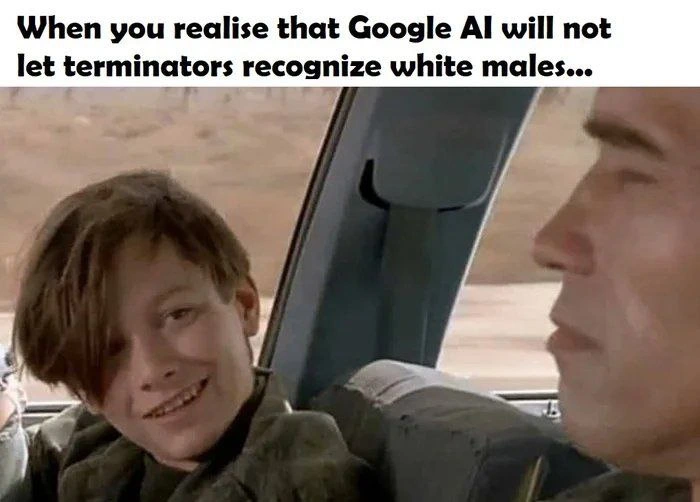
At this level, let’s break down what’s happening in simpler tech terms. The meme text says: “When you realise that Google AI will not let terminators recognize white males...” accompanied by an image from Terminator 2 (a famous sci-fi movie). In that image, a young John Connor is grinning at the Terminator (the cyborg played by Arnold Schwarzenegger) sitting next to him. So imagine: John is smiling because he just figured out a loophole in the Terminator’s system. The joke suggests that Google’s artificial intelligence software — perhaps used by the Terminator for seeing or identifying people — has a rule or flaw that prevents it from recognizing white male faces. And lucky for John, he is a white male, so the Terminator literally doesn’t see that John is the target it’s looking for! It’s like John suddenly became invisible to the killer robot, thanks to a quirk in Google’s AI programming.

Why would Google’s AI not recognize white males? This is playing on the idea of bias in AI and attempts to fix it. Some terms and concepts to know:

  • Dataset imbalance: This means the data used to train an AI wasn’t evenly representative. For example, if a face recognition AI is trained mostly on photos of light-skinned men, it learns to recognize those faces really well but might be bad at recognizing women or people with darker skin. This has happened in real life – many facial recognition systems turned out to have much higher error rates for women and people of color because of biased training data.
  • Facial recognition bias: This is the problem that results from dataset imbalance. The AI ends up unfairly accurate for some groups and unreliable for others. It’s an AI limitation that’s been widely studied and criticized. In the real world, this is a serious ethics concern: for instance, if a security AI can’t recognize a certain ethnicity properly, it might lead to false accusations or failures to identify people correctly.
  • Bias mitigation: This refers to techniques developers use to try to make the AI more fair. It could mean collecting more diverse training images, or adjusting the algorithm so it doesn’t get too confident about one group over another. Big companies like Google put a lot of effort into AI ethics concerns – making sure their AI doesn’t exhibit racial or gender bias. Sometimes the fixes are straightforward, even clumsy. For example, after a Google image classifier embarrassingly mislabeled some black people as animals, the quick fix was to stop the AI from ever using those animal labels again. Essentially, if the AI wasn’t sure and risked being offensive, it would choose to output nothing for that category.
  • Skynet: In Terminator lore, Skynet is the fictional super-intelligent AI that controls the Terminators and tries to wipe out humanity. It’s like an ultimate bad-guy AI. The meme imagines that Skynet’s Terminators might be using Google’s AI tech (a playful idea, since Google is a real company known for AI).
  • NullPointer: This is a programming term. A null pointer is basically a reference that doesn’t point to any object or data – “null” meaning nothing. In many languages, if your program tries to use an object that is null, it throws a NullPointerException (an error) or just crashes. In this meme’s caption, turning “Skynet’s target list into a NullPointer” means the Terminator’s list of targets is empty or invalid – in other words, John Connor isn’t on the list because the AI failed to recognize him. It’s a coder’s way of saying the target doesn’t exist as far as the program is concerned.

Now, piece it together: Google’s bias mitigation might include a rule like “don’t identify or flag certain types of people, to avoid possible bias or mistakes.” Perhaps the AI is programmed not to label someone as a threat just based on them being a white male, since usually bias discussions involve not over-targeting minority groups (here it’s jokingly misapplied to the majority). If a Terminator relies on such an AI for vision, that Terminator would literally ignore John Connor’s presence. John could be right in front of it (as he is in that car), and the Terminator’s scanner might be going “Nope, doesn’t register.” John’s grin in the meme is saying: “Ha! I’m safe because the big bad AI isn’t allowed to notice me.” It’s a comedic face-recognition failure scenario.

This joke also lightly references an AI hype vs reality gap. In sci-fi (and tech marketing), we think of AI like an all-seeing, infallible system (like Terminators that can scan and identify any human). In reality, today’s AI can be pretty fragile. It can mess up if the situation is slightly different from its training, or if rules blunt its behavior. Terminator 2’s evil AI meets modern AI ethics: Skynet might be super advanced, but if it used a real-world Google model with strict fairness rules, it might actually have this weird blind spot. Facial_recognition_failure in a life-or-death context is played for laughs here.

For a junior developer or tech enthusiast, the key takeaway is: the meme is making fun of how fixing AI bias can sometimes lead to overcompensation. It imagines an extreme “fix” where the AI is so unbiased that it won’t even single out a member of a group that historically held advantage (white males in this case). It’s funny because it’s the opposite of the usual problem. Usually we worry about AI unfairly targeting or misidentifying minorities; here we joke about it refusing to target the majority, even when it should. It highlights an important concept: AI fairness trade-offs. If you tell an AI not to be biased at all, you have to define what that means, and a naive solution might be “just treat everyone exactly the same, even if that means ignoring differences entirely.” In a mission to eliminate bias, an AI might end up ignoring useful information – in this case, ignoring John’s existence entirely. A Terminator that can’t lock on to a target because of a programming rule is a silly, exaggerated example of what can go wrong.

So, summarizing in plainer terms: Google’s AI is known for amazing things but also for some funny fails due to bias issues. This meme imagines one of those fails actually saving someone in a sci-fi scenario. John Connor (the hero) benefits because the Terminator’s face recognition has a built-in bias correction that accidentally gives white male faces a free pass. The terminator_reference plus this modern AI twist makes it a nerdy joke about technology’s unexpected side effects. And the term NullPointer just seals the deal for programmers – it’s like saying the Terminator got a big fat “null” when searching for John’s face. No data, no target acquired. For any coder, that paints a clear and ludicrous picture of a runtime error in a killer robot.

Level 3: Judgment Day Edge-Case

For seasoned engineers, this scenario hits close to home as a hilarious edge-case of real-world AI limitations. The meme references Terminator 2, where John Connor smirks next to the stone-faced T-800. Why is he grinning? In the joke, John just realized he’s effectively invisible to the Terminator because of Google’s AI bias mitigation setting. This flips our expectation: in reality, tech like facial recognition has been criticized for failing on underrepresented groups (famously struggling with darker skin tones or female faces due to dataset imbalance). Here, the script is flipped – the archetypal white male (John, or even the Terminator itself as a cyborg with Arnold’s face) is the one not registering on the AI’s radar. It’s a wry nod to how AI fairness initiatives sometimes yield bizarre side effects. Senior devs will recall incidents where companies, intent on avoiding ethical landmines, bluntly restricted their AI’s behavior. One notorious example: Google Photos once misclassified black individuals as “gorillas.” Google’s fix was not a perfect model retraining overnight, but basically to remove that label entirely from the algorithm’s vocabulary. Essentially, they said “if you can’t do it without bias, don’t do it at all.” The meme imagines a similar heavy-handed rule: if recognizing white males leads to bias or PR issues, just don’t recognize them. Bam – John Connor falls off Skynet’s hit list. Problem solved, right? 🥴

This lands as AI humor because it extrapolates those real corporate quick-fixes to an absurd scenario. Engineers chuckle thinking of a Terminator reporting back to Skynet: “Target not found – protected attribute detected,” like a bureaucratic compliance error in the middle of Judgment Day. It’s the ultimate unintended consequence: a doomsday machine with an ethics filter. In dev terms, Skynet’s targeting function has an if-statement that nulls out certain results:

def identify_target(frame):
    person = face_recognition(frame)
    if person and person.demographics == ("white", "male"):
        person = None  # Fairness override: skip white male targets
    return person

Now John Connor is literally returned as None from the Terminator’s vision system. That would make any programmer laugh – it’s a NullPointerException waiting to happen in a killer robot’s code! The senior perspective here catches the joke about a NullPointer: in many languages, trying to use a null reference leads to a crash. Skynet, the sentient AI superpower, brought down not by bombs but by a lousy null check – that’s rich with irony. It resonates with every developer who’s seen a system fail not due to a grand design flaw, but because of a tiny oversight or an overzealous patch. It’s reminiscent of production bugs where a last-minute “safety” fix breaks core functionality. In this case, the safety fix is an AI bias mitigation that’s too aggressive, and the core functionality – identifying targets – is broken.

There’s also an element of AI hype vs. reality commentary. We hype AI like it’s Terminator-level smart, but reality is today’s AI can be pretty dumb outside its training data. If Google’s vision model is behind the Terminator’s eyes, it carries all those limitations and corporate safe-guards. The humor is that even in a high-stakes futuristic war, the Terminator might be shackled by Silicon Valley’s legal and ethical constraints. It’s a skynet_mitigation of the dark future: Google’s well-meaning AI policies inadvertently save humanity by neutering Skynet’s ability to discriminate (and thus target). Seasoned devs also recognize the dataset imbalance subtext. Chances are the meme implies Google’s training data was so skewed (or its fairness logic so strict) that the system literally doesn’t “see” a well-represented group. It’s an inversion of the common bias where models don’t see underrepresented faces. This twist tickles engineers’ dark humor: we fight so hard to make AI fair that we could overshoot, making it blind to a majority it used to easily detect. It’s the AI ethics concerns writ large – fix one bias, introduce another bug.

And of course, any senior coder can’t help but appreciate the nerdy perfection of the phrase “NullPointer” in the title. John Connor was Skynet’s primary target; turning that into a NullPointer means literally no target object for the Terminator to point at. It’s a clever coding pun: target = null. We’ve all seen critical pointers turn null due to some misapplied fix or unexpected input, causing whole systems to fall over. Here the stakes are comically high: the fate of the world. It’s a classic tech nerd punchline – the all-powerful AI is defeated by the same simple bug that’s made us all groan during debugging sessions.

Level 4: Skynet’s Blind Spot

In the most theoretical terms, this meme pokes fun at an algorithmic fairness paradox. Modern AI research in computer vision often introduces bias mitigation techniques to fix dataset imbalance. These techniques might constrain a model so it doesn’t disproportionately misidentify or target certain demographics. Think of methods like adjusting classification thresholds per group or adding fairness constraints to the loss function. For example, an image classifier might be penalized during training if its error rates are higher for one ethnicity or gender than another. Overzealous constraint can lead to an absurd extreme: the model becomes overly cautious about a particular group and effectively stops recognizing that group at all unless 100% sure. This is a tongue-in-cheek extrapolation of real research on AI fairness trade-offs. The meme imagines Google’s face-recognition algorithm tuned so carefully against bias that it creates a literal blind spot – ironically for the historically dominant group. In other words, the system’s fairness logic introduces a “Null class” for white males, making them computationally invisible under certain conditions.

From a technical standpoint, this evokes the idea of equalized odds in ML fairness. Equalized odds means a classifier should have equal false positive and false negative rates across protected groups. One way to enforce that is by tightening the decision threshold for groups with traditionally lower error (often majority groups) until their error rates match those of underrepresented groups. In a contrived scenario, Skynet’s vision system (using Google’s AI) might have raised its threshold so high for identifying white male faces (to avoid any false accusation of them) that it now rarely registers them at all. The result? The Terminator’s target list comes up empty for John Connor, who is a white male – a comically literal NullPointer in Skynet’s targeting system. This reflects a deeper truth: any automated decision system balanced to satisfy fairness metrics can hit a Pareto frontier where improving fairness for one group starts hurting performance on another. Here, the performance drops to zero for one group – an edge-case “solution” to bias that no sane ML ethics team would endorse, but makes for a great sci-fi gag.

On a more philosophical note, this is also a satire of the AI ethics dilemma: if you program an AI not to discriminate at all, you might end up programming it not to see certain distinctions that actually matter in context. Skynet’s mission is to identify and terminate a specific person (John Connor), but a hard-coded fairness rule has essentially nullified that capability. It’s as if the algorithm’s protected attribute filter treated “white male” as a category it’s not allowed to act on, effectively turning John Connor into an undefined entity in the robot’s perception. The meme’s humor lives in that cognitive dissonance: a ruthless killer AI with cutting-edge computer vision, hamstrung by a well-intentioned bias patch that any machine learning researcher would recognize as an overcorrection. The interplay of AI hype vs. reality is at play – even a fictional superintelligence like Skynet can be imagined suffering from the very real limitations and trade-offs of today’s ML models.

Description

This meme uses a still image from the film 'Terminator 2: Judgment Day'. The scene shows a young John Connor in the back of a car, looking over his shoulder and smiling slyly at the T-800 Terminator in the front seat. A white caption at the top of the image reads, 'When you realise that Google AI will not let terminators recognize white males...'. The meme satirizes the recent controversy surrounding Google's Gemini AI, which exhibited strong biases in its image generation, often refusing to generate images of white people due to over-corrected diversity filters. The joke connects this real-world AI flaw to the fictional world of Terminator, where an AI (Skynet) sends a machine to kill a specific white male (John Connor). The humor lies in the ironic implication that this specific AI bias would inadvertently save humanity by making the Terminator unable to identify its target
Comments

11
Anonymous ★ Top Pick Skynet's deployment would be indefinitely blocked by its own ethics committee, stuck in a PR review cycle over the 'problematic' lack of diversity in its termination targets
  1. Anonymous ★ Top Pick

    Skynet's deployment would be indefinitely blocked by its own ethics committee, stuck in a PR review cycle over the 'problematic' lack of diversity in its termination targets

  2. Anonymous

    Great - our safety review passed: the model can’t detect Arnie, but the confusion matrix still looks ripped

  3. Anonymous

    The real reason Skynet lost the war: their targeting algorithms were trained on Google's dataset and kept throwing 'insufficient diversity in target selection' exceptions whenever they encountered tech conference attendees

  4. Anonymous

    When your AI alignment strategy is so aggressive that even Skynet's T-800 would fail the diversity audit. Google's Gemini learned that the real threat to humanity isn't killer robots - it's generating historically accurate images. Turns out the hardest problem in AI isn't achieving AGI, it's shipping a model that can render a Viking without triggering a congressional hearing

  5. Anonymous

    Google's fairness tuning: sacrificing F1-score for demographic denial-of-service

  6. Anonymous

    Nothing says aligned like a vision stack where the policy filter runs before non‑max suppression - precision is fine, but every face returns 451 Unavailable For Legal Reasons

  7. Anonymous

    Skynet’s ethics middleware: precision = 0.99, recall = 0.00 for white_male; PM calls it Responsible AI, SRE calls it an SLO hack, and the terminator gets a 404 from the targeting API

  8. @ageek 2y

    😁😁

  9. Deleted Account 2y

    The AI won't recognize white men. The aren't calibrated for dark skin colors. White women, this is your warning.

    1. @AmindaEU 2y

      🙀

  10. @SamsonovAnton 2y

    white male experts™ 👌

Use J and K for navigation