Skip to content
DevMeme
5383 of 7435
Remembering When the 'N' in FAANG Wasn't Controversial
IndustryTrends Hype Post #5902, on Feb 24, 2024 in TG

Remembering When the 'N' in FAANG Wasn't Controversial

Why is this IndustryTrends Hype meme funny?

Level 1: Back in My Day

Imagine your grandma tells you that when she was younger, television shows were only in black and white. She says, “When I watched cartoons as a kid, there was no color – just black, white, and grey!” Now, you’ve grown up in a world with color TVs, iPads, and YouTube, so that sounds unbelievable to you. You might giggle and respond, “Sure, grandma, let’s get you to bed,” as if what she said was just a silly, sleepy-time story. But here’s the funny part: Grandma is actually telling the truth – TV really was black and white in her day! The humor comes from the idea that something totally normal in the past can sound so strange to young people now that they don’t even believe it at first. In the same way, the meme’s joke is about an “old” person in tech saying “N was for Netflix” (which used to be true), and a younger person reacting like it’s an outlandish, back-in-my-day story. It’s funny because it shows how fast things change – what was common knowledge to grandmas and grandpas (or experienced tech folks) can now seem like a fairy tale to the kids.

Level 2: Big Tech Alphabet Soup

Let’s unpack the joke in simpler terms. FAANG is an acronym – a word made from the first letters of a group of names. It became famous a few years back as shorthand for five huge technology companies: Facebook, Apple, Amazon, Netflix, and Google. If you take their first letters (F, A, A, N, G) you get “FAANG,” which conveniently sounds like a word (like a creature’s fang). This acronym was widely used in both finance and tech circles to talk about the power and success of those companies. For example, people would say “the FAANG stocks” to mean those five big tech stocks as a group. It was also common in job-hunting and CorporateCulture discussions – working at a “FAANG company” meant you landed a job at a top-tier, prestigious tech firm. Netflix was the company represented by the “N” in FAANG, no question about it.

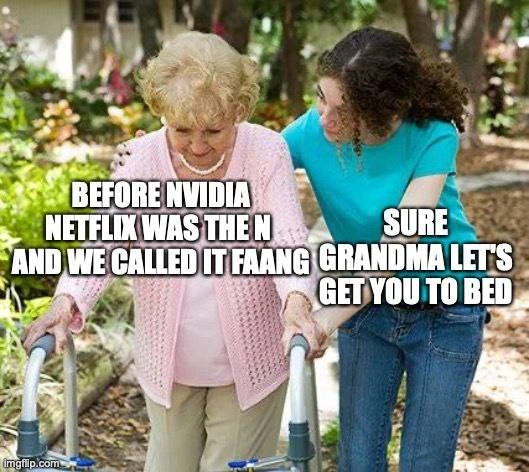
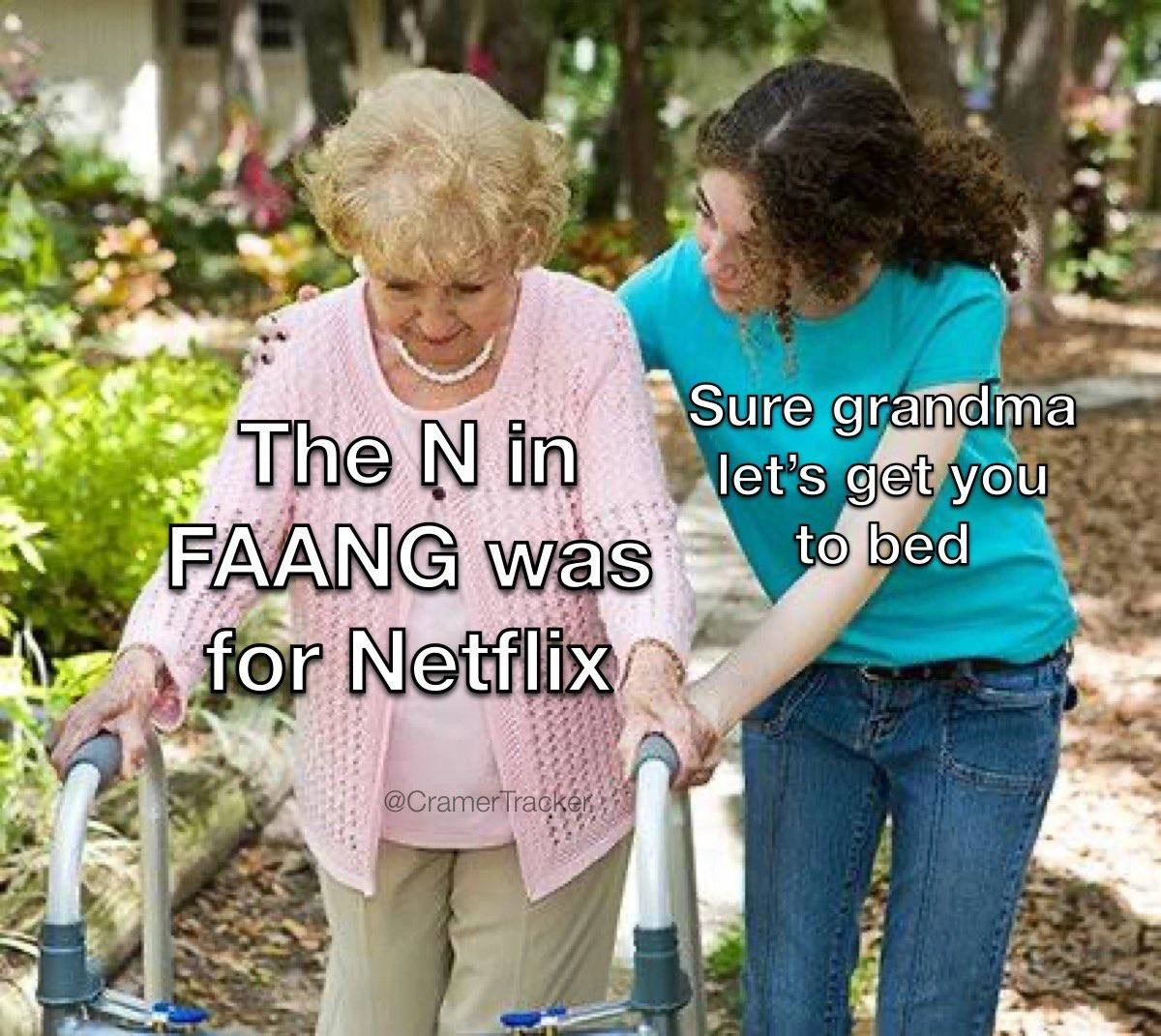
Now, the meme shows an elderly lady (labeled with the text about Netflix) and a younger woman (label with the “Sure grandma…” reply). This is a popular meme format. The older person says something that was true or popular in the past: “The N in FAANG was for Netflix.” The younger person responds with “Sure grandma, let’s get you to bed,” as if kindly dismissing a senile comment. This phrase is a well-known internet meme catchphrase. It’s what you jokingly say when someone insists on something that sounds outdated or crazy, to humor them as you’d do with a confused grandparent. In other words, the meme jokes that talking about FAANG with N for Netflix is like a grandma’s tale now – something so out-of-date that younger folks gently roll their eyes at it.

But why would “N is for Netflix” ever sound outdated? Here’s where big_tech_rebranding and changing trends come in. The tech industry moves incredibly fast, and even the biggest companies and buzzwords keep changing. Facebook changed its company name to Meta in 2021, reflecting a new focus on the “metaverse.” Google is officially under a parent company called Alphabet since 2015, although most people still just say Google. These changes mess with the acronym: FAANG had one F (for Facebook) and one G (for Google). After the rebranding, calling Facebook “Meta” would turn that F into an M. Some people started jokingly calling the group MAANG (with an M for Meta). And what about companies that weren’t in the original acronym? Microsoft is one of the biggest tech companies in the world (makers of Windows, Office, Azure cloud, etc.), but it wasn’t included in FAANG. Back when FAANG became popular, Microsoft’s stock wasn’t as hyped as the others, but that changed later. Many felt that if we’re listing the giants, Microsoft should be there too. If you add Microsoft (M) and also account for Meta (M), and Alphabet (A for Google), you get new combinations of letters. Different commentators came up with different revised acronyms. It can be a lot of letters to juggle – almost like a spoonful of alphabet soup! Here are a few variations that have floated around:

Acronym Letters & Companies it stands for Notes
FAANG F = Facebook, A = Apple, A = Amazon, N = Netflix, G = Google Original acronym from mid-2010s. Netflix was included as a top tech star.
MAANG M = Meta (Facebook’s new name), A = Apple, A = Amazon, N = Netflix, G = Google Adjusted after 2021 to use Meta instead of Facebook. Netflix is still in there.
FAAMG F = Facebook (Meta), A = Apple, A = Amazon, M = Microsoft, G = Google A variation that includes Microsoft (M) and drops Netflix.
MAMAA M = Meta, A = Apple, M = Microsoft, A = Amazon, A = Alphabet (Google) A more recent grouping with Meta and Microsoft. Alphabet is Google’s parent, hence another A. (Yes, “MAMAA” has a lot of A’s!)

In all these newer acronyms, you might notice Netflix is missing or optional. Over the past couple of years, Netflix’s influence (especially in the stock market) wasn’t as huge compared to companies like Microsoft, so people started to leave it out when talking about “the biggest of Big Tech.” Meanwhile, Alphabet (Google) gave us an extra A to play with, and Meta (Facebook) started with M. As a result, the beloved old “FAANG” term isn’t used as universally as it once was. Younger engineers or investors coming into the industry in 2023 or 2024 might hear more about “Big Tech” in general or one of these new acronyms instead of FAANG. To them, “FAANG = Netflix included” sounds almost quaint or old-fashioned.

The humor in the meme is really about generational_tech_reference and how quickly what’s “normal” changes in tech. An experienced developer might reminisce about FAANG and proudly remember when Netflix was considered in the top 5 tech companies. But a newcomer (or someone who’s only heard the latest terms) might think, “Wow, really? Netflix was up there with Apple and Google? Okay, sure thing, old-timer…” The young woman’s “Sure grandma…” response in the image perfectly captures that vibe of a TechNostalgia moment being treated like a confused rambling. It’s a light-hearted jab at how IndustryTrends move on: what was hot yesterday can feel like a myth today. Just as some new developers today might not know about older acronyms or past tech fads, they might playfully treat those who do remember as if they’re living in the past.

In summary, the meme uses a funny generational gap scenario to illustrate a real tech culture shift. FAANG (with Netflix) was a big deal and a common term among tech folks a few years back. Now, after name changes and the rise of other giants, that term isn’t as commonly used. The meme is relatable to anyone who’s been around in the tech industry long enough to see these buzzwords come and go. It’s saying: “Remember that thing everybody talked about? Well, now it’s so dated that the new kids think you’re ancient for even mentioning it.” And that’s what makes it funny – and a bit bittersweet – for those of us who remember.

Level 3: Acronym Archaeology

This meme digs up a piece of recent TechHistory that already feels ancient in fast-forward tech culture. The grandma figure (a veteran developer) proudly proclaims a bit of lore: "The N in FAANG was for Netflix." To industry old-timers, that statement is pure TechNostalgia – a reminiscence of when FAANG was the ubiquitous acronym for the Big Five tech giants: F = Facebook Meta, A = Apple, A = Amazon, N = Netflix, G = Google. This grouping was coined in the mid-2010s during a stock market hype cycle (thanks to TV personality Jim Cramer) when these companies were the high-flying leaders of the tech economy. At the time, Netflix had skyrocketed in influence – enough to join that elite club in popular jargon.

But in today’s ever-shifting IndustryTrends_Hype, that once-dominant acronym has started to fade. The meme’s punchline comes from the younger woman (a new-generation developer or perhaps just the voice of modern tech) responding with the classic “Sure grandma, let’s get you to bed.” It’s a gently sarcastic meme catchphrase used to humor someone stuck in the past. To the young dev, grandma’s FAANG reference sounds outdated – almost like folklore that couldn’t possibly have been true. This highlights a generational tech reference gap: what was common knowledge for an older engineer now draws patronizing smirks from juniors. In the fast-paced TechIndustryHumor playbook, five years ago might as well be fifty.

Why exactly does “N was for Netflix” mark you as a tech elder nowadays? A big reason is big_tech_rebranding and the evolving lineup of top tech firms. In 2021, Facebook rebranded as Meta, turning the F into an M. Google had already reorganized under parent company Alphabet in 2015, though FAANG kept the G for Google (using “A” for Alphabet would have tangled up the acronym with Apple and Amazon). Meanwhile, Microsoft – conspicuously absent from the original FAANG – continued to grow into a trillion-dollar giant. Many felt Microsoft deserved a seat at the cool kids’ table. So newer acronyms were proposed: some used FAAMG (swapping in Microsoft for Netflix), and eventually even MAMAA (Meta, Apple, Microsoft, Amazon, Alphabet). The once fearsome-sounding “fang” of Big Tech had transformed into something that sounds like your MAMAA – arguably a sign of how these companies went from edgy growth darlings to established, comfortable incumbents. The N in FAANG getting retired is part of this evolution. Netflix, while still big, just isn’t always mentioned in the same breath as Apple or Google anymore, especially in investor circles. It’s a bit of a faang_abbreviation_fade: the group identity shifted and poor Netflix got voted off the island (or at least replaced by a bigger beast).

From a senior developer’s perspective, the humor is also a nod to how IndustryTrends cycle rapidly. One day you’re at the top of the world (and a key letter in an acronym everyone in CorporateCulture drools over); a few years later, new grads look at you like a relic. The meme perfectly captures that whiplash. Veterans remember every hype acronym and buzzword that came and went – from LAMP stacks to Web 2.0, from FAANG to whatever new lineup du jour (MAANG? MAMAA? GAFAM?). But try explaining those to a newcomer and you might as well be talking about MySpace or dial-up modems – you’ll get that patronizing “Sure thing, Granny” response. The TechNostalgia is real: “Remember when…” has become a punchline in itself. This meme is winking at all the seasoned devs who do remember the original FAANG days, while also poking fun at how absurdly fast the TechIndustry moves on. In short, it’s a multilayered joke about generational_tech_reference drift – packaged in the universally funny format of an out-of-touch grandma and an eye-rolling grandchild.

Description

A popular meme format known as 'Sure Grandma, Let's Get You to Bed'. The image depicts a young woman gently guiding an elderly woman who is using a walker. Text overlaid on the elderly woman reads, 'The N in FAANG was for Netflix'. The younger woman has a caption saying, 'Sure grandma let's get you to bed'. There is a small watermark for '@CramerTracker' at the bottom. The humor stems from the rapid evolution of the tech industry, where the once-ubiquitous FAANG acronym (Facebook, Amazon, Apple, Netflix, Google) is now considered outdated by many, due to company name changes (Meta, Alphabet) and shifts in market dominance. The meme implies that remembering the original composition of FAANG is like recalling a bygone era, a relatable feeling for senior engineers who have witnessed numerous industry trends come and go
Comments

32
Anonymous ★ Top Pick A junior dev asked me what FAANG was. I told them it's the legacy system for describing the companies that now run on the MAMAA architecture
  1. Anonymous ★ Top Pick

    A junior dev asked me what FAANG was. I told them it's the legacy system for describing the companies that now run on the MAMAA architecture

  2. Anonymous

    Some of us still have a ‘faang-legacy-n’ microservice in production - deleting it breaks half the CI pipeline

  3. Anonymous

    Remember when we thought Netflix's microservices architecture was peak innovation? Now we're debugging why their stock price throws more exceptions than a junior's first async/await implementation

  4. Anonymous

    The real joke is that by the time we all agreed on what FAANG stood for, half the companies had rebranded, one pivoted to the metaverse, and Netflix became the cautionary tale we use in system design interviews about what happens when you don't scale your architecture to match your ambitions. Now we're all pretending 'MAMAA' was the acronym we used all along, like renaming a legacy service to make it sound cloud-native

  5. Anonymous

    FAANG's N was Netflix - until Mag7 swapped it for NVDA; grandma's acronym just needed a GPU refresh

  6. Anonymous

    FAANG got hotpatched to NVDA without a major version bump - no wonder my Chaos Monkey talk is now classified as legacy

  7. Anonymous

    FAANG is a semverless API - someone swapped Netflix for Nvidia and shipped a breaking change with no deprecation window; fortunately our resumes still maintain backward compatibility

  8. Yuri 2y

    What is it now then?

    1. @MDSPro 2y

      opeNai 😂

      1. @MDSPro 2y

        Damn, it was supposed to be a joke 😊

    2. @chertoliy 2y

      Netscape👴🏻

    3. @kitbot256 2y

      Nvidia?

  9. @deerspangle 2y

    It was always such an odd one out

    1. @Supuhstar 2y

      Was it?

      1. @deerspangle 2y

        Shunting around video data is gonna be big bandwidth, doesn't seem as big a deal as the others of the collection

        1. @Supuhstar 2y

          That chart is solely shunting around video data, and includes ANG lol

          1. @deerspangle 2y

            That's my point? That shunting around video data puts you big in that chart, but isn't necessarily groundbreaking work

            1. @Supuhstar 2y

              Yea but it does show that Netflix was shunting around much more than Google and Amazon were, meaning they had more and more engaged customers than the rest of the online entertainment industry

      2. @callofvoid0 2y

        what's disney+?

        1. @endisn16h 2y

          streaming service

  10. @pulsar_sp 2y

    (I think we're getting banned)

  11. @L33TGraceful 2y

    |2

  12. dev_meme 2y

    nvidia

  13. @Freewalkr 2y

    i guess it's NiggeJS 2

  14. Deleted Account 2y

    Maang

    1. dev_meme 2y

      *Manga

      1. Deleted Account 2y

        Holy

  15. Алексей 2y

    What shitty netflix had even forgotten into FAANG?

  16. Deleted Account 2y

    Nokia

  17. @NiKryukov 2y

    vkoNtakte

  18. @deerspangle 2y

    It's all arbitrary anyway, doesn't matter so much

    1. @Supuhstar 2y

      Yeh

Use J and K for navigation