Skip to content
DevMeme
6205 of 7435
The Art of Prompt Engineering vs. Actual Artistry
AI ML Post #6803, on May 23, 2025 in TG

The Art of Prompt Engineering vs. Actual Artistry

Why is this AI ML meme funny?

Level 1: Like Using a Cake Mix

Imagine you want to make a fancy cake, but you don’t know how to bake from scratch. So you grab a cake mix from the store, follow the instructions, and out comes a pretty nice cake. You then put your name on it with frosting and show it off at a party as “my homemade cake.” Most people at the party might say, “Wow, yummy cake!” but one friend knows you used a mix and blurts out, “Dude, you just used a mix and then put your name on it like you’re a master baker!” 🍰

In this story, the cake mix is like the AI tool that did most of the work. You adding your name in frosting is like the guy putting his @ name watermark on the AI-generated picture. The friend calling you out is just like the tweet reply in the meme saying, “Bro, you didn’t really bake that!” It’s funny (and a bit embarrassing) because it’s true – you took a shortcut. The heart of the joke is about taking credit for work you didn’t fully do. Even a kid gets that it’s not fair to claim you drew a picture if you just colored in a coloring book. Here, the AI did the detailed drawing (like the coloring book outlines), and the person just gave instructions (colored it in) and said “look what I made!” It’s a playful reminder: if you’re gonna use a shortcut, maybe don’t act like you’re a master artist or chef – or someone might call you out in front of everyone.

Level 2: Prompt vs Paintbrush

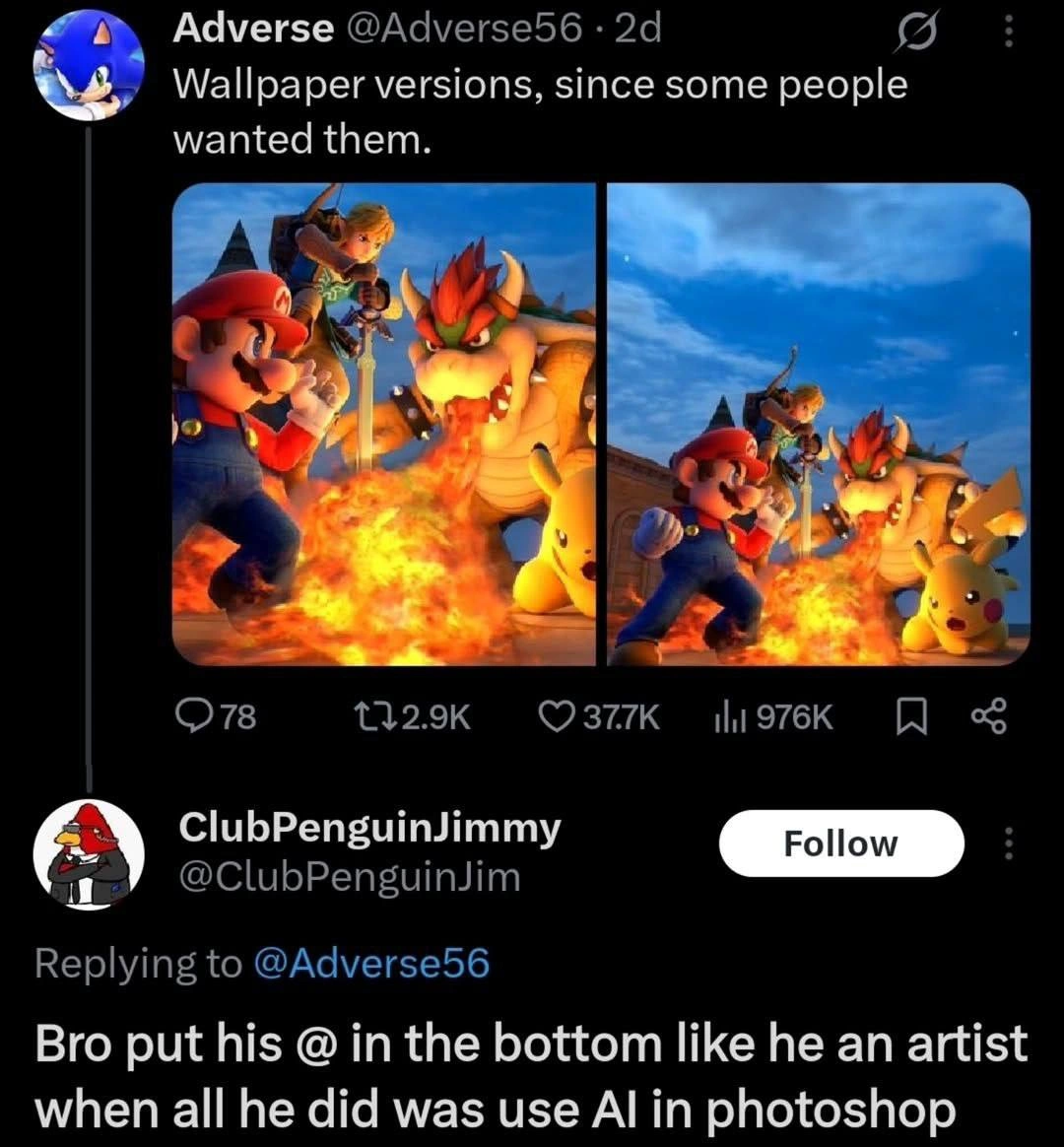
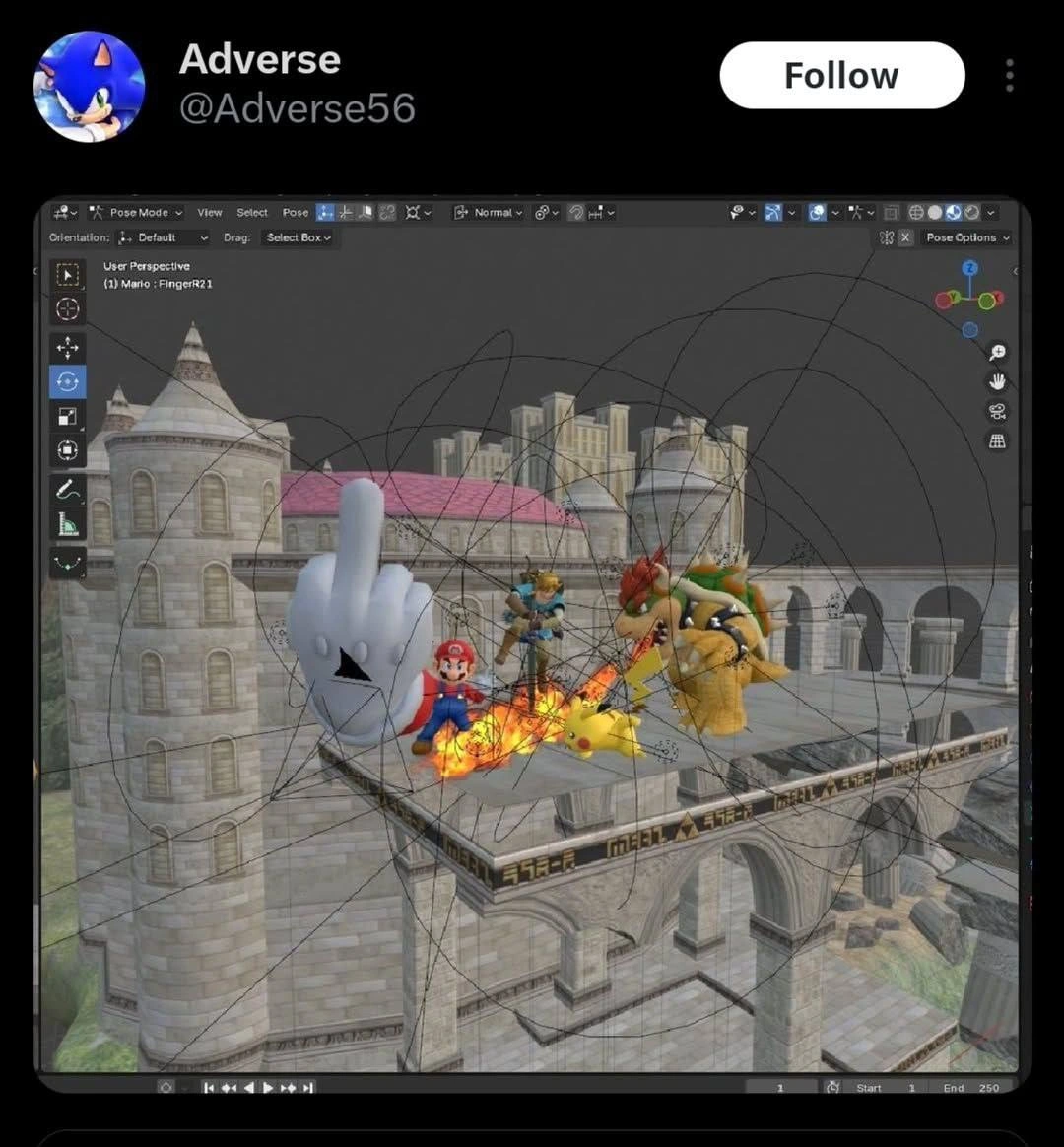
Let’s break down what’s happening in simpler terms. We have a person who used AI (Artificial Intelligence) to create an image, and another person calling them out for acting like an artist. In the meme (a screenshot of a Twitter thread), the first person @Adverse56 shares two really cool images of famous Nintendo characters – think Mario, Bowser, Pikachu, Link (all characters from big games that also meet up in the fighting game Super Smash Bros). The images look like dramatic posters you might see for a new Smash Bros game, with Bowser breathing fire and everyone in an action pose. They’re so cool that people on Twitter asked for “wallpaper versions” (high-resolution images they could use as their computer or phone background). So @Adverse56 posts these wallpapers and, importantly, puts a tiny watermark of his Twitter handle in the corner of the artwork. A watermark is like a signature or label on an image that shows who the creator or owner is – photographers and artists often do this to get credit or prevent theft of their work.

Now, enter @ClubPenguinJim’s reply, which basically says: “Bro, you put your @ name on the image like you’re the artist, when all you actually did was use an AI in Photoshop.” This comment is pointing out a distinction: using an AI tool to generate art vs. actually drawing or painting it yourself. Photoshop is a well-known image editing software, and recently tools like Photoshop have started adding AI features (for example, you can type a description and have it fill or create images). So the reply suggests that @Adverse56 didn’t paint Mario or model Pikachu in 3D; he likely typed a description (prompt) into some AI software and got these images. Maybe he did a bit of touch-up or combined two images side by side in Photoshop, but he didn’t handcraft the scene in the traditional sense.

For someone newer to this whole AI art scene, think of it like this: Imagine you have a super advanced art robot. You tell it “Draw Mario and Pikachu fighting Bowser with fire everywhere, in a cool poster style,” and a minute later, out pops the image. That’s essentially AI-generated content – the human provides a text description (that’s the prompt), and the computer does the detailed drawing based on patterns it learned from lots of existing images. Prompt engineering is a fancy term you might hear; it just means phrasing your request to the AI in a way that gets the best result. It’s a bit of a skill, sure, but it’s not the same as actually knowing how to draw Mario by hand. It’s more like knowing how to ask the robot the right way.

Now, why the beef about the watermark? In the art community (and similarly in coding or other creative communities), credit_claiming is important. If you truly made something from scratch, you have every right to put your name on it. But if a lot of the work was done by someone (or something) else, claiming full credit is frowned upon. Here the “something else” is a machine learning model trained by many people’s artwork. The commenter, ClubPenguinJim, is basically accusing Adverse56 of acting as if he’s an artist without doing an artist’s work. It’s a bit like artist_vs_prompter – a small culture clash happening right now: traditional artists spend years learning anatomy, lighting, 3D modeling, etc., whereas a “prompter” can get impressive results by just describing what they want to an AI. When the prompter then watermarks the image, it can come off as though they’re taking as much credit as a painter would for their painting. Some folks find that unfair or at least kind of presumptuous.

It might help to draw a parallel: say you wrote a few lines to tell a program to generate a bunch of code for you. If you then turned around and said “I wrote this program all by myself” and signed your name, a more experienced developer might raise an eyebrow. After all, the heavy work was done by the code generator. Similarly, here the heavy lifting was done by the AI. DevCommunities often emphasize transparency – it’s okay to use tools, libraries, or AI, but usually you’d mention it. For example, you might say “Here’s a website I built using WordPress” rather than implying you hand-coded every component. In art, the expectation (at least right now) is similar: if an image is AI-generated, many people feel you should clarify that, rather than present it exactly like your personal hand-drawn art.

The social_media_callout aspect is strong in this meme. On platforms like Twitter, people aren’t shy about calling each other out publicly. The reply got a lot of attention itself because it’s voicing something many think: using AI isn’t the issue, it’s the attitude about it. If Adverse56 had said “Made with AI” somewhere or not watermarked it, maybe no one would have cared. But putting his @ handle in the corner – that’s what artists do to sign their work. It created a feeling of “hold on, did you really make that?”. And ClubPenguinJim basically voiced that skepticism in one blunt, meme-worthy sentence.

For a newcomer, it’s interesting to see how this mirrors things in coding and other creative tech fields. Early-career devs sometimes use lots of boilerplate code or an app generator to create something, and that’s fine – that’s using the tools available. But if they start claiming they invented the whole thing, seniors will usually gently (or humorously) set the record straight. It’s part of learning: understanding the difference between using a tool and mastering a craft. This meme is just one vivid example, using AI art as the context. Oh, and the reason those specific game characters are in the image? They’re hugely popular and very recognizable; using them is a quick way to get attention (who doesn’t love a good Mario and Pikachu team-up?). It also shows that the AI was capable enough to recreate well-known characters in a new scene – which is both cool and a little concerning, because it raises the question of how much the AI is borrowing from the original game art. That’s a whole other ai_watermark_debate around copyright and such, but the immediate issue here is the human claiming credit.

So in summary: The meme is pointing out the funny and contentious situation when someone slaps their watermark (their name) on an image that was mostly produced by an AI. It’s like someone taking a store-bought birthday cake, writing their name on it in icing, and saying “I baked this!” You can imagine some people applauding “Yay, cake!” while others say “Uh, you just added icing to a cake mix cake.” In the developer and artist world, that’s an ongoing conversation – how much credit do you deserve when AI or pre-made tools do a lot of the work? This meme doesn’t answer it, but it humorously shows one person answering it with: “Not as much as you think, bro.”

Level 3: Signature Smackdown

The meme captures a DevCommunities drama that’s both very modern and very relatable to seasoned developers: someone using a powerful tool to do the hard part, then acting as if they did the hard part themselves. We have a tweet from user @Adverse56 proudly sharing AI-generated Smash Bros-style wallpapers and subtly embedding his @ handle as a watermark on the corner – just like a digital artist would sign their painting. The content itself is pure nerd bait: Mario, Link, Bowser, Pikachu in a flashy, fire-breathing showdown (a nod to Super Smash Bros). It got the internet’s attention – thousands of retweets, tens of thousands of likes, nearly a million views. In the IndustryTrends_Hype era of generative AI, flashy content draws hype like a magnet. People love it: “Cool wallpaper, bro!” On the surface, it looks like this creator is delivering what the audience wanted, even being gracious enough to provide high-res versions on request.

Enter the reply from ClubPenguinJimmy that delivers the smackdown: “Bro put his @ in the bottom like he an artist when all he did was use AI in Photoshop.” 🔥 This one-liner is basically the social media equivalent of pointing out the emperor’s lack of clothes. It’s dripping with TwitterHumor and call-out culture sass – a perfect social_media_callout. For those of us who have been around tech (and hype cycles), it hits a shared nerve. We’ve seen variations of this pattern:

  • A self-proclaimed “developer” copy-pastes code from Stack Overflow and then boasts about their “coding”AIHypeVsReality in coding form.
  • A newbie “builds” a website by using a template or no-code tool and puts their name in the footer like a web design auteur.
  • That colleague who used an auto-generator to create a report but then slaps their name on the cover, accepting all the praise.

In this meme’s context, it’s artist_vs_prompter. The prompter used an AI (perhaps via a plugin or Photoshop’s AI features) to conjure images of beloved gaming characters. The credit_claiming is the watermark – historically a way for artists to prevent plagiarism or at least to ensure if their art is shared, their name travels with it. By watermarking, @Adverse56 is implying “I made this.” And that’s what irks people like @ClubPenguinJim: from their perspective, prompting isn’t the same as painting or 3D modeling. It feels like he’s taking a victory lap for work he didn’t actually sweat over. The humor has an edge to it because it reflects a brewing resentment in creative and dev circles: AI tools have empowered more people to produce impressive outputs, but there’s tension over whether using such tools is a skill on the same level as traditional craft.

Why do senior devs and artists nod knowingly (perhaps with a smirk) at this? Because we’ve all seen “that person” in our field. The one who uses a high-level tool or one-liner library and then brags as if they built it from scratch. It’s like writing import tensorflow as tf and calling yourself an AI researcher, or running a script and claiming you handled a complex task manually. The AIHype part is that new tools are powerful – you can achieve in hours what used to take weeks. The reality check part is that true expertise isn’t just pushing the button; it’s understanding or at least acknowledging what’s under the hood (or who built the hood!). In dev terms, it’s the gap between prompt engineering and actual engineering. Prompting an AI is useful (and not always trivial – phrasing can matter), but it doesn’t impart the deep skills of an illustrator or modeler who spends years honing the craft.

The meme’s popularity and those engagement numbers also hint at a broader social commentary. People are clearly wowed by the AI art – hence the demand for wallpapers – which feeds into the AIHype. Social media algorithms reward eye-catching content, not caring if it was hand-drawn or generated. So someone riding the AI wave can gain clout fast (followers, likes, maybe even commissions) by curating cool outputs. That creates a bit of a gold rush mentality: why spend 10 hours on a digital painting if an AI can spit out something 90% as good in 10 seconds? The DevCommunities see parallels in coding (why write code when Copilot can autocomplete?). Experienced folks know there’s a catch: reliance on tools can become a crutch, and claiming credit crosses an ethical line that communities frown upon. It’s about authenticity. Engineers value giving credit – open-source contributors get attribution, good devs cite sources or at least don’t pass off borrowed code as entirely their own. Similarly, artists value honesty about process; using references or tools is fine, but pretending you did it solo is not.

The phrase “all he did was use AI in Photoshop” suggests this wasn’t a painstaking composite or a heavily edited piece – it implies he probably typed a prompt into something like Photoshop’s neural filter or an AI plug-in, got the images, maybe did minor tweaks and that’s it. To a senior person, that’s like using a drag-and-drop game engine template and then acting like you designed the game characters yourself. ClubPenguinJimmy calling it out publicly is a bit savage, but it resonates because a lot of people (especially actual artists) have been feeling this irritation: seeing AI generative art get massive praise without context, and the “artist” sometimes not clarifying that it was AI-assisted. In fact, the inclusion of a watermark but omission of “AI-generated” in the tweet can be read as somewhat misleading. It’s the AIHypeVsReality conflict embodied in one tweet thread.

Ultimately, this level of analysis sees the meme as commentary on credibility and credit in the age of AI. It’s funny in that slightly painful way – like an inside joke among professionals who’ve seen technology change the game. We laugh because the reply is blunt and true: many of us have thought the same thing when we see someone over-hype their “creation” that a tool mostly did. It’s a bit of schadenfreude too; the call-out feels satisfying if you identify with the ones defending traditional craft. At the same time, the scenario isn’t black-and-white: the AI prompter did have the idea to put these characters together and was thoughtful enough to share high-res versions when asked. Is that worth nothing? The senior perspective recognizes the nuance but also the irony – it’s a hype bubble moment. We’ve seen many hype bubbles (the Blockchain bros, the “10x engineer” myth, the NoSQL-for-everything craze); each time, egos inflate until someone pierces it with a well-aimed quip. This meme is that little pinprick for the AI art hype.

Level 4: Diffusion Dilemma

At the cutting edge of AI_ML, image generation models like Stable Diffusion and Midjourney churn out artwork from mere text. Under the hood, these models operate in a latent space – a high-dimensional representation where visual concepts (like Mario’s iconic red hat or Bowser’s fiery breath) are encoded as numbers. Through iterative refinement (diffusion), the model transforms random noise into a coherent image that matches a prompt. It’s a bit like watching a photograph develop in a darkroom, but here the “chemicals” are billions of neural network parameters.

This meme highlights a conundrum born from this technology: who is the artist? The neural network has essentially “learned” from a vast training dataset (potentially scraping countless images, including Nintendo art and fan creations). When a user types a prompt – e.g. “Mario and Pikachu fighting Bowser in a dramatic sunset, Super Smash Bros style” – the AI synthesizes a new image by statistically combining elements it has seen during training. The human prompter isn’t drawing Mario’s mustache or Pikachu’s lightning tail pixel by pixel; the algorithm is doing the heavy lifting, guided by the prompt. In academic terms, the prompter provides a high-level specification, and the pre-trained model solves an extremely complex optimization problem to produce a matching image. It’s a triumph of modern machine learning: a generative model can produce novel, high-fidelity visuals that feel creative.

But here’s the dilemma: traditional notions of authorship don’t map neatly onto this workflow. The original artists who drew the reference images (used in training) are absent from the final output’s credits. The prompter – who may have simply typed a sentence and tweaked a few settings – can now output a wallpaper-worthy image in minutes. Do they “own” the result? The meme’s scenario shows the prompter adding a watermark (their Twitter handle) to the image, implicitly claiming authorship. This is provocative because it touches on unresolved ethical and legal questions: If an AI model’s knowledge is distilled from thousands of real artworks, is the human operator just remixing others’ work via algorithmic proxy? There’s ongoing debate over whether AI-generated images might infringe on copyrights or at least on the spirit of creative ownership. Technically, each output is “new” in terms of pixel arrangement, but conceptually it can be an amalgam of learned patterns. (Earlier AI models even accidentally reproduced watermarks from stock photo libraries – a literal imprint of training data leaking out!)

In sum, at this deep technical level we see AIHypeVsReality in stark relief. The hype: Anyone can create amazing art with a few keystrokes, as if wielding a magic paintbrush. The reality: that magic paintbrush is powered by a vast corpus of other people’s artistry and a lot of matrix calculus under the hood. The humor (and controversy) arises from this disconnect. The prompter behaves like an artist, stamping a signature, but the true “artist” is a Frankenstein’s monster of collective creative data and clever algorithms. It’s a classic case of technology challenging our assumptions – here, about creativity and credit – much as we saw in earlier eras (like sampling in music production or using templates in software). And just as in those cases, the DevCommunities and design circles are now wrestling with the question: when an AI paints Mario and friends in epic battle, whose masterpiece is it, really?

Description

A screenshot of a Twitter exchange about AI-generated art. The top tweet, from a user named 'Adverse', shares two wallpaper-style images featuring characters from the video game Super Smash Bros. (Mario, Bowser, Pikachu, Link) in a dramatic, fiery scene. Below this, a reply from 'ClubPenguinJimmy' criticizes the original poster with the text: 'Bro put his @ in the bottom like he an artist when all he did was use AI in photoshop'. This interaction captures the heated, ongoing debate in the tech and art communities about the legitimacy of AI-generated content. The core conflict is whether crafting a prompt for an AI model constitutes 'art' and if the person should claim authorship by watermarking the output. The reply suggests that using a tool like Photoshop's AI Generative Fill is a low-effort act being misrepresented as genuine artistic creation, a common point of contention among digital artists and developers

Comments

7
Anonymous ★ Top Pick The time it takes to get a PR comment saying 'this could have been a one-liner' is now roughly the same as the time it takes to get an art comment saying 'this was a one-liner'
  1. Anonymous ★ Top Pick

    The time it takes to get a PR comment saying 'this could have been a one-liner' is now roughly the same as the time it takes to get an art comment saying 'this was a one-liner'

  2. Anonymous

    Slapping your handle on a Stable Diffusion render is the git-add-* of the art world - minimal effort, maximum ownership claims

  3. Anonymous

    The real merge conflict here isn't in git - it's between traditional artists and developers who think prompt engineering counts as a creative contribution to their commit history

  4. Anonymous

    Nothing says 'I'm a professional' quite like watermarking AI-generated content with your handle - it's the digital equivalent of signing a git commit that's 99% Stack Overflow copypasta. At least when we steal code, we have the decency to refactor the variable names first

  5. Anonymous

    Tagging an AI wallpaper with your handle is the visual equivalent of shipping a generator scaffold and calling it 'hand‑crafted microservice'; prompt ownership != authorship

  6. Anonymous

    AI Photoshop: prompt in, PNG out, signature slaps - your new 'from-scratch' microservice architecture

  7. Anonymous

    Slapping your @ on Photoshop's generative fill is the art-world version of shipping a 200-line reverse proxy to /v1/generate and calling it a platform

Use J and K for navigation