Skip to content
DevMeme
6532 of 7435
Agile Kisses Enterprise Frog and Transforms Into Enterprise Herself
Agile Post #7160, on Sep 22, 2025 in TG

Agile Kisses Enterprise Frog and Transforms Into Enterprise Herself

Why is this Agile meme funny?

Level 1: Fairy Tale Flip

Imagine a classic fairy tale where a princess’s kiss is supposed to turn a frog into a handsome prince. In this picture, the opposite happens – the princess kisses the frog, and she turns into a frog instead! The frog stays a frog the whole time. This is a funny twist because we expected the frog to change, but instead the princess changed. It’s like trying to teach an old slow friend a new fast game: you hope your friend will start running fast like you, but instead you end up slowing down to match your friend. In the end, nothing about the frog was different – now there are just two frogs. The humor comes from this surprise reversal and shows that sometimes, when a big stubborn thing meets a new idea, the new idea ends up becoming just as slow and stubborn. It’s a silly way to say the big frog didn’t become a prince at all – instead, it turned the princess into another frog, which is the goofy surprise that makes us laugh.

Level 2: Water-Scrum-Fall Woes

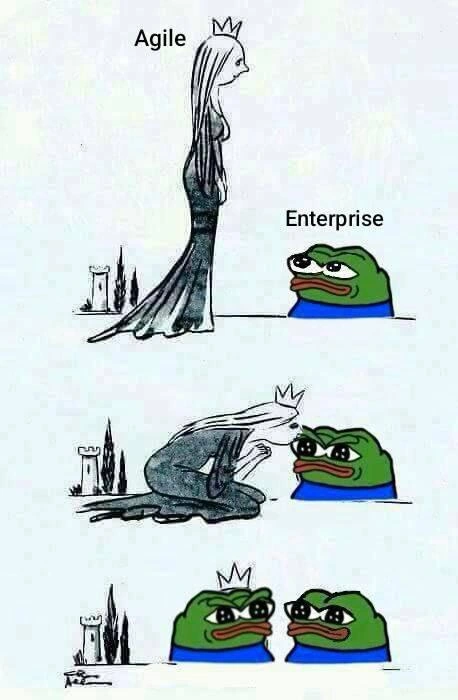
In simpler terms, this meme is poking fun at what happens when a big enterprise company tries to adopt Agile practices. We have two characters: an elegant crowned princess labeled “Agile,” and a grinning frog labeled “Enterprise.” In a fairy tale, when a princess kisses a frog, the frog is supposed to turn into a prince. Here, the joke flips that story. The enterprise (frog) and Agile (princess) meet – but instead of the frog becoming more like the princess (i.e. the company becoming flexible and quick), the princess turns into another frog! In the final panel, Agile has literally transformed into the same kind of smug frog as the enterprise. The enterprise itself hasn’t changed at all. This is exactly how many developers feel about enterprise Agile transformations: the big company doesn’t truly change its old habits; instead, it changes Agile to fit its habits.

Let’s break down some terms. Agile is a way of developing software that emphasizes quick, iterative work and being able to adjust plans easily. Instead of spending a whole year planning and then building (that old method is known as Waterfall), Agile suggests you work in small chunks (often 1-2 week cycles called sprints in a method like Scrum), get feedback, and adjust as you go. A small Scrum team, for example, has daily short meetings (stand-ups), demos work frequently, and reprioritizes tasks regularly. It’s supposed to be lightweight and fast-moving.

An enterprise, on the other hand, is a huge organization – think a big bank, a fortune 500 company, or any corporation with thousands of employees and lots of rules and departments. These companies traditionally use heavier processes: lots of paperwork, approval from multiple managers, fixed long-term roadmaps, etc. When such a company tries to become “Agile”, it’s often a tough culture shift. The term enterprise agile transformation means the whole company is attempting to change from the old Waterfall style (big upfront planning, rigid phases) to the new Agile style (adaptive, continuous development). Sounds great in theory, right? The expectation is that the slow frog (enterprise) will turn into a speedy prince by learning Agile from the princess’s “kiss.”

But in reality, many enterprises end up doing something we call Water-Scrum-Fall. This phrase combines Waterfall + Scrum + Waterfall to indicate a hybrid that’s not truly agile. For example: the company might still require a giant requirements document and approval at the start (that’s the “Waterfall” head), then allow the development teams to do iterative work in sprints for a while (that’s the “Scrum” middle), but then still have a long testing, integration, and sign-off period at the end (the “Fall” tail). So you get Water–Scrum–Fall: a big heavy process with a little Agile Scrum squeezed in the center. It’s like calling a boulder an “agile boulder” because you moved it a few inches every day – it’s still a boulder! In the meme, Agile turning into a frog represents exactly this scenario: Agile gets absorbed by the existing heavy process. The enterprise basically says, “Sure, we’ll do Agile – as long as it fits into all our existing bureaucracy.” They add some sprint meetings and new terminology, but the overall approach (the weight of process and approvals) remains the same.

The frog character here is drawn as Pepe the Frog, a well-known internet meme cartoon. Pepe is often used in memes to represent something or someone in a humorous or mocking way. In this cartoon, the enterprise is Pepe with a smug look, implying the enterprise is a bit smug or content that it didn’t have to change. In the final panel, even the Agile princess has become a Pepe frog, crown and all – meaning Agile ended up just as bogged down and “froggy” as the enterprise. The two frogs grinning together suggests they’re both now on the same (not-so-agile) page. It’s funny because Agile was supposed to improve the enterprise, but instead the enterprise’s culture transformed Agile.

New developers (and anyone early in their career) often encounter this when they join a large company. You might have learned about Agile/Scrum in school or bootcamp – expecting quick stand-up meetings, frequent releases, close teamwork with lots of flexibility. But then at BigCorp Inc., you discover there’s something called an “Agile process” that has tons of rules: there are meetings after meetings, multiple layers of managers to sign off any change, and maybe a 200-page “Agile playbook” to follow. It feels like the same old bureaucracy, just with new labels like “Sprint Planning” or “Retrospective” slapped on. That can be really confusing. This meme is pointing out that contradiction in a humorous way. It’s saying: when big enterprises say they embrace Agile, they often just force Agile to behave like their old way of working. They might even adopt big complex frameworks (like Scaled Agile Framework (SAFe) or other agile scaling frameworks) which are meant to handle Agile at scale. These frameworks introduce extra roles, big planning sessions, and lots of structure so that the corporation feels “in control” again. To a newcomer, it might seem normal that agile involves so many charts and committees, but old-timers know that’s not what the Agile pioneers intended! The meme’s transformation of the elegant queen into a frog illustrates that Agile’s lightweight spirit got lost and it became heavy once inside the enterprise.

In short, the enterprise frog didn’t become a fast prince – instead, it pulled the agile princess down into the pond. The joke lands because anyone who’s seen a “fake Agile” rollout recognizes this role reversal. Agile was supposed to change the enterprise, but the enterprise ended up changing Agile. It’s a bit of a cautionary tale: just calling something “Agile” doesn’t magically make a company flexible or fast, especially if the company is stuck in its old corporate culture. The meme uses a simple fairy tale metaphor (princess and frog) to highlight a common real-world Agile pain point: the Agile methodology gets bent and twisted until it’s “Agile” in name only. For developers and project teams, it’s funny in a you-gotta-laugh-or-else-you’ll-cry way. 😂

Level 3: The Frogification of Agile

This meme perfectly captures a enterprise Agile transformation gone wrong. In theory, when a traditional enterprise (the frog) embraces Agile principles (the princess’s “kiss”), the big clumsy frog should turn into a nimble prince. But in practice – and as this cartoon jokes – it’s Agile that gets frogified into the enterprise’s bloated form. The princess labeled “Agile” literally becomes another smug Pepe-frog in the final panel, while the original enterprise frog hasn’t changed one bit. Seasoned developers recognize this as the all-too-familiar outcome: instead of the enterprise turning truly agile, Agile gets contorted to fit the enterprise’s old ways.

Why is this so funny (and painful)? Because it satirizes how corporate culture can steamroll even the best methodologies. Large companies often announce an “Agile transformation” with great fanfare – training sessions, new Scrum teams, fancy agile coaches – expecting their slow castle of bureaucracy to magically become a quick, adaptive kingdom. But the unspoken reality is that the enterprise usually doesn’t really change its fundamental habits. It keeps its layers of governance, lengthy approvals, fixed deadlines, and heavy documentation. What changes instead? Agile gets redefined to accommodate all those old habits. The background castle silhouette in every panel is telling: the enterprise’s fortress of rules and hierarchy still stands unchanged throughout the story. The queen Agile even kneels down in panel 2 (trying to meet the enterprise at its level), and by panel 3 she has lost her identity – crowned but now a frog just like the enterprise. The smug grin on both frogs says it all: the enterprise is quite pleased that it didn’t have to alter a thing; it simply pulled Agile down into the swamp.

Experienced devs have a nickname for this phenomenon: “Water-Scrum-Fall.” It describes how many organizations adopt Scrum (a popular Agile framework) in name, but sandwich it between old-school Waterfall planning and fall-style delivery. For example, a Water-Scrum-Fall project might still start with a massive upfront requirements phase (Waterfall’s “plan everything at the start”), then do a bit of Scrum-like iterative development in the middle (daily stand-ups, a few sprints of coding), but end with a traditional long integration, testing, and approval phase (the classic waterfall “big bang” at the end). In other words, nothing really changed except vocabulary. The meme’s princess-to-frog transformation is Water-Scrum-Fall in a nutshell: agile gets mutated to fit the old waterfall structure, rather than the other way around.

To veteran engineers, the humor cuts deep because they’ve lived this. They remember that the original Agile Manifesto (2001) was a rebellion against heavyweight processes. Agile promised “individuals and interactions over processes and tools” and “responding to change over following a plan.” But big enterprises often pay lip service to those values while piling on even more process overhead. This mismatch between Agile’s ideals and enterprise reality is fertile ground for dark comedy. The meme exaggerates it perfectly by turning the graceful Agile princess into yet another grinning frog – a visual metaphor for how Agile in name becomes “Agile in name only.” In many companies, teams still endure marathon status meetings, exhaustive documentation, and multiple approval layers, just now these are done under the banner of “being agile.” It’s the same old slow frog, wearing Agile’s crown.

Let’s break down a few common Agile ideals versus what they morph into under enterprise adoption:

Agile Practice (Ideal) Enterprise “Agile” Twist (Reality)
Daily Stand-up – a 15-minute quick sync for a small team Daily Status Meeting – 60-minute call with 50 people and slide decks 😒
Iterative Releasesfrequent small releases, adapting each sprint Milestone Deadlines – fixed roadmap dates, just sliced into “Sprint 1, Sprint 2, …” (Big bang at end)
Self-organizing teams – team decides how to meet goals Command-and-control – managers still micromanage tasks (now it’s called a “Scrum of Scrums” meeting)
Light documentation – focus on working software Heavy paperwork – forms, approvals, and 100-page “user story” specs (labeled as agile “artifacts”)

In the table above, each Agile ideal (left) gets a frog-like enterprise twist (right). Daily stand-ups meant for quick team coordination turn into bloated status meetings with dozens of attendees (defeating the whole purpose of a stand-up). The principle of “release early, release often” gets overridden by old habits: the enterprise still does infrequent big releases, but now calls them “sprint increments” to sound Agile. Team autonomy? It disappears under extra layers of management oversight – perhaps there’s now an “Agile Program Management Office” requiring reports for everything. Documentation and approvals remain as heavy as ever, just rebranded with Agile terminology. This meme is basically pointing out that the enterprise can absorb Agile into its own culture – symbolized by the princess turning into the frog – rather than truly embracing Agile culture itself.

A classic real-world example is the adoption of SAFe (Scaled Agile Framework) in huge organizations. SAFe is an official framework meant to apply Agile across dozens or hundreds of teams. It introduces concepts like Agile Release Trains, PI (Program Increment) Planning, and new roles like Release Train Engineer and Epic Owner. The intent is to coordinate large-scale development, but many developers joke that SAFe often just formalizes the bureaucracy. Instead of empowering small teams, it adds layers: teams of teams, Scrum-of-Scrums meetings, quarterly planning mega-sessions – basically a lot of the big upfront planning and hierarchy that vanilla Agile tries to eliminate. It’s agile with a thick enterprise sauce on top. In the meme, that’s the equivalent of the princess donning the frog suit – Agile ends up looking and acting just like the old system, only with new labels. Cynics quip that SAFe really stands for “Still All Fences Everywhere” or call it “Waterfall with sticky notes.” The smug Pepe frog face in the cartoon mirrors how veteran devs feel when they see this outcome: “Yep, the frog (enterprise) didn’t change at all. It just dragged the princess down into the swamp.”

Ultimately, this meme resonates because it highlights a truth many in tech know: culture eats methodology for breakfast. You can introduce all the Agile ceremonies and jargon you want into a large, change-resistant enterprise, but if the underlying culture – the “castle” of hierarchy, policies, and habits – doesn’t truly embrace the spirit of agility, then Agile will be twisted to fit the old mold. The enterprise stays a frog, and now you just have Agile wearing frog’s clothing. For those who’ve been through these pseudo-transformations, the joke is equal parts funny and painfully accurate. It’s a laugh of recognition: when an enterprise frog promises a magical agile kiss, seasoned devs know the result – you get two frogs instead of a prince. 🐸👑🐸

Description

Three-panel fairy tale meme drawn in pencil sketch style. Top panel: A beautiful princess labeled 'Agile' stands near a castle while a Pepe the Frog labeled 'Enterprise' watches sadly. Middle panel: The princess ('Agile') bends down and kisses the frog ('Enterprise'). Bottom panel: Instead of the frog transforming into a prince, the princess has been transformed into another Pepe frog -- now both are Enterprise frogs standing by the castle. The meme illustrates how when Agile methodologies are adopted by enterprise organizations, rather than enterprises becoming agile, the Agile methodology itself gets corrupted and transformed into another form of enterprise bureaucracy

Comments

19
Anonymous ★ Top Pick Enterprise Agile: where the fairy tale ends with two frogs filing Jira tickets to schedule a meeting about the next sprint retrospective to discuss why the backlog refinement ceremony needs its own approval workflow
  1. Anonymous ★ Top Pick

    Enterprise Agile: where the fairy tale ends with two frogs filing Jira tickets to schedule a meeting about the next sprint retrospective to discuss why the backlog refinement ceremony needs its own approval workflow

  2. Anonymous

    We successfully adopted Agile. Our sprints are now called 'cascades,' our backlog is a 300-page Word document, and the only thing that moves fast is the deadline

  3. Anonymous

    SAFe: because why settle for a lightweight framework when you can just put kanban cards on a waterfall and call it agile?

  4. Anonymous

    After 15 years of 'Agile transformations,' I've learned that Enterprise Agile is just Waterfall with daily standups where we discuss why the Gantt chart is behind schedule while a Scrum Master updates JIRA tickets that no developer will ever read

  5. Anonymous

    This perfectly captures the inevitable heat death of Agile in enterprise environments - where 'two-week sprints' become 'two-week planning sessions for next quarter's roadmap,' daily standups require three layers of management approval, and 'responding to change' means filing a change request that goes through a six-month governance review. By the end, you're running SAFe with a 47-person scrum-of-scrums, calling it 'Agile' while somehow being less flexible than the waterfall process you replaced. The real tragedy? Both Pepes are now wearing crowns, convinced they've achieved transformation excellence

  6. Anonymous

    Enterprise kissed Agile and got SAFe - PI Planning, an RTE, and a CAB crown on every deploy

  7. Anonymous

    Enterprise Agile: after bowing to governance, Scrum becomes WaterScrumFall and velocity is reported in slide decks

  8. Anonymous

    Agile enters enterprise standing tall; exits kneeling to a pair of crowned frogs demanding dual daily standups

  9. @a_646_man 9mo

    fixed

    1. @ArtemVoikov 9mo

      exactly

  10. @NaNmber 9mo

    damn these var names go crazy

    1. @ZgGPuo8dZef58K6hxxGVj3Z2 9mo

      Damn

    2. @callofvoid0 9mo

      why does it concatenate those strings

      1. @NaNmber 9mo

        scam source code obfuscation

        1. @callofvoid0 9mo

          using chinese does better obfuscation than those useless concats

          1. @NaNmber 9mo

            well, they also have a Function with 17k lines of pieces to it so I guess it's fine

          2. @Broken_Cloud_1 9mo

            lol

      2. @laoshubaby 9mo

        make decomplier learn character art(

  11. @Art3m_1502 9mo

    why

Use J and K for navigation