AGI Builders vs Podcasters: $500B vs Firing the Video Editor
Why is this AI ML meme funny?
Level 1: The Bridge and the Megaphone
Imagine someone spending every day and every penny they have building an enormous bridge, getting more tired and grey each week, telling everyone, "Just two more years and I'll connect the continents!" Sitting comfortably nearby is a guy with a snack and a megaphone who describes the bridge-building to a crowd for money. When the exhausted builder explains his world-changing plan, the megaphone guy's only question is: "Cool — when the bridge is done, can I use it to stop paying the kid who holds my megaphone?" It's funny because one person is gambling everything on something huge, and the other can't imagine anything bigger than saving himself a little pocket money.
Level 2: Who These Two Wojaks Are
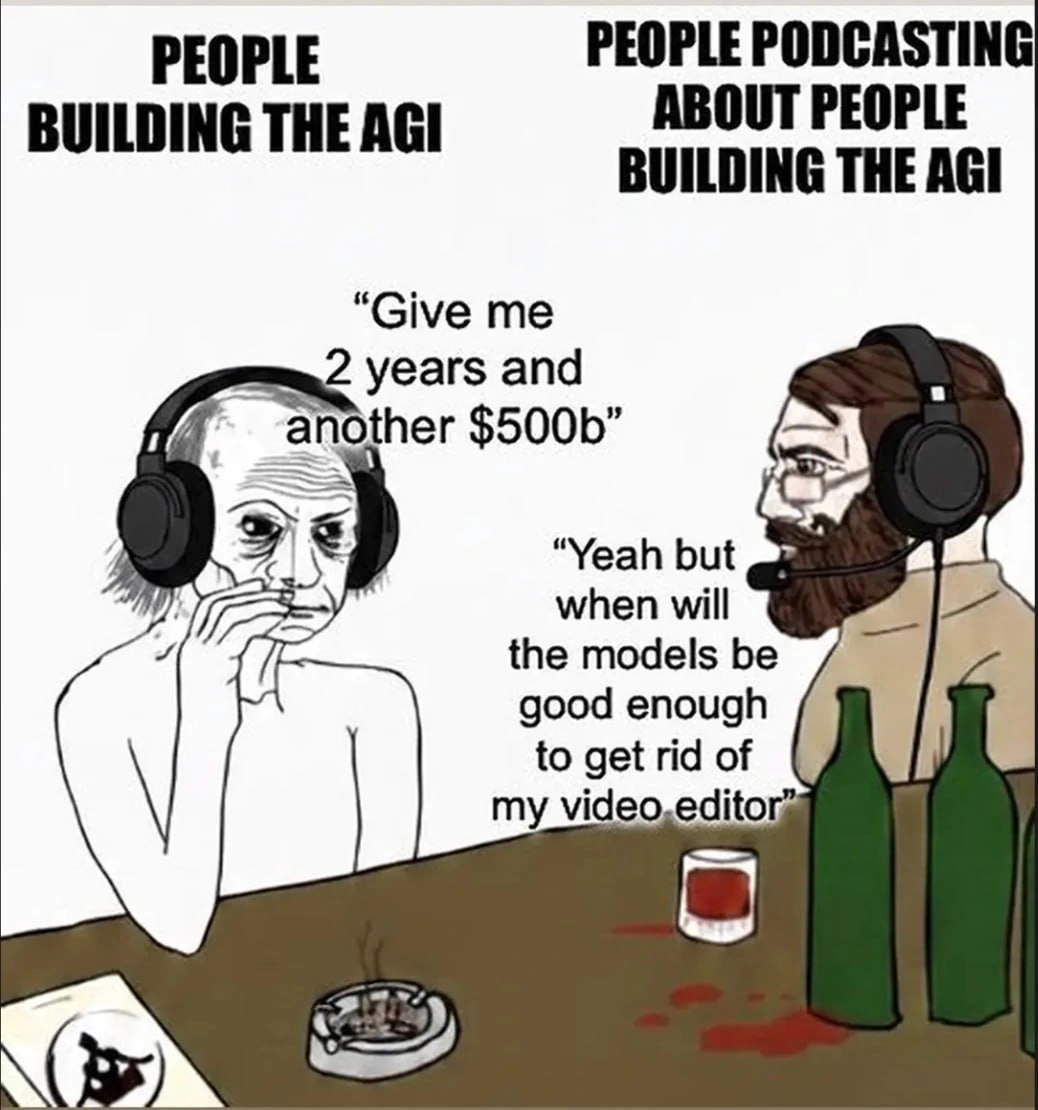
AGI (artificial general intelligence) is the hypothetical model that matches or exceeds humans across most cognitive work — the explicit goal of the big frontier labs, the handful of organizations training the largest models. Training those models requires staggering compute spend, which is why "$500b" isn't a random number; real infrastructure programs have been announced at exactly that scale. A wojak comic is the meme format here: crudely drawn faces whose physical condition encodes their life situation — the builder's sunken eyes and cigarette signal burnout, the podcaster's beard-and-wine-bottles setup signals cozy detachment. The video editor line refers to the actual production cost of podcasts: editors cut filler, sync clips, and make hosts sound coherent, typically as freelancers — historically among the first roles people fantasize about automating. If you're newer to the industry, the dynamic to recognize is the gap between people who do the risky technical work and people who build careers talking about it; both exist on your future org chart and in your YouTube feed, and only one of them is sleeping well.
Level 3: Capex Asceticism Meets the Commentary Economy
The composition is doing precise sociological work. The figure labeled "PEOPLE BUILDING THE AGI" is rendered as the gaunt, hollow-eyed doomer wojak — shirtless, smoking over an ashtray, headphones on, visibly aged decades by the work — and his single line is a perfect distillation of frontier-lab rhetoric: "Give me 2 years and another $500b." That sentence has been the AGI race's load-bearing structure for years now: a rolling two-year horizon and a capital ask that has inflated from millions to billions to half-trillion-dollar infrastructure announcements, always justified by scaling laws — the empirical observation that model capability grows predictably with compute and data, which functions in the discourse somewhere between physics and theology. The wojak's exhaustion is the part the keynote slides omit: the people actually running these training jobs live inside a permanent existential bet, burning datacenter-scale capex on the conviction that the next order of magnitude is the one that matters.
Across the table sits "PEOPLE PODCASTING ABOUT PEOPLE BUILDING THE AGI" — bearded, comfortable, headset mic, flanked by green wine bottles with a glass of red spilled across the bar. His response to the half-trillion-dollar pitch is the meme's thesis: "Yeah but when will the models be good enough to get rid of my video editor." The joke cuts several ways at once. First, it's about scale collapse: a technology pitched as civilization-altering gets evaluated against the smallest imaginable line item — one freelancer's invoice. Second, it skewers the AI podcast economy specifically, a commentary layer that extracts steady, low-risk income from narrating other people's high-risk work. The builder ages like a corpse; the narrator drinks wine and monetizes the spectacle. The asymmetry of who bears the downside is the whole picture.
But the sharpest reading is that the podcaster's question is the question, embarrassingly stated. All the AGI grandiosity eventually has to cash out in mundane labor substitution — and "can it replace my video editor" is exactly the kind of concrete, falsifiable benchmark that the "2 more years" rhetoric perpetually dodges. Video editing is a genuinely hard automation target (taste, pacing, narrative judgment), so the honest answer is awkward for both characters: not yet, and possibly not for another $500b. There's also the delicious irony that the podcaster's first instinct upon contemplating machine superintelligence is to fire the one human collaborator he has. The commentary class loves automation precisely up to the boundary of its own job — narrating, opining, vibing into a headset mic being, of course, irreplaceable.
Description
A two-character wojak comic at a bar table. Left, labeled 'PEOPLE BUILDING THE AGI': a gaunt, exhausted, balding wojak with dark eye circles wearing headphones, smoking over an ashtray, saying 'Give me 2 years and another $500b.' Right, labeled 'PEOPLE PODCASTING ABOUT PEOPLE BUILDING THE AGI': a comfortable bearded podcaster wojak with glasses and a headset mic, surrounded by green wine bottles and a spilled glass of red, asking 'Yeah but when will the models be good enough to get rid of my video editor.' The meme contrasts the existential, capital-burning grind of frontier-lab researchers with the commentary economy that orbits them, whose deepest question about superintelligence is trimming one line item from podcast production costs
Comments
2Comment deleted
Half a trillion dollars to build a god, and the first acceptance test is whether it can cut silence out of a two-hour podcast
Same Comment deleted