Peak XML: The Ultimate Binary Representation
Why is this DataFormats meme funny?
Level 1: One Cookie Per Box
Imagine you have a bunch of cookies to send to a friend. The normal way would be to put all the cookies in one box and send the box. Maybe you'd even just put them in a bag – something simple. But instead, picture this: you put each individual cookie in its own tiny box, then put each tiny box in a shipping box with padding, tape it up, and mail all those boxes to your friend. So if you had 10 cookies, your friend receives 10 separate packages, and they have to open every single one to get the cookies. Sounds silly, right? So much extra work and packaging for no good reason!
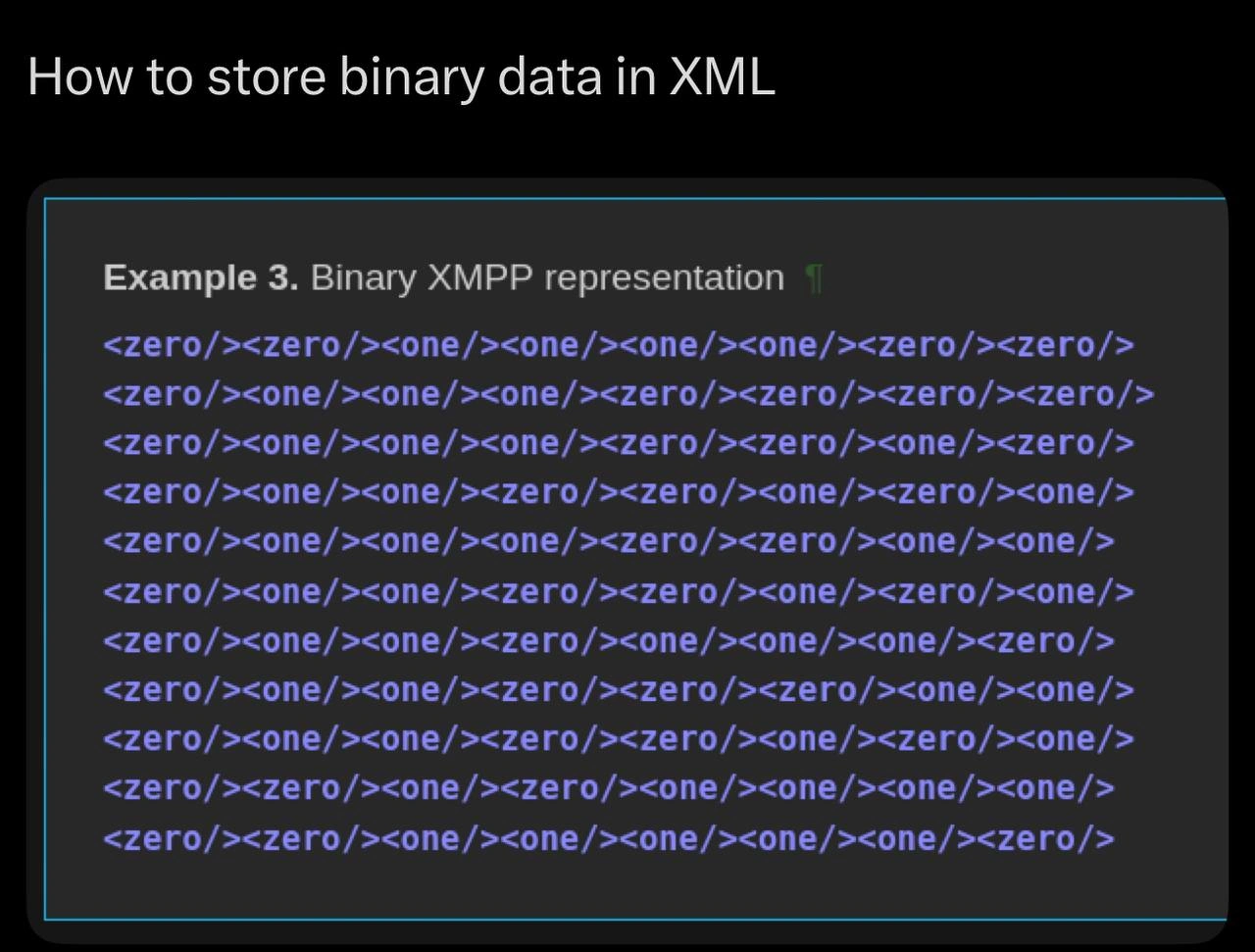
That’s exactly why the XML joke is funny. Storing binary data (which is basically ones and zeros) in XML by using a <zero/> or <one/> tag for each bit is like using one big box per cookie. It’s an incredibly complicated and wasteful way to do something really simple. Instead of just keeping the information together in a small, neat form, this method splits it into millions of little pieces and wraps each piece in heavy packaging. It makes a tiny thing huge.
The emotional core here is the ridiculous overkill. Just like you’d laugh (or maybe facepalm) at someone who mails you 8 boxes to send you 8 cookies, programmers laugh at the idea of using thousands of characters of XML just to store a handful of bits. It’s doing things the hard way for no real reason. In everyday terms, it’s like writing a one-sentence note but using a whole stack of papers, writing one letter on each page. It’s obviously overcomplicated. So, the meme is funny because it highlights an unnecessarily convoluted solution – and everyone can recognize that it’s a goofy way to do it. Developers find it extra funny (and a bit painful) because it reminds them of real-world cases where people did overcomplicate things, though maybe not as blatantly. But at the simplest level, you can just think: Why use 100 steps when 1 step would do? Seeing someone do that is both absurd and amusing, which is why this joke lands even without any coding knowledge.
Level 2: Turning 1s into Tags
Let’s break down what’s going on here in simpler terms. XML is a text-based format for storing data, kind of like HTML but for arbitrary data rather than web pages. It uses <tags> with names to mark up data. For example, if you wanted to store a person’s name and age in XML, you might have:
<Person>
<Name>Alice</Name>
<Age>30</Age>
</Person>
This format is self-descriptive (you can see "Name" and "Age" labels) and was very popular in enterprise systems for data exchange and configuration. However, XML is known to be pretty verbose (wordy). Every piece of data needs opening and closing tags, which adds a lot of extra text (often called tag bloat or the angle bracket tax, since < and > are angle brackets around every field).
Now, binary data means data in its raw 0s and 1s form – like the contents of an image, a PDF, or even just an integer in memory. Normally, binary data isn’t something you’d put directly into an XML file, because XML is plain text. If you try to stick raw bytes (which might include unprintable values) into an XML, it could break the format or not be readable. The common solution is to encode binary as text. One typical method is Base64 encoding: this converts binary bytes into a set of readable characters (A-Z, a-z, 0-9, +, and /). It’s a way to embed binary into text formats like XML or JSON. Base64 is still an overhead – it usually makes the data about 33% larger – but it's a known trade-off to safely send binary through text systems. For instance, if you had one byte of data (8 bits), base64 would turn it into 4 characters (because base64 works in 6-bit chunks and pads to a multiple of 4 characters). So, 1 byte becomes 4 bytes of text (roughly a 300% increase for that tiny case, though it gets a bit more efficient with larger chunks).
What the meme humorously suggests is an even more extreme way to encode binary in XML: literally make an XML tag for each bit. So if you have a sequence of bits like 1011 (which is 4 bits long), instead of storing "1011" or the equivalent byte value, you would write <one/><zero/><one/><one/> in the XML. Each <one/> represents a bit with value 1, and each <zero/> represents a bit with value 0. That means four separate XML elements just to convey those four bits. In a more normal scenario, you might have just written 0xB (one byte in hex) or "11" (if you were writing the number in decimal) or at most "1011" as a string. This XML approach is wildly verbose. To visualize the overhead: the string <zero/> is 7 characters long (including the brackets and slash) to represent a single '0' bit. That’s 7 bytes of text per 1 bit of data – which is a 56x inflation in size (since 1 bit is 1/8 of a byte). And <one/> is 6 characters (assuming the slash makes it self-closing) for a '1' bit, which is 6 bytes per bit (48x inflation). No matter how you slice it, that's incredibly inefficient.
Why is this funny to developers? Because it’s taking the idea of XML data formats to a ridiculous level. In real life, no one (sane) does one-tag-per-bit, but we often joke that enterprise systems love XML so much that they'll try to use it for everything. This meme is basically saying, "Haha, look, an Enterprise solution might even store raw binary by counting <zero/> tags." It’s a playful jab at how enterprise or legacy systems sometimes choose overly complex approaches. OverEngineering is the term often used: it means designing a solution that's far more complicated or elaborate than necessary for the task at hand. If the task is "store some binary data", a simple method might be to just keep it as binary (in a file or BLOB) or use a concise encoding. An over-engineered method is to wrap it with tons of XML structure.
Let’s touch on XMPP mentioned in the meme. XMPP stands for Extensible Messaging and Presence Protocol. It’s a protocol (essentially rules for communication) primarily for instant messaging, and it’s built on XML. So in XMPP, every message or presence update is an XML snippet (called an "XML stanza"). For example, a chat message in XMPP might look like:
<message from="[email protected]" to="[email protected]" type="chat">
<body>Hello, Bob!</body>
</message>
Because XMPP is XML-based, you can extend it by adding custom tags. But if you wanted to send binary data (like a file or an image) through XMPP, you have to find a way to encode that binary as text (since the XMPP stream is textual XML). As mentioned, the usual way would be to base64 encode the file and then wrap it in an XML tag, or use a separate out-of-band transfer. The meme’s "Example 3. Binary XMPP representation" pretends that someone is illustrating how to represent binary data in XMPP by literally listing bits as <one/> and <zero/> tags. It’s not from a real spec – it’s a joke – but it’s funny because XMPP devs did have to make something called "Bits of Binary" to handle images, and the name sounds humorous on its own. The idea of bit-by-bit XML tags is like a parody of how far you could stretch the idea of using XML for everything.
Now let's define a few terms that are relevant:
Data format: This just means the way information is structured and encoded for storage or transmission. XML is a data format, JSON is another, a raw binary file is another. Each format has pros and cons (readability, size, ease of parsing, etc.). Here the data format in question is XML, which is human-readable but verbose.
Legacy system: A polite term for an older system or technology that is still in use. Legacy systems often have limitations or old design choices (like "we only accept XML messages") that new systems wouldn’t have. Developers working with legacy systems sometimes have to contort new requirements to fit into old frameworks – exactly like forcing binary data through an XML channel.
Technical debt: When engineers talk about TechDebt, they mean the idea that if you choose a quick, not-so-good solution now, you'll "owe" extra work in the future to fix or deal with the consequences. It’s like taking a shortcut that you'll have to pay for later. Using a clunky method like encoding bits as XML might solve your immediate need ("we got the data through the system without rewriting the system"), but it creates a burden of complexity and inefficiency that someone will struggle with for a long time. That burden is the "interest" on the technical debt.
Protocol layering: This refers to how different communication protocols stack on top of each other. For example, in a web request, you might have something like: your data is JSON (one protocol) sent inside an HTTP message (another protocol) over TCP/IP (other protocols). Each layer adds its own wrapping. Protocol layering gone wrong is when these layers stack in a really inefficient or absurd way. The meme’s scenario is a perfect example: taking binary (lowest level data) -> wrapping each bit in XML (a high-level format) -> which would then itself be sent over a lower-level protocol like TCP. It’s like wrapping a small gift box inside a huge box, then shipping it. One or two layers of wrapping make sense, but too many layers or an overly large wrapper is wasteful.
Over-engineering: As mentioned, it’s when a solution is more complicated than necessary. This often happens in big organizations (hence "Enterprise solution") where processes, abstract frameworks, or design patterns are applied even when not appropriate, resulting in something overly complex. Developers find humor in it because we often encounter systems where a simple task has been made hilariously complex by too much engineering love.
XML verbosity: This is just a way to say "XML uses a lot of characters to say a little". For example, to store the number 5, an XML might say
<number>5</number>(that’s 17 characters including the tags for just one digit of useful data). The meme example magnifies that: to store the bit "1", it uses<one/>(7 characters including angle brackets) to convey 1 bit of information.
To put it plainly, the meme is showing a ridiculous example of using XML. It's as if someone said, "We have data in binary (ones and zeros). How can we represent it in XML, since XML is our standard for everything?" and another person answered, "Let's make each bit into its own XML tag!" It’s funny (especially to programmers) because it’s clearly doing things the hard, inefficient way. It highlights how sometimes our industry gets obsessed with a tool or format and tries to use it for jobs it’s not suited for. Here, XML is the heavy-duty tool being misused to hammer in a tiny nail (each bit).
For a junior developer or someone new to this idea, imagine a scenario: you have a simple piece of information, say "yes" or "no". A straightforward way might be just send the text "yes" or "no". A slightly more formal way might be to send <answer value="yes"/> as XML. But the absurd way would be to send <y/><e/><s/> with each letter in its own tag (that’s not even as bad as the meme, which would go down to binary bits!). It becomes immediately apparent that the last way is overkill. This meme just pushes that overkill to the limit for comedic effect.
The bottom line: XML, DataFormatsAndSerialization, and enterprise design choices can sometimes be taken to extremes that make developers groan. This meme uses that to get a laugh – it's a form of TechHumor that’s Relatable to anyone who’s had to work with bloated, byzantine data formats. By explaining the joke, hopefully it's clear that the humor comes from the sheer absurdity of using a heavyweight solution for a trivial problem, something many of us have seen in less exaggerated forms.
Level 3: Tag Bloat Blues
What we see in this meme is an overengineering horror story that senior developers find hilariously and painfully familiar. The image caption "How to store binary data in XML" sets the stage, and the code block full of <zero/> and <one/> tags drives it home: it's encoding each individual bit of data as its own XML element. Talk about tag bloat! This is XML verbosity turned up to eleven. Experienced folks chuckle because they've seen shades of this in real life (even if not quite so cartoonish). It's poking fun at enterprise systems and LegacySystems where XML was (or still is) the hammer for every nail. Need to send a simple yes/no value? Sure, wrap it in layers of <Value><Boolean><Data><True/></Data></Boolean></Value> – why not? 😅 Here the meme just takes that mentality to the extreme: storing a 0 or 1 as <zero/> or <one/>. It’s the ultimate send-up of enterprise_payload_pain, where the payload (actual data) is microscopic and the surrounding structure is gargantuan.
We laugh because it's so plausible. Not that anyone literally enumerates bits with <zero/> tags (we hope not!), but the satire is only a couple steps beyond reality. In real enterprise projects, it's common to see things like binary files or images squeezed through text-based formats. For example, to transmit an image in an XML-based SOAP message, you'd use base64 encoding – which already inflates size by ~33%. But at least base64 packs bits into characters efficiently. This meme says, "Ha, base64? Hold my beer," and spells out every bit with an XML tag. It’s a brilliant parody of the xml_verbosity we gripe about. Senior devs have war stories of SOAP envelopes thousands of lines long, of XML config files so nested and verbose that just opening them in an editor lags. We know the pain of digging through a 5 MB XML log file to find the one line of real info, or writing an XSLT script (an XML-based programming language!) to transform one horribly complex XML into another. So when we see row after row of <zero/><one/><one/><zero/>..., it’s a familiar headache cranked up to comical levels. It's the Tag Bloat Blues: a tune every maintainer of legacy enterprise software has had to sing.
Consider XMPP, the "Extensible Messaging and Presence Protocol" often used for chat systems. XMPP uses XML for its message format. Back in the day, this was seen as flexible and human-readable (you could telnet into a server and actually read the XML stanzas of a chat). But it was also chatty (pun intended) in terms of extra characters. If you wanted to send binary data (say a file or an avatar image) over XMPP, you basically had two choices: send it out-of-band (not through XMPP itself), or encode it (usually using base64) and stick that text in the XMPP XML. There’s even an XMPP extension called "Bits of Binary" (no joke, commonly known as BoB) which is essentially a way to send small binary blobs by base64-encoding them inside an <data> tag. So the struggle to fit binary into an XML text stream is real! This meme just humorously imagines if someone took the XMPP philosophy of "everything is XML" to a ridiculous extreme: encoding the actual bits as XML tags. The code block labeled "Example 3. Binary XMPP representation" is a tongue-in-cheek fake example, but it resonates because XMPP devs did have to wrestle with binary data awkwardly. The tag <zero/> and <one/> look like custom XML elements you might define if you were truly insane about self-describing data. It's a nod to protocol design gone awry – truly protocol_layering_gone_wrong territory.
From a senior perspective, this joke highlights a broader relatable developer experience: the frustration of LegacySystems and backward compatibility. Why would anyone do this? Often, it's not because engineers are dumb; it's because they're constrained. Imagine a big old enterprise system that only knows how to handle XML messages. One day you need to send binary data through it (perhaps a file or a fingerprint or some bytes from a device). You should revamp the system or use a binary channel, but that might require changing multiple subsystems, coordination between teams, and risking stability on a legacy platform. Management says “No way, too risky/expensive – just find a quick solution.” So what do developers do? They encode the binary as text to shove it through the XML pipeline. Usually they'd use something like hex or base64 (which is bad enough), but in a hyper-bureaucratic or clueless scenario you might get someone literally mapping bits to verbose XML because "we already have an XML schema for messages, and by gosh we will make everything conform to it!" It's an OverEngineering caricature: solving a problem in the most convoluted way to avoid stepping outside the comforts of an existing framework. It’s like building an entire data format stack on top of another data format just because that’s what your tools support. Short term, it "works" (the data gets through), but long term you’ve added massive TechDebt and performance headaches.
The humor also lies in the RelatableHumor of dealing with the consequences. Senior devs have been there: the system works in the functional sense, but it’s slow, memory-hungry, and painful to maintain. Yet nobody can easily fix it. The XML monstrosity might be mandated by a standards body or baked into dozens of systems. So you end up with enterprise_payload_pain: every time you handle that data, you need huge bandwidth and CPU just to parse out a simple value. It's not unlike reading a novel where 90% of the pages are just the word "the". You get fatigued by the sheer volume of repetitive markup. And debugging? Good luck. If something goes wrong in that binary encoding, you might see an error like "Expected tag" at 3 AM after sifting through thousands of tags. As a cynical veteran might joke, RelatableDeveloperExperience teaches you that "human-readable" formats aren’t so human-friendly when you scale them to these extremes. In an outage call at midnight, nobody is manually reading those <zero/> tags to figure out the issue – they're desperately writing scripts to parse it or hoping the application didn't choke on it.
We also see a touch of dark humor about TechDebt here. This XML-for-bits approach is the kind of decision that, once made, haunts an organization. Maybe it was done under pressure ("we have XML parsing everywhere, just get the binary data through somehow by Friday"). It becomes a legacy quirk that new developers find and go "What were they thinking?!" But the original authors might be long gone, or have some elaborate rationale lost to time. Meanwhile, the devs inheriting it are stuck maintaining it because "it works and we can't break compatibility now." It's a classic enterprise tech debt scenario: a kludge that everyone hates but can't remove easily, because too many systems depend on it. The meme exaggerates for effect, but it’s triggering those memories. Seasoned engineers laugh, then sigh, recalling meetings about bloated XML configs, or the time they jokingly said “at this rate, we’ll be encoding bits in XML next” not realizing someone might actually try it.
In essence, "storing binary by counting <zero/> tags in XML" is a perfect satirical tagline. It's absurd, but it encapsulates a real phenomenon: the tendency of enterprise solutions to be far more complex and bloated than necessary. The TechHumor lands because it's taking a real gripe (XML is verbose and misused) to an illogical conclusion (one tag per bit) that feels just plausible enough to make us cringe. It’s the kind of thing you joke about after a long week of wrestling with misdesigned systems: “If we keep going like this, pretty soon we'll be counting bits with XML tags, haha…” and then you see the meme and think oh no, someone did it in a joke. For a senior dev audience, every element of the meme – the trivial tag names, the dense repetition, the formal "Example 3. Binary XMPP representation" heading – drips with irony. We’ve lived through the XML era, survived to tell the tale, and now we can chuckle at its excesses. But it’s a laughter laced with a bit of PTSD: we know the only difference between satire and reality is often just a matter of degree.
Level 4: The Angle Bracket Tax
At the extreme end of absurd abstraction, this "binary in XML" scheme is like paying a huge angle bracket tax on every single bit of data. In terms of pure information theory, it's almost an anti-compression. Claude Shannon would facepalm: the entropy of truly random binary data is as high as it gets (you need 1 bit of information to represent 1 bit of random data), yet here each 1 or 0 is wrapped in a verbose <one/> or <zero/> tag spanning many bytes. Essentially, they've taken something that could be stored in a few bits and exploded it into dozens of characters of markup. The Kolmogorov complexity (the theoretical minimal description length) of an $N$-bit string is just $N$ bits (plus constant overhead for any format), but this method blows it up to something like 50×N bits. It's as if someone deliberately sought the least efficient encoding: for each 1 or 0, add a whole XML element. The overhead here approaches a kind of pathological limit where the payload (the actual binary data) is dwarfed by the structural metadata around it.
On a computational level, think about what an XML parser has to do with this. Each <zero/> or <one/> is a separate element node. So parsing a sequence of, say, 8 million bits would produce 8 million little XML elements. That means millions of tiny allocations, tag name lookups, and closing tags – just to reconstruct a bitstream that originally was 8 million bits in a neat contiguous form. In Big-O terms, parsing is still $O(n)$ in the size of the input, but here n has been made ridiculously large relative to the useful content. The constant factors (like dozens of characters per bit, plus XML parsing overhead per element) are through the roof. The memory footprint for a DOM (Document Object Model) representation would be enormous: every <zero/> might become an object with its own pointers and metadata. You'd consume tens or hundreds of bytes of memory to represent a single bit of actual information. This isn’t just theoretical – push this far enough and you’ll hit practical limits like out-of-memory errors or extreme CPU time, essentially a self-inflicted denial-of-service.
This approach also thumbs its nose at the layered design of network protocols. Normally, binary data is handled at lower layers or encoded efficiently (e.g., via base64) if it must pass through a text layer. Here, though, each bit is being re-framed as text, only to be sent over a network which will reconvert it to bits on the wire (since all data, even XML text, is bits under the hood). It’s a full circle of inefficiency: bit → <zero/> text → bit. We’re wrapping the physical layer’s smallest unit in the application layer’s heaviest construct. It’s like protocol_layering_gone_wrong manifested as an XKCD comic: taking the simplest possible data (binary) and routing it through the most verbose representation (XML tags) for no gain whatsoever. In fact, the existence of standards like Efficient XML Interchange (EXI) and other binary XML formats underscores that real engineers have grappled with XML’s performance issues. Those standards essentially compress or compact XML; by contrast, our meme encoding does the polar opposite, maximizing verbosity. It’s as if someone read about data serialization best practices and decided to rebel in the most extravagant way.
In summary, from a theoretical standpoint this is a masterpiece of inefficiency, a caricature of enterprise architecture run amok. It violates the spirit of everything from Shannon’s law of information to basic sanity in algorithm design. We often joke that hardware improvements (like faster CPUs and bigger RAM) get eaten up by software bloat — here you can practically hear Moore’s Law groaning under the weight of all those needless <zero/> tags. This Enterprise solution to store binary data is a perfect parody of what happens when formalism and abstraction completely overshadow practicality: you end up with a data format that is technically valid and self-describing, but at a TechDebt cost so high that it's off the charts. It’s an absurd endpoint on the spectrum of DataFormats design, one that gives any seasoned engineer a mix of academic horror and morbid amusement.
Description
A screenshot of a code example under the heading 'How to store binary data in XML'. The image is in a dark mode interface. Inside a bordered box, a title reads 'Example 3. Binary XMPP representation', followed by ten lines of XML-like code. Instead of using standard binary digits (0 and 1), the data is represented with verbose XML tags: '<zero/>' for 0 and '<one/>' for 1. This meme satirizes the notorious verbosity and inefficiency of XML. The technical joke is that while this is a technically possible way to represent binary data in a text format, it is absurdly impractical, consuming massive amounts of space compared to standard methods like Base64 encoding. It's a humorous jab at the 'everything must be XML' design philosophy that was once prevalent, which often led to over-engineered and inefficient solutions
Comments
21Comment deleted
An enterprise architect looked at this and said, 'Finally, a human-readable, schema-valid, and self-documenting representation for a boolean.'
Sure, it’s 10 GB for one byte, but hey - at least it’s "human-readable" enough to survive the next mandatory SOAP migration
This is what happens when the architect who insisted on 'everything must be semantic XML' discovers binary data exists - next they'll propose storing JPEGs as nested <pixel> tags with RGB attributes for 'better queryability'
When your architect insists on 'human-readable' binary data and you take it literally - turning 8 bytes into 1KB of XML tags. At this encoding efficiency, you could store an entire megabyte of data in just... *checks notes* ...112 megabytes of XMPP stanzas. Perfect for that enterprise messaging system where bandwidth is infinite and parsing time is just a social construct. Base64 was clearly too compact and efficient for modern distributed systems
XML binary: where 1KB becomes 1MB, proving schemas value pedigree over payload efficiency
Base64 adds 33% overhead; BaseXML turns a 1 KB payload into a multi‑megabyte DOM and a surprise cloud egress bill
Binary XMPP: when “human readable” becomes “pager readable” - BaseTag-2 that turns 1 MB into a quarterly bandwidth budget
What the absolute cancer is this Comment deleted
Well this is clearly more efficient Comment deleted
i'll stick to base64 thanks Comment deleted
Why base64? You know there are butterflies, right? Comment deleted
💀 https://xmpp.org/extensions/xep-0239.html Comment deleted
its a joke standard tho Comment deleted
Like the RFC 1149? Comment deleted
Use of port 10110 is obviously secure, since 10110 in base 2 is 22 in base 10, the same default port as Secure Shell Okay, I love that Comment deleted
port 10110 Nobody can hack me 💀😂😂 Comment deleted
4. Internationalization Considerations¶ The <zero/> and <one/> elements use English-language words as the element names. Clearly it would have been preferable to define an i18n-friendly binding, such that German-language applications could encode Binary XMPP using the <null/> and <eins/> elements, Greek-language applications could use the <μηδέν/> and <ἑνα/> elements, etc. Flexibility regarding internationalization of the element names may be added in Binary XMPP 2.0. Comment deleted
How dare are you to ruin the party? Comment deleted
actually I was laughing at the contact information at first. but only then noticed this Type note Comment deleted
I'll stock to json, thanks Comment deleted
Hell naww😭💀 Comment deleted